For most homeowners, making home upgrades that could save money over time and make their homes more energy efficient and comfortable sounds like an easy call. However, many people wouldn't know where to start. Through a data platform backed by artificial intelligence, Climative is tackling that knowledge gap and helping homeowners take action.
The tech company provides an AI-powered data platform and works with organizations in Canada and the U.S. to bring insights to homeowners on their homes’ energy efficiency. The digital assessment also provides a risk rating for extreme climate events like wildfire and floods as well as resiliency upgrades to help homeowners potentially prevent or lessen damage. Traditionally, homeowners rely solely on in-person energy assessments, but Climative’s tool allows people to get initial recommendations by providing some information about their home.
“One of the benefits of using AI is it can work cost-effectively with less site-specific data, compared to an on-site assessment,” says Winston Morton, CEO of Climative.
Scotiabank launched the Home Energy and Advice Tool, powered by Climative, on April 21. The link to the tool can be found on Scotiabank's Climate Action and Sustainability page. The tool leverages the company’s data platform — backed by a transparent and responsible AI framework — to allow Canadians to fill out a five-minute questionnaire about their home and receive a digital energy assessment.

Winston Morton, CEO of Climative
“Scotiabank is pleased to support Climative to give clients, and all Canadian homeowners, practical, personalized insights into their home efficiency and energy use,” said Anique Asher, Executive Vice President, Real Estate Secured Lending at Scotiabank. “The Home Energy and Advice Tool helps homeowners better understand how energy efficient upgrades can strengthen their home, reduce ongoing costs, and support more informed financing and renovation decisions over time.”
How the Home Energy and Advice Tool works
Canada’s homes and buildings also account for 13% of national greenhouse gas emissions, so increasing their energy efficiency could have environmental benefits as well.
While a major part of Climative’s goal is to support a transition to a low-carbon economy, for many homeowners, the leading motivation for making upgrades is to reduce energy costs over time.
The tool relies on information like the size of the home, when it was built and what systems it uses for heating and cooling, which can be entered by the homeowner or pulled from publicly available records and used to produce the report. This data is used to create personalized scenarios projecting costs and savings for upgrades, as well as insights on extreme weather risks to the home.
Homeowners can explore potential upgrades like switching from a gas furnace to an electric heat pump or improving attic insulation. The tool also recommends preventive measures for extreme climate events, such as cutting overhanging branches to reduce the impact of a potential wildfire.
For next steps, homeowners can consider connecting virtually with an energy coach to learn more about their options or explore a list of qualified local contractors who can work on the upgrades. Optionally, homeowners can also explore financing options by connecting with a Scotiabank Financial Advisor.
The tool is available to both clients and non-clients of the Bank through Scotiabank’s website and works for single detached, attached, row and mini homes in Canada.
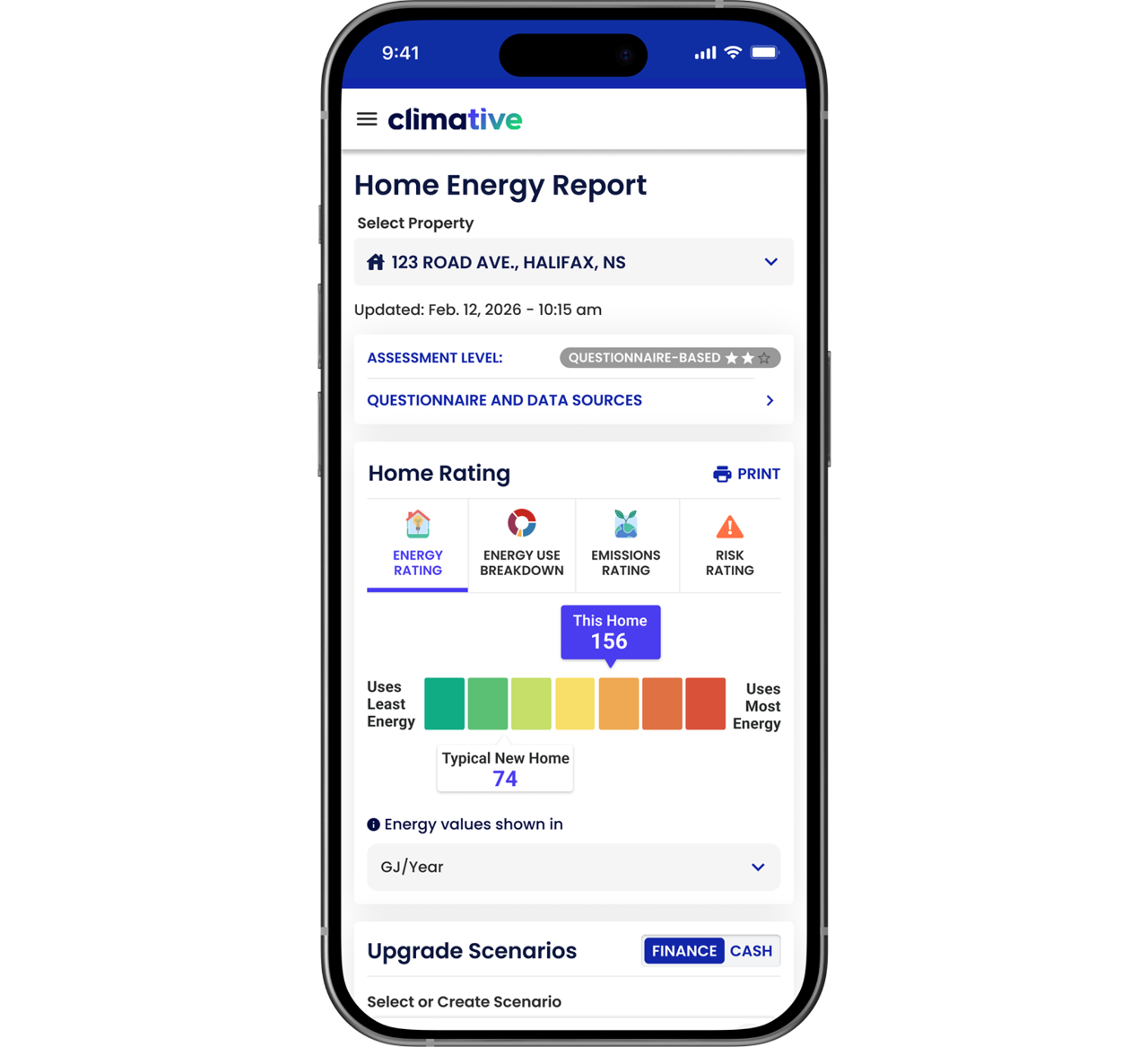
The Home Energy and Advice Tool interface seen on a mobile phone.
How AI powers digital home assessments
According to Climative’s website, about 10% of the building stock in Canada and the U.S. has been assessed, and Climative’s AI tools are trained on this data to provide insights when homeowners complete digital assessments. In Canada, the AI model is trained on data from EnerGuide, the federal government’s energy performance rating and labeling program for homes and some consumer items.
Morton says the AI-powered digital assessments also gives homeowners dynamic plans that may improve as more industry data becomes available or the homeowner’s plans evolve.
While powering the AI model behind the platform uses some energy, Morton says their digital assessment still has lower carbon costs compared to an initial onsite assessment that requires inspectors driving to different locations. Additionally, the digital approach is free and makes it easier for people to inquire about energy efficiency upgrades. Homeowners are then better informed if they choose to also conduct a full in-person energy audit, which can come with a fee.
“The goal here is to fill the funnel with these projects as quickly as we can,” Morton says.
Climative and Scotiabank’s shared goals
Winston says in order for Climative to have a broader impact, it needs to raise awareness and working with banks is a good way to get those conversations going.
“We're really excited to work with Scotiabank because it provides a really great medium to help homeowners at scale,” he says.
From Scotiabank’s perspective, the partnership provides value to its clients, supports its climate efforts and can help clients find financing solutions to enable their upgrade plans.
“This tool reflects Scotiabank’s commitment to supporting our clients’ in their efforts for a transition to a lower carbon economy,” said Kim Brand, Vice President and Global Head of Sustainable Business at Scotiabank. “By integrating practical climate advice directly into our client experience, we’re helping Canadians take accessible steps to improve the efficiency and resiliency of their homes.”
Before partnering with Scotiabank, Climative worked with a lot of government partners and at a more regional scale, so Morton says he’s excited to see how the tool can reach new audiences and support their mission nationally.
“It’s great that we’re doing this work,” he says. “I think it’s how we make big changes.”