

- The Bank of Mexico’s Governing Board decided to cut the policy rate by 25bps to 6.50%, in a split vote with three out of five members supporting the move.
- The statement explicitly signals the end of the easing cycle that began in March 2024.
- The Board highlighted that economic activity contracted in 1Q-2026, implying a greater degree of slack in the economy.
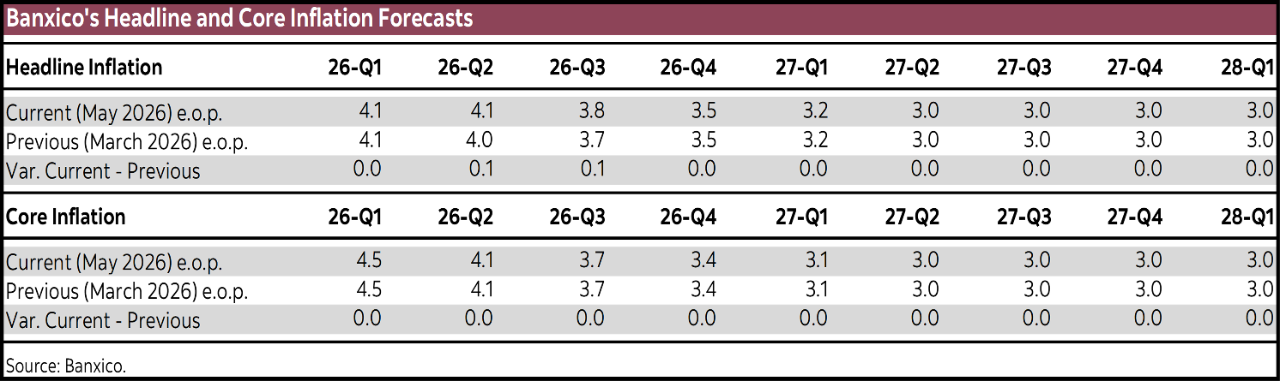
- Headline inflation forecasts were revised slightly upward for the remainder of the year, with convergence to target expected in 2Q-2027.
- We maintain our year-end policy rate forecast at 6.50%, contingent on the inflation path, exchange rate dynamics, and the interest rate differential with the United States.
The Bank of Mexico’s Governing Board decided, by majority (three out of five members), to cut the policy rate by 25 basis points, bringing it to 6.50%. This decision was in line with market expectations following the Governor’s remarks in the Senate last week. Notably, for the second consecutive meeting, Galia Borja and Jonathan Heath voted to keep the rate unchanged. Additionally, the Board signaled the end of the easing cycle that began in March 2024, which accumulated a total of 475 basis points in cuts. The Board also revised its headline inflation projections slightly upward, while keeping core inflation forecasts unchanged, as well as its expectation for convergence to the 3.0% target by the second quarter of 2027.
The statement reiterated that global economic activity expanded at a faster pace in 1Q-2026 compared to the previous quarter. This occurred despite an increase in headline inflation—driven by higher energy prices—and persistent core inflation in some advanced economies. It also highlighted that the Federal Reserve held its policy rate unchanged in April, and that despite a moderation in uncertainty related to the Middle East conflict, financial markets exhibited volatility and mixed performance, with a weaker dollar and limited movements in U.S. Treasury yields. The statement noted that the impact of the Middle East conflict remains uncertain and will depend on its duration and intensity.
On the domestic front, the Board noted that since the last monetary policy decision, government bond yields in Mexico declined across short- and medium-term maturities, while increasing at the long end, and the peso appreciated. Economic activity contracted in 1Q-2026, implying greater slack than previously anticipated, with downside risks persisting going forward.
Regarding inflation, in April headline inflation declined from 4.63% to 4.45%, driven by a slowdown in the core component, which fell from 4.46% to 4.26%. The statement noted no evidence of second-round effects stemming from tax and tariff increases implemented earlier in the year. Year-end inflation expectations were revised upward, while long-term expectations remained stable. The Board emphasized upward revisions to inflation expectations for upcoming quarters in 2026, particularly due to the non-core component, while core inflation projections remained unchanged. It reiterated that headline inflation is still expected to converge to target in 2Q-2027, although forecasts remain subject to upside risks, including trade policy disruptions, inflationary impacts from geopolitical conflicts, persistent core inflation, cost pressures, and a depreciation bias in the peso. Downside risks include weaker-than-expected economic activity, lower cost pass-through, and reduced pressures due to peso appreciation observed since last year.
Thus, the risk balance remains tilted to the upside, driven by uncertainty related to factors such as changes in U.S. economic policy and escalating geopolitical tensions.
We believe the monetary policy decision reflects a more accommodative stance relative to the previous meeting, due to the expected rate cut, although the announcement of the end of the easing cycle and the split vote temper this bias. It is also important to highlight that the Board appears comfortable with the current level of the policy rate and considers it appropriate to hold it steady. Based on the ex-ante real rate, policy is already in neutral territory despite both headline and core inflation remaining above Banxico’s tolerance range and with inflation risks still tilted to the upside—largely driven by supply shocks, which are beyond the reach of monetary policy.
In this context, it will be crucial to monitor the evolution of inflation and developments in the Middle East conflict, including the impact of rising energy prices and potential second-round effects on goods and services, as well as domestic economic weakness, exchange rate dynamics, and the relative stance versus the Federal Reserve.
We maintain our forecast for the policy rate at 6.50% by year-end 2026, provided that second-round effects from tax increases, tariffs, minimum wage hikes, and energy prices do not materialize. Finally, to better understand each Board member’s stance, it will be important to analyze the minutes to be published on May 21st, 2026.
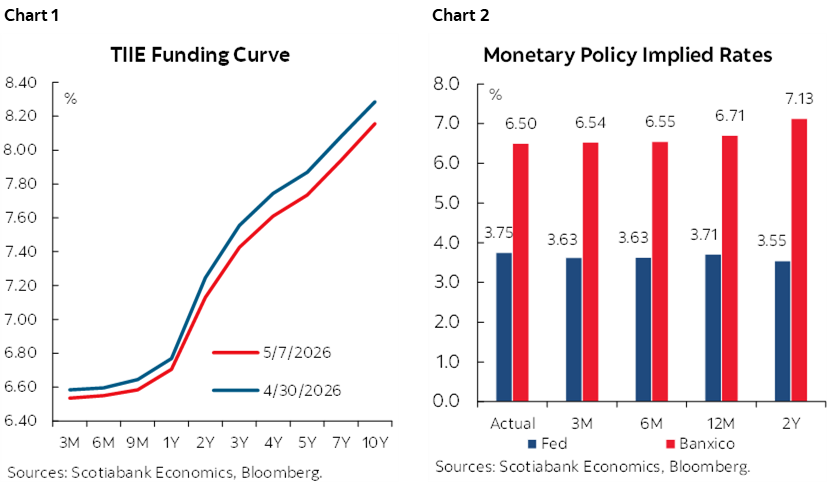
In terms of market reaction, the exchange rate showed a limited response to the decision, moving from MXN 17.24 to MXN 17.26 per dollar. Meanwhile, the TIIE funding curve posted modest movements: the short end (up to one year) declined between 1 and 4 bps, while the rest of the curve (up to 30 years) increased between 2 and 4 bps. The implied curve stood at 6.54% at three months and 6.71% at one year, suggesting market expectations of rate hikes towards the end of the horizon.
DISCLAIMER
This report has been prepared by Scotiabank Economics as a resource for the clients of Scotiabank. Opinions, estimates and projections contained herein are our own as of the date hereof and are subject to change without notice. The information and opinions contained herein have been compiled or arrived at from sources believed reliable but no representation or warranty, express or implied, is made as to their accuracy or completeness. Neither Scotiabank nor any of its officers, directors, partners, employees or affiliates accepts any liability whatsoever for any direct or consequential loss arising from any use of this report or its contents.
These reports are provided to you for informational purposes only. This report is not, and is not constructed as, an offer to sell or solicitation of any offer to buy any financial instrument, nor shall this report be construed as an opinion as to whether you should enter into any swap or trading strategy involving a swap or any other transaction. The information contained in this report is not intended to be, and does not constitute, a recommendation of a swap or trading strategy involving a swap within the meaning of U.S. Commodity Futures Trading Commission Regulation 23.434 and Appendix A thereto. This material is not intended to be individually tailored to your needs or characteristics and should not be viewed as a “call to action” or suggestion that you enter into a swap or trading strategy involving a swap or any other transaction. Scotiabank may engage in transactions in a manner inconsistent with the views discussed this report and may have positions, or be in the process of acquiring or disposing of positions, referred to in this report.
Scotiabank, its affiliates and any of their respective officers, directors and employees may from time to time take positions in currencies, act as managers, co-managers or underwriters of a public offering or act as principals or agents, deal in, own or act as market makers or advisors, brokers or commercial and/or investment bankers in relation to securities or related derivatives. As a result of these actions, Scotiabank may receive remuneration. All Scotiabank products and services are subject to the terms of applicable agreements and local regulations. Officers, directors and employees of Scotiabank and its affiliates may serve as directors of corporations.
Any securities discussed in this report may not be suitable for all investors. Scotiabank recommends that investors independently evaluate any issuer and security discussed in this report, and consult with any advisors they deem necessary prior to making any investment.
This report and all information, opinions and conclusions contained in it are protected by copyright. This information may not be reproduced without the prior express written consent of Scotiabank.
™ Trademark of The Bank of Nova Scotia. Used under license, where applicable.
Scotiabank, together with “Global Banking and Markets”, is a marketing name for the global corporate and investment banking and capital markets businesses of The Bank of Nova Scotia and certain of its affiliates in the countries where they operate, including; Scotiabank Europe plc; Scotiabank (Ireland) Designated Activity Company; Scotiabank Inverlat S.A., Institución de Banca Múltiple, Grupo Financiero Scotiabank Inverlat, Scotia Inverlat Casa de Bolsa, S.A. de C.V., Grupo Financiero Scotiabank Inverlat, Scotia Inverlat Derivados S.A. de C.V. – all members of the Scotiabank group and authorized users of the Scotiabank mark. The Bank of Nova Scotia is incorporated in Canada with limited liability and is authorised and regulated by the Office of the Superintendent of Financial Institutions Canada. The Bank of Nova Scotia is authorized by the UK Prudential Regulation Authority and is subject to regulation by the UK Financial Conduct Authority and limited regulation by the UK Prudential Regulation Authority. Details about the extent of The Bank of Nova Scotia's regulation by the UK Prudential Regulation Authority are available from us on request. Scotiabank Europe plc is authorized by the UK Prudential Regulation Authority and regulated by the UK Financial Conduct Authority and the UK Prudential Regulation Authority.
Scotiabank Inverlat, S.A., Scotia Inverlat Casa de Bolsa, S.A. de C.V, Grupo Financiero Scotiabank Inverlat, and Scotia Inverlat Derivados, S.A. de C.V., are each authorized and regulated by the Mexican financial authorities.
Not all products and services are offered in all jurisdictions. Services described are available in jurisdictions where permitted by law.