

Next Week's Risk Dashboard
- CUSMA crunch time
- Will US CPI reinforce the impact of weak jobs on Fed pricing?
- The short and the long on US inflation
- The Fed and midterms
- The perils of bonds leading the Fed
- Trump v. Cook returns
- BCRP may hold but pressure is building
- Norges Bank will probably hold
- RBA is in watch and wait mode
- US retail sales and sentiment to inform consumer tracking
- UK data dump expected to depict further softening
- Inflation: China, Norway, India, Brazil, Colombia
Chart of the Week
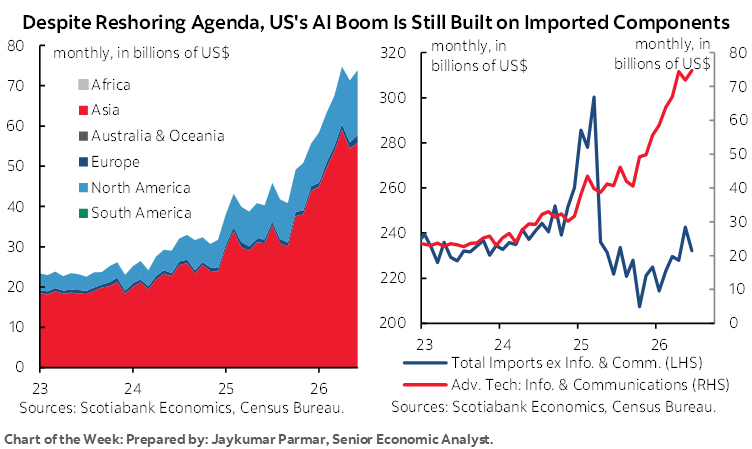
The market’s addiction to inflation tracking will get its latest fix this week. In fact, it’s entirely conceivable that nothing else really matters in terms of calendar-based risk this week.
If I’m right in expecting an up-tick in core CPI, then any modest relief in rates after disappointing jobs numbers (recap here) could prove fleeting. If consensus is right in expecting a temperate reading, then it could reinforce reduced pricing for near-term tightening.
And yet there is a solid case for how this is all a very silly exercise marked by excessive dependency upon backward-looking data—stretching back five years in time—relative to forward-looking factors and excessive willingness by Chair Warsh to rely upon bond market signals. The CPI preview below will delve into these issues. At least as important could be how Chair Warsh defends Governor Cook and Fed independence if guidance that the administration is imminently moving toward removing her on the Board is intensified.
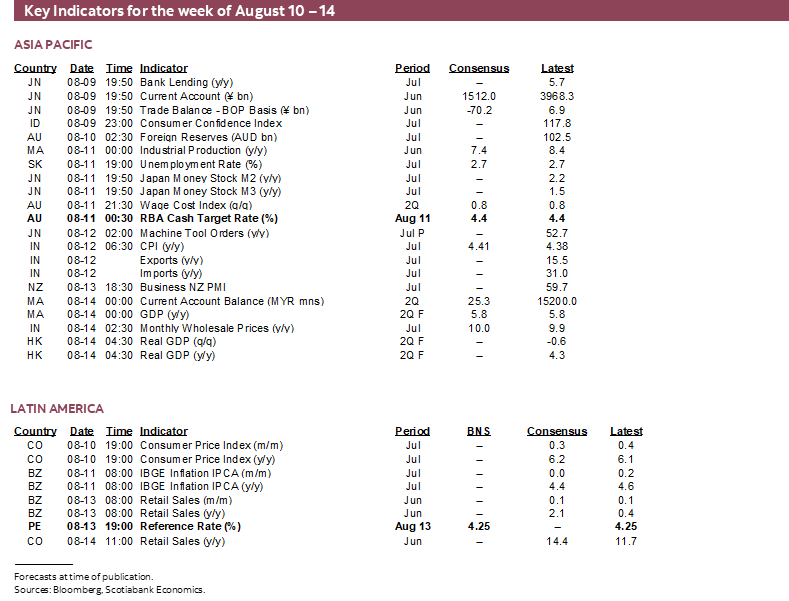
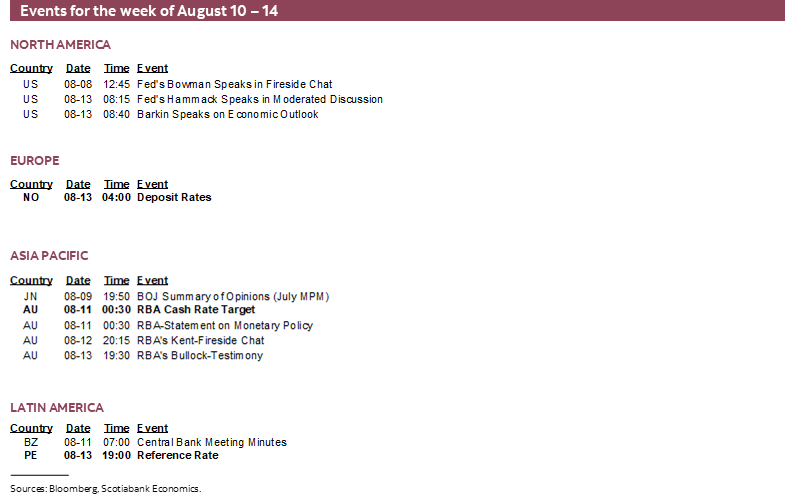
Other developments will include a few central bank decisions (the RBA, Norges, and BCRP) plus updates on US consumer spending, a round of UK macro reports and a few inflation readings.
CUSMA CRUNCH TIME
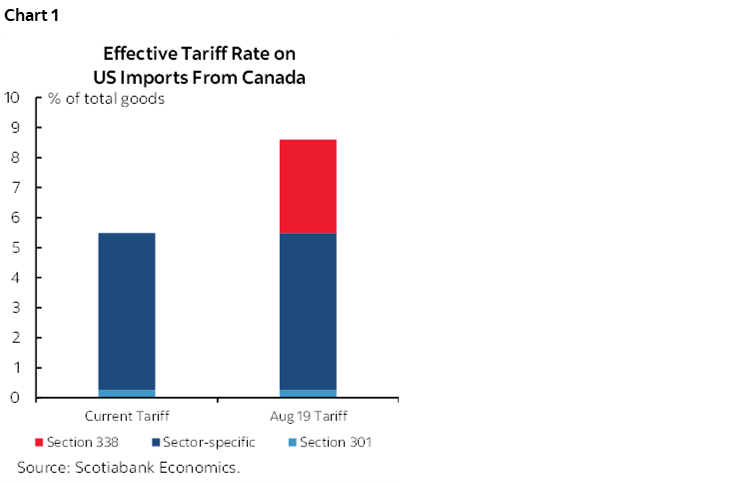
It’s also going to be crunch time for Canadian and US trade negotiators. Either they must achieve a deal of some sort before the August 19th deadline set by Trump for additional Section 338 tariffs on about $20 billion worth of Canadian imports, or Trump extends the deadline which he is prone to doing while citing whatever excuse merits a delay. If the tariffs were to go ahead, then they would meaningfully add to the average effective tariff rate on Canadian imports into the US (chart 1). PM Carney has also warned that “everything is on the table” by way of retaliation if the US tariffs were to go ahead.
If media accounts fed by anonymous sources are on the mark, then a deal may be possible by Canada bending on US trade irritants in exchange for tariff relief on the most affected sectors like steel, aluminum, autos and lumber. The reported concessions by Canada—if accurate—would be pretty modest in that they would remove or lessen some forms of retaliation like limited Canadian tariffs on US imports principally on autos, the ban on US alcohol across the cooperating provinces, more tweaks to dairy quotas and at a sensitive moment with Quebec’s referendum approaching in October, and some procurement policies.
Talk about the mother of all zero-sum, fruitless efforts if tariffs are meaningfully reduced in exchange for reduced retaliation. It could well be positioned as a victory for retaliation. In my opinion, Canada should hold resist short-term deals.
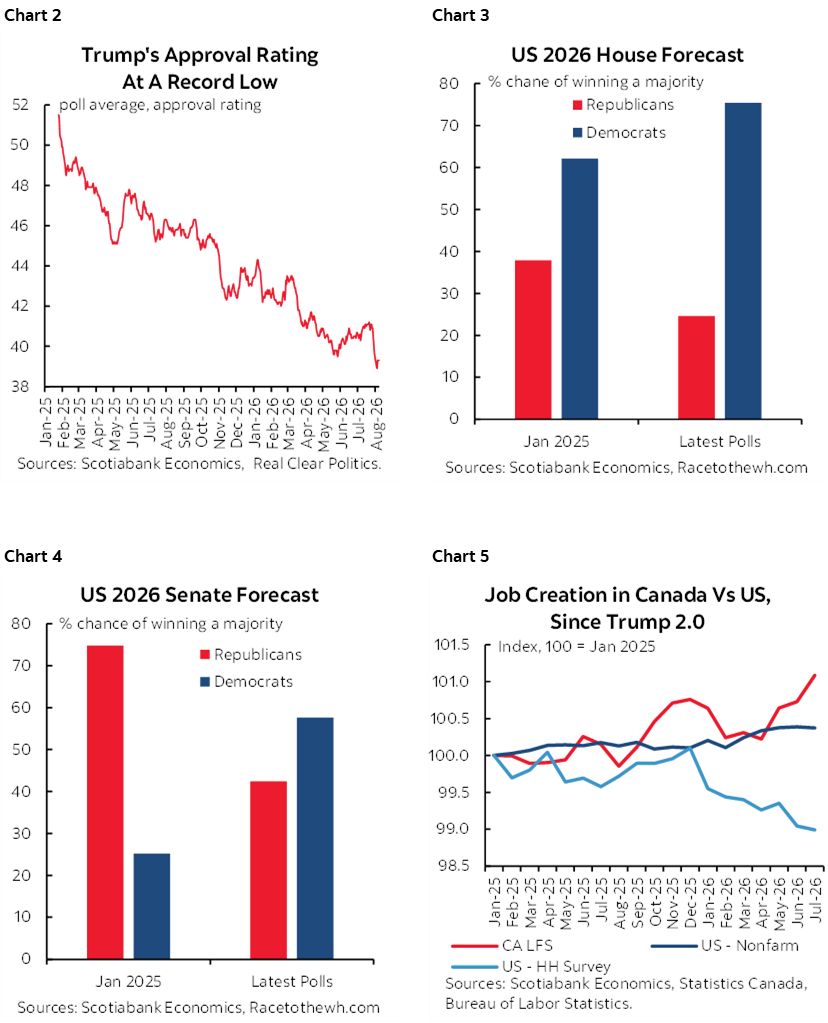
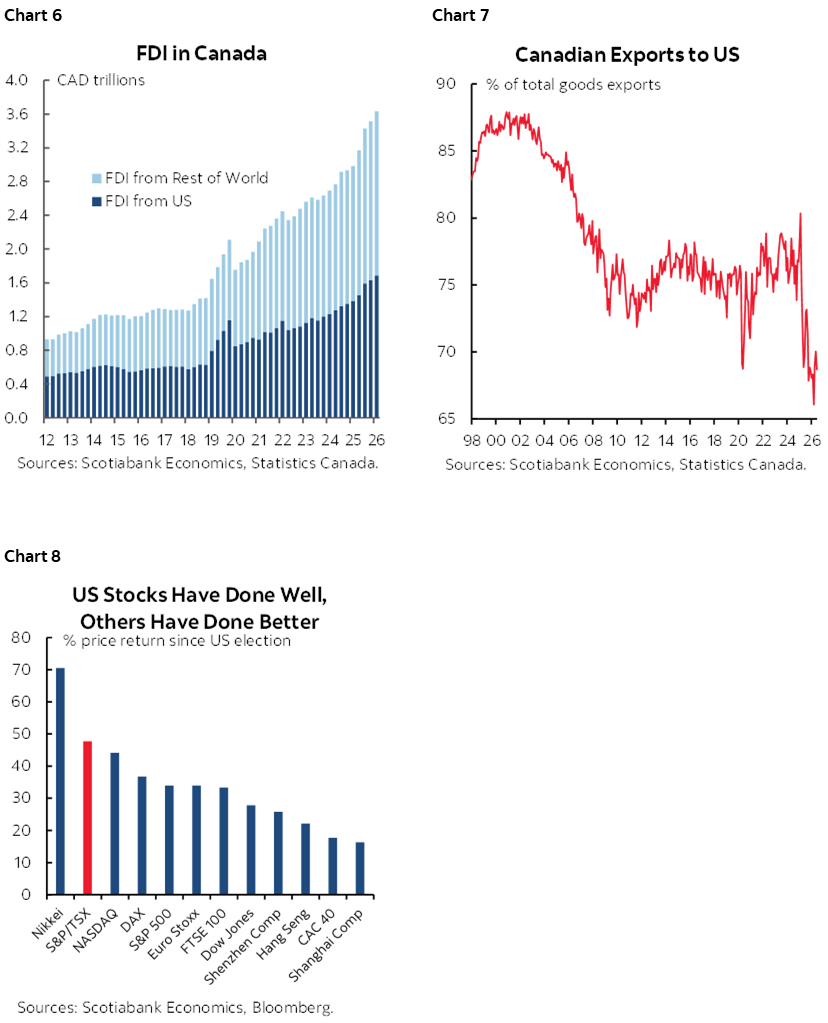
Canada holds most of the cards. The US faces midterms that have Trump and the GOP on the run (charts 2–4) whereas PM Carney holds a majority until no later than October 2029. Canada’s economy and labour market are roaring ahead as punctuated by the latest jobs report (chart 5, recap here). The US labour market is stumbling as noted. Tariffs and wars have been contributing factors to the US administration’s affordability woes before voters and some of the special interests most affected by Canada’s retaliation may rejoice should a deal be struck. The US war with Iran has benefited Canada in terms of buoying commodities and therefore driving improved terms of trade with trickle down effects through the economy. CAD has depreciated by about a couple of dimes to the dollar since 2021 to offset more than the tariff shock. Canadian fiscal policy is on the verge of sustainably adding to growth potentially for years to come while US fiscal policy is turning restrictive. Canada is dangling major projects that will be attractive to big investors at home and abroad and it’s in US interests to participate in potentially trillions of dollars of such projects over time. Foreign direct investment into Canada is on a tear with countries other than the US leading (chart 6). A part of this is that Canada is raising spending on defence with major contracts like military jets yet to be decided upon. Canadian exports are trending up for several quarters and diversifying away from the United States (chart 7 and here). Canadian financial markets are also doing rather well with lower bond yields, tight credit spreads and one of the few global stock markets to outperform the US since the day before the US election in 2024 (chart 8).
Waving a shiny new trade deal before the electorate and signalling improved cooperation with allies may resonate well on November 7th. Continued divisions on all fronts may not. A deal before the new Congress convenes in January would raise the possibility of DJT’s signature going on it rather than having to then negotiate with the Democrats should they take one or both chambers. Just be careful about the durability of that signature in terms of keeping that ace in the hole.
US INFLATION—THE SHORT AND THE LONG OF IT
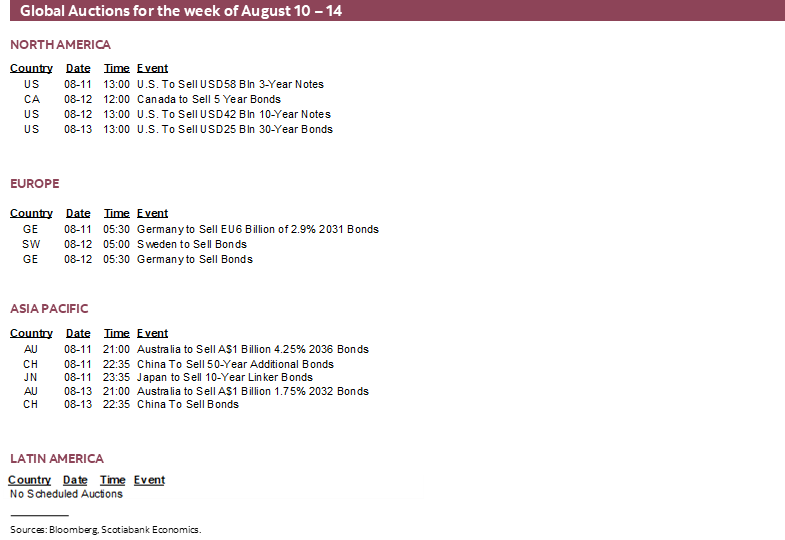
Another round of US inflation readings lands this week. It may be influential to pricing the FOMC’s policy decision on September 16th along with one more batch of such figures before then. CPI and producer prices will be updated with July readings on Wednesday and Thursday respectively. Taken together they will help to firm up expectations for what has historically been treated as the Fed’s preferred PCE inflation readings which is now up in the air because of Chair Warsh’s taskforces.
CPI is estimated to have increased by 0.2% m/m SA which would mean an unchanged 3½% y/y rate of change in prices. Core CPI is estimated to rise by 0.3% m/m SA which would keep the year-over-year rate at 2.6%.
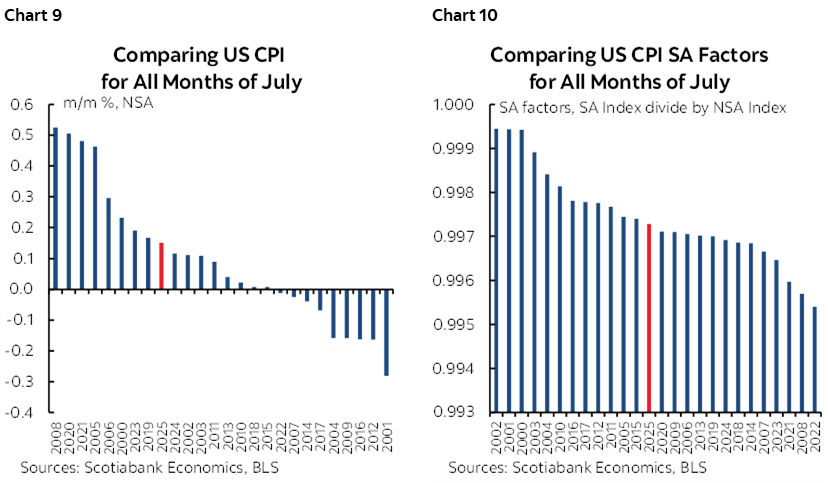
July is normally a mild seasonal up-month for unadjusted prices (chart 9) and the seasonal adjustment factor has been lower in the pandemic-era than prior years (chart 10) which could restrain the pace of price increases compared to like months of July in history.
Gasoline will be a modest downside which is part of the reason behind a weaker headline estimate than for core CPI. Food prices are expected to be a small contributor. Year-ago base effects would drop the y/y rates of headline and core inflation if prices were unchanged over June. New vehicle prices appear to have slipped in seasonally adjusted terms.
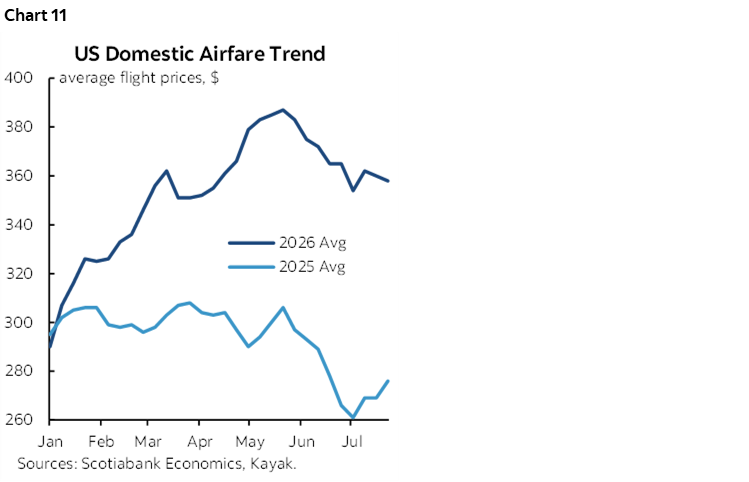
I’m expecting a sharp rebound in core service prices (CPI services ex-housing services and energy services). The prior month’s plunge was rather anomalous. Categories like airfare, for example, do not appear to have experienced the same drop in July as in June whether in terms of domestic airfare (chart 11) or international airfare.
Core goods prices (ex-food and energy) may also be ripe for an acceleration partly on a combination of maturing tariff effects (for now, TBC) but also amid ongoing watch over potential pass-through effects from higher commodity prices.
Short-Term Inflation Risk is High…
Herein lies the rub. I buy that near-term inflation risk remains elevated and an overly data dependent FOMC may well react by raising rates. In the context of lagging effects of monetary tightening, however, I don’t see this as appropriate in the face of how inflation risk is likely to evolve in a medium-term sense.
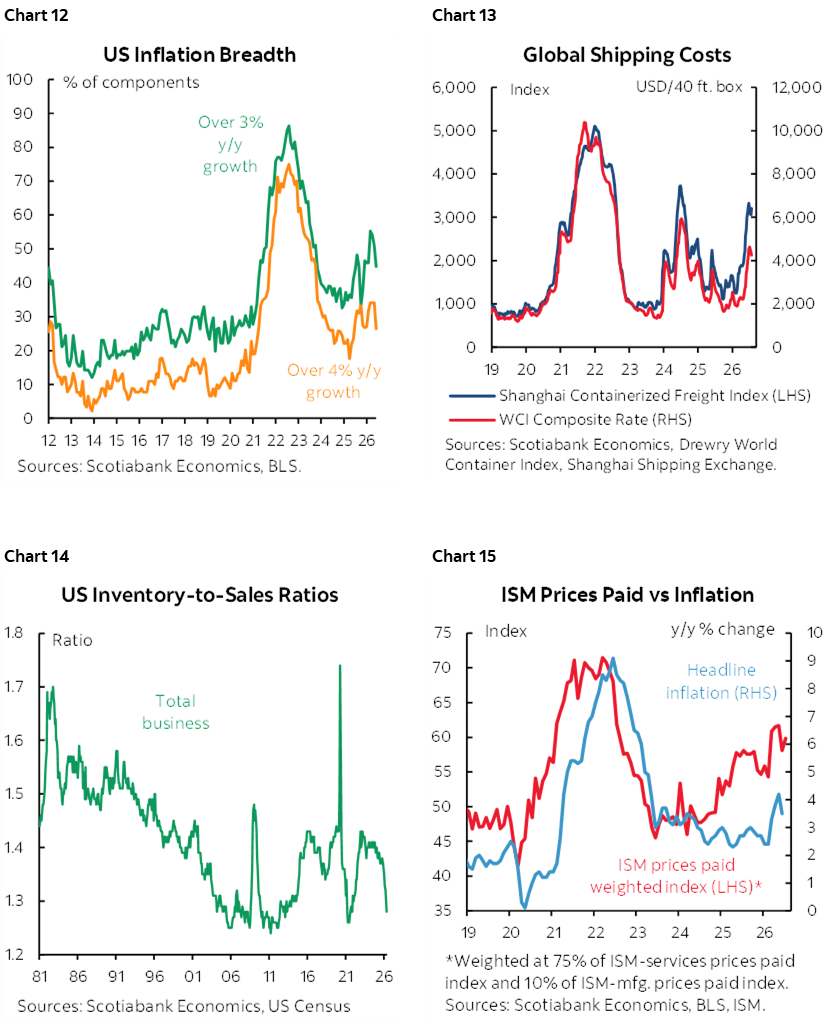
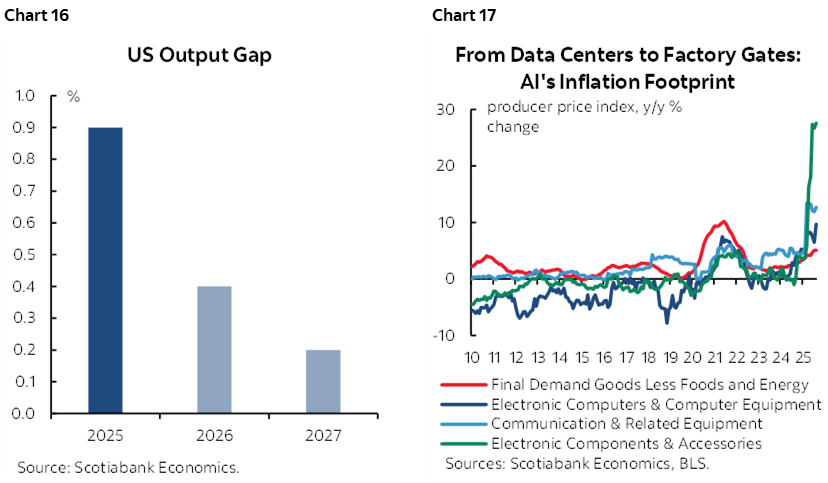
In terms of nearer term inflation risk, breadth is challenging (chart 12). Shipping costs are soaring (chart 13). Inventories are tightening which means that the ability to mitigate inflation by selling down stockpiles at older prices may be maturing (chart 14). Soft data like ISM-prices paid point to rising inflation (chart 15). The US economy remains in excess demand as measured by output gaps (chart 16). Heavy AI investment is clearly driving prices for electronics and communications equipment sharply higher (chart 17). If monetary policy were to be driven exclusively or mostly by near-term inflation risk, then this evidence could easily support hiking.
…but Not Unambiguously Amid the Risk of Longer-Run Disinflation…
And then there is the other side of the coin. Housing inflation continues to diminish (chart 18). The lagging effects of market measures suggest that housing inflation could remain tame into next year (chart 19). Shelter is about 35% of the CPI basket mostly through owners’ equivalent rent but also primary rent. It’s a large chunk of the basket but PCE cuts that weight by more than half (15½%) and therefore relatively downplays this form of disinflation.
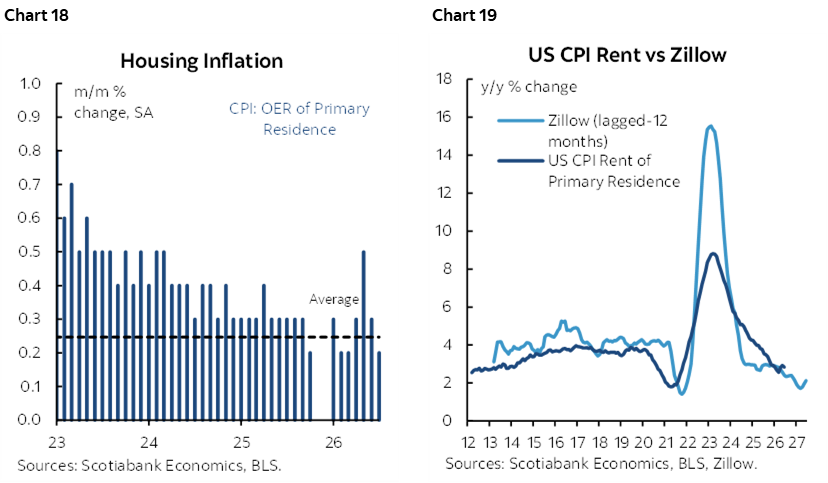
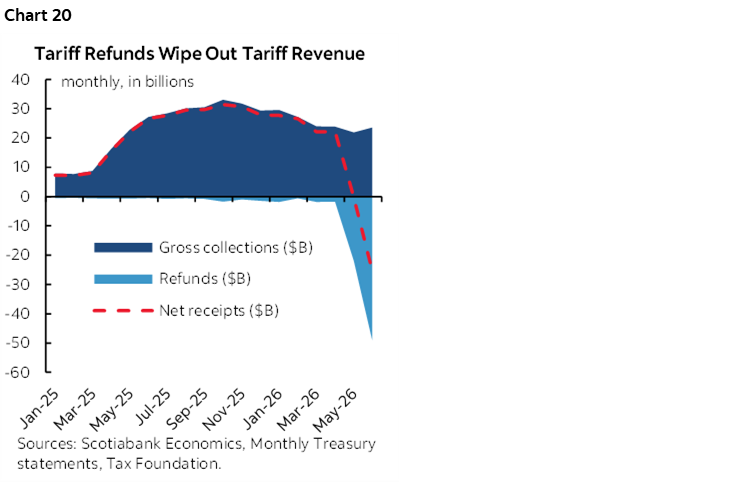
Further, tariff refunds due to struck-down tariffs are swamping tariff collections and driving net disbursements back to companies who may use the proceeds to hold off on price hikes (chart 20). USD strength may be helping to restrain some price pass through effects. And whatever happens to core goods inflation encounters the reality that the trend has been weak. Further, the extent to which surging AI-driven prices for electronics and communications equipment spills over into other goods may cause disinflationary second-round effects by discouraging purchases. Fm2c, you can keep your phones amid coming price hikes.
As previously shown, we also forecast that the output gap will become more balanced as heavy investment drives the supply side alongside expectations for moderate growth.
The supply side is expanding because the investment stock in the US is climbing rapidly (charts 21, 22). It’s not a miracle per se. It’s not because of tariffs bringing home investment despite the administration’s claims. In fact, over time, that could cause the opposite effect; I would argue that history shows when countries build protectionist walls it lessens competitive pressures which results in less focus upon doing the things to remain competitive. The capital stock decays, factories fall into ruin, and competitiveness suffers. Hello Soviet Union as an extreme example.
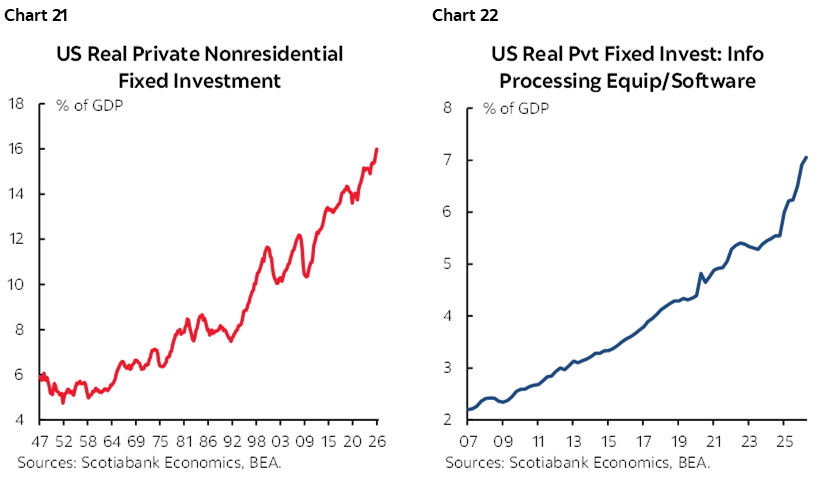
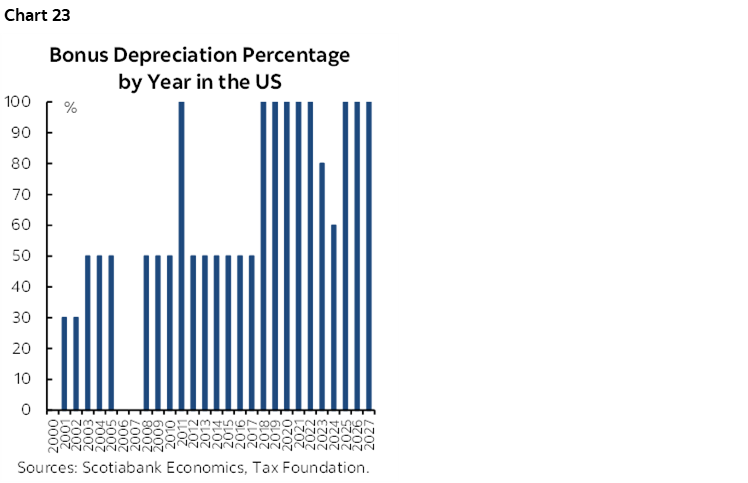
Rather, rapidly rising investment is being aided by heavy subsidies that includes making permanent the ‘bonus’ write-offs as the BBB did. Bonus depreciation for equipment purchases allows deducting the cost of investment and started at 30% in 2002, was increased to 100% (ie: full-year write-offs) in 2018 under the Tax Cuts and Jobs Act during Trump 1.0, was then curtailed by the Biden administration, and then raised back to 100% and made permanent in the BBB Act (chart 23).
The trillion-dollar question is whether this will drive a subsidized productivity bonanza, or a lot of waste through a capital overhang in the US economy alongside a fiscal mess that fails to rein in deficits after years of procyclical fiscal policy. It might also weaken the labour market and hence the other half of the Fed’s dual mandate by raising the capital:labour ratio. I don’t have a full answer for all of that, but it would be imprudent not to be on guard. Not all of the investment going into AI will reveal winners, just as the rapid expansion of firms in the early days of the auto industry did not. Not all of that investment will be monetized into something useful. At some point, stimulating investment through subsidies beyond what free market forces would have otherwise invested may bring forward investment and create a vacuum in its aftermath. An extreme example of this was China coming out of the GFC.
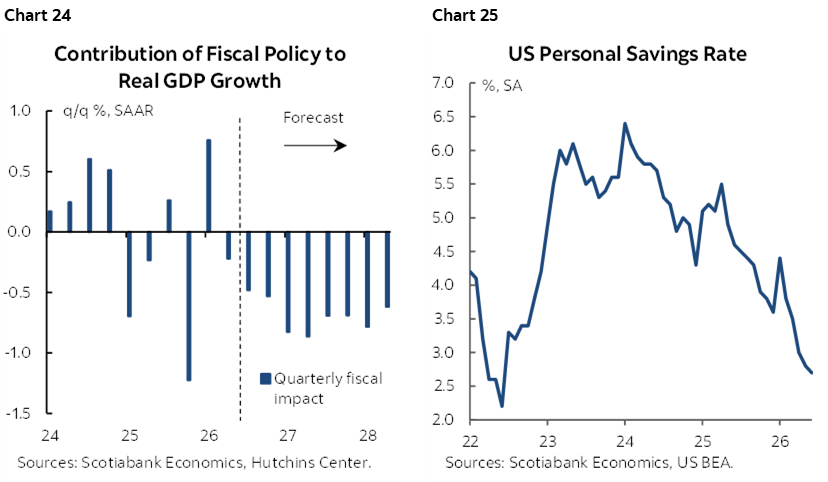
On the demand side, fiscal policy is moving toward tightening using the measure in chart 24 that sums up expenditure and taxation policies across all levels of government. Real wage pressures, an increasingly depleted saving rate (chart 25), a negative housing wealth effect amid falling real house prices, and AI’s likely effects on jobs may restrain consumers.
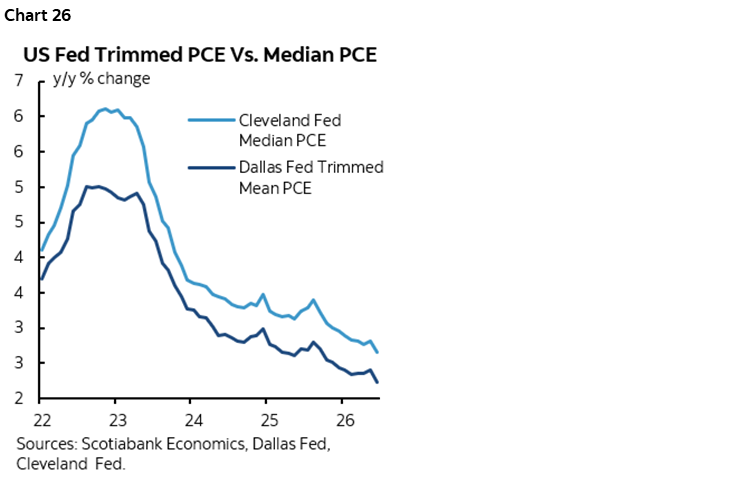
There is also the very important consideration of whether today’s inflation is as generalized as popular narratives suggest, or more narrowly driven in a relative price shock. Trimmed mean and weighted median price measures lean more toward the latter argument relative to headline measures of inflation (chart 26). The supply chain shocks of the pandemic are confronted by today’s supply side expansion. The demand surge coming out of the pandemic has no parallel today. Moderate nominal wage growth and a relative price shock combine to present the risk of second-round disinflationary pressures as households spend more upon what they must to a degree—namely energy and groceries—and have less to spend on other things.
…and the Perils of Fed Reliance Upon Markets
And so enter two cautions on market attitudes in terms of what the Fed should do. Markets are pricing just over half of a hike by the September 16th decision and most of a hike by October.
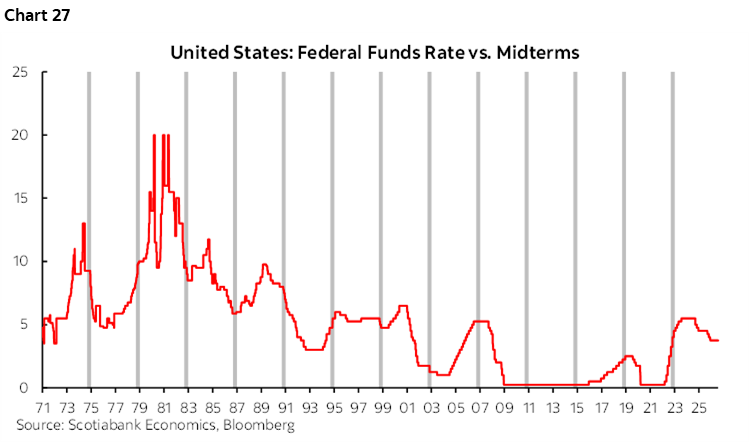
The first caution is that would be a first in the sense that the Fed has never commenced a hiking cycle in September or October during midterm election years (chart 27). Continued, yes, but not started. That doesn’t mean it’s impossible, but under current political realities, you’d better have extreme confidence that you’re doing the right thing to avoid stiffer Congressional oversight and more enemies in Washington. The Fed’s history of mistakes should make it very cautious from a credibility standpoint. At least in the shorter run, the political calculus to the Fed is likely to be riskier if they hiked pre-midterms than held until after and reevaluated.
The second caution is about Warsh’s apparent willingness to take his cues on appropriate policy from the bond market. Talk about the tail wagging the dog.
For example, had the Fed conducted policy in line with what markets believed about inflation risk coming out of the GFC then the Fed might have hiked by hundreds of basis points and caused a depression rather than a subdued period of growth. Markets and umpteen op-eds by the WSJ thought the biggest risk to Fed balance sheet expansion was a massive spurt of inflation; they didn’t get that narrow money expansion was a pittance against broad money destruction and what was happening to money multipliers and velocity.
An opposite example is that had the Fed abided by what markets were pricing when SVB collapsed and regional banks were under pressure in 2023, then it might have slashed rates and created a bigger subsequent inflation problem as markets did not understand that the Fed had other tools for addressing these challenges. For example, the June 2023 OIS contract was pricing about 100bps of easing and the 2-year Treasury yield had plummeted by about 125bps which the FOMC was correct to have looked through.
Overall, amid the uncertainty, I would prefer to see a patient Fed. If you by chance recall anything I wrote in the pandemic, then that wasn’t my argument then; the Fed’s muddled interpretation of its mandate and data led to it raising rates too late. The risk is the opposite today (ie: mistimed tightening), but the probability of error may be similar.
CENTRAL BANKS—THREE PROBABLE HOLDS*
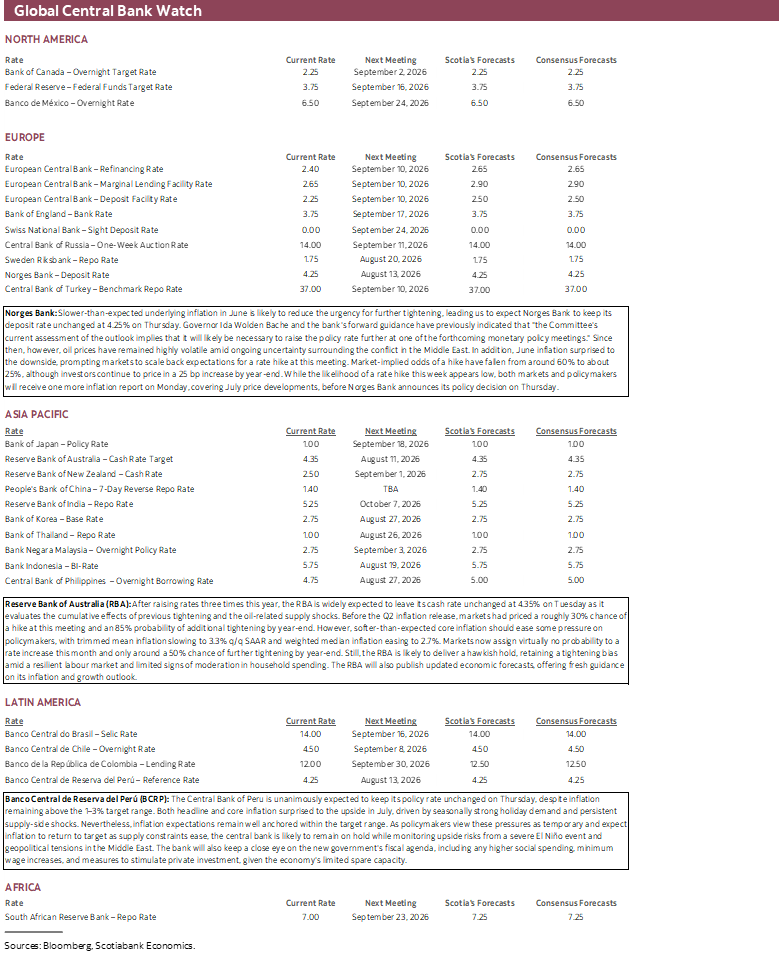
Three central banks will offer updated decisions this week. Each one is expected to stay on hold but at least two of them offer uncertain hawkish risks, hence the asterisk in the header.
RBA—Watching and Waiting
Australia’s central bank weighs in with a decision on monetary policy on Tuesday. Consensus unanimously expects a hold at a cash rate target of 4.35%. Markets are aligned with consensus and are only pricing half of a quarter point hike by year-end.
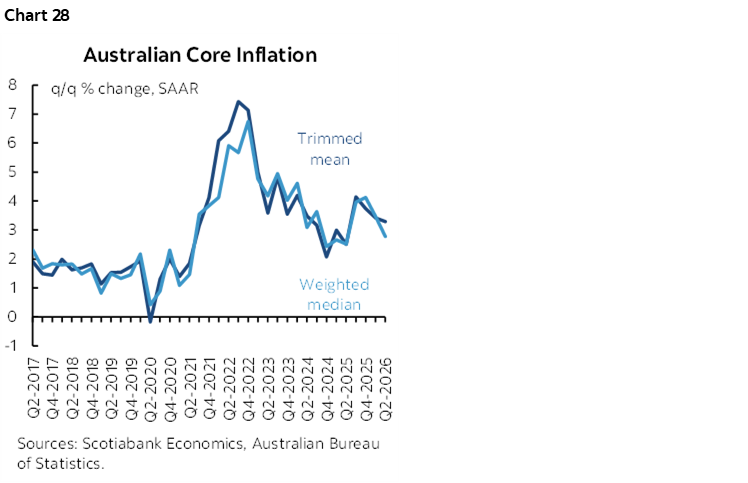
After 75bps of hikes this year, the RBA appears to be satisfied with evaluating the effects before deciding upon next steps. Slight undershooting of Q2 CPI inflation measures relative to consensus bought a bit more time for this evaluation phase (chart 28). By contrast, the labour market remains very strong with 120k jobs created in the past two months and 161k so far this year.
Nevertheless, the broad tone is likely to land on the hawkish side of neutral. That could come in terms of verbiage, or by letting updated forecasts do the talking.
Norges—Tightening Bias
Thursday’s decision by Norway’s central bank is a little more uncertain. Consensus is somewhat divided on hold versus hike scenarios. Markets have only less than a one-in-four chance of a hike at this meeting but most of a hike priced by September and a full hike priced by year-end.
In the hike camp is prior guidance from Governor Ida Wolden Bache who said after the last decision “the Committee’s current assessment of the outlook implies that it will likely be necessary to raise the policy rate further at one of the forthcoming monetary policy meetings.” Chart 29 depicts their explicit forward rate guidance as at June. Ok, so which one, and how likely?
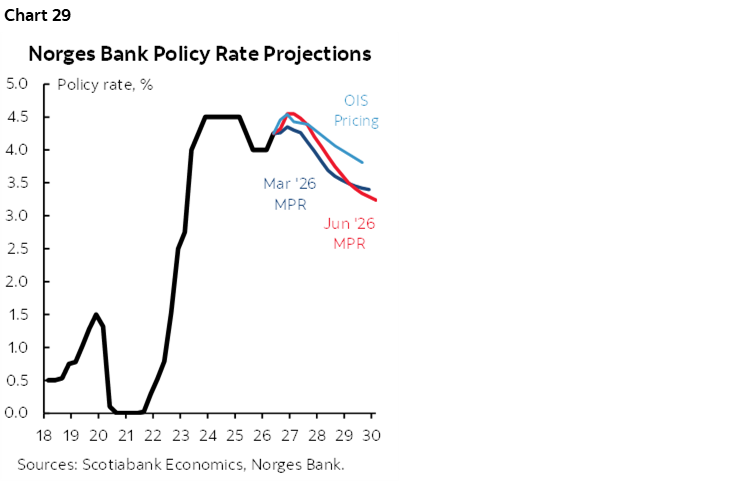
It’s not very likely at this meeting. The most recent underlying CPI inflation reading for June surprised lower at 2.7% y/y (3.3% consensus, 3.4% prior). What complicates matters, however, is that Norway updates CPI for July on Monday and some expect underlying inflation to snap higher. Combined with volatility around elevated energy prices that matter enormously to Norway’s economy, this could be enough to tilt the balance either to a hike or more hawkish guidance.
BCRP—In Motion
Peru’s central bank is expected to remain on hold at a reference rate of 4.25% on Thursday evening (ET). There may be a hawkish tinge to the communications going forward.
The BCRP stayed on hold as inflation soared amid political uncertainty. Some of this uncertainty has dissipated with right-leaning President Keiko Fujimori taking office following a lengthy election campaign. Now the focus turns to what combination of policy measures may be pursued.
Fiscal and regulatory policies will be closely monitored in terms of potentially aiding growth. Draft legislation is in the works to reform the tax system in a more growth friendly manner. The legislation reportedly opens the prospect of raising interest rate caps on lending that could stoke more lending activity. There is also talk of easing regulatory measures in the mining sector.
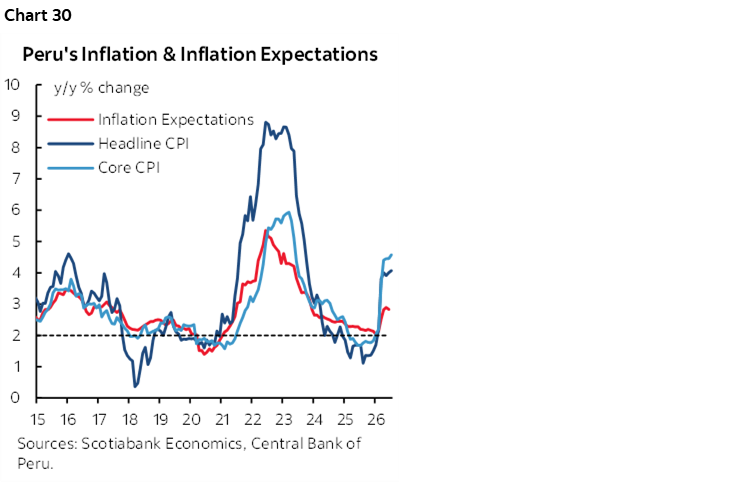
With core inflation running at 4½% and on the rise and inflation expectations on the rise alongside potentially growth-friendly policy changes (chart 30), the BCRP could be put in a position of responding with a tightening stance especially due to upside inflation risks stemming from a potentially severe El Niño event and tensions in the Middle East.
GLOBAL MACRO—US CONSUMERS AND THE UK ECONOMY
Beyond what has already been addressed, the handful of other key developments on tap will be mostly skewed toward assessing the health of the US consumer and the UK economy. Off-calendar risk will remain focused upon developments in the Middle East and perhaps CUSMA trade negotiations.
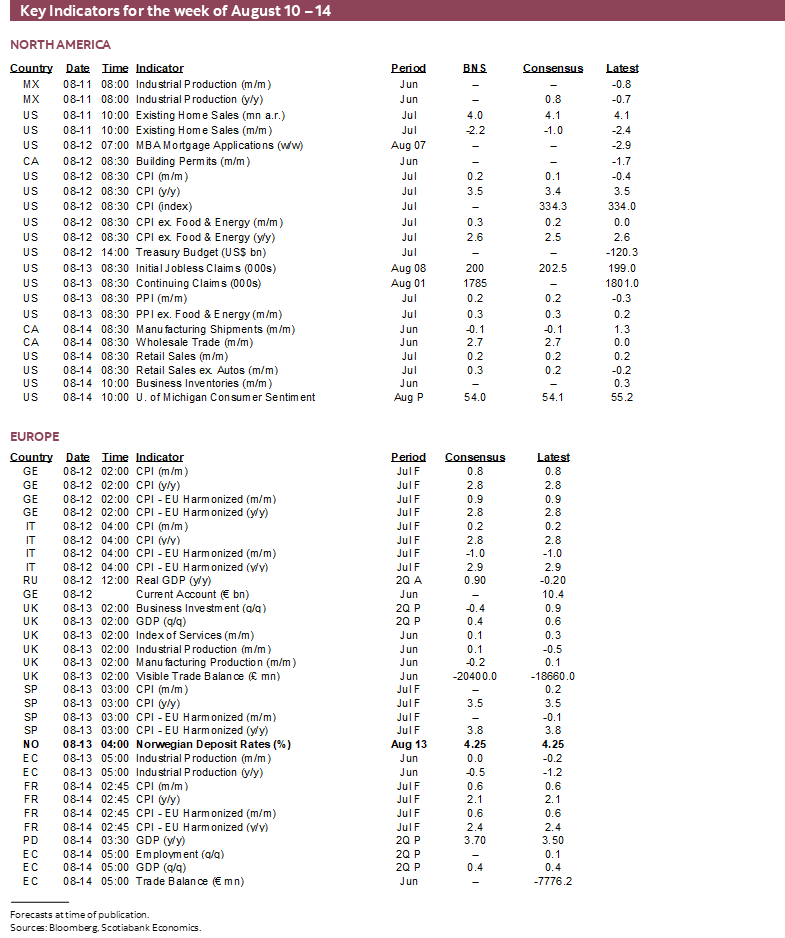
US markets will be obsessed with aforementioned inflation readings and with little else to noodle over the coming week. Existing home sales could soften in July’s reading (Tuesday) given soft tracking of pending home sales. Retail sales during July (Friday) are expected to post a modest gain in total sales and a slightly warmer gain in sales ex-autos as auto sales slipped in July. Ninety minutes after retail sales will see attention pivot toward UMich consumer sentiment that is expected to slip on cash flow drivers like higher energy prices.
European markets will be dominated by attention to UK macro readings and with little else by way of calendar-based risk. Thursday will be the big day when the UK dumps a massive line-up of readings. Q2 GDP growth is expected to be moderate with estimates between about 0.2–0.6% q/q SA nonannualized. Consumption is expected to be soft along with investment, but net trade could offer a lift. The economy is expected to have slipped in June’s GDP reading and we’ll get the breakdown in terms of industrial output, services output, construction activity and net trade in the same batch of readings.
Canadian markets could be primarily driven by spillover effects from US inflation and developments abroad alongside any headline risk emanating from trade negotiations with the US ahead of the following week’s threatened US tariff deadline and potential Canadian retaliation. Data risk will be low. Manufacturing shipments (Friday) are expected to be flat after a solid prior gain, but mostly due to lower energy prices in June before they rebounded. Wholesale trade is expected to post a strong gain based upon advance guidance from Statcan (Friday).
Norway’s CPI for July (Monday) has already been noted in the Norges Bank section.
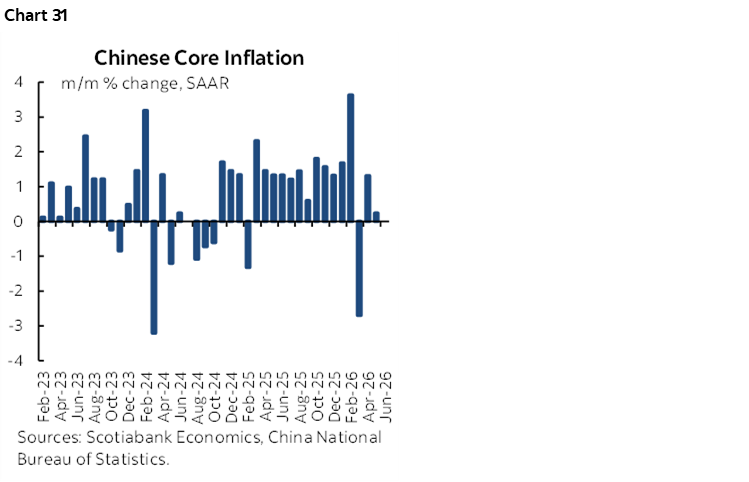
Elsewhere the focus will be upon a sprinkling of inflation readings out of China (August 8th) amid a waning trend (chart 31), Colombia (higher core, Monday), Brazil (softer, Tuesday) and India (steady, Wednesday).
DISCLAIMER
This report has been prepared by Scotiabank Economics as a resource for the clients of Scotiabank. Opinions, estimates and projections contained herein are our own as of the date hereof and are subject to change without notice. The information and opinions contained herein have been compiled or arrived at from sources believed reliable but no representation or warranty, express or implied, is made as to their accuracy or completeness. Neither Scotiabank nor any of its officers, directors, partners, employees or affiliates accepts any liability whatsoever for any direct or consequential loss arising from any use of this report or its contents.
These reports are provided to you for informational purposes only. This report is not, and is not constructed as, an offer to sell or solicitation of any offer to buy any financial instrument, nor shall this report be construed as an opinion as to whether you should enter into any swap or trading strategy involving a swap or any other transaction. The information contained in this report is not intended to be, and does not constitute, a recommendation of a swap or trading strategy involving a swap within the meaning of U.S. Commodity Futures Trading Commission Regulation 23.434 and Appendix A thereto. This material is not intended to be individually tailored to your needs or characteristics and should not be viewed as a “call to action” or suggestion that you enter into a swap or trading strategy involving a swap or any other transaction. Scotiabank may engage in transactions in a manner inconsistent with the views discussed this report and may have positions, or be in the process of acquiring or disposing of positions, referred to in this report.
Scotiabank, its affiliates and any of their respective officers, directors and employees may from time to time take positions in currencies, act as managers, co-managers or underwriters of a public offering or act as principals or agents, deal in, own or act as market makers or advisors, brokers or commercial and/or investment bankers in relation to securities or related derivatives. As a result of these actions, Scotiabank may receive remuneration. All Scotiabank products and services are subject to the terms of applicable agreements and local regulations. Officers, directors and employees of Scotiabank and its affiliates may serve as directors of corporations.
Any securities discussed in this report may not be suitable for all investors. Scotiabank recommends that investors independently evaluate any issuer and security discussed in this report, and consult with any advisors they deem necessary prior to making any investment.
This report and all information, opinions and conclusions contained in it are protected by copyright. This information may not be reproduced without the prior express written consent of Scotiabank.
™ Trademark of The Bank of Nova Scotia. Used under license, where applicable.
Scotiabank, together with “Global Banking and Markets”, is a marketing name for the global corporate and investment banking and capital markets businesses of The Bank of Nova Scotia and certain of its affiliates in the countries where they operate, including; Scotiabank Europe plc; Scotiabank (Ireland) Designated Activity Company; Scotiabank Inverlat S.A., Institución de Banca Múltiple, Grupo Financiero Scotiabank Inverlat, Scotia Inverlat Casa de Bolsa, S.A. de C.V., Grupo Financiero Scotiabank Inverlat, Scotia Inverlat Derivados S.A. de C.V. – all members of the Scotiabank group and authorized users of the Scotiabank mark. The Bank of Nova Scotia is incorporated in Canada with limited liability and is authorised and regulated by the Office of the Superintendent of Financial Institutions Canada. The Bank of Nova Scotia is authorized by the UK Prudential Regulation Authority and is subject to regulation by the UK Financial Conduct Authority and limited regulation by the UK Prudential Regulation Authority. Details about the extent of The Bank of Nova Scotia's regulation by the UK Prudential Regulation Authority are available from us on request. Scotiabank Europe plc is authorized by the UK Prudential Regulation Authority and regulated by the UK Financial Conduct Authority and the UK Prudential Regulation Authority.
Scotiabank Inverlat, S.A., Scotia Inverlat Casa de Bolsa, S.A. de C.V, Grupo Financiero Scotiabank Inverlat, and Scotia Inverlat Derivados, S.A. de C.V., are each authorized and regulated by the Mexican financial authorities.
Not all products and services are offered in all jurisdictions. Services described are available in jurisdictions where permitted by law.