

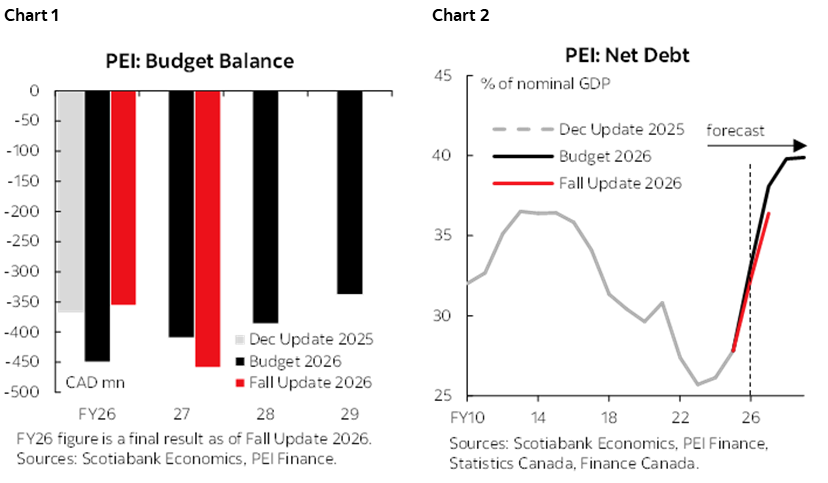
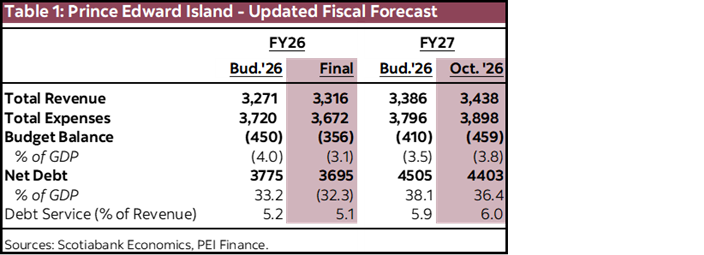
- PEI’s mid-year fiscal update increases its FY27 deficit forecast from $409.9mn (3.5% of nominal GDP) to $459mn (3.8%). The updated second quarter forecast constitutes a negative revision of $49.4mn vs the province’s Budget 2026 outlook, as increased expenditure forecasts outweigh some positive revisions to projected revenues.
- Total revenue for FY27 has been revised up by +1.5%. A substantial contributor to revenue growth was stronger income from taxes (corporate income taxes, sales taxes, real property tax revenues, and HST recoveries), as well as a one-time Federal housing supply payment. Additional upward revisions were realized via Health and Wellness gains, as well as by higher federal transfers through the Oil to Heat Pump Affordability Program. This was partially offset by reduced forecasts from Transportation and Infrastructure (reflecting delays in recognizing Federal Infrastructure funding with project timing) and somewhat lower revenues from government business enterprises.
- FY27 expenditures have been revised up by 2.7% vs the Budget estimates. This year’s expenditures are now expected to land at approximately $39.0 bn, compared to the Spring estimate of $38.0bn. Health PEI’s expenditure increase of approximately $74.4mn (+6.0%) was the single-largest contributor to total upward revisions, with factors such as agency staffing, wage levies, salary premiums, and out-of-province contracted services applying pressure on operating expenses. In addition, over-budget estimates for Innovation PEI and expenditure increases in the Department of Health and Wellness have also materially contributed to higher overall forecasted expenditures for FY27.
- The net debt-to-GDP path has improved somewhat. Despite the increase in the projected FY27 deficit, the end-of-year debt burden has been revised lower. The FY26 deficit came in lower than estimate in the Spring and planned acquisition of tangible capital assets has been dropped by $77.0mn (or 15.8%) compared to Spring estimates. Additionally, labour market strength, wage growth, elevated housing construction, and goods exports growth have all contributed to upward revisions in expected 2026 GDP, despite persistent drags from continuing trade tensions with the US, and cost pressures for households and businesses from higher oil prices. As a result, projected FY27 net debt has been revised down by 1.7ppts, from 38.1% to 36.4%. However, the debt burden will climb quickly if elevated deficits continue.
- Many domestic and global economic headwinds endure, though there is a case to remain cautiously optimistic going forward. Though many tariffs on Canadian exports to the U.S. are still in place and continue to evolve, it remains a possibility that the state of trade tensions have reached their peak. Meanwhile, efforts towards de-escalation in the Middle East continue. Should constructive trade negotiations resume, and regional de-escalation efforts succeed, a path towards tariff relief across industries could unfold in the near future, along with the easing of global supply chains and inflationary pressures.
DISCLAIMER
This report has been prepared by Scotiabank Economics as a resource for the clients of Scotiabank. Opinions, estimates and projections contained herein are our own as of the date hereof and are subject to change without notice. The information and opinions contained herein have been compiled or arrived at from sources believed reliable but no representation or warranty, express or implied, is made as to their accuracy or completeness. Neither Scotiabank nor any of its officers, directors, partners, employees or affiliates accepts any liability whatsoever for any direct or consequential loss arising from any use of this report or its contents.
These reports are provided to you for informational purposes only. This report is not, and is not constructed as, an offer to sell or solicitation of any offer to buy any financial instrument, nor shall this report be construed as an opinion as to whether you should enter into any swap or trading strategy involving a swap or any other transaction. The information contained in this report is not intended to be, and does not constitute, a recommendation of a swap or trading strategy involving a swap within the meaning of U.S. Commodity Futures Trading Commission Regulation 23.434 and Appendix A thereto. This material is not intended to be individually tailored to your needs or characteristics and should not be viewed as a “call to action” or suggestion that you enter into a swap or trading strategy involving a swap or any other transaction. Scotiabank may engage in transactions in a manner inconsistent with the views discussed this report and may have positions, or be in the process of acquiring or disposing of positions, referred to in this report.
Scotiabank, its affiliates and any of their respective officers, directors and employees may from time to time take positions in currencies, act as managers, co-managers or underwriters of a public offering or act as principals or agents, deal in, own or act as market makers or advisors, brokers or commercial and/or investment bankers in relation to securities or related derivatives. As a result of these actions, Scotiabank may receive remuneration. All Scotiabank products and services are subject to the terms of applicable agreements and local regulations. Officers, directors and employees of Scotiabank and its affiliates may serve as directors of corporations.
Any securities discussed in this report may not be suitable for all investors. Scotiabank recommends that investors independently evaluate any issuer and security discussed in this report, and consult with any advisors they deem necessary prior to making any investment.
This report and all information, opinions and conclusions contained in it are protected by copyright. This information may not be reproduced without the prior express written consent of Scotiabank.
™ Trademark of The Bank of Nova Scotia. Used under license, where applicable.
Scotiabank, together with “Global Banking and Markets”, is a marketing name for the global corporate and investment banking and capital markets businesses of The Bank of Nova Scotia and certain of its affiliates in the countries where they operate, including; Scotiabank Europe plc; Scotiabank (Ireland) Designated Activity Company; Scotiabank Inverlat S.A., Institución de Banca Múltiple, Grupo Financiero Scotiabank Inverlat, Scotia Inverlat Casa de Bolsa, S.A. de C.V., Grupo Financiero Scotiabank Inverlat, Scotia Inverlat Derivados S.A. de C.V. – all members of the Scotiabank group and authorized users of the Scotiabank mark. The Bank of Nova Scotia is incorporated in Canada with limited liability and is authorised and regulated by the Office of the Superintendent of Financial Institutions Canada. The Bank of Nova Scotia is authorized by the UK Prudential Regulation Authority and is subject to regulation by the UK Financial Conduct Authority and limited regulation by the UK Prudential Regulation Authority. Details about the extent of The Bank of Nova Scotia's regulation by the UK Prudential Regulation Authority are available from us on request. Scotiabank Europe plc is authorized by the UK Prudential Regulation Authority and regulated by the UK Financial Conduct Authority and the UK Prudential Regulation Authority.
Scotiabank Inverlat, S.A., Scotia Inverlat Casa de Bolsa, S.A. de C.V, Grupo Financiero Scotiabank Inverlat, and Scotia Inverlat Derivados, S.A. de C.V., are each authorized and regulated by the Mexican financial authorities.
Not all products and services are offered in all jurisdictions. Services described are available in jurisdictions where permitted by law.