

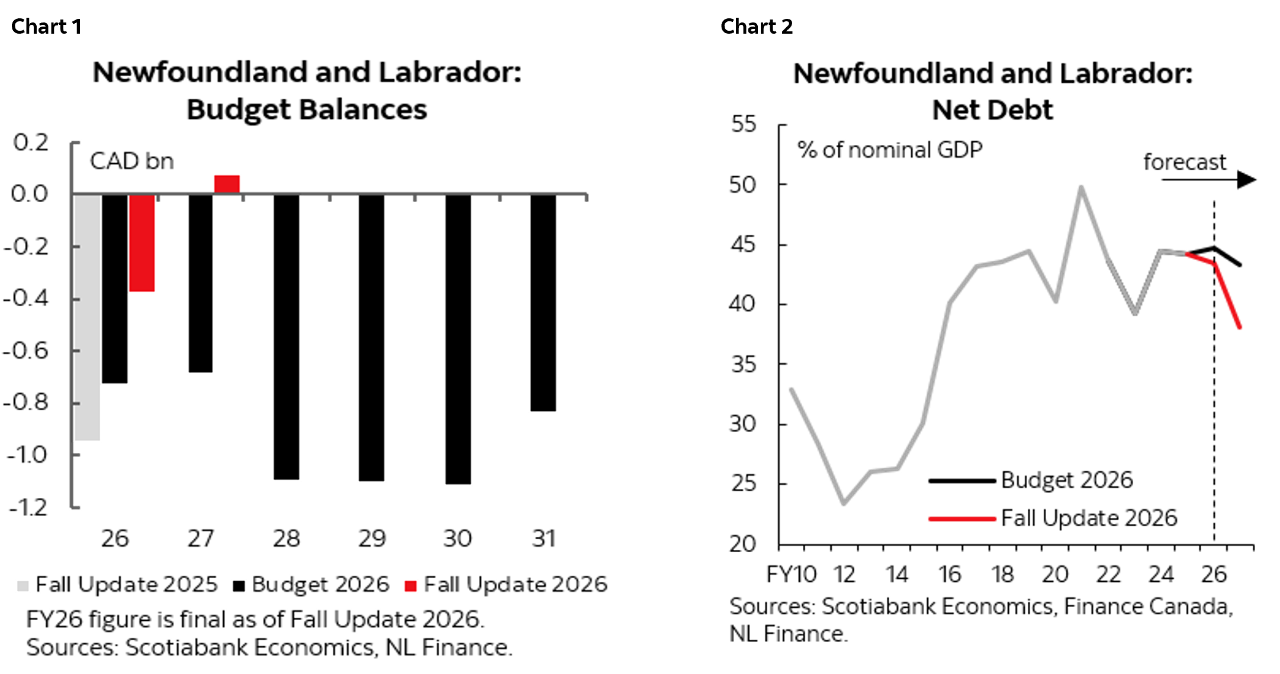
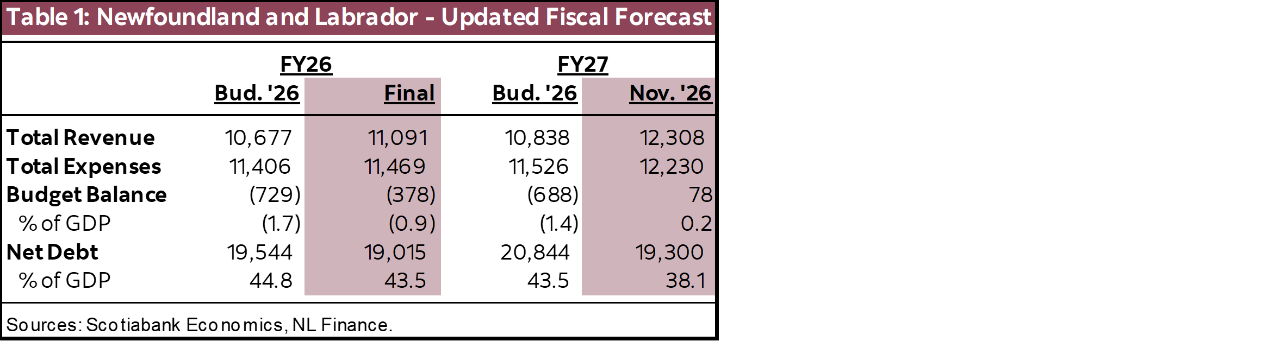
- Newfoundland and Labrador’s mid-year fiscal update reveals a projected surplus of $78mn (0.2% of nominal GDP) in FY27, up from a previously projected $688mn deficit (-1.4%). The swing to a surplus vs Budget 2026’s deficit projection can be mainly attributed to the significant revision to the province’s total revenue forecasts, which has been revised higher by approximately $1.5bn—more than compensating for a $0.7bn rise in forecasted total expenditures.
- The economic outlook for FY27 has improved. The province’s oil industry has posted significant gains in 2026, with oil production forecast to increase by roughly 15% for the second year in a row. Strength in the mining, fisheries, and tourism sectors have also supported solid economic growth throughout the year, while consumption has remained robust and labour markets have been stable. The nature of how U.S. tariffs have been applied (with Canadian energy products exempt) has meant that Newfoundland and Labrador faces one of the lowest effective tariff rates among provinces, mitigating the impact on the economy. The update boosts anticipated real GDP growth in 2026 to 7.1% from the spring’s estimate of 5.5%, substantially greater than our own real GDP forecast of 2.8% from our mid-October Scotiabank Forecast publication.
- Total revenue for FY27 has been revised upward by $1.5 bn, or 13.6%. The aforementioned greater oil production, along with higher prices, and solid export and multisectoral performances have significantly boosted revenue projections for the year—now estimated to land around $12.3bn in FY27, nearly $1.5bn greater than Budget 2026’s initial projection and roughly 11% greater than total revenue reported in FY26. The higher oil production, alongside elevated oil prices, have led to the budget impact rising to approximately $3.0bn, an increase of $1 billion compared to Budget 2026’s estimate (even after introducing an oil risk adjustment of $74mn). However, while the annual average price of Brent crude oil in 2026 will almost certainly be materially higher than the $79 USD/bbl previously assumed in the spring Budget, the final figure could prove to be lower than the now-estimated $98 USD/bbl, should prices continue their current downward trend, though significant upside risks still exist. Robust consumption and retail sales, along with expected year-over-year increases in employment growth and household income have also contributed to higher economic growth and revenue projections.
- FY27 expenditures have been increased by $0.7 bn, or 6.1%. Total spending is now anticipated to reach $12.2bn, for projected year-over-year growth of approximately 6.6%. Roughly $200mn of the additional expenditure measures derive from affordability payments (reflecting the government’s commitment to use 20% of the oil windfalls to support citizens), including the Seniors Affordability Payment ($64mn), Families and Children Affordability Payment ($39mn), and the 15% Churchill Falls Electricity rebate ($45mn). In addition, healthcare expenses have reportedly been revised approximately $400mn higher than what was set out in the spring Budget.
- The net debt-to-GDP path has improved. An improved budget balance and strong economic performance in 2026, where nominal GDP is projected to grow by 15.7%, has culminated in today’s mid-year update projecting net debt in FY27 to total approximately $19.3bn or 38.1% of GDP, a material improvement on Budget 2026’s initial forecast ($20.8bn), as well as last year’s actual ratio (both 43.5%). The government has committed to use 80% of the oil revenue windfall towards reducing its debt, and in particular that this year’s windfall will allow the government to reduce its borrowing next year by $637mn (though the borrowing plan for this year remains at $3.9bn) and make a one-time special contribution to a sinking fund of $175mn.
- The medium-term outlook is uncertain. The spring Budget had forecasted fairly sizeable deficits out to 2031, and this mid-year update did not include new projections past FY27. While the improvement in the near-term fiscal outlook is undoubtedly positive, the medium-term outlook is unlikely to improve as much. Oil production, while greater than 2025, has declined over the course of 2026 and oil prices have also fallen in recent weeks (though remain volatile). As a result, revenue growth could be significantly weaker next year (especially from oil), and the province continues to face cost pressures from health and other key spending areas. As a result, the government’s commitment to bank 80% of the revenue windfall is wise, and will help mitigate pressures to create new permanent costs out of temporarily higher revenues. In addition, the medium-term economic outlook is promising, especially as the Churchill Falls expansion and Bay du Nord offshore field get closer to approvals and implementation.
DISCLAIMER
This report has been prepared by Scotiabank Economics as a resource for the clients of Scotiabank. Opinions, estimates and projections contained herein are our own as of the date hereof and are subject to change without notice. The information and opinions contained herein have been compiled or arrived at from sources believed reliable but no representation or warranty, express or implied, is made as to their accuracy or completeness. Neither Scotiabank nor any of its officers, directors, partners, employees or affiliates accepts any liability whatsoever for any direct or consequential loss arising from any use of this report or its contents.
These reports are provided to you for informational purposes only. This report is not, and is not constructed as, an offer to sell or solicitation of any offer to buy any financial instrument, nor shall this report be construed as an opinion as to whether you should enter into any swap or trading strategy involving a swap or any other transaction. The information contained in this report is not intended to be, and does not constitute, a recommendation of a swap or trading strategy involving a swap within the meaning of U.S. Commodity Futures Trading Commission Regulation 23.434 and Appendix A thereto. This material is not intended to be individually tailored to your needs or characteristics and should not be viewed as a “call to action” or suggestion that you enter into a swap or trading strategy involving a swap or any other transaction. Scotiabank may engage in transactions in a manner inconsistent with the views discussed this report and may have positions, or be in the process of acquiring or disposing of positions, referred to in this report.
Scotiabank, its affiliates and any of their respective officers, directors and employees may from time to time take positions in currencies, act as managers, co-managers or underwriters of a public offering or act as principals or agents, deal in, own or act as market makers or advisors, brokers or commercial and/or investment bankers in relation to securities or related derivatives. As a result of these actions, Scotiabank may receive remuneration. All Scotiabank products and services are subject to the terms of applicable agreements and local regulations. Officers, directors and employees of Scotiabank and its affiliates may serve as directors of corporations.
Any securities discussed in this report may not be suitable for all investors. Scotiabank recommends that investors independently evaluate any issuer and security discussed in this report, and consult with any advisors they deem necessary prior to making any investment.
This report and all information, opinions and conclusions contained in it are protected by copyright. This information may not be reproduced without the prior express written consent of Scotiabank.
™ Trademark of The Bank of Nova Scotia. Used under license, where applicable.
Scotiabank, together with “Global Banking and Markets”, is a marketing name for the global corporate and investment banking and capital markets businesses of The Bank of Nova Scotia and certain of its affiliates in the countries where they operate, including; Scotiabank Europe plc; Scotiabank (Ireland) Designated Activity Company; Scotiabank Inverlat S.A., Institución de Banca Múltiple, Grupo Financiero Scotiabank Inverlat, Scotia Inverlat Casa de Bolsa, S.A. de C.V., Grupo Financiero Scotiabank Inverlat, Scotia Inverlat Derivados S.A. de C.V. – all members of the Scotiabank group and authorized users of the Scotiabank mark. The Bank of Nova Scotia is incorporated in Canada with limited liability and is authorised and regulated by the Office of the Superintendent of Financial Institutions Canada. The Bank of Nova Scotia is authorized by the UK Prudential Regulation Authority and is subject to regulation by the UK Financial Conduct Authority and limited regulation by the UK Prudential Regulation Authority. Details about the extent of The Bank of Nova Scotia's regulation by the UK Prudential Regulation Authority are available from us on request. Scotiabank Europe plc is authorized by the UK Prudential Regulation Authority and regulated by the UK Financial Conduct Authority and the UK Prudential Regulation Authority.
Scotiabank Inverlat, S.A., Scotia Inverlat Casa de Bolsa, S.A. de C.V, Grupo Financiero Scotiabank Inverlat, and Scotia Inverlat Derivados, S.A. de C.V., are each authorized and regulated by the Mexican financial authorities.
Not all products and services are offered in all jurisdictions. Services described are available in jurisdictions where permitted by law.