

WEAKER GROWTH LEADS TO HIGHER FUTURE DEFICITS, BUT UPSIDE RISKS REMAIN
- Bottom line: This year’s deficit has shrunk, but weaker revenue growth next year increases expected deficits for future years (from already-large levels). The government is taking action to keep the deficits from increasing even further through a mix of public sector job cuts, tax increases, and delays to capital projects. It has also set aside a significant contingency budget for each year, which if unused could lead to much smaller deficits.
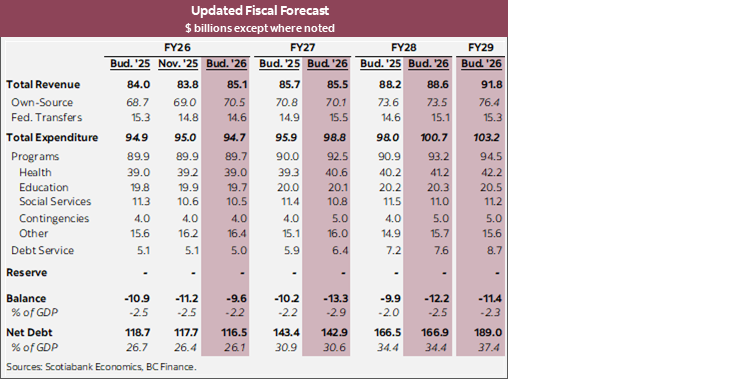
- Budget balance: -$9.6 bn (-2.2% of nominal GDP) in FY26, growing to -$13.3 bn (-2.9%) in FY27, before declining thereafter over the outlook to -$11.4 bn (-2.3%) in FY29 (chart 1).
- Economic assumptions: real GDP growth is assumed to slow from an estimated 1.5% in 2025 to 1.3% in 2026 before picking up to 1.8% in 2027.
- Net debt: projected to increase from $116.5 bn (26.1% of nominal GDP) in FY26 to $189.0 bn (37.4%) in FY29 (chart 2).
- Borrowing requirements: new borrowing of $31.5 bn in FY26, $34.9 bn in FY27, $35.0 bn in FY28, and $30.3 bn in FY29.

OUR TAKE
British Columbia’s Budget 2026 presents a budget balance that falls further into the red for the upcoming fiscal year as revenue growth is expected to slow amid still-strong spending measures. The budget balance is then forecast to marginally improve over the ensuing years, which will require fiscal restraint to ensure planned increases in spending do not outpace growth in revenue. The deficit for the current fiscal year 2025–26 (FY26) ending March 31st is estimated to be $9.6 bn (-2.2% of nominal GDP), then rising to $13.3 bn (-2.9%) in the upcoming fiscal year (FY27). The deficit is then projected to decline to $12.2 bn (-2.5%) in FY28 and $11.4 bn (-2.3%) in FY29 as spending growth moderates and revenues increase owing to greater economic activity and new tax measures.
The province’s revenue growth is projected to moderate in the upcoming fiscal year before rising over the outlook amid improving economic activity and revenue generated from new tax measures. Total revenue is expected to increase 0.5% to $85.5 bn in FY27, up from $85.1 bn in FY26, as revenue from the tobacco settlement is reflected as a one-time payment in FY26, offset by higher federal transfers. Provincial own-source revenue is projected to increase 4.9% in FY28 and 4.0% in FY29 as changes to tax measures are expected to generate $4.2 bn in additional revenue over FY27–FY29. Notable updates that will contribute to this higher revenue over the three-year period include an increase in the lowest personal income tax (PIT) rate from 5.06% to 5.60% (+$1.48 bn), a freeze in PIT brackets and non-refundable credits for 2027 through 2030 (+$0.96 bn), and expand the provincial sales tax to certain professional services (+$1.36 bn).
An improvement in economic activity also supports some of the rise in revenue over the outer years of the budget. Real GDP growth is expected to slow to 1.3% in 2026, down from an estimated 1.5% in 2025, before increasing 1.8% in 2027 and around 2% per year thereafter. Nominal GDP growth is expected to pick up from an estimated 4.1% in 2025 to 4.4% in 2026 before growing around 4.2% per year thereafter. The Budget also assumes the provincial population will contract 0.9% in 2026 as the federal government reigns in immigration, before normalizing in 2028, and that soft housing activity will improve in 2027 onwards. The economic outlook underpinning the budget includes all tariff and support measures announced and enacted as of January 12th, 2026.
Budget 2026 adds further spending to the outlook while incorporating some of the cost saving measures that resulted from the Expenditure and Management Review initiated a year ago. The Budget adds $5.6 bn in new spending over FY27 and FY28 compared to Budget 2025, of which $0.8 bn is directed towards higher debt servicing costs while the other $4.8 bn is directed towards program spending. Total expenditure is planned to increase 4.4% to $98.8 bn in FY27. In order to limit further deteriorations in the bottom line, growth in total spending is planned to moderate in the outer years, rising 1.9% to $100.7 bn in FY28 and 2.4% to $103.2 bn in FY29. The expenditure management efficiency review is estimated to result in $6.36 bn in savings across FY27–FY29 through streamlined program delivery and workforce reduction of 15,000 public sector jobs, which is 3.4% of the public sector workforce, and includes 2,500 full-time equivalents in the BC Public Service by the end of FY29. The Budget also includes $5.0 bn in contingencies each year from FY27 onwards, up from $4.0 bn, which offers some buffer room that could see improvements in the budget balance should the province not use the full contingency amounts.
The projected net debt path has remained virtually unchanged since Budget 2025. While the projected deficits for future years have increased, the final figure for FY25 ended up better than projected in last year’s budget, and the number for FY26 appears on track to be smaller as well. The smaller deficits have offset the larger deficits such that the new projected net debt burden FY27 (30.6% of GDP) is less than was projected in Budget 2025, and the figure for FY28 (34.4%) is the same. Net debt is projected to increase to 37.4% in FY29 (which appears in the forecast horizon for this first time in Budget 2026). While BC remains on track to significantly increase its indebtedness compared to the 15% in FY23, it is positive that the government appears committed to ensure that the projected debt path does not get even steeper. In addition, the significant contingency buffers built into the fiscal framework could help the government continue its recent track record of beating their deficit and debt projections.
BC’s borrowing program will pick up in the near-term given higher planned deficits and strong capital spending. New borrowing requirements are estimated to rise from $31.5 bn in FY26 to around $35 bn in FY27 and FY28—slightly higher than what was expected in Budget 2025. Borrowing is set to fall back to around $30 bn in FY29, driven by the lower budget deficit and less capital spending.
DISCLAIMER
This report has been prepared by Scotiabank Economics as a resource for the clients of Scotiabank. Opinions, estimates and projections contained herein are our own as of the date hereof and are subject to change without notice. The information and opinions contained herein have been compiled or arrived at from sources believed reliable but no representation or warranty, express or implied, is made as to their accuracy or completeness. Neither Scotiabank nor any of its officers, directors, partners, employees or affiliates accepts any liability whatsoever for any direct or consequential loss arising from any use of this report or its contents.
These reports are provided to you for informational purposes only. This report is not, and is not constructed as, an offer to sell or solicitation of any offer to buy any financial instrument, nor shall this report be construed as an opinion as to whether you should enter into any swap or trading strategy involving a swap or any other transaction. The information contained in this report is not intended to be, and does not constitute, a recommendation of a swap or trading strategy involving a swap within the meaning of U.S. Commodity Futures Trading Commission Regulation 23.434 and Appendix A thereto. This material is not intended to be individually tailored to your needs or characteristics and should not be viewed as a “call to action” or suggestion that you enter into a swap or trading strategy involving a swap or any other transaction. Scotiabank may engage in transactions in a manner inconsistent with the views discussed this report and may have positions, or be in the process of acquiring or disposing of positions, referred to in this report.
Scotiabank, its affiliates and any of their respective officers, directors and employees may from time to time take positions in currencies, act as managers, co-managers or underwriters of a public offering or act as principals or agents, deal in, own or act as market makers or advisors, brokers or commercial and/or investment bankers in relation to securities or related derivatives. As a result of these actions, Scotiabank may receive remuneration. All Scotiabank products and services are subject to the terms of applicable agreements and local regulations. Officers, directors and employees of Scotiabank and its affiliates may serve as directors of corporations.
Any securities discussed in this report may not be suitable for all investors. Scotiabank recommends that investors independently evaluate any issuer and security discussed in this report, and consult with any advisors they deem necessary prior to making any investment.
This report and all information, opinions and conclusions contained in it are protected by copyright. This information may not be reproduced without the prior express written consent of Scotiabank.
™ Trademark of The Bank of Nova Scotia. Used under license, where applicable.
Scotiabank, together with “Global Banking and Markets”, is a marketing name for the global corporate and investment banking and capital markets businesses of The Bank of Nova Scotia and certain of its affiliates in the countries where they operate, including; Scotiabank Europe plc; Scotiabank (Ireland) Designated Activity Company; Scotiabank Inverlat S.A., Institución de Banca Múltiple, Grupo Financiero Scotiabank Inverlat, Scotia Inverlat Casa de Bolsa, S.A. de C.V., Grupo Financiero Scotiabank Inverlat, Scotia Inverlat Derivados S.A. de C.V. – all members of the Scotiabank group and authorized users of the Scotiabank mark. The Bank of Nova Scotia is incorporated in Canada with limited liability and is authorised and regulated by the Office of the Superintendent of Financial Institutions Canada. The Bank of Nova Scotia is authorized by the UK Prudential Regulation Authority and is subject to regulation by the UK Financial Conduct Authority and limited regulation by the UK Prudential Regulation Authority. Details about the extent of The Bank of Nova Scotia's regulation by the UK Prudential Regulation Authority are available from us on request. Scotiabank Europe plc is authorized by the UK Prudential Regulation Authority and regulated by the UK Financial Conduct Authority and the UK Prudential Regulation Authority.
Scotiabank Inverlat, S.A., Scotia Inverlat Casa de Bolsa, S.A. de C.V, Grupo Financiero Scotiabank Inverlat, and Scotia Inverlat Derivados, S.A. de C.V., are each authorized and regulated by the Mexican financial authorities.
Not all products and services are offered in all jurisdictions. Services described are available in jurisdictions where permitted by law.