

- The Bank of Canada’s Gravelle spoke last week on the topic of CORRA, the key benchmark for Canadian repo rates. This tucked-away corner of the market is a fundamental part of the financial system.
- Since 2023, CORRA has been deviating from the BoC’s target rate, often by over 5bps. This has taken place alongside consistent volatility in CORRA. A persistent rise in CORRA creates concerns of both stress in the repo market and implementation of monetary policy.
- One popular explanation attributes pressure on CORRA to an excess demand for repo borrowing. The BoC has taken a number of actions to increase the supply of funds in the repo market. Despite this, CORRA has remained high.
- There may be little relief CORRA over the near-term, since its dislocations from target may be caused by longer-term underlying factors.
Last week, the Bank of Canada’s Deputy Governor Gravelle gave a speech about the repo market and its reference rate, CORRA. Despite its critical importance to the financial system, the repo market remains an arcane topic, and we’re rarely treated to a full speech on the finer points of repo market liquidity. In this explainer, we’ll discuss what CORRA is, why it’s currently a topic of concern, and what that all means going forward.
Repo markets form the backbone of both short-term lending markets and central bank policy implementation. Repos are short-term loans, often overnight, collateralized by high-quality securities like Government of Canada bonds. Because of their high-quality collateral, repo markets are highly liquid and take place at low rates compared to other forms of lending. The result is that repo markets act as both a key source of funds and a barometer for the current state of financial markets. When repo markets face liquidity stress, that stress often spills into nearby markets quickly.
The Canadian Overnight Repo Rate Average, usually referred to as CORRA, is the key repo benchmark in Canada. At its most basic level, CORRA measures the average cost of overnight repo funding in Canada and can act as a gauge of repo market liquidity and funding availability. When CORRA volumes are high and CORRA sets close to the BoC’s target rate, repo market liquidity is relatively strong. If volumes decline and CORRA begins to rise, this can be a sign of market stress.
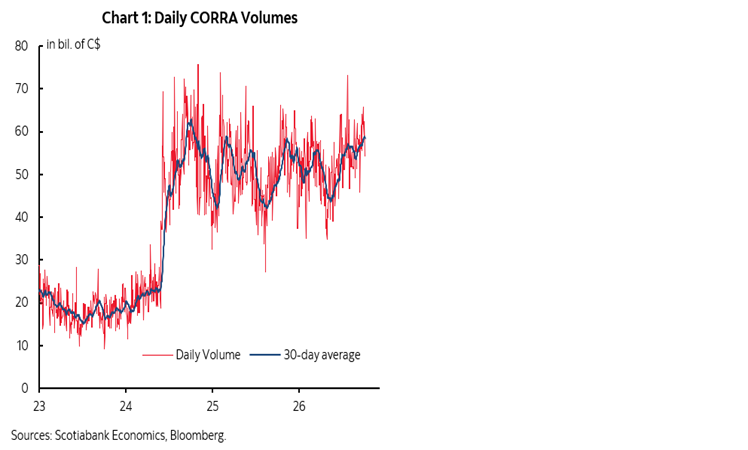
Since a change in repo-market settlement procedures in 2024, CORRA now covers an average daily volume of near $60 billion (chart 1).1 This represents just under half of the BoC estimate of total daily Canadian repo volume ($130 billion).2
Since it acts as a benchmark rate for short-term funding, CORRA’s importance goes well beyond repo markets.3 Ultimately, it acts as the underlying rate for a large swath of derivatives contracts and variable rate lending. As of August 2026, the Ontario Securities Commission estimates that derivatives referencing CORRA have an outstanding notation value of $30.23 trillion, with the vast majority being fixed-float swap contracts.4 These are contracts in which one party receives the floating rate (CORRA) while the other receives a fixed rate. The size of this market is important, because a small spread in CORRA away from the target rate flows through into the large derivatives space.
When CORRA changes, so does the value of these derivatives. A common measure of derivatives’ sensitivity to interest rates is DV01, the change in the derivative’s dollar value per 1bp of underlying interest rate change. To provide a sense of scale, the most recent report from the OSC estimated the absolute DV01 of CORRA fixed-float swaps in 2025 was $4.96B. Some of this value will be offset and netted out by other positions, so the true change in market values will be smaller. However, to put it plainly, a small change in CORRA can have a large impact.
WHAT’S THE CONUNDRUM WITH CORRA?
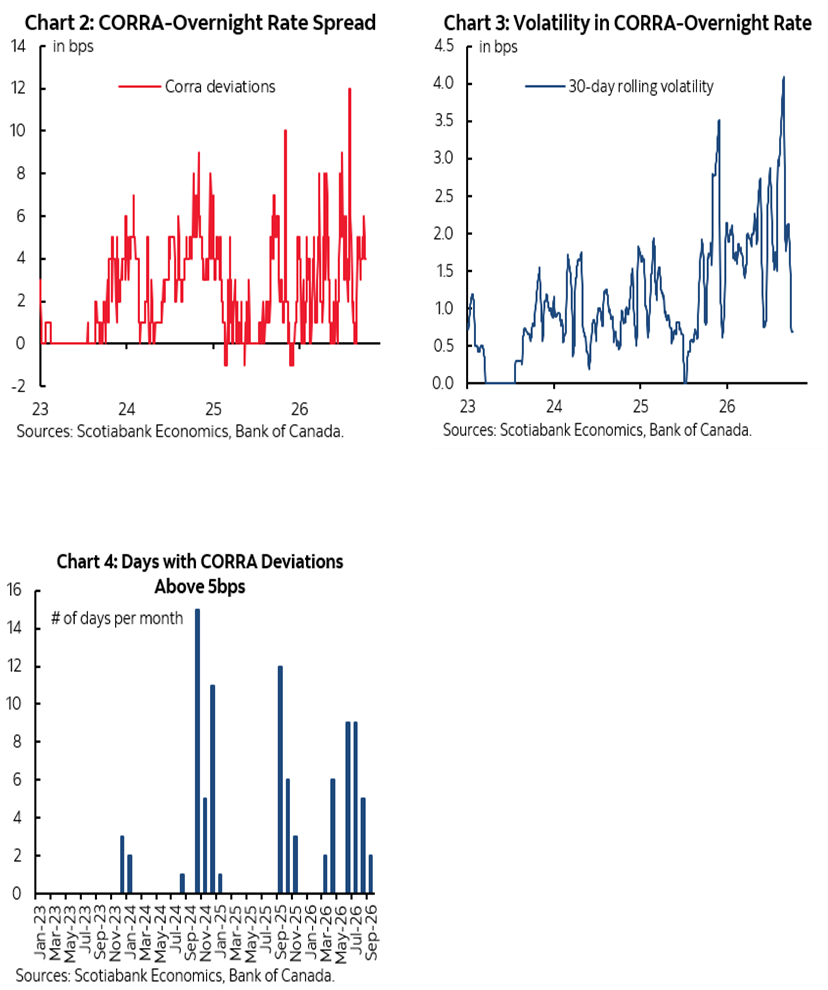
CORRA has begun consistently deviating above the BoC’s target rate. Since the middle of 2023, CORRA has regularly set between 0bps and 5bps above the target rate (chart 2), and the volatility of that spread has increased markedly (chart 3). If we focus on the worst days, where CORRA sets at least 5 bps (1/5 of a hike) above the target rate, we’re off the peak volatility of late 2024, but are still not out of the woods (chart 4).
Because of CORRA’s role as both a barometer of repo market conditions and as the underlying rate for other financial products, a large and persistent spread between CORRA and target can be an issue on multiple fronts. It’s easy to see why the central bank may want to track down the underlying cause.
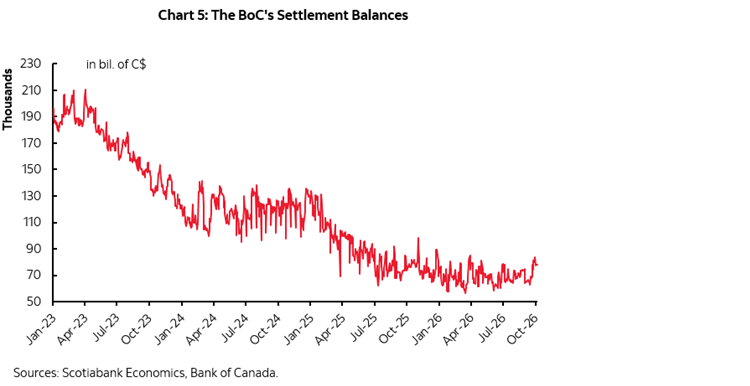
One popular explanation for CORRA’s persistent deviations is an imbalance in supply and demand. Under this explanation, as central banks have wound down their balance sheets post-COVID, the supply of funds available to lend has also decreased. Supporting this idea, increases in CORRA volatility occurred at the same time as the reduction in BoC settlement balances from well over $300 billion at their peak during the COVID-19 pandemic, to around $80 billion today (chart 5).
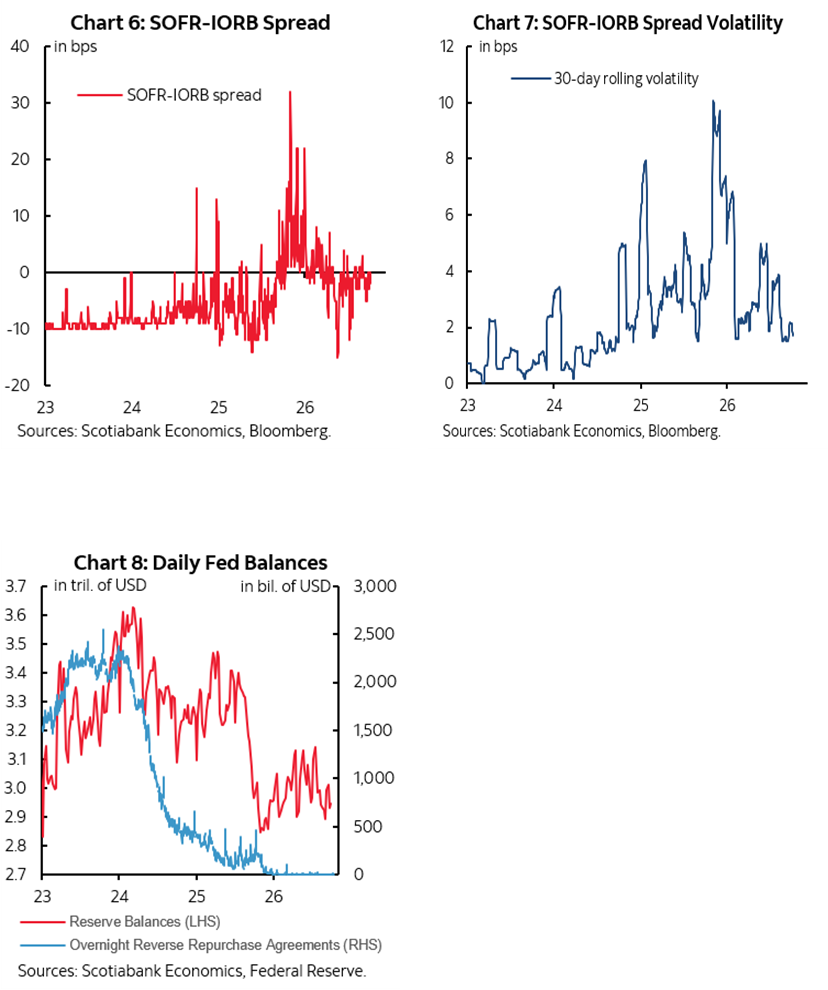
While our focus is on the Canadian marketplace, this is far from a uniquely Canadian issue. The U.S.’s secured funding benchmark, SOFR, had seen the same issue. The SOFR-IORB spread, that the difference between SOFR and the rate that the Fed pays on reserve balances though it has recently come off its peaks (chart 6), however, its volatility remains higher than in the past (chart 7). As in Canada, this happened alongside the decline in reserve-like assets held at the Fed (chart 8). There are some important differences between the Canadian and U.S. markets, such as the size of money-market mutual funds, the degree of central clearing and the presence of the Fed’s Overnight Reverse Repurchase Agreement (ON RRP) Operations, but the underlying story remains similar.
The explanation of excess demand for repo lending is appealing. The mechanism makes economic sense and the solution is relatively straightforward. If the quantity of central bank reserves in the system is too low, increasing them should alleviate the pressure on repo markets. Unfortunately, as with many straightforward explanations, it may not be telling the full picture.
NEW PRESCRIPTIONS
Gravelle pointed to a range of actions: reducing the BoC’s Deposit Rate by 5bps, upcoming improvements in repo market infrastructure and an increase in the BoC’s term repo operations. Together, these suggest a joint effort to both increase the supply of funds available in the repo market and to increase the efficiency of deploying those funds. These are exactly the sort of actions that would help if the problem was a shortage of lendable funds.
In the near-term, the most interesting of these may be the increase in term repo operations. In a broad sense, central bank term repo operations increase the amount of cash available in the financial system to be lent out, which should reduce pressure on funding rates. Compared to an overnight repo, a term repo provides additional stability and certainty, since the rollover period is much longer.
Beginning in October 2025, the BoC added 14-day term repos to their toolkit (chart 9). These have increased the volume of their term repo lending substantially compared to early 2025 and by our estimations, now represent a majority of the BoC’s outstanding term repo operations. There seems to be a preference for these shorter-term 14-day operations compared to their longer 1-month and 3-month terms. This could be giving them more operational flexibility to smooth out short-term bumps.
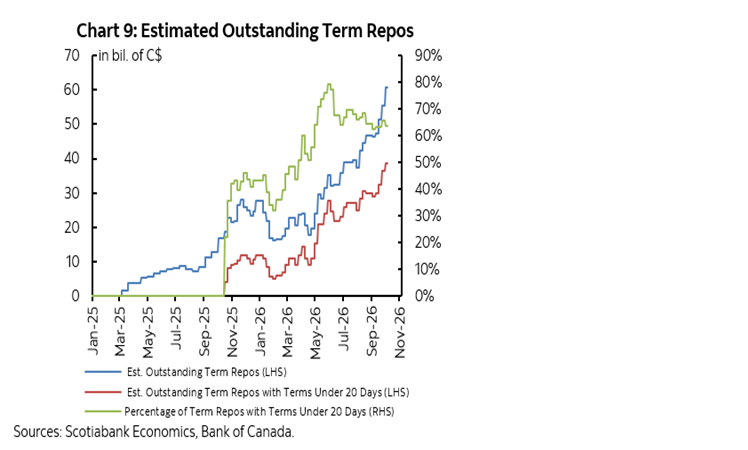
One interesting thing to watch will be how this increase in term repos interacts with the path for settlement balances going forward. The recent increase in term repos has moved them back above the BoC’s previously communicated $50B–$70B optimal range. If they maintain a preference for smoothing out repo market frictions, settlement balances may remain on the higher end if term repos continue to increase.
Despite their best efforts, upward pressure in CORRA seems to be frustratingly sticky. Given their measures to increase the supply of repo liquidity, this suggests that the problem may be something more than just an excess demand for repo lending. Deeper frictions in the repo market could be tougher for them to solve and require longer-term market infrastructure solutions.
Gravelle highlighted the introduction of tri-party repo trading in Canada and improvements to central clearing infrastructure, as measures which could improve repo market resilience. These measures could improve lending capacity, smooth over frictions on collateral use and improve counterparty credit risk management but will likely take time to both implement and attract volume.
BOTTOM LINE
What’s the outlook? On the positive side, CORRA is having fewer days with deviations above 5bps than it was at the end of 2024. It’s certainly possible that the combination of BoC actions is putting a ceiling on wider spreads from target. On the downside, barring a further change in their policy stance or a change in the demand for repo borrowing, it’s hard to see reason for the current situation to change over the near-term.
One unknown factor is how the repo market handles a hiking cycle. Yields have been rising and our current forecast calls for 3 hikes by the end of 2027. Persistently higher rates could put a damper on the demand for repo funding. If the underlying cause of CORRA’s trouble is truly an excess demand for funds, a hiking cycle could move the market back into balance. This could be worth keeping an eye on over the coming months.
1 In 2024, the Canadian repo market moved from T+2 to T+1 settlement. This increased the volume of repos captured by CORRA and is responsible for the large jump in chart 1.
2 The BoC last reported this in its spring 2026 Financial Stability Report: https://www.bankofcanada.ca/publications/financial-stability-report/financial-stability-report-2026/a-resilient-repo-market-is-important-for-financial-stability/
3 CORRA actually replaced an earlier benchmark rate called CDOR as part of a broader financial benchmark modernization effort.
4 The OSC releases its CORRA derivatives tracking on a monthly basis: https://www.osc.ca/en/industry/derivatives/corraterm-corra-based-otc-derivatives-trend-analysis
DISCLAIMER
This report has been prepared by Scotiabank Economics as a resource for the clients of Scotiabank. Opinions, estimates and projections contained herein are our own as of the date hereof and are subject to change without notice. The information and opinions contained herein have been compiled or arrived at from sources believed reliable but no representation or warranty, express or implied, is made as to their accuracy or completeness. Neither Scotiabank nor any of its officers, directors, partners, employees or affiliates accepts any liability whatsoever for any direct or consequential loss arising from any use of this report or its contents.
These reports are provided to you for informational purposes only. This report is not, and is not constructed as, an offer to sell or solicitation of any offer to buy any financial instrument, nor shall this report be construed as an opinion as to whether you should enter into any swap or trading strategy involving a swap or any other transaction. The information contained in this report is not intended to be, and does not constitute, a recommendation of a swap or trading strategy involving a swap within the meaning of U.S. Commodity Futures Trading Commission Regulation 23.434 and Appendix A thereto. This material is not intended to be individually tailored to your needs or characteristics and should not be viewed as a “call to action” or suggestion that you enter into a swap or trading strategy involving a swap or any other transaction. Scotiabank may engage in transactions in a manner inconsistent with the views discussed this report and may have positions, or be in the process of acquiring or disposing of positions, referred to in this report.
Scotiabank, its affiliates and any of their respective officers, directors and employees may from time to time take positions in currencies, act as managers, co-managers or underwriters of a public offering or act as principals or agents, deal in, own or act as market makers or advisors, brokers or commercial and/or investment bankers in relation to securities or related derivatives. As a result of these actions, Scotiabank may receive remuneration. All Scotiabank products and services are subject to the terms of applicable agreements and local regulations. Officers, directors and employees of Scotiabank and its affiliates may serve as directors of corporations.
Any securities discussed in this report may not be suitable for all investors. Scotiabank recommends that investors independently evaluate any issuer and security discussed in this report, and consult with any advisors they deem necessary prior to making any investment.
This report and all information, opinions and conclusions contained in it are protected by copyright. This information may not be reproduced without the prior express written consent of Scotiabank.
™ Trademark of The Bank of Nova Scotia. Used under license, where applicable.
Scotiabank, together with “Global Banking and Markets”, is a marketing name for the global corporate and investment banking and capital markets businesses of The Bank of Nova Scotia and certain of its affiliates in the countries where they operate, including; Scotiabank Europe plc; Scotiabank (Ireland) Designated Activity Company; Scotiabank Inverlat S.A., Institución de Banca Múltiple, Grupo Financiero Scotiabank Inverlat, Scotia Inverlat Casa de Bolsa, S.A. de C.V., Grupo Financiero Scotiabank Inverlat, Scotia Inverlat Derivados S.A. de C.V. – all members of the Scotiabank group and authorized users of the Scotiabank mark. The Bank of Nova Scotia is incorporated in Canada with limited liability and is authorised and regulated by the Office of the Superintendent of Financial Institutions Canada. The Bank of Nova Scotia is authorized by the UK Prudential Regulation Authority and is subject to regulation by the UK Financial Conduct Authority and limited regulation by the UK Prudential Regulation Authority. Details about the extent of The Bank of Nova Scotia's regulation by the UK Prudential Regulation Authority are available from us on request. Scotiabank Europe plc is authorized by the UK Prudential Regulation Authority and regulated by the UK Financial Conduct Authority and the UK Prudential Regulation Authority.
Scotiabank Inverlat, S.A., Scotia Inverlat Casa de Bolsa, S.A. de C.V, Grupo Financiero Scotiabank Inverlat, and Scotia Inverlat Derivados, S.A. de C.V., are each authorized and regulated by the Mexican financial authorities.
Not all products and services are offered in all jurisdictions. Services described are available in jurisdictions where permitted by law.