

- Mexico: GDP growth accelerates in Q3 2026
- Peru: Record September cement sales strengthen the 2026 growth outlook
MEXICO: GDP GROWTH ACCELERATES IN Q3 2026
According to INEGI, Mexico’s preliminary GDP estimate for the third quarter of 2026 points to a sharp acceleration in economic activity (chart 1), with growth of 3.2% year over year on an unadjusted basis—the strongest rate since Q3-23—after 2.2% growth in Q2-26 and a seasonally adjusted quarterly increase of 0.9%, slowing from 1.5% q/q.
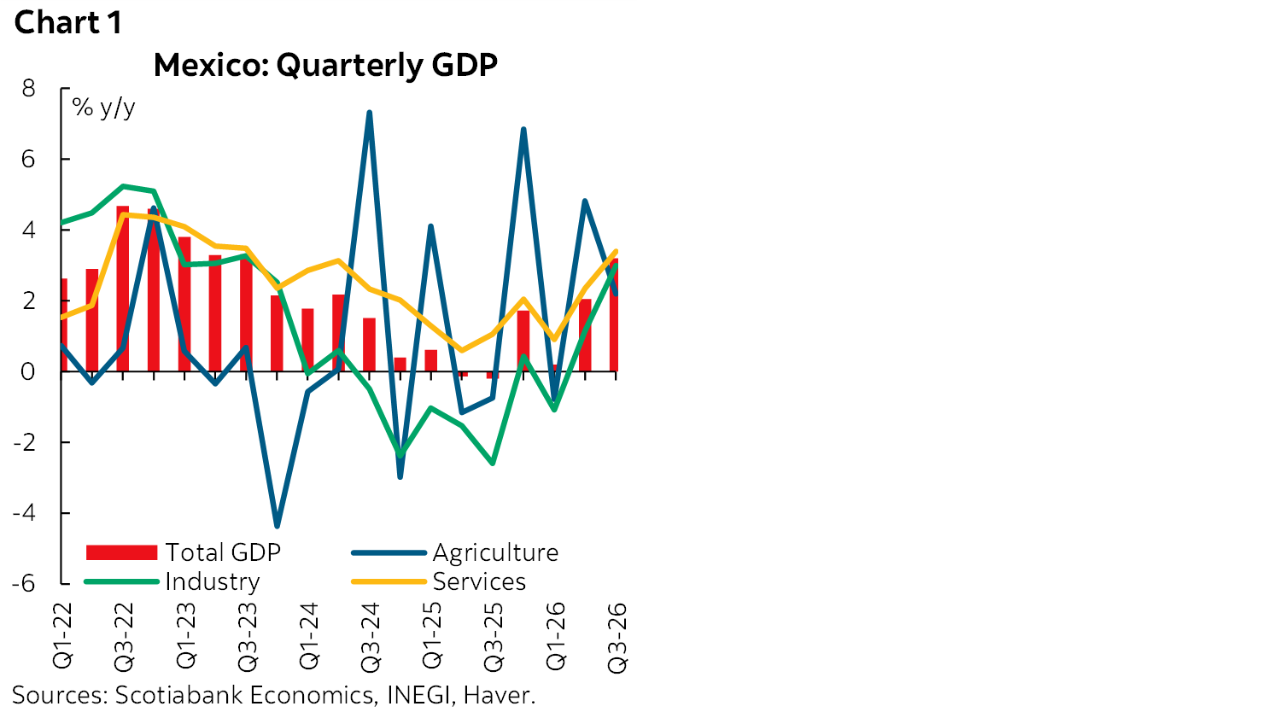
Growth was broad-based across sectors: primary activities expanded by 2.2% year over year, despite a slight quarterly decline of 0.4%; secondary activities grew by 3.0% year over year and 0.8% quarter over quarter; and tertiary activities increased by 3.4% year over year and 1.1% quarter over quarter. Secondary and tertiary activities also posted their strongest annual growth rates since Q3-23.
As a result, the economy expanded by 1.8% in the first nine months of 2026 compared with the same period in 2025, suggesting a recovery from the weakness observed throughout 2025 and early 2026, driven primarily by services and a rebound in industrial activity.
—Rodolfo Mitchell, Miguel Saldaña & Martha Cordova
PERU: RECORD SEPTEMBER CEMENT SALES STRENGTHEN THE 2026 GROWTH OUTLOOK
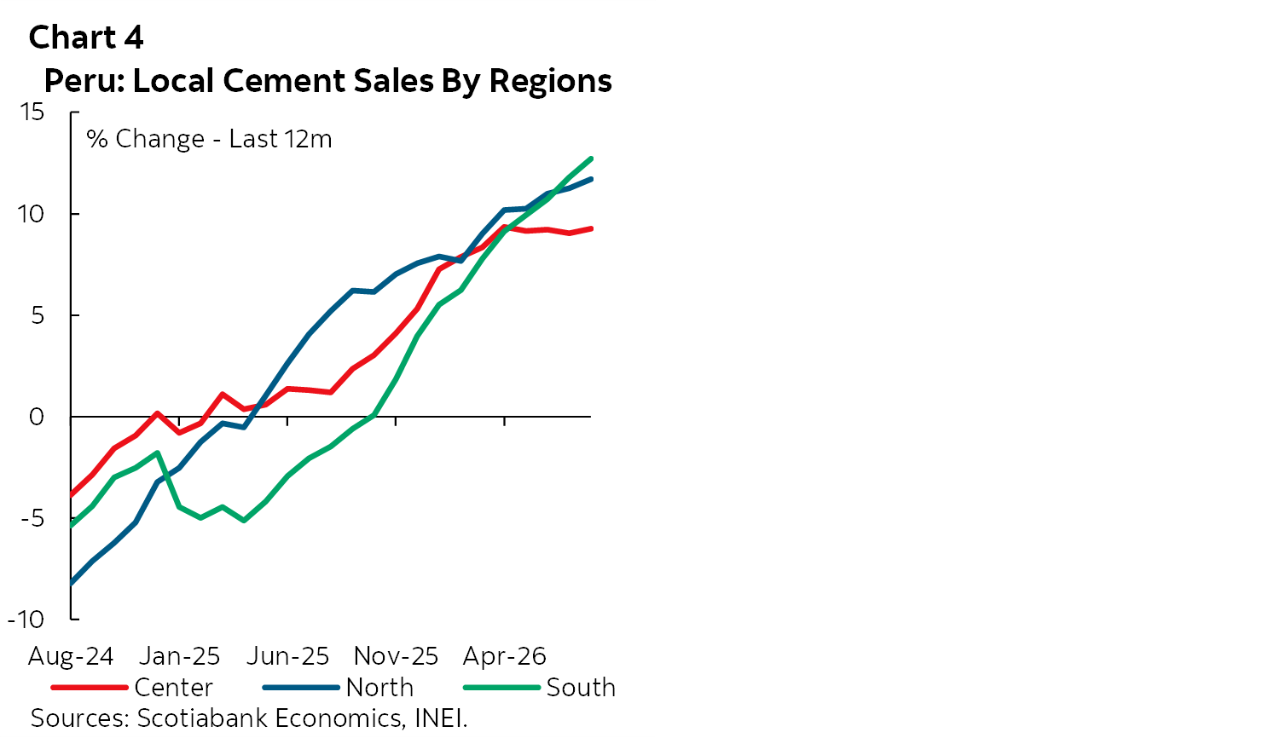
September marked a new milestone for Peru’s cement market. Sales reached nearly 1.3 million metric tonnes, up just over 11% y/y, according to the Peruvian Cement Producers Association (ASOCEM). This was not only the strongest monthly volume of 2026, but also an all-time high (chart 2). The result extended an uninterrupted run of y/y growth since April 2025, with double-digit gains recorded since June 2026 (chart 3). Three factors underpinned September’s performance. First, self-construction housing activity benefited from sustained growth in formal private-sector employment, which rose 6.6% y/y in August, adding 296,000 jobs, according to BCRP. Second, momentum in the formal residential property market remained strong, with new mortgage lending by the banking system increasing 20% y/y in August, according to SBS. Third, cement prices remained relatively stable, particularly in Lima, where the price per bag increased from PEN 30.4 in December to PEN 31.2 in September, according to the National Institute of Statistics and Informatics (INEI). Public investment, however, offered little additional support, remaining broadly unchanged from a year earlier, as declines at the national and regional government levels offset higher investment by local governments.
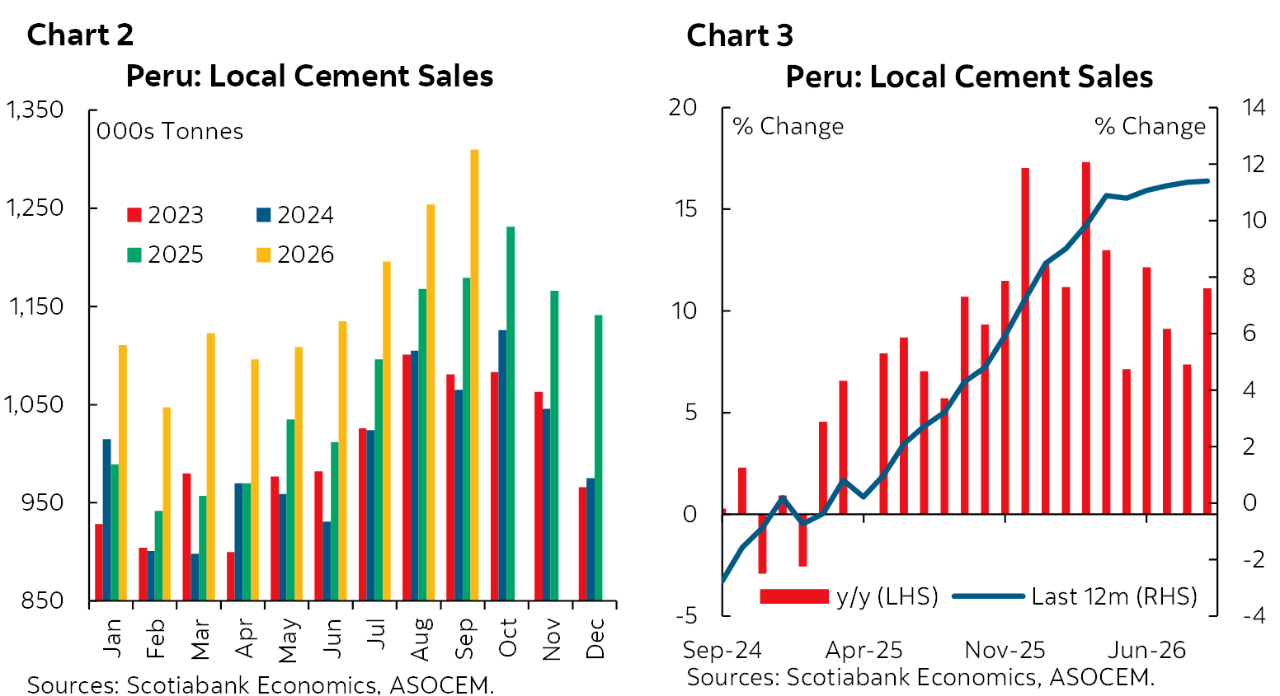
The September result lifted cement consumption to nearly 10.4 million metric tonnes in January–September, up 11% y/y, supported by broadly the same demand drivers. Regional sales data through August show that the recovery is broad-based (chart 4). Southern Peru led growth at 14%, supported by mining investment. The north followed at 13%, benefiting from owner-built housing, road construction and mining projects, while sales in central Peru rose 8%, supported by residential development, particularly in Lima, and transport infrastructure projects such as Lima Metro Line 2.
2026 Outlook
With nine months of data in hand, we now see upside risk to our 2026 construction sector growth forecast of 9.3%. Self-construction should remain a key driver, supported by solid formal private-sector employment and improving household incomes, as well as preventive works ahead of El Niño. Formal housing construction should provide additional support, as mortgage rates remain below levels seen in previous years. Home sales in Lima rose 26% y/y in January–September, according to the Confederation of Real Estate Developers of Peru (CODIP). Demand also benefits from major infrastructure projects executed under public-private partnership concessions and Peru’s Works for Taxes framework. The latter investment mechanism is expected to post a record value of project awards by year-end.
The outlook is not without constraints. Slower public investment growth, particularly at the national government level as the new administration moves up the learning curve, is likely to temper full-year demand. Adverse weather associated with El Niño remains a downside risk, especially in November–December, as it can halt construction work and erode household spending capacity. Relative geopolitical stability in the Strait of Hormuz is another important assumption. Renewed hostilities could increase oil-price volatility and intensify inflationary pressures on food and, especially, fuel, constraining household budgets for labour and building materials in the owner-built housing segment.
Beyond the near-term cycle, the sector’s medium-term growth potential remains compelling. According to the Ministry of Economy and Finance, the government aims for investment promotion agency ProInversión to award US$35 billion in projects over 2026–2030. This prospective pipeline may have helped attract international cement producers Holcim and Heidelberg Materials. Holcim completed the acquisition of an indirect majority stake in Cementos Pacasmayo in mid-March, strengthening its presence in Peru’s cement market. Germany’s Heidelberg Materials followed with the acquisition of a 70% stake in Cementos Inka in mid-October 2026.
—Carlos Asmat
DISCLAIMER
This report has been prepared by Scotiabank Economics as a resource for the clients of Scotiabank. Opinions, estimates and projections contained herein are our own as of the date hereof and are subject to change without notice. The information and opinions contained herein have been compiled or arrived at from sources believed reliable but no representation or warranty, express or implied, is made as to their accuracy or completeness. Neither Scotiabank nor any of its officers, directors, partners, employees or affiliates accepts any liability whatsoever for any direct or consequential loss arising from any use of this report or its contents.
These reports are provided to you for informational purposes only. This report is not, and is not constructed as, an offer to sell or solicitation of any offer to buy any financial instrument, nor shall this report be construed as an opinion as to whether you should enter into any swap or trading strategy involving a swap or any other transaction. The information contained in this report is not intended to be, and does not constitute, a recommendation of a swap or trading strategy involving a swap within the meaning of U.S. Commodity Futures Trading Commission Regulation 23.434 and Appendix A thereto. This material is not intended to be individually tailored to your needs or characteristics and should not be viewed as a “call to action” or suggestion that you enter into a swap or trading strategy involving a swap or any other transaction. Scotiabank may engage in transactions in a manner inconsistent with the views discussed this report and may have positions, or be in the process of acquiring or disposing of positions, referred to in this report.
Scotiabank, its affiliates and any of their respective officers, directors and employees may from time to time take positions in currencies, act as managers, co-managers or underwriters of a public offering or act as principals or agents, deal in, own or act as market makers or advisors, brokers or commercial and/or investment bankers in relation to securities or related derivatives. As a result of these actions, Scotiabank may receive remuneration. All Scotiabank products and services are subject to the terms of applicable agreements and local regulations. Officers, directors and employees of Scotiabank and its affiliates may serve as directors of corporations.
Any securities discussed in this report may not be suitable for all investors. Scotiabank recommends that investors independently evaluate any issuer and security discussed in this report, and consult with any advisors they deem necessary prior to making any investment.
This report and all information, opinions and conclusions contained in it are protected by copyright. This information may not be reproduced without the prior express written consent of Scotiabank.
™ Trademark of The Bank of Nova Scotia. Used under license, where applicable.
Scotiabank, together with “Global Banking and Markets”, is a marketing name for the global corporate and investment banking and capital markets businesses of The Bank of Nova Scotia and certain of its affiliates in the countries where they operate, including; Scotiabank Europe plc; Scotiabank (Ireland) Designated Activity Company; Scotiabank Inverlat S.A., Institución de Banca Múltiple, Grupo Financiero Scotiabank Inverlat, Scotia Inverlat Casa de Bolsa, S.A. de C.V., Grupo Financiero Scotiabank Inverlat, Scotia Inverlat Derivados S.A. de C.V. – all members of the Scotiabank group and authorized users of the Scotiabank mark. The Bank of Nova Scotia is incorporated in Canada with limited liability and is authorised and regulated by the Office of the Superintendent of Financial Institutions Canada. The Bank of Nova Scotia is authorized by the UK Prudential Regulation Authority and is subject to regulation by the UK Financial Conduct Authority and limited regulation by the UK Prudential Regulation Authority. Details about the extent of The Bank of Nova Scotia's regulation by the UK Prudential Regulation Authority are available from us on request. Scotiabank Europe plc is authorized by the UK Prudential Regulation Authority and regulated by the UK Financial Conduct Authority and the UK Prudential Regulation Authority.
Scotiabank Inverlat, S.A., Scotia Inverlat Casa de Bolsa, S.A. de C.V, Grupo Financiero Scotiabank Inverlat, and Scotia Inverlat Derivados, S.A. de C.V., are each authorized and regulated by the Mexican financial authorities.
Not all products and services are offered in all jurisdictions. Services described are available in jurisdictions where permitted by law.