

CHILE: LABOUR MARKET RECOVERY APPEARS TO HAVE BEGUN
- Bad but good data: solid private salaried job creation, although more people are looking for work
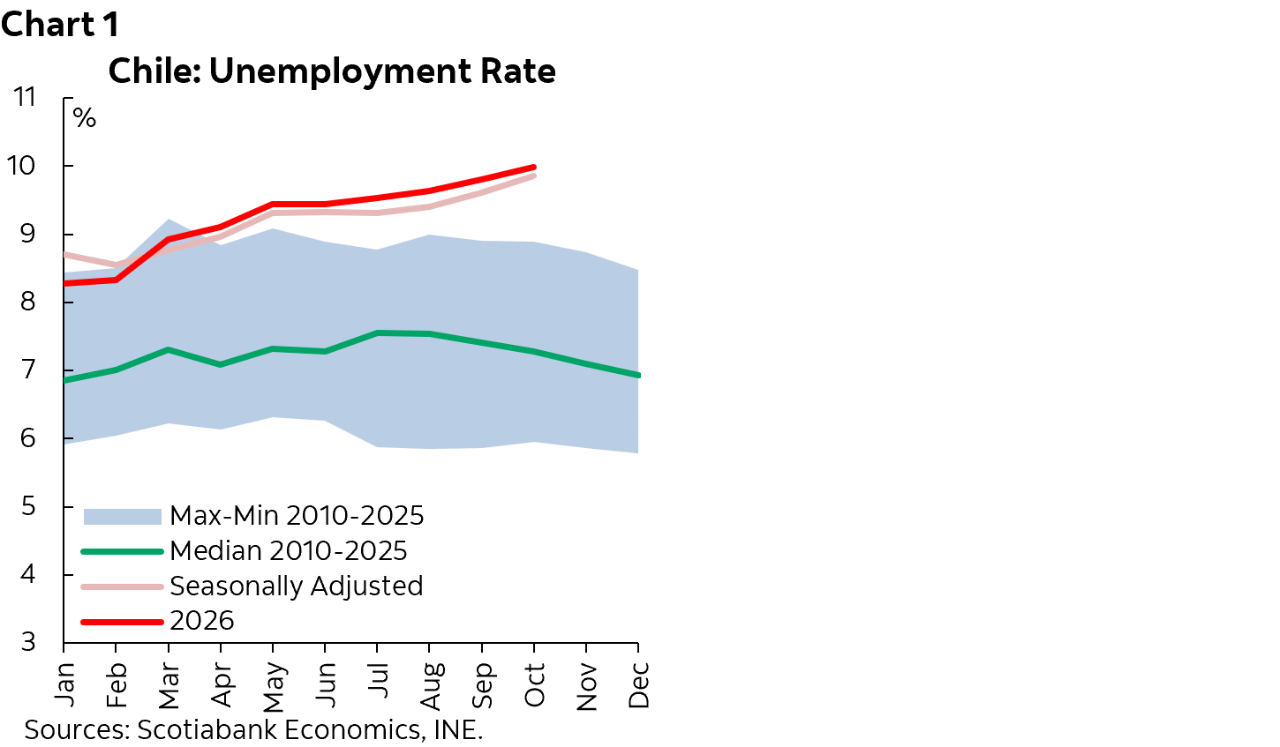
The unemployment rate rose to 10% in the rolling quarter ending in October (9.9% SA) despite solid job creation, which was overshadowed by higher labour force participation, surprising expectations of a 9.8% rate (chart 1). However, the headline unemployment rate masks the start of job creation. The unemployment rate will fall significantly in the coming months, helped by seasonality, but also by a genuine recovery in total employment, which is already visible in September and October.
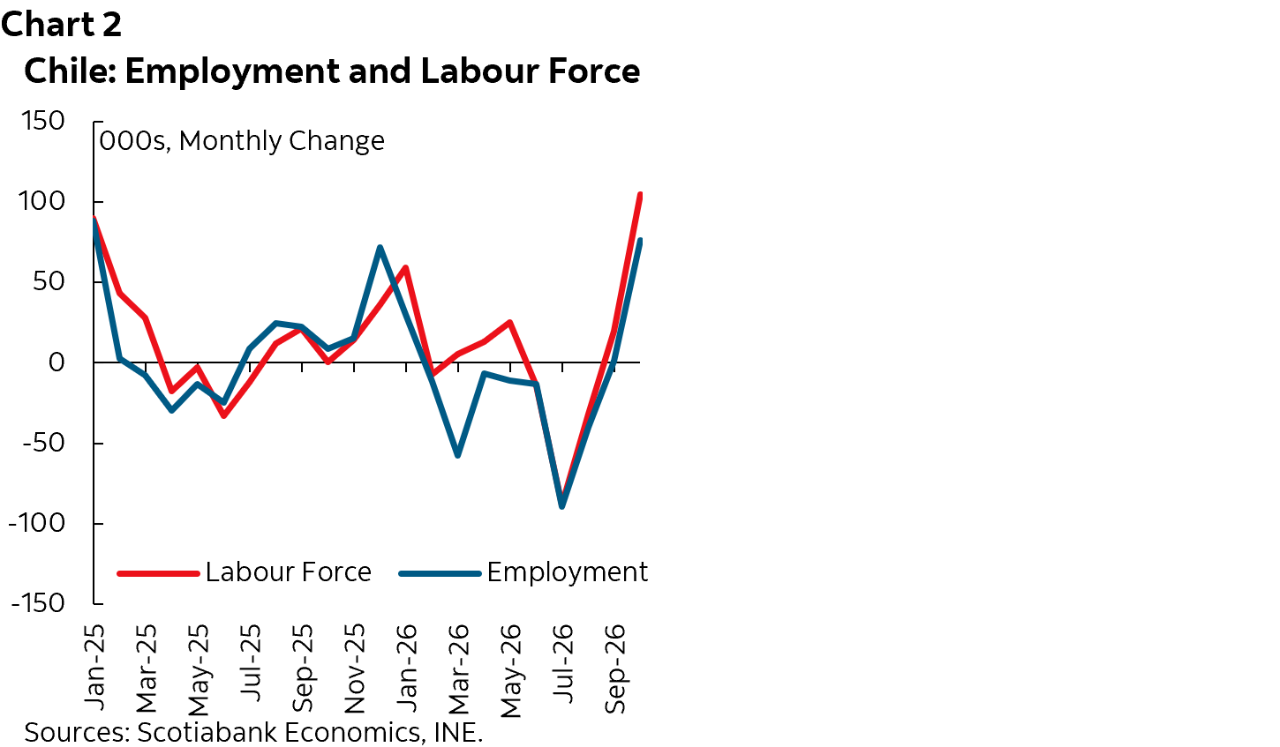
High unemployment rate, but benign employment composition. Job creation reached 76k, a record high for the month, while the labour force increased by 105k (chart 2), well above its seasonal pattern. Salaried job creation in education, transport and agriculture stands out, along with a rebound even in informal employment. In this vein, we estimate that job creation in the rolling quarter ending in November could exceed the current figure, supported by the positive figures reported by INE for September and October. The decline in the unemployment rate in the coming months could be very significant provided that the labour force does not show strong dynamism.
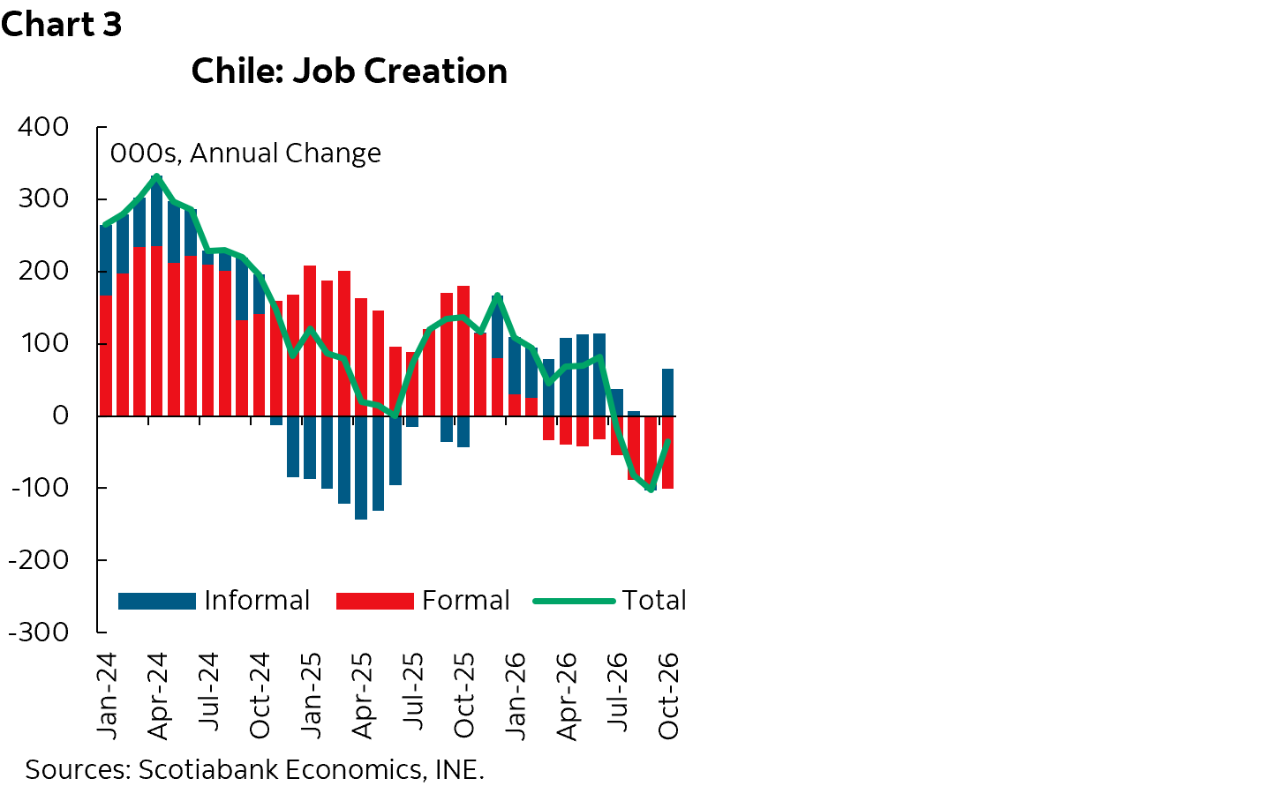
Informal job creation supports the labour market. On a y/y basis, 66k jobs were created in informal sectors and firms, which prevented the decline in total employment from deepening further in the face of persistent destruction of formal jobs (chart 3). By category, this is consistent with the creation of 107k self-employment jobs, concentrated in transport, manufacturing and education. Although informal employment and self-employment have contributed positively to annual job creation during almost the whole year, the level of employment continues to show some lag relative to the pre-pandemic historical trend.
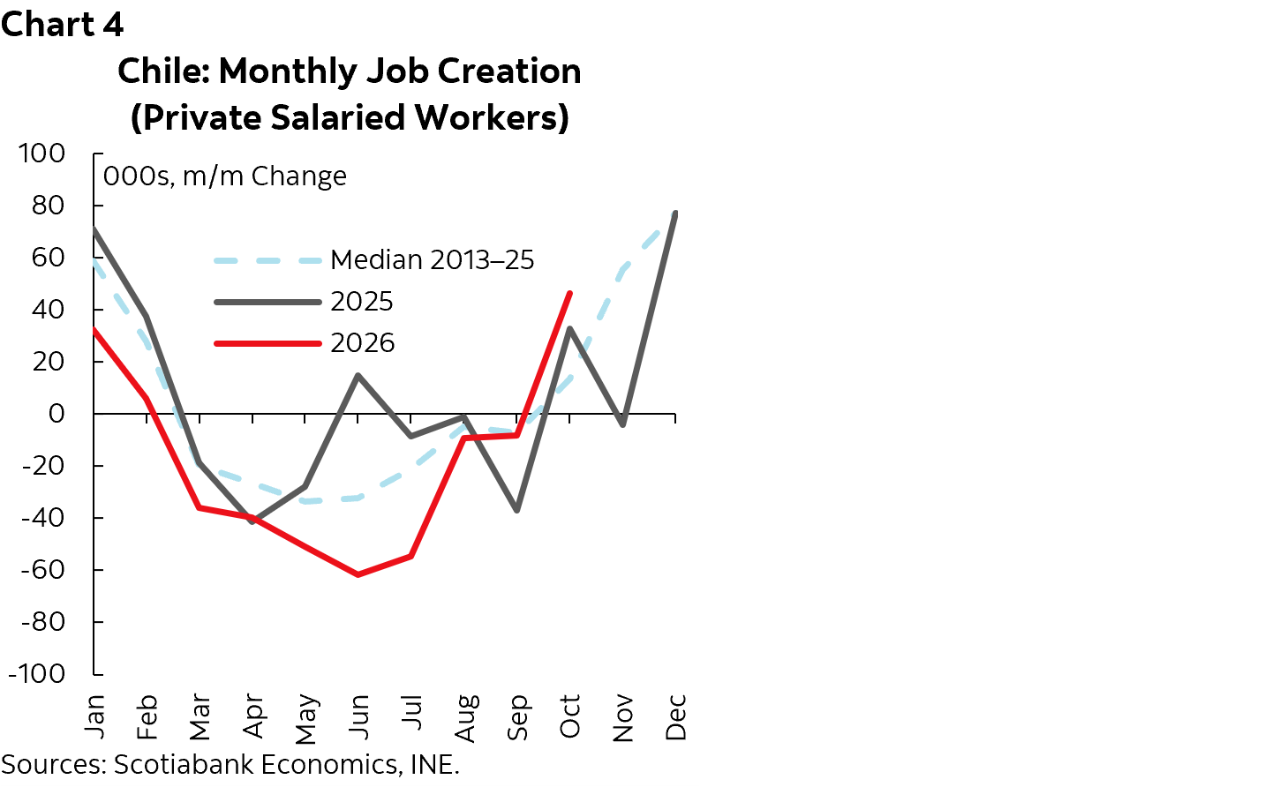
By sector, salaried job creation in education, agriculture and transport stands out, along with the recovery in manufacturing. Regarding the latter, although the month's seasonality favoured an increase in employment, the October figure is at the upper end of its historical range, after four months of employment decline in this sector (chart 4).
—Aníbal Alarcón
DISCLAIMER
This report has been prepared by Scotiabank Economics as a resource for the clients of Scotiabank. Opinions, estimates and projections contained herein are our own as of the date hereof and are subject to change without notice. The information and opinions contained herein have been compiled or arrived at from sources believed reliable but no representation or warranty, express or implied, is made as to their accuracy or completeness. Neither Scotiabank nor any of its officers, directors, partners, employees or affiliates accepts any liability whatsoever for any direct or consequential loss arising from any use of this report or its contents.
These reports are provided to you for informational purposes only. This report is not, and is not constructed as, an offer to sell or solicitation of any offer to buy any financial instrument, nor shall this report be construed as an opinion as to whether you should enter into any swap or trading strategy involving a swap or any other transaction. The information contained in this report is not intended to be, and does not constitute, a recommendation of a swap or trading strategy involving a swap within the meaning of U.S. Commodity Futures Trading Commission Regulation 23.434 and Appendix A thereto. This material is not intended to be individually tailored to your needs or characteristics and should not be viewed as a “call to action” or suggestion that you enter into a swap or trading strategy involving a swap or any other transaction. Scotiabank may engage in transactions in a manner inconsistent with the views discussed this report and may have positions, or be in the process of acquiring or disposing of positions, referred to in this report.
Scotiabank, its affiliates and any of their respective officers, directors and employees may from time to time take positions in currencies, act as managers, co-managers or underwriters of a public offering or act as principals or agents, deal in, own or act as market makers or advisors, brokers or commercial and/or investment bankers in relation to securities or related derivatives. As a result of these actions, Scotiabank may receive remuneration. All Scotiabank products and services are subject to the terms of applicable agreements and local regulations. Officers, directors and employees of Scotiabank and its affiliates may serve as directors of corporations.
Any securities discussed in this report may not be suitable for all investors. Scotiabank recommends that investors independently evaluate any issuer and security discussed in this report, and consult with any advisors they deem necessary prior to making any investment.
This report and all information, opinions and conclusions contained in it are protected by copyright. This information may not be reproduced without the prior express written consent of Scotiabank.
™ Trademark of The Bank of Nova Scotia. Used under license, where applicable.
Scotiabank, together with “Global Banking and Markets”, is a marketing name for the global corporate and investment banking and capital markets businesses of The Bank of Nova Scotia and certain of its affiliates in the countries where they operate, including; Scotiabank Europe plc; Scotiabank (Ireland) Designated Activity Company; Scotiabank Inverlat S.A., Institución de Banca Múltiple, Grupo Financiero Scotiabank Inverlat, Scotia Inverlat Casa de Bolsa, S.A. de C.V., Grupo Financiero Scotiabank Inverlat, Scotia Inverlat Derivados S.A. de C.V. – all members of the Scotiabank group and authorized users of the Scotiabank mark. The Bank of Nova Scotia is incorporated in Canada with limited liability and is authorised and regulated by the Office of the Superintendent of Financial Institutions Canada. The Bank of Nova Scotia is authorized by the UK Prudential Regulation Authority and is subject to regulation by the UK Financial Conduct Authority and limited regulation by the UK Prudential Regulation Authority. Details about the extent of The Bank of Nova Scotia's regulation by the UK Prudential Regulation Authority are available from us on request. Scotiabank Europe plc is authorized by the UK Prudential Regulation Authority and regulated by the UK Financial Conduct Authority and the UK Prudential Regulation Authority.
Scotiabank Inverlat, S.A., Scotia Inverlat Casa de Bolsa, S.A. de C.V, Grupo Financiero Scotiabank Inverlat, and Scotia Inverlat Derivados, S.A. de C.V., are each authorized and regulated by the Mexican financial authorities.
Not all products and services are offered in all jurisdictions. Services described are available in jurisdictions where permitted by law.