

- Peru: Mining investment remains robust, while production slows
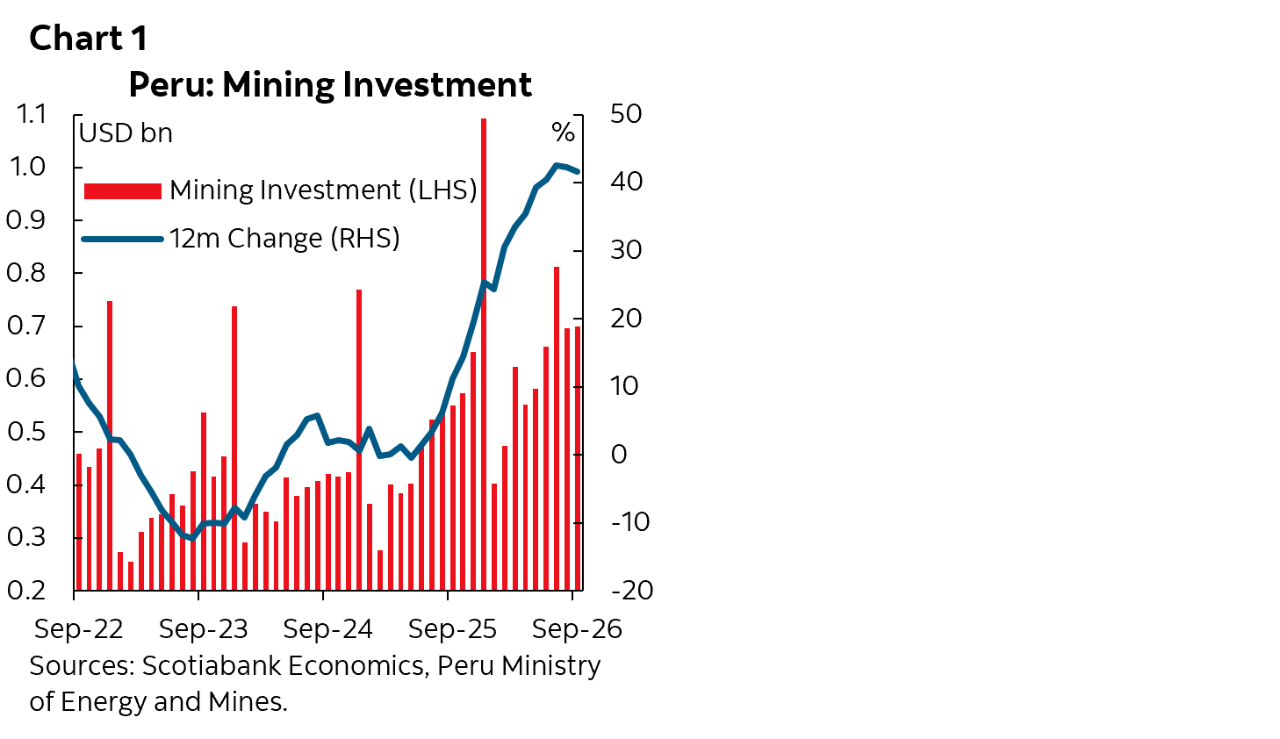
Mining investment totalled US$ 5.5 bn between January and September 2026, up 40.4% y/y from US$ 3.9 bn in the same period of 2025 (chart 1). In September, mining investment continued to be driven mainly by brownfield projects and, to a lesser extent, by new projects such as Tía María (Southern) and Romina (Chungar). Given the results through September, our forecast for a 20% increase in mining investment in 2026 now carries upside risk.
Southern Peru remained the leading investor (table 1), with US$769 mn invested between January and September (+108.7% y/y). The company continues to develop the Tía María project (US$1.8 bn). As of the end of September, the project was 49.6% complete, with US$884 mn invested since construction began. Work is currently focused on the construction and installation of processing facilities and electrical systems. The company expects operations to begin in the first half of 2028, with annual copper production of around 120 thousand tonnes.
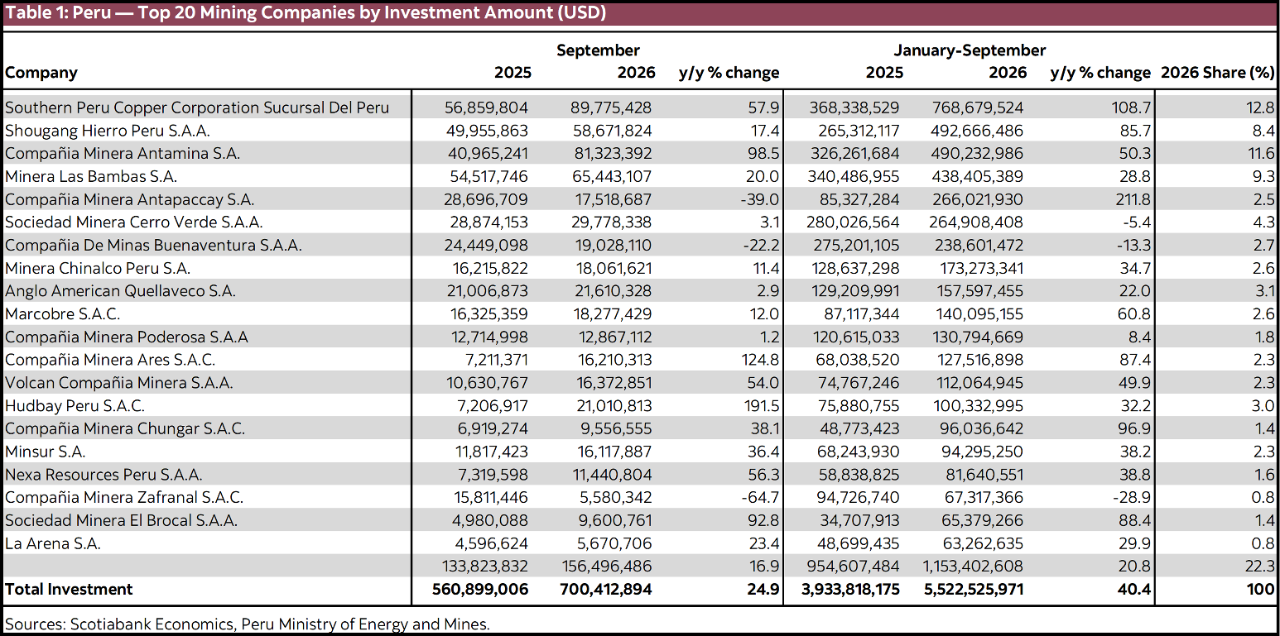
Shougang Hierro Perú again ranked second, with US$493 mn invested through September (+85.7% y/y). The increase in spending reflects investments aimed at sustaining and expanding the company’s iron ore operations in Marcona. The firm is planning the expansion and deepening of open pits, new waste rock dumps, and improvements to its ore transportation system, aimed at accessing new reserves and extending the life of the operation.
Antamina followed with US$490 mn, while Las Bambas invested US$438 mn. Antamina continues to develop the Antamina Replacement Project (US$1.319 bn), while Las Bambas is moving forward with the Ferrobamba Replacement Project (US$1.753 bn).
Mining production weakened further in September (table 2). Metallic mining output fell 7.2% y/y, deepening the contraction recorded in August (-6.1% y/y). Production declined for copper (-8.9% y/y), zinc (-21.1% y/y), gold (-13.2% y/y), silver (-11.8% y/y), and lead (-11.1% y/y), mainly due to lower volumes of ore processed and lower head grades. Conversely, iron ore (+0.3% y/y), tin (+2.8% y/y), and particularly molybdenum (+24.7% y/y) production increased. The rise in molybdenum production was driven mainly by Southern and Las Bambas and appears to reflect higher recovery rates and better grades in processed ore, as molybdenum is primarily obtained as a by-product of copper production. The weakness observed in recent months poses downside risk to our forecast of 1% mining sector growth in 2026.

—Katherine Salazar
DISCLAIMER
This report has been prepared by Scotiabank Economics as a resource for the clients of Scotiabank. Opinions, estimates and projections contained herein are our own as of the date hereof and are subject to change without notice. The information and opinions contained herein have been compiled or arrived at from sources believed reliable but no representation or warranty, express or implied, is made as to their accuracy or completeness. Neither Scotiabank nor any of its officers, directors, partners, employees or affiliates accepts any liability whatsoever for any direct or consequential loss arising from any use of this report or its contents.
These reports are provided to you for informational purposes only. This report is not, and is not constructed as, an offer to sell or solicitation of any offer to buy any financial instrument, nor shall this report be construed as an opinion as to whether you should enter into any swap or trading strategy involving a swap or any other transaction. The information contained in this report is not intended to be, and does not constitute, a recommendation of a swap or trading strategy involving a swap within the meaning of U.S. Commodity Futures Trading Commission Regulation 23.434 and Appendix A thereto. This material is not intended to be individually tailored to your needs or characteristics and should not be viewed as a “call to action” or suggestion that you enter into a swap or trading strategy involving a swap or any other transaction. Scotiabank may engage in transactions in a manner inconsistent with the views discussed this report and may have positions, or be in the process of acquiring or disposing of positions, referred to in this report.
Scotiabank, its affiliates and any of their respective officers, directors and employees may from time to time take positions in currencies, act as managers, co-managers or underwriters of a public offering or act as principals or agents, deal in, own or act as market makers or advisors, brokers or commercial and/or investment bankers in relation to securities or related derivatives. As a result of these actions, Scotiabank may receive remuneration. All Scotiabank products and services are subject to the terms of applicable agreements and local regulations. Officers, directors and employees of Scotiabank and its affiliates may serve as directors of corporations.
Any securities discussed in this report may not be suitable for all investors. Scotiabank recommends that investors independently evaluate any issuer and security discussed in this report, and consult with any advisors they deem necessary prior to making any investment.
This report and all information, opinions and conclusions contained in it are protected by copyright. This information may not be reproduced without the prior express written consent of Scotiabank.
™ Trademark of The Bank of Nova Scotia. Used under license, where applicable.
Scotiabank, together with “Global Banking and Markets”, is a marketing name for the global corporate and investment banking and capital markets businesses of The Bank of Nova Scotia and certain of its affiliates in the countries where they operate, including; Scotiabank Europe plc; Scotiabank (Ireland) Designated Activity Company; Scotiabank Inverlat S.A., Institución de Banca Múltiple, Grupo Financiero Scotiabank Inverlat, Scotia Inverlat Casa de Bolsa, S.A. de C.V., Grupo Financiero Scotiabank Inverlat, Scotia Inverlat Derivados S.A. de C.V. – all members of the Scotiabank group and authorized users of the Scotiabank mark. The Bank of Nova Scotia is incorporated in Canada with limited liability and is authorised and regulated by the Office of the Superintendent of Financial Institutions Canada. The Bank of Nova Scotia is authorized by the UK Prudential Regulation Authority and is subject to regulation by the UK Financial Conduct Authority and limited regulation by the UK Prudential Regulation Authority. Details about the extent of The Bank of Nova Scotia's regulation by the UK Prudential Regulation Authority are available from us on request. Scotiabank Europe plc is authorized by the UK Prudential Regulation Authority and regulated by the UK Financial Conduct Authority and the UK Prudential Regulation Authority.
Scotiabank Inverlat, S.A., Scotia Inverlat Casa de Bolsa, S.A. de C.V, Grupo Financiero Scotiabank Inverlat, and Scotia Inverlat Derivados, S.A. de C.V., are each authorized and regulated by the Mexican financial authorities.
Not all products and services are offered in all jurisdictions. Services described are available in jurisdictions where permitted by law.