

- Banxico cut the policy interest rate by 25 bps to 6.25% in a split vote, signaling that the disinflation process has continued.
- The global economy remained resilient, although with mixed performance and elevated volatility given the conflicts in the Middle East and Europe.
- The Mexican economy expanded in the third quarter of 2026, surprising the market, driven by solid performance in construction and specialized manufacturing, although it remains heterogeneous.
- Headline inflation rose to 3.62% y/y in the first half of October, driven by movements in the non-core component; however, services remain under pressure.
- The tone shifts in the minutes; members consider it prudent to keep the rate unchanged in upcoming decisions.
- Going forward, Banxico is expected to hold a pause for the rest of the year, with the terminal rate expected at 6.25%.
Banco de México published the minutes of the November 4th meeting, in which the Board of Governors decided, in a 3-2 split vote, to cut the policy rate by 25 bps to 6.25%. The minutes confirmed the position of some members in favour of decoupling local monetary policy from that of the Federal Reserve, which maintains a more restrictive stance. On inflation, although the balance of risks is perceived to be skewed to the upside, the Board expects the price level to remain relatively stable given the absence of demand-side pressures. It also considers that orderly movements in USDMXN will be consistent with the monetary policy stance. Going forward, Board members agree that the rates level should be kept unchanged for a prolonged period.
According to the minutes, the Board described a global economy that is still resilient, albeit with heterogeneous performance and a balance of risks skewed to the downside. The United States stood out for the strength of domestic demand and of non-housing investment linked to artificial intelligence, while the Eurozone moderated and China accelerated. The conflict in the Middle East and the war in Eastern Europe kept energy and commodity price volatility elevated, while headline inflation rose in several advanced economies and core inflation continued to show persistence. In response, most major central banks held their rates, although several monetary authorities raised them; the Federal Reserve kept its range at 3.75–4.00%, amid tighter financial conditions, elevated long-term rates and greater global volatility.
On the domestic front, most Board members acknowledged that the Mexican economy surprised favourably by growing 0.9% quarter over quarter, seasonally adjusted, in the third quarter, supported by industry and services. Construction remained dynamic and manufacturing rebounded, particularly in computer equipment, electronics and transportation, as the recovery remained concentrated in a few sectors. On the demand side, consumption was weak, while investment and exports advanced; the latter were driven by non-automotive shipments tied to U.S. technology demand. Despite the upward revision of 2026 GDP growth forecasts to figures close to 2%, the Board considered that slack persists and the balance of risks is to the downside, with signs of labour market weakness reflected in lower participation, weak formal employment and rising informality.
The Board of Governors noted that headline inflation rose from 3.42% y/y in the first fortnight of September to 3.62% in the first fortnight of October, mainly due to the acceleration of the non-core component, while core inflation remained practically stable at 3.78% and kept a slow but downward trend. Services inflation fell to 4.26% but remained the main source of persistence; goods stayed at relatively low levels despite a marginal uptick. Non-core inflation rose to 3.08% on fruits and vegetables, LP gas and the seasonal withdrawal of electricity subsidies. Short-term expectations declined, but long-term expectations remained closer to 4% than to the 3% target. Most members estimated that slack will limit demand pressures and exchange rate pass-through, although they kept the balance of inflation risks skewed to the upside due to geopolitics, energy prices, peso depreciation, services persistence and wage pressures.
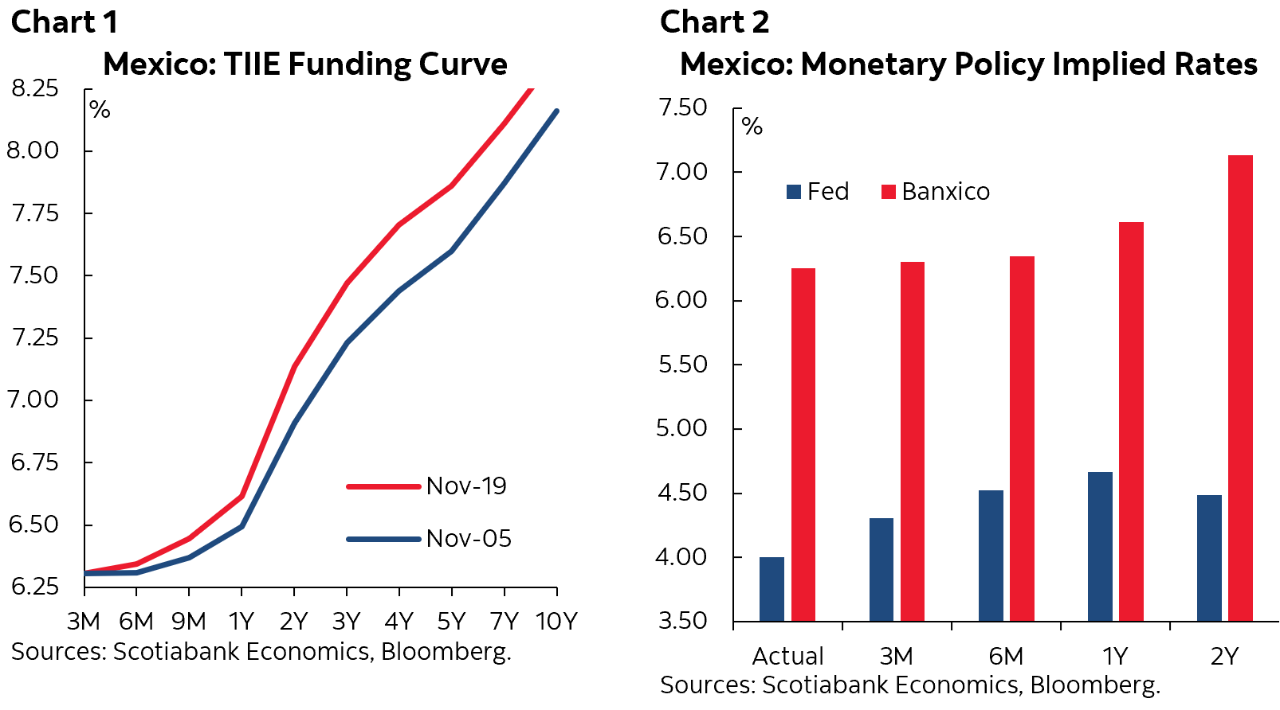
Domestic financial markets reflected external volatility. The peso depreciated 5.58% between decisions and traded between $17.49 and $18.93 pesos per dollar, a movement that most members considered orderly and consistent with a correction from previously appreciated levels. Nevertheless, long positions decreased and demand for hedges increased. Government yields fell mainly at medium and long tenors, while high sensitivity to the international environment and elevated inflation risk premiums persisted. The interest rate differential versus the United States reached 262.5 basis points in September, the lowest since the adoption of Banxico’s target rate in 2008, which divided the Board: for some, exchange rate flexibility, low pass-through and lower reliance on external savings allow a policy focused on the domestic outlook; for others, the narrowing of the differential raises exchange rate and financial vulnerability. Bank credit, especially consumer and mortgage lending, showed signs of slowing.
On monetary policy, the Board cut the rate by a majority of 25 basis points to 6.25% and communicated that it would hold it for a prolonged period. Victoria Rodríguez Ceja, José Gabriel Cuadra García and Omar Mejía Castelazo voted for the cut, arguing that the disinflation process continues, that there are no demand pressures, that slack reduces exchange rate pass-through, and that a one-off adjustment preserves a restrictive stance without starting a new easing cycle. However, Galia Borja Gómez voted to hold at 6.50% under a risk-management approach: she judged that the stance is close to neutral, that decoupling from other central banks weakens the relative position and may raise volatility, and that it is advisable to wait given upside inflation risks. For his part, Jonathan Heath Constable also voted to hold, with a more restrictive stance. He argued that several supports for disinflation have reversed, that the depreciation and the historically low differential versus the Fed threaten the exchange rate and the yield curve, and that the relevant discussion was whether to pause or even raise the rate, not cut it. Overall, the decision was moderately dovish because of the cut, but its forward-looking signal was cautious and restrictive by committing to a prolonged pause.
Going forward, based on members' comments, we believe they will remain on hold at least until Q1-27. However, given the departure of Deputy Governor Jonathan Heath, we could see a Board more inclined to continue cutting, provided that inflationary pressures, the exchange rate level and relative monetary conditions with the United States allow it. Following the publication of the minutes, the exchange rate stood around $19.03 pesos per dollar. In this context, we maintain our expectation of a terminal rate of 6.25% for 2026.
—Rodolfo Mitchell, Miguel Saldaña & Martha Cordova
DISCLAIMER
This report has been prepared by Scotiabank Economics as a resource for the clients of Scotiabank. Opinions, estimates and projections contained herein are our own as of the date hereof and are subject to change without notice. The information and opinions contained herein have been compiled or arrived at from sources believed reliable but no representation or warranty, express or implied, is made as to their accuracy or completeness. Neither Scotiabank nor any of its officers, directors, partners, employees or affiliates accepts any liability whatsoever for any direct or consequential loss arising from any use of this report or its contents.
These reports are provided to you for informational purposes only. This report is not, and is not constructed as, an offer to sell or solicitation of any offer to buy any financial instrument, nor shall this report be construed as an opinion as to whether you should enter into any swap or trading strategy involving a swap or any other transaction. The information contained in this report is not intended to be, and does not constitute, a recommendation of a swap or trading strategy involving a swap within the meaning of U.S. Commodity Futures Trading Commission Regulation 23.434 and Appendix A thereto. This material is not intended to be individually tailored to your needs or characteristics and should not be viewed as a “call to action” or suggestion that you enter into a swap or trading strategy involving a swap or any other transaction. Scotiabank may engage in transactions in a manner inconsistent with the views discussed this report and may have positions, or be in the process of acquiring or disposing of positions, referred to in this report.
Scotiabank, its affiliates and any of their respective officers, directors and employees may from time to time take positions in currencies, act as managers, co-managers or underwriters of a public offering or act as principals or agents, deal in, own or act as market makers or advisors, brokers or commercial and/or investment bankers in relation to securities or related derivatives. As a result of these actions, Scotiabank may receive remuneration. All Scotiabank products and services are subject to the terms of applicable agreements and local regulations. Officers, directors and employees of Scotiabank and its affiliates may serve as directors of corporations.
Any securities discussed in this report may not be suitable for all investors. Scotiabank recommends that investors independently evaluate any issuer and security discussed in this report, and consult with any advisors they deem necessary prior to making any investment.
This report and all information, opinions and conclusions contained in it are protected by copyright. This information may not be reproduced without the prior express written consent of Scotiabank.
™ Trademark of The Bank of Nova Scotia. Used under license, where applicable.
Scotiabank, together with “Global Banking and Markets”, is a marketing name for the global corporate and investment banking and capital markets businesses of The Bank of Nova Scotia and certain of its affiliates in the countries where they operate, including; Scotiabank Europe plc; Scotiabank (Ireland) Designated Activity Company; Scotiabank Inverlat S.A., Institución de Banca Múltiple, Grupo Financiero Scotiabank Inverlat, Scotia Inverlat Casa de Bolsa, S.A. de C.V., Grupo Financiero Scotiabank Inverlat, Scotia Inverlat Derivados S.A. de C.V. – all members of the Scotiabank group and authorized users of the Scotiabank mark. The Bank of Nova Scotia is incorporated in Canada with limited liability and is authorised and regulated by the Office of the Superintendent of Financial Institutions Canada. The Bank of Nova Scotia is authorized by the UK Prudential Regulation Authority and is subject to regulation by the UK Financial Conduct Authority and limited regulation by the UK Prudential Regulation Authority. Details about the extent of The Bank of Nova Scotia's regulation by the UK Prudential Regulation Authority are available from us on request. Scotiabank Europe plc is authorized by the UK Prudential Regulation Authority and regulated by the UK Financial Conduct Authority and the UK Prudential Regulation Authority.
Scotiabank Inverlat, S.A., Scotia Inverlat Casa de Bolsa, S.A. de C.V, Grupo Financiero Scotiabank Inverlat, and Scotia Inverlat Derivados, S.A. de C.V., are each authorized and regulated by the Mexican financial authorities.
Not all products and services are offered in all jurisdictions. Services described are available in jurisdictions where permitted by law.