

- Colombia: January 6.94% inflation highest since Sept-2016
- Mexico: Indicators send mixed messages
COLOMBIA: JANUARY 6.94% INFLATION HIGHEST SINCE SEPT-2016
Monthly CPI inflation was 1.67% m/m in January 2022, according to DANE data published on Saturday, February 5. This result is well above the median forecast in BanRep’s survey (0.91% m/m), and Scotiabank Economics’ projection (1.11% m/m). Food prices again posted the biggest increases with all items posting positive m/m contribution. January’s CPI result brings annual headline inflation to 6.94% y/y, the highest in 5 years, up from 5.62% y/y in December (chart 1), and above the ceiling of BanRep’s target range (2%–4%) for the sixth month in a row.
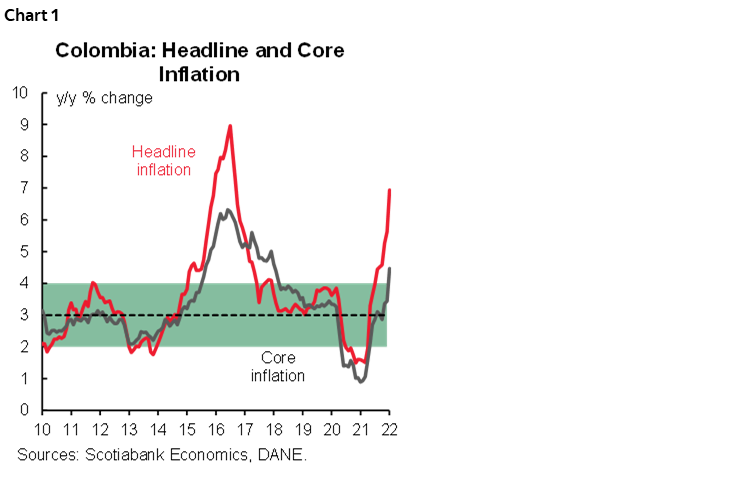
Core inflation also increased from 3.44% y/y to 4.47% y/y, while ex-food and regulated goods inflation came in at 3.47% y/y (up from the 2.49 % in the previous month). January’s inflation reflects a new significant shock to food prices due to higher input costs, but also the effects of indexation on core components.
We continue to expect a 100 bps rate hike in March’s monetary policy meeting and that headline inflation will start to moderate in H2-2022. Having said that, since the balance of risks is clearly to the upside for both headline and core inflations, if CPI does not begin to converge on target in Q2-2022, we would revise our forecast with a higher-than-expected terminal rate, which we currently estimate at 5.75%
Looking at the January’s numbers in detail, every component but education showed positive contributions to inflation (charts 2 and 3). Once again, foodstuffs posted the highest gains. The main highlights are:
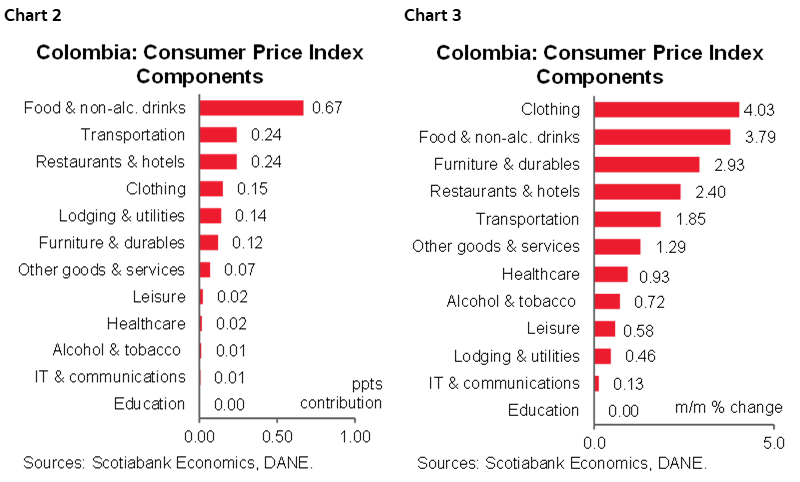
- Foodstuffs prices (+3.79% m/m) had the largest contribution to overall inflation (+67 bps), with the main gains coming from meat (+2.66% m/m), milk (+4.25% m/m), potatoes (+25.34% m/m) and bananas (+15.53% m/m). Rising input prices and FX depreciation are driving food prices higher, especially imported commodities such as soy and corn. Other important items in the production process such as fertilizers also increased.
- Transport group (+1.85% m/m and +24 bps) posted the second major contribution to January’s inflation. This component was affected by the effect of higher gasoline prices (+1.84% m/m), the FX depreciation through higher prices in vehicles (+0.78% m/m), and the effect of the public transport system fee increases (+3.23% m/m).
- Restaurants and hotels component was the third largest contribution (+24 bps and +2.40% m/m), showing the effect of higher food prices, but also the effect of the minimum wage.
- Lodging & utilities sector inflation stood at 0.46% m/m due to utility fees (+1.16% m/m), especially electricity (+1.92% m/m). Rental fees increased by 0.26% m/m, which is a moderate increase given the expected indexation.
- The rest of the components showed the effect of usual price increases that take place at the beginning of the year and contributed to the highest inflation in recent years. The clothing group particularly showed the reversal effect from the VAT holiday contributing bps to the overall figure.
Looking at annual inflation across major categories, goods inflation jumped to 5.29% y/y in January, while services inflation increased by 61 bps from 2.18% y/y to 2.79% y/y. Regulated-price inflation jumped 121 bps to 8.31% y/y.
All in all, 40% of total inflation was explained by food inflation, the remainder being a combination of usual indexation effects and the reversal of the VAT holiday. January’s inflation result skews year-end 2022 inflation to 5%, which would lead to even more indexation effects for 2023.
In terms of monetary policy, we anticipate that the board will continue with a 100 bps hike in March’s meeting, raising the policy rate to 5%. We project a terminal rate of 5.75%, provided that headline inflation begins to moderate in coming months.
—Sergio Olarte & Jackeline Piraján
MEXICO: INDICATORS SEND MIXED MESSAGES
I. Private consumption continues recovery in November
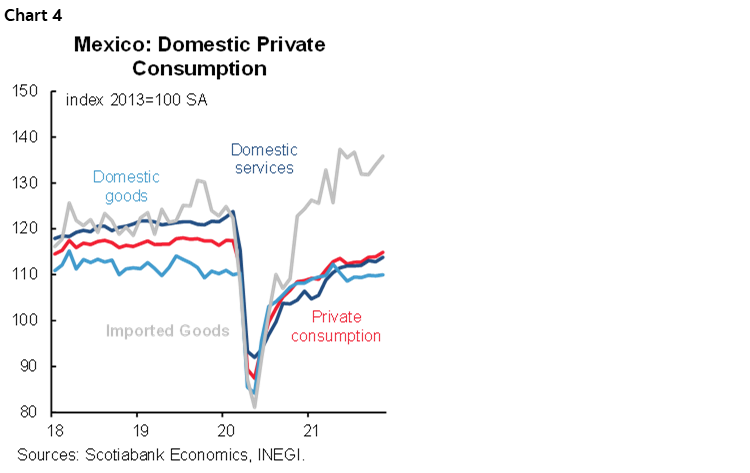
According to INEGI, seasonally-adjusted private consumption increased 0.7% m/m in November, stringing together five consecutive increases (chart 4). Consumption of domestic goods increased 0.2% m/m, while imported goods increased 1.2% m/m. At the retail level, domestic goods increased 0.2% m/m and services 0.7% m/m. In real annual terms, on a non-seasonally adjusted basis, consumption increased 7.5% (5.8% previously), with goods advancing 3.5% and services rising 8.9%, in line with lower restrictions (Mexico was under a partial COVID-19 lockdown in November) and boosted by the sales from “El Buen Fin”. Going forward, we expect consumption growth to moderate owing to high inflation levels and the recent rebound in caseloads.
II. Gross fixed investment remains sluggish, with no signs of recovery
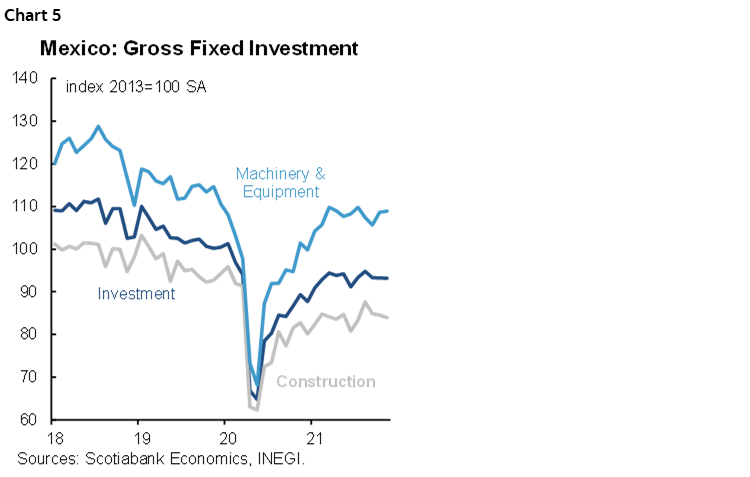
INEGI also released the gross fixed investment index, which registered its third consecutive monthly decline in November, -0.1% m/m. Gross fixed investment started to decline in November 2018 and still remains below pre-pandemic levels (chart 5). Construction dropped -0.7% m/m in November, making three consecutive declines. Residential construction fell again (-0.7% m/m), which was not offset by a modest increase in non-residential construction (1.0% m/m). On the other hand, machinery and equipment posted an advance of 0.2% m/m, driven by an increase in imported machinery and equipment of 12.0% m/m, as the domestic counterpart decreased -5.9%m/m. On a year-over-year basis, gross fixed investment rose 4.3%, with construction up 1.4% y/y and machinery and equipment 7.3% y/y, mainly due to a base effect.
As noted in our comment on Banxico’s survey of expectations, the majority of respondents consider it a bad time to make investments and that the business climate for private sector productive activities will remain the same or worsen in the next six months. Consequently, we don’t expect investment to recover in the short term.
III. Weak start to the year in the auto industry
The automotive industry continued to contract in January, albeit at a slower pace. While recording the seventh consecutive decline, production contracted at a lower rate, falling -9.1% y/y (average previous declines -24.0%), pointing to persistent problems in supply chains. Sales also declined at a slower pace, -3.8% y/y (average four previous declines -7.9%), while exports fell -3.1% y/y (average six previous declines -20.2%), in line with the shortage of inputs and inventories. In terms of the number of units, these are the lowest levels for a similar month since: 2013 for sales (78,585 units in 2022); 2015 for production (253,366 units in 2022); and 2017 for exports (216,630 units in 2022) (chart 6).
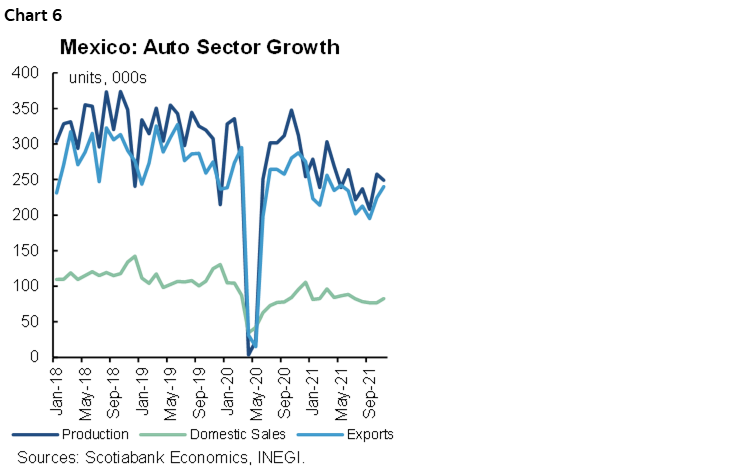
In the short term, we expect sales to recover in line with private consumption, while supply chain disruptions normalize in the coming months. Accordingly, automotive production and exports should start to recover in the second half of the year.
—Luisa Valle & Miguel Saldaña
DISCLAIMER
This report has been prepared by Scotiabank Economics as a resource for the clients of Scotiabank. Opinions, estimates and projections contained herein are our own as of the date hereof and are subject to change without notice. The information and opinions contained herein have been compiled or arrived at from sources believed reliable but no representation or warranty, express or implied, is made as to their accuracy or completeness. Neither Scotiabank nor any of its officers, directors, partners, employees or affiliates accepts any liability whatsoever for any direct or consequential loss arising from any use of this report or its contents.
These reports are provided to you for informational purposes only. This report is not, and is not constructed as, an offer to sell or solicitation of any offer to buy any financial instrument, nor shall this report be construed as an opinion as to whether you should enter into any swap or trading strategy involving a swap or any other transaction. The information contained in this report is not intended to be, and does not constitute, a recommendation of a swap or trading strategy involving a swap within the meaning of U.S. Commodity Futures Trading Commission Regulation 23.434 and Appendix A thereto. This material is not intended to be individually tailored to your needs or characteristics and should not be viewed as a “call to action” or suggestion that you enter into a swap or trading strategy involving a swap or any other transaction. Scotiabank may engage in transactions in a manner inconsistent with the views discussed this report and may have positions, or be in the process of acquiring or disposing of positions, referred to in this report.
Scotiabank, its affiliates and any of their respective officers, directors and employees may from time to time take positions in currencies, act as managers, co-managers or underwriters of a public offering or act as principals or agents, deal in, own or act as market makers or advisors, brokers or commercial and/or investment bankers in relation to securities or related derivatives. As a result of these actions, Scotiabank may receive remuneration. All Scotiabank products and services are subject to the terms of applicable agreements and local regulations. Officers, directors and employees of Scotiabank and its affiliates may serve as directors of corporations.
Any securities discussed in this report may not be suitable for all investors. Scotiabank recommends that investors independently evaluate any issuer and security discussed in this report, and consult with any advisors they deem necessary prior to making any investment.
This report and all information, opinions and conclusions contained in it are protected by copyright. This information may not be reproduced without the prior express written consent of Scotiabank.
™ Trademark of The Bank of Nova Scotia. Used under license, where applicable.
Scotiabank, together with “Global Banking and Markets”, is a marketing name for the global corporate and investment banking and capital markets businesses of The Bank of Nova Scotia and certain of its affiliates in the countries where they operate, including; Scotiabank Europe plc; Scotiabank (Ireland) Designated Activity Company; Scotiabank Inverlat S.A., Institución de Banca Múltiple, Grupo Financiero Scotiabank Inverlat, Scotia Inverlat Casa de Bolsa, S.A. de C.V., Grupo Financiero Scotiabank Inverlat, Scotia Inverlat Derivados S.A. de C.V. – all members of the Scotiabank group and authorized users of the Scotiabank mark. The Bank of Nova Scotia is incorporated in Canada with limited liability and is authorised and regulated by the Office of the Superintendent of Financial Institutions Canada. The Bank of Nova Scotia is authorized by the UK Prudential Regulation Authority and is subject to regulation by the UK Financial Conduct Authority and limited regulation by the UK Prudential Regulation Authority. Details about the extent of The Bank of Nova Scotia's regulation by the UK Prudential Regulation Authority are available from us on request. Scotiabank Europe plc is authorized by the UK Prudential Regulation Authority and regulated by the UK Financial Conduct Authority and the UK Prudential Regulation Authority.
Scotiabank Inverlat, S.A., Scotia Inverlat Casa de Bolsa, S.A. de C.V, Grupo Financiero Scotiabank Inverlat, and Scotia Inverlat Derivados, S.A. de C.V., are each authorized and regulated by the Mexican financial authorities.
Not all products and services are offered in all jurisdictions. Services described are available in jurisdictions where permitted by law.