

- Colombia: Colombia mixed August economic indicators—GDP proxy slows; imports up boosted by prices & capital goods
COLOMBIA: COLOMBIA MIXED AUGUST ECONOMIC INDICATORS—GDP PROXY SLOWS; IMPORTS UP BOOSTED BY PRICES & CAPITAL GOODS
I. Economic activity slowed down in August amid weaker construction activity
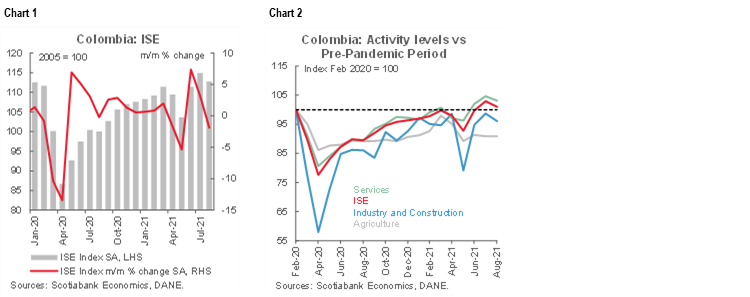
On Tuesday, October 19, Colombia’s Statistical Agency (DANE) released August’s Economic Activity Indicator (ISE, the main GDP proxy). Compared with the same month in 2020, August’s activity expanded by 13.3% y/y, below the market consensus of 15.5% y/y according to Bloomberg; and below the previous month’s 14.3% y/y, defying any diminishing base effects. On a seasonally adjusted basis, Colombia’s economic activity contracted by 1.9% m/m (chart 1), interrupting solid gains of previous months as the construction sector is weakening. August’s result would configure a dovish signal for the central bank as the economic recovery still has some room to close the remaining activity gap (chart 2). This new data reaffirms our expectation of a 25 bps hike at the upcoming BanRep monetary policy meeting on October 29.
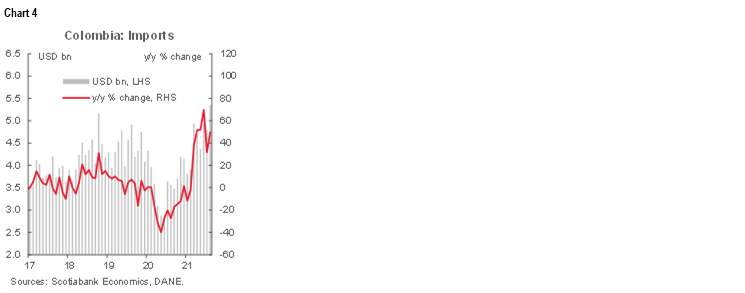
Economic recovery looks different across the three main activity groups (chart 3). A closer look is detailed below:
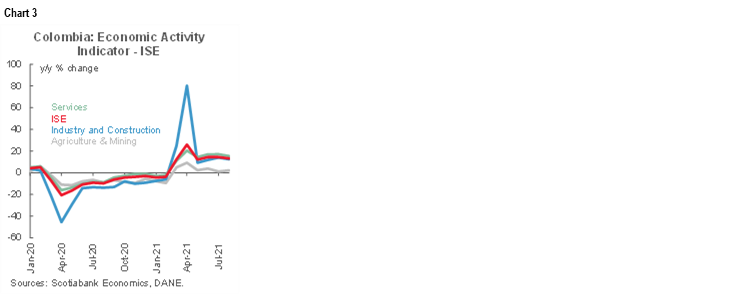
- Primary activities (13% of the economy) grew by 2.2% y/y but unchanged m/m seasonally adjusted in August. This means that the sector closed the month operating ~9% below pre-pandemic levels (chart 2 again), agricultural activity is growing at a slower pace, while mining continued on the negative side as oil and coal production are improving at a slow pace, while gold prices reduction also is weighing against mining sector.
- Secondary sectors (19% of the economy) were up by 12.5% y/y. However, it contracted by 2.7% m/m sa, showing that the economic recovery still faces challenges ahead. As shown in Friday’s release, manufacturing production is still robust in lines related to reopening and mobility. Construction activities, meanwhile, remained weak due to a contraction in non-residential buildings and civil works. International prices on key raw materials for the construction would continue to impose challenges ahead to the sector, which is a thing to keep an eye on since construction is a strategic sector for economic recovery especially in term of non-qualified labour dynamics. For now, the secondary sector operates ~4% below pre-pandemic levels.
- Services-related activities (68% of the economy) were up by 15.4% y/y and contracted by 1.5% m/m. Commerce, transport, and hotel sectors were broadly unchanged vs the previous month. On the other side, the main contraction came from the insurance sector (-7.5%y/y according to the DANE’s press conference). Payments of life insurance have increased due to the pandemic. That said, services-related activities are now operating above pre-pandemic levels (+3.13% y/y).
Overall, economic activity results showed that the economic recovery is not at cruising speed yet and, some key sectors such as construction would continue to moderate future gains. However, the services sector remains robust and, we think that as normality consolidates they could continue positively in the forthcoming months. Either way, if the Colombian economy maintains current activity levels, and GDP growth in 2021 reaches above-consensus expansion, it would skew our current 8.2% forecast to the upside. However, as uncertainty remains, we read today’s data as a dovish signal ahead of the central bank meeting, affirming our expectation of a gradual normalizing process in the monetary policy rate with a 25 bps hike in October.
II. August imports reached highest level since 2014; boosted by high international prices, capital goods imports
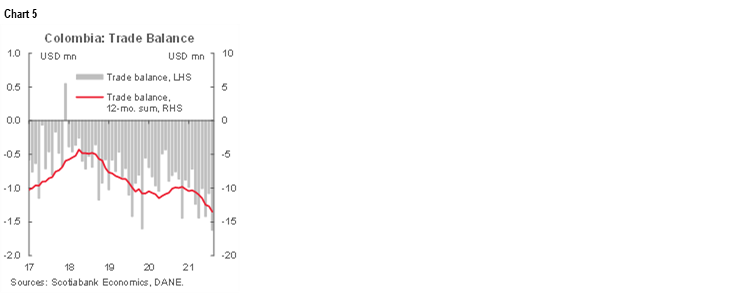
August imports data, released by DANE on Tuesday, October 19, came in at USD 5.35 bn (CIF terms), expanding 49.8% y/y (chart 4), reaching their highest level since December 2014. Compared with August 2019, imports increased by 8.9%, showing two effects: i) a better-than-expected economic recovery, and ii) the impact of higher international commodities prices. Raw material imports are close to the historical high, while capital goods imports are in the best levels since the pandemic began and, consistent with the previous month (yet again), investment-related imports are boding well for medium-term FDI.
Manufacturing imports grew by 45.1% y/y (+12.8% versus August-2019) accounting for the strongest positive contribution to annual imports growth, while agriculture-related imports increased by 45.2% y/y and mining-related imports grew by 129.9% y/y. As a result, the monthly trade deficit widened to USD 1.62 bn (FOB) (chart 5), Colombia’s YTD trade deficit stood at USD 9.5 bn for January–August affirming our expectation of a current account deficit of 5.2% of GDP in 2021.
From the perspective of imports by use, the three major segments showed positive signals compared with August 2020 (chart 6):
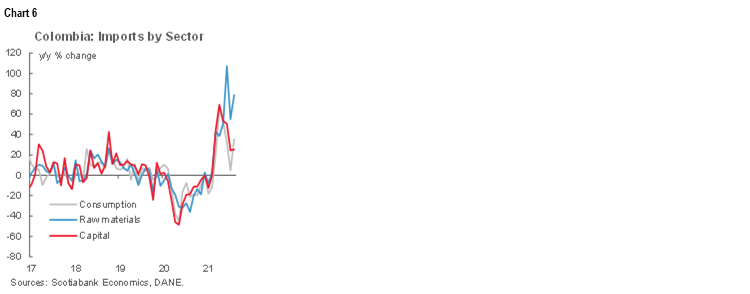
- Consumption-goods imports increased by +35.34% y/y and stood at USD 1.21 bn, owing mainly to higher durable-goods imports (+59.2% y/y), especially in vehicles with an expansion of 82.6% and jewelry (+57.5% y/y); meanwhile, non-durable goods imports increased by 20.5% y/y, mainly foodstuff (+25.1%y/y) and pharma products (+23.5% y/y). Consumption-related imports continued getting closer to pre-pandemic monthly averages (2019: USD 1.05 bn and 2020 YTD: USD 996 mn).
- Raw-materials imports grew by 78.9% y/y, due to larger purchases of foreign goods for the industrial sector (+72.2% y/y), especially those related with chemical products (+65.4%y/y) and mining products (+101.8% y/y). Raw materials imports, in dollar terms, are close to their historical high, and it continued showing the effect of higher prices as well as the ongoing economic recovery.
- Capital-goods imports were up by 25.3% y/y (USD 1.52 bn), led by higher purchases of investment-related goods in the industry (13.8% y/y) and in the construction (+151.2% y/y). Capital-goods imports surpassed pre-pandemic averages (2019: USD 1.37 bn and YTD-2020: USD 1.30 mn), which let us to affirm our expectation of better FDI in coming months.
All in all, despite August’s strong imports evidencing economic recovery, they are also showing an impact from higher international prices, specially in raw materials. We have to keep an eye on the impact for the trade balance, since the deficit would continue deteriorating as exports are lagging the recovery due to production in some mining products, while imports keep increasing impacted by higher international prices. For now, we affirm our expectation of a 5.2% current account deficit in 2021.
—Sergio Olarte & Jackeline Piraján
DISCLAIMER
This report has been prepared by Scotiabank Economics as a resource for the clients of Scotiabank. Opinions, estimates and projections contained herein are our own as of the date hereof and are subject to change without notice. The information and opinions contained herein have been compiled or arrived at from sources believed reliable but no representation or warranty, express or implied, is made as to their accuracy or completeness. Neither Scotiabank nor any of its officers, directors, partners, employees or affiliates accepts any liability whatsoever for any direct or consequential loss arising from any use of this report or its contents.
These reports are provided to you for informational purposes only. This report is not, and is not constructed as, an offer to sell or solicitation of any offer to buy any financial instrument, nor shall this report be construed as an opinion as to whether you should enter into any swap or trading strategy involving a swap or any other transaction. The information contained in this report is not intended to be, and does not constitute, a recommendation of a swap or trading strategy involving a swap within the meaning of U.S. Commodity Futures Trading Commission Regulation 23.434 and Appendix A thereto. This material is not intended to be individually tailored to your needs or characteristics and should not be viewed as a “call to action” or suggestion that you enter into a swap or trading strategy involving a swap or any other transaction. Scotiabank may engage in transactions in a manner inconsistent with the views discussed this report and may have positions, or be in the process of acquiring or disposing of positions, referred to in this report.
Scotiabank, its affiliates and any of their respective officers, directors and employees may from time to time take positions in currencies, act as managers, co-managers or underwriters of a public offering or act as principals or agents, deal in, own or act as market makers or advisors, brokers or commercial and/or investment bankers in relation to securities or related derivatives. As a result of these actions, Scotiabank may receive remuneration. All Scotiabank products and services are subject to the terms of applicable agreements and local regulations. Officers, directors and employees of Scotiabank and its affiliates may serve as directors of corporations.
Any securities discussed in this report may not be suitable for all investors. Scotiabank recommends that investors independently evaluate any issuer and security discussed in this report, and consult with any advisors they deem necessary prior to making any investment.
This report and all information, opinions and conclusions contained in it are protected by copyright. This information may not be reproduced without the prior express written consent of Scotiabank.
™ Trademark of The Bank of Nova Scotia. Used under license, where applicable.
Scotiabank, together with “Global Banking and Markets”, is a marketing name for the global corporate and investment banking and capital markets businesses of The Bank of Nova Scotia and certain of its affiliates in the countries where they operate, including; Scotiabank Europe plc; Scotiabank (Ireland) Designated Activity Company; Scotiabank Inverlat S.A., Institución de Banca Múltiple, Grupo Financiero Scotiabank Inverlat, Scotia Inverlat Casa de Bolsa, S.A. de C.V., Grupo Financiero Scotiabank Inverlat, Scotia Inverlat Derivados S.A. de C.V. – all members of the Scotiabank group and authorized users of the Scotiabank mark. The Bank of Nova Scotia is incorporated in Canada with limited liability and is authorised and regulated by the Office of the Superintendent of Financial Institutions Canada. The Bank of Nova Scotia is authorized by the UK Prudential Regulation Authority and is subject to regulation by the UK Financial Conduct Authority and limited regulation by the UK Prudential Regulation Authority. Details about the extent of The Bank of Nova Scotia's regulation by the UK Prudential Regulation Authority are available from us on request. Scotiabank Europe plc is authorized by the UK Prudential Regulation Authority and regulated by the UK Financial Conduct Authority and the UK Prudential Regulation Authority.
Scotiabank Inverlat, S.A., Scotia Inverlat Casa de Bolsa, S.A. de C.V, Grupo Financiero Scotiabank Inverlat, and Scotia Inverlat Derivados, S.A. de C.V., are each authorized and regulated by the Mexican financial authorities.
Not all products and services are offered in all jurisdictions. Services described are available in jurisdictions where permitted by law.