

- Chile: Update on the constitutional process—key dates to keep in mind
- Peru: Inflation surpasses market expectations again; BCRP likely to evaluate new rise in rates
CHILE: UPDATE ON THE CONSTITUTIONAL PROCESS—KEY DATES TO KEEP IN MIND
November 2 kickstarted the process of installing the seven thematic commissions that will address the different constitutional contents (or verticals), as established in the regulations binding the constitutional body. While some commissions are still fine-tuning their work schedules, others have already begun calling public hearings, as is the case with the Political Systems Commission. The Plenary timeline that has been presented already budgets for a one-time 3-month extension contemplated at the onset, foretelling that the constitutional body will indeed take the full year of work to conclude on July 5, 2022.
According to the commissions regulations, a series of technical secretariats made up of experts in each of the respective fields must accompany the work of the conventional ones. They will be collegiate and technical bodies and, for the most part, on commission or ad honorem. These secretariats are: Directorate of Administration, Finance and transparencies; Secretary of the Convention, Commissions and Subcommittees; Secretariat of Communications, Information and Transparency; Technical Secretary, External Assignment Committee and Ethics Committee. Some have already been formed, while others are in the process of calling for nominations, as is the case of the Technical Secretariat for Popular Participation, which will be in charge of implementing the different participation mechanisms established also by regulation, which in total add up to seven different instances between town councils, hearings, initiatives of popular norms, among others.
In the last two weeks, the different commissions have been preparing their work schedule, that is, what will be the deadlines for hearings, debates, reviews and votes: a Gantt Chart. This schedule must match the work of the Plenary and that of the committees. Along these lines, it has already presented a proposal that establishes a total term of one year, which implies making use of the three-month extension contemplated in the norm that approved the creation of the constitutional body, with the end date of the process being July 5, 2022.
The following dates have been established for the voting of the different constitutional norms emanating from the different commissions: January 10 to 14; January 31 to February 4; February 28 to March 4; March 28 to April 1. Subsequently, on April 28, the process of harmonizing standards will begin, also to be voted on between June 20 and 24. This last stage will be in the hands of a dedicated Harmonization Commission, whose members will be defined weeks in advance. This instance will be in charge of ensuring that each norm conforms to the constitutional ranges. The above proposed timeline must be voted on by the Commission’s Plenary, and once this occurs, each committee must adapt its work based on this “master schedule”.
—Jorge Selaive
PERU: INFLATION SURPASSES MARKET EXPECTATIONS AGAIN; BCRP LIKELY TO EVALUATE NEW RISE IN RATES
Peru’s inflation increased 0.58% m/m in October, higher than the Bloomberg consensus of 0.24% m/m, but in line with our forecast of 0.55% m/m. Headline annual inflation jumped from 5.2% y/y in September to 5.8% y/y in October (chart 1), surpassing the upper limit of the central bank’s target range (between 1% and 3%) for the fifth consecutive month, and reaching levels not seen since the beginning of 2009. Inflation has been surprisingly strong and is moving further and further away from the BCRP’s inflation forecast of 4.9% for this year. However, these results are in line with our inflation forecast of 6.5% for the full year in 2021 and 4.5% for 2022.
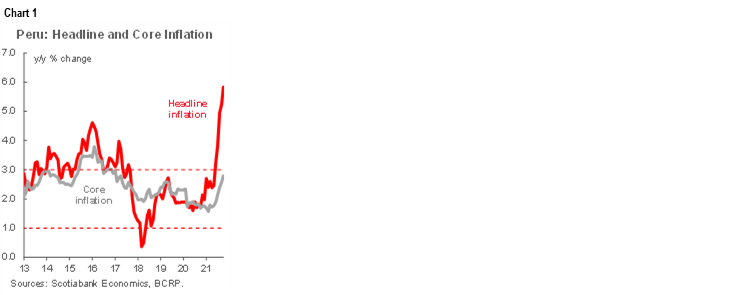
Core inflation also continued to pick up, going from 2.6% y/y in September to 2.8% y/y in October, exceeding the 2% y/y target for headline inflation. Wholesale inflation, linked to production costs, continues to rise, approaching 14% y/y, the highest rate in 27 years. Cost pressures are likely to continue to persist for the rest of this year and next. The PEN depreciation slowed somewhat, going from 15% y/y in September to 12% y/y in October, in a context of some moderation in political uncertainty. The dragging effects of the FX rate on inflation could also persist in the coming months, adding to the growing concerns at the BCRP.
Over the last three months, the central bank raised its benchmark rate by 125 basis points to 1.50% and increased reserve requirements twice, giving stronger signals to withdraw the monetary stimulus. The BCRP has been acting reactively rather preventively in the face of rising inflation, which is why we believe further increases in the policy rate will be necessary for inflationary expectations to return to the target range. We expect a 50 bps increase at the next BCRP meeting next week, on November 11.
—Mario Guerrero
DISCLAIMER
This report has been prepared by Scotiabank Economics as a resource for the clients of Scotiabank. Opinions, estimates and projections contained herein are our own as of the date hereof and are subject to change without notice. The information and opinions contained herein have been compiled or arrived at from sources believed reliable but no representation or warranty, express or implied, is made as to their accuracy or completeness. Neither Scotiabank nor any of its officers, directors, partners, employees or affiliates accepts any liability whatsoever for any direct or consequential loss arising from any use of this report or its contents.
These reports are provided to you for informational purposes only. This report is not, and is not constructed as, an offer to sell or solicitation of any offer to buy any financial instrument, nor shall this report be construed as an opinion as to whether you should enter into any swap or trading strategy involving a swap or any other transaction. The information contained in this report is not intended to be, and does not constitute, a recommendation of a swap or trading strategy involving a swap within the meaning of U.S. Commodity Futures Trading Commission Regulation 23.434 and Appendix A thereto. This material is not intended to be individually tailored to your needs or characteristics and should not be viewed as a “call to action” or suggestion that you enter into a swap or trading strategy involving a swap or any other transaction. Scotiabank may engage in transactions in a manner inconsistent with the views discussed this report and may have positions, or be in the process of acquiring or disposing of positions, referred to in this report.
Scotiabank, its affiliates and any of their respective officers, directors and employees may from time to time take positions in currencies, act as managers, co-managers or underwriters of a public offering or act as principals or agents, deal in, own or act as market makers or advisors, brokers or commercial and/or investment bankers in relation to securities or related derivatives. As a result of these actions, Scotiabank may receive remuneration. All Scotiabank products and services are subject to the terms of applicable agreements and local regulations. Officers, directors and employees of Scotiabank and its affiliates may serve as directors of corporations.
Any securities discussed in this report may not be suitable for all investors. Scotiabank recommends that investors independently evaluate any issuer and security discussed in this report, and consult with any advisors they deem necessary prior to making any investment.
This report and all information, opinions and conclusions contained in it are protected by copyright. This information may not be reproduced without the prior express written consent of Scotiabank.
™ Trademark of The Bank of Nova Scotia. Used under license, where applicable.
Scotiabank, together with “Global Banking and Markets”, is a marketing name for the global corporate and investment banking and capital markets businesses of The Bank of Nova Scotia and certain of its affiliates in the countries where they operate, including; Scotiabank Europe plc; Scotiabank (Ireland) Designated Activity Company; Scotiabank Inverlat S.A., Institución de Banca Múltiple, Grupo Financiero Scotiabank Inverlat, Scotia Inverlat Casa de Bolsa, S.A. de C.V., Grupo Financiero Scotiabank Inverlat, Scotia Inverlat Derivados S.A. de C.V. – all members of the Scotiabank group and authorized users of the Scotiabank mark. The Bank of Nova Scotia is incorporated in Canada with limited liability and is authorised and regulated by the Office of the Superintendent of Financial Institutions Canada. The Bank of Nova Scotia is authorized by the UK Prudential Regulation Authority and is subject to regulation by the UK Financial Conduct Authority and limited regulation by the UK Prudential Regulation Authority. Details about the extent of The Bank of Nova Scotia's regulation by the UK Prudential Regulation Authority are available from us on request. Scotiabank Europe plc is authorized by the UK Prudential Regulation Authority and regulated by the UK Financial Conduct Authority and the UK Prudential Regulation Authority.
Scotiabank Inverlat, S.A., Scotia Inverlat Casa de Bolsa, S.A. de C.V, Grupo Financiero Scotiabank Inverlat, and Scotia Inverlat Derivados, S.A. de C.V., are each authorized and regulated by the Mexican financial authorities.
Not all products and services are offered in all jurisdictions. Services described are available in jurisdictions where permitted by law.