

- Peru: President Castillo stays mostly on script in his inauguration speech, but cabinet announcements delayed
- Chile: Politics begin to feel impact of inflation; we simulate impacts on CPI as MoF announces possible measures to reduce price of gasoline
- Colombia: Rate expected to hold at 1.75% at tomorrow’s BanRep meeting with hawkish call but broad analyst consensus; Citibank survey results
PERU: PRESIDENT CASTILLO STAYS MOSTLY ON SCRIPT IN HIS INAUGURATION SPEECH, BUT CABINET ANNOUNCEMENTS DELAYED
Pedro Castillo’s inauguration ceremony took place yesterday, July 28, as the country celebrated its Bicentennial anniversary of Independence. The inauguration speech, together with the announcement of the composition of the cabinet, were much awaited events as they would help dispel uncertainty on the profile of the government. It was disappointing that no cabinet announcements were made.
In a break with tradition, if not strictly with the law, the new president of the cabinet —widely called the Prime Minister—will not be appointed until later today (Thursday, July 29) and the remainder of the cabinet will not be known until Friday, July 30. This means two more days of uncertainty over the profile of the new government. It also brings into question what this means, either reflective of the very short transition time, or the challenging balance that Mr Castillo must strike to pick names between moderate leftists, Perú Libre members, and the experts that he seeks for his cabinet.
Until we know the cabinet names, we cannot be assured of the new cabinet’s governance capabilities, its ability to relate with Congress, or its policy vision and guidelines. It is unusual that Castillo, during his inauguration speech, went into specifics on sector policies without the input from the people that are meant to design these policies.
Castillo’s inauguration speech was coherent with the ideas and proposals that Castillo had been repeating over the past two months. In a well-structured and articulate speech, Castillo sought to identify much more with his Andean roots and the country’s multiplicity of ethnicities, than with a leftist ideology. This identification was explicit in the overture portion of his speech, but also in his dress and his symbolic announcement that he would not govern from the government palace (known as Casa de Pizarro) which is representative of colonial times, but, instead, will turn it into a museum to be run by the newly renamed Ministry of Cultures.
Castillo was also explicit, at the end of his speech in stating that ideologies must be left behind. In line with this, even though many of the initiatives that Castillo mentioned in his speech are recognizably leftist in nature, this was not a speech that preached leftist ideology per se.
The speech itself mixed moderation with elements of risk. In a message to the business community and investors, Castillo vowed to respect private property, not expropriate, not introduce controls on the use of foreign currency, and be responsible in introducing changes so as to maintain order and predictability.
At the same time, Castillo stated that his government would “end the abuses” of monopolies and mentioned three specific markets as candidates for some type of price control: gas, medicine, and interest rates for small-business loans. Castillo also intends to expand the role of the State Banco de la Nación so it can participate in the full gamut of financial services, although the emphasis was in allowing it to provide loans to small businesses. Another State enterprise which would have a more enhanced role is Petroperú, the State oil company. Very little else was mentioned in terms of expanding the State role in the economy, except for a somewhat unusual announcement that the Armed Forces would be given a role in development projects.
Regarding natural resources, Castillo refrained from demanding sovereign control over them, as he had done as a candidate, but he did introduce the concept of “social profitability” or “social yield” (“rentabilidad social”). This would be an augmented version of social responsibility, in which mining, oil & gas, and even some manufacturing industries, would need to contribute to the development of the regions they operate in. The details of what this would entail were not given, but the message was clear for mining companies: if there is no “social yield”, then the project “no va” (would not be approved). Even here Castillo preached moderation, however, stating the desire to provide mining with clear rules that would enable an increase in production.
The two top priorities mentioned by Castillo were more in line with traditional state management concerns, namely, improving health services, including COVID-19 vaccination and control, and reactivating the economy. Regarding the latter, Castillo announced a number of employment programs, including PEN 3 bn for municipal and regional governments, PEN 1 bn for rural roads, and PEN 700 mn for the ongoing Trabaja Perú jobs program he is inheriting. In addition, “vulnerable” families will receive a PEN 700 transfer each. This would be aside from expansions in the budgets for the education, health and water and sanitation files.
The most significant structural change that was announced was the eventual merger of the current private pension fund system and the public systems into one. This would be part of a larger intention of providing universal health and pension services. However, the details of how this will work will be left to a Committee to be created to reform the system.
Castillo also announced the creation of a new Ministry of Science, Technology and Technological Innovation. Very little details were given.
Castillo further devoted time to climate change, an issue not prominent among local politicians, but which hopefully suggests growth in his Statesmanship stature. He stated the government’s intention to reverse the deforestation of the Amazon, transform Peru into a carbon-neutral country by 2050, with a significant reduction in carbon gas emissions over the next decade.
The Constitutional Assembly
Castillo began and ended his speech with a mention of the Constitutional Assembly. To stress the importance of the issue, Castillo mentioned the Constitutional Assembly when he was sworn in. He also stated, however, that the path towards an Assembly had to comply with the current legal and Constitutional framework, which would require going through Congress. Since the current Constitution does not speak of a Constitutional Assembly, the first step would be to submit to Congress a bill that would open a path for this possibility. So far, so reasonable. However, Castillo further stated that the Constitutional Assembly should not only include political parties, but also social organizations, worker unions, ethnic leader, among others, although it is not clear how this could be done within the current electoral framework and procedures.
Thus, the possibility of a Constitutional Assembly and a wholesale change in the Constitution continues to be a source of uncertainty hanging over society and the economy, as it opens the door to unknown institutional change. Mr Castillo reiterated his pledge to leave office, per the Constitution, in 2026.
—Guillermo Arbe
CHILE: POLITICS BEGIN TO FEEL IMPACT OF INFLATION; WE SIMULATE IMPACTS ON CPI AS MOF ANNOUNCES POSSIBLE MEASURES TO REDUCE PRICE OF GASOLINE
On Tuesday, July 27, the Chamber of Deputies’ Finance Committee rejected a bill that proposed to reduce the tax on gasoline and diesel by 50%. This opened a window for the government to provide relief through reductions in fuel prices. The Ministry of Finance announced possible changes to the MEPCO (the mechanism through which gasoline prices are controlled) to reduce the price of fuels. The measure had been previously implemented by the former Minister of Finance during the social protests of late 2019. The government has stated such changes would be transitory and could be applied as early as next week.
Our simulated scenarios
Based on the recent initiatives and declarations by the Ministry of Finance, we simulated scenarios on the various alternatives we could expect from these efforts to temporarily control the price of fuels, in terms of fiscal cost and impact on inflation (CPI):
- In the baseline scenario, gasoline will increase by CLP 25 per liter in August, with an impact on the m/m CPI of +0.09 percentage points.
- In an alternative scenario of maintaining gasoline prices throughout August, the impact on the m/m CPI would be +0.04 percentage points, which would have an additional fiscal cost of USD 8.3 mn.
- Another scenario considers a drop of CLP 80 per liter in gasoline during August, whose incidence in the m/m CPI would be -0.23 percentage points, with a fiscal cost of USD 51 mn.
- Lastly, the scenario proposed in the bill now rejected at congressional committee would imply, in our estimations, a drop in the price of gasoline of approximately CLP 160 per liter, with an incidence of -0.5 percentage points in the m/m CPI and a fiscal cost of USD 130 mn.
We have previously stated that inflation in the second semester has significant downside risks, particularly relative to the central bank's projection for 2021 (4.4% y/y). Based on market factors already visible in June’s CPI, and political factors such as legislative projects that could affect short-term inflation, we believe that inflation will indeed abate during the second half of the year. Hence, we have maintained a consensus inflation projection for 2021 (3.5% y/y).
—Jorge Selaive, Anibal Alarcón, & Waldo Riveras
COLOMBIA: RATE EXPECTED TO HOLD AT 1.75% AT TOMORROW’S BANREP MEETING WITH HAWKISH CALL BUT BROAD ANALYST CONSENSUS; CITIBANK SURVEY RESULTS
I. Monetary Policy meeting preview—BanRep expected to hold at 1.75% but with a hawkish call
On Friday, July 30, BanRep will hold its regular monetary policy meeting. Analyst’s consensus expects the Board to keep the policy rate at the current 1.75%, consistent with our projection. At BanRep’s last meeting on June 25, the central bank unanimously opted to maintain the historically low policy rate, while sending a message of caution and patience to start the normalization. The Board downplayed the effect of other central banks’ decision to start a hiking cycle in the region (i.e. Mexico and Brazil) in its decision. In the post-meeting press conference, Governor Villar said that Colombian monetary policy depends on how GDP recovery unfolds, domestic inflation and inflation expectations. Therefore, BanRep would only react to more hawkish peers’ decisions should those push the COP up and affect medium term inflation expectations.
July’s meeting is also relevant because the board will have new forecasts from the staff for GDP, Inflation, FX, implicit policy rate, and the Balance of Payments, which will have important information on how BanRep’s staff is thinking about future normalization of the policy rate.
After June’s meeting, economic activity has shown stronger behaviour. In fact, energy demand is already consistently above pre-pandemic levels, as well as gasoline demand. Additionally, GDP perspectives from domestic and international analysts have shown better expectations. As a result, previous elements tilt the risk balance to a much better 2021 economic activity, even knowing that BanRep’s staff already revised its GDP growth forecast upward to 6.5%. Per the Citibank survey of expectations (discussed below) consensus is currently closer to GDP growth in the 7% range y/y for 2021, and just under 4% y/y for 2022.
Regarding CPI inflation, although July results weren’t significantly above expectations, it showed that food prices continue affected by several bottlenecks that will make food inflation keep high levels for slightly longer—consistent with our own expectations. Finally, recent COP depreciation would raise concerns of the pass-through effects in tradable goods; YTD the COP has depreciated by more than 12% and is pushing tradable core inflation a bit higher (from 0.26% in December 2020 to 2.56% in June 2021).
Taking all the above into account, we expect BanRep’s staff to continue showing revisions in GDP growth and inflation forecasts upward. That said, staff would point that the current real policy rate is going too negative for Colombia, and the output gap is still negative but is narrowing at a faster pace. Therefore, we would not be surprised if the bank’s staff signals more than one hike this year in their models. However, they usually do not publish the explicit rate path; they usually compare qualitatively their path with analyst’s consensus (currently pointing to one hike of 25 bps this year).
In past events, BanRep’s Board typically anticipates the first hike either through a split decision or showing stronger numbers in the projection and sending a hawkish tone in the press conference. We think something like that will happen in tomorrow’s meeting. Thus, it is possible that one or two members of the Board might already vote in favour of a policy rate hike of 25 bps. In fact, Steiner (hawk) or/and Villar (technical and generally aligned with staff) can vote in a more hawkish way, while Taboada (recently named by the President), Minister Restrepo, and Jaramillo are likely to vote for keeping the policy rate constant. We think Villamizar and Soto are willing to wait a bit more before the first hike to confirm the consolidation of the economic activity recovery. Therefore, we affirm our expectation that BanRep will maintain the policy rate at 1.75% for July’s meeting but send a message that anticipates the first hike by September’s meeting (recall that August is not a decision meeting).
II. July’s Citibank survey—Analysts expect temporary spike in inflation; rate stability over short term
July’s Citi Survey results were released late on Tuesday (July 27). Colombia’s central bank (BanRep) uses this survey as one of its measures of inflation expectations, the monetary policy rate (MRP), GDP, and the COP.
Key points included:
- Growth forecasts improved again. In 2021, GDP recovery is expected to hit a pace of 6.72% y/y, higher than the previous survey’s 6.08% y/y consensus; this is the third upside revision in a row. Despite the negative impact of the nationwide strike in late April and May, the economy is now recovering at a faster pace, and in the 2H-2021, the perspective is positive given Colombia’s main cities continue to reopen in what appears to be a sustained way. In 2022 and 2023, economic growth is expected at 3.51% (no change from the previous survey) and 3.35% (previous: 3.36%), respectively.
- Inflation expectations also increased again for Dec-2021, although they remained anchored for 2022. On average, consensus for July’s monthly inflation rate is expected at 0.07% m/m and 3.71% y/y. However, we expect 0.26% m/m and 3.90% y/y as we expect positive inflation in foodstuff due to certain long-lasting effects from the nationwide strike in relevant supply chains. For December 2021, the survey’s average projection is 3.84% y/y, well above the previous survey expectation (3.70% y/y). By December 2022, inflation is expected to hit 3.22% y/y, slightly above the central bank’s target.
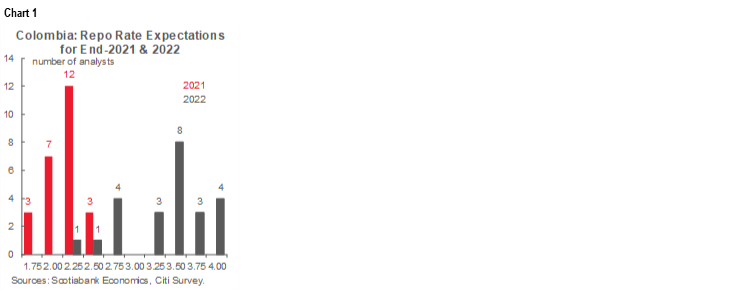
- Market consensus points to rate stability in the short run, with 100% of analysts surveyed expecting the monetary policy rate to be kept at 1.75% at tomorrow’s BanRep meeting (July 30), consistent with our view, above. For 2021, fewer survey respondents now expect rates unchanged (3 out of 25, versus 6 out of 25 in June). The rest of analysts expect between one and three 25bps rate hikes in 2021. In 2022, the median policy rate expected is 3.50% (chart 1).
- The USDCOP forecasts point to a slight appreciation in the currency through December 2021. On average, respondents expect a level of USDCOP 3,660 by the end of 2021 (previous survey: 3,592) and USDCOP 3,586 in 2022.
—Sergio Olarte & Jackeline Piraján
DISCLAIMER
This report has been prepared by Scotiabank Economics as a resource for the clients of Scotiabank. Opinions, estimates and projections contained herein are our own as of the date hereof and are subject to change without notice. The information and opinions contained herein have been compiled or arrived at from sources believed reliable but no representation or warranty, express or implied, is made as to their accuracy or completeness. Neither Scotiabank nor any of its officers, directors, partners, employees or affiliates accepts any liability whatsoever for any direct or consequential loss arising from any use of this report or its contents.
These reports are provided to you for informational purposes only. This report is not, and is not constructed as, an offer to sell or solicitation of any offer to buy any financial instrument, nor shall this report be construed as an opinion as to whether you should enter into any swap or trading strategy involving a swap or any other transaction. The information contained in this report is not intended to be, and does not constitute, a recommendation of a swap or trading strategy involving a swap within the meaning of U.S. Commodity Futures Trading Commission Regulation 23.434 and Appendix A thereto. This material is not intended to be individually tailored to your needs or characteristics and should not be viewed as a “call to action” or suggestion that you enter into a swap or trading strategy involving a swap or any other transaction. Scotiabank may engage in transactions in a manner inconsistent with the views discussed this report and may have positions, or be in the process of acquiring or disposing of positions, referred to in this report.
Scotiabank, its affiliates and any of their respective officers, directors and employees may from time to time take positions in currencies, act as managers, co-managers or underwriters of a public offering or act as principals or agents, deal in, own or act as market makers or advisors, brokers or commercial and/or investment bankers in relation to securities or related derivatives. As a result of these actions, Scotiabank may receive remuneration. All Scotiabank products and services are subject to the terms of applicable agreements and local regulations. Officers, directors and employees of Scotiabank and its affiliates may serve as directors of corporations.
Any securities discussed in this report may not be suitable for all investors. Scotiabank recommends that investors independently evaluate any issuer and security discussed in this report, and consult with any advisors they deem necessary prior to making any investment.
This report and all information, opinions and conclusions contained in it are protected by copyright. This information may not be reproduced without the prior express written consent of Scotiabank.
™ Trademark of The Bank of Nova Scotia. Used under license, where applicable.
Scotiabank, together with “Global Banking and Markets”, is a marketing name for the global corporate and investment banking and capital markets businesses of The Bank of Nova Scotia and certain of its affiliates in the countries where they operate, including; Scotiabank Europe plc; Scotiabank (Ireland) Designated Activity Company; Scotiabank Inverlat S.A., Institución de Banca Múltiple, Grupo Financiero Scotiabank Inverlat, Scotia Inverlat Casa de Bolsa, S.A. de C.V., Grupo Financiero Scotiabank Inverlat, Scotia Inverlat Derivados S.A. de C.V. – all members of the Scotiabank group and authorized users of the Scotiabank mark. The Bank of Nova Scotia is incorporated in Canada with limited liability and is authorised and regulated by the Office of the Superintendent of Financial Institutions Canada. The Bank of Nova Scotia is authorized by the UK Prudential Regulation Authority and is subject to regulation by the UK Financial Conduct Authority and limited regulation by the UK Prudential Regulation Authority. Details about the extent of The Bank of Nova Scotia's regulation by the UK Prudential Regulation Authority are available from us on request. Scotiabank Europe plc is authorized by the UK Prudential Regulation Authority and regulated by the UK Financial Conduct Authority and the UK Prudential Regulation Authority.
Scotiabank Inverlat, S.A., Scotia Inverlat Casa de Bolsa, S.A. de C.V, Grupo Financiero Scotiabank Inverlat, and Scotia Inverlat Derivados, S.A. de C.V., are each authorized and regulated by the Mexican financial authorities.
Not all products and services are offered in all jurisdictions. Services described are available in jurisdictions where permitted by law.