

Chile: Finance minister resigns to embark on a presidential campaign
Colombia: Citi survey shows economists anticipate a hold at the January 29 BanRep meeting
Mexico: Domestic commercial activity improved in November
CHILE: FINANCE MINISTER RESIGNS TO RUN FOR PRESIDENT
On Tuesday, January 26, the Minister of Finance Ignacio Briones presented his resignation to the cabinet in order to start his pre-campaign for the presidential election whose first round is due to be held on November 21, 2021. Briones will represent Evopoli in the presidential race, a center-right political party formed in 2012. He stepped down just as the government is in the middle of important negotiations with Congress regarding policies to support economic recovery, pension reform, the tax system, and regulations for the fintech and pension advisers industries.
Rodrigo Cerda, 47-years old, was appointed as the new Minister of Finance. Cerda has a PhD in Economics from the University of Chicago and recently served as Director of the Budget Office during the first two years of Sebastián Piñera’s second government (2018–19). He was also the Coordinator of Advisers to Minister Felipe Larraín in the Ministry of Finance during the first government of Sebastián Piñera (2010–13). Prior to his nomination, he worked as an academic at the Universidad Católica de Chile and was a member of the Board of Directors of Codelco, the state-owned mining company. He is associated with a more liberal approach to economic policy than his predecessor, given his closeness to former Finance Minister Felipe Larraín.
Some pending issues that Min. Cerda must address include: (i) closing the discussion on and producing an agreement to proceed on pension reform; (ii) promoting economic reactivation and job creation; (iii) carrying out tax adjustments, with a focus on the elimination of tax exemptions; (iv) strengthening the social protection network through a possible additional fiscal stimulus package or a universal guaranteed income project; and (v) managing the legislative agenda, which currently includes several populist projects being promoted by Congress and other more reasonable efforts. As a result, he will have to visit and negotiate intensively and extensively with Congress in order to deal with the country’s economic situation and the state of public finances.
This cabinet adjustment should have no direct market impact. The authorities will continue with the existing schedule of issuances and the current slate of ministerial advisers, with the possible incorporation of a macroeconomic coordinator who would come from the Ministry’s public service. The change should, however, generate an environment of greater calm and less confrontation between the Ministry’s staff and the political side of the government, at least for a couple of months—enough time to carry out a pension reform and make needed adjustments to the tax system.
—Waldo Riveras
COLOMBIA: CITI SURVEY SHOWS ECONOMISTS ANTICIPATE A HOLD AT THE JANUARY 29 BANREP MEETING
January’s Citi Survey, which the BanRep uses as one of its measures of expectations of inflation, the monetary policy rate, GDP, and the COP, came out on Tuesday, January 26.
Key points included:
- Growth forecasts were broadly unchanged. For 2020, a contraction of -7.16% y/y, 0.4 ppts deeper than last month’s survey reading of -7.20% y/y, is now expected. In 2021, the recovery is projected, on average, to hit a pace of 4.78% y/y, above the previous survey’s 4.73% y/y consensus. We forecast -7.5% y/y in 2020 and a rebound to 5.0% y/y in 2021 (see the Latam Weekly from January 25).
- Inflation expectations remained anchored in 2021 and 2022. January’s monthly inflation rates are, on average, expected to be 0.42% m/m and 1.61% y/y; we expect 0.34% m/m and 1.53% y/y on the back of more modest indexation effects, with positive contributions from foodstuffs, gasoline, and utility-fees prices. For December 2021, the survey’s average projection is 2.69% y/y, lower than the previous survey’s 2.74% y/y. Having said that, by December 2022, inflation is expected to hit 3.08% y/y, slightly above the central bank’s target. Our forecasts anticipate 2.8% y/y and 3.0% y/y for end-2021 and end-2022, respectively.
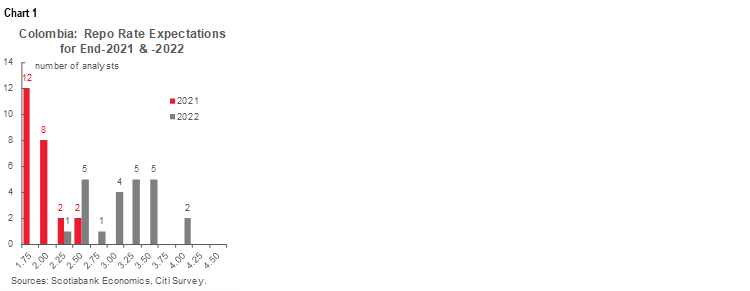
- Market consensus points to policy rate stability, with 100% of analysts surveyed expecting the BanRep to hold its headline rate at 1.75% at its Friday, January 29, meeting. For the remainder of 2021, analysts’ projections are dispersed between stability and 125 bps in hikes, with the mode at 1.75% (chart 1). For end-2022 the average of survey expectations is at 3.00%, but most analysts expect higher rates (chart 1, again)—including ourselves, where we forecast the BanRep policy rate to hit 4.00% by end-2022.
- The USDCOP forecasts point to a slight appreciation in the currency through December 2021. On average, respondents expect a level of USDCOP 3,460 by the end of 2021 and USDCOP 3,399 at end-2022. Here, consensus is very close to our forecasts of USDCOP 3,450 for end-2021 and USDCOP 3,400 for end-2022.
—Sergio Olarte & Jackeline Piraján
MEXICO: DOMESTIC COMMERCIAL ACTIVITY IMPROVED IN NOVEMBER
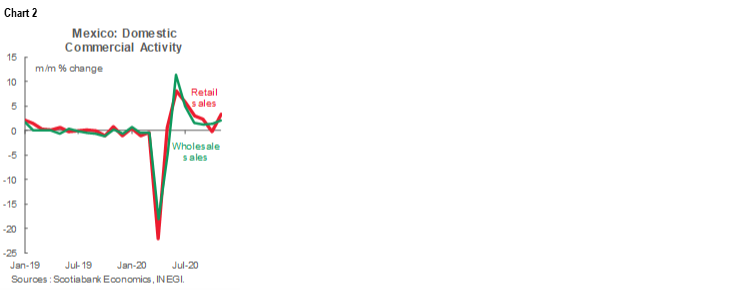
According to figures published by INEGI on Tuesday, January 26, November domestic commercial activity improved on a monthly basis, rebounding from a contraction of -0.2% m/m in October to 3.3% m/m growth (chart 2), thereby restoring the advances that have dominated the last seven months. Growth in wholesale trade remained in positive territory for a sixth consecutive month and accelerated from 1.4% m/m to 2.1% m/m (chart 2, again). The November 2020 sales numbers were skewed, however, by an unusually long “Buen Fin” 20-day seasonal sales event: Mexico’s equivalent to Black Friday normally lasts only four days, but it was extended in 2020 to support commercial activity amidst the pandemic. In our view, November’s sales were likely driven more by in-store discounts rather than a recovery in household consumption. We certainly suspect that the return to tighter lockdowns in December will dent the month’s sales numbers.
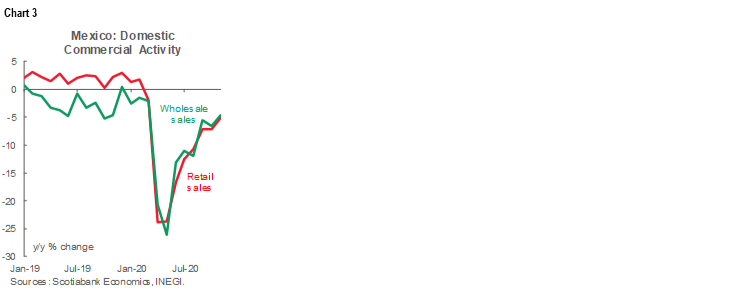
As expected, in its annual measurement, the figures for commercial activity remained in negative territory compared with a year ago, but the retail sales gap narrowed from -7.1% y/y in October to -5.1% y/y and the wholesale sales gap shrunk from 6.6% y/y in October to -4.7% y/y (chart 3).
Looking into the future, the recovery of consumption, employment, and economic activity as a whole will depend to a large extent on effective containment of the spread of COVID-19. In order to prevent strict lockdown measures from being maintained for a prolonged period, which would disproportionately hurt small and micro enterprises that employ a majority of the population, more effective testing, tracing, and containment measures would be needed.
—Paulina Villanueva
DISCLAIMER
This report has been prepared by Scotiabank Economics as a resource for the clients of Scotiabank. Opinions, estimates and projections contained herein are our own as of the date hereof and are subject to change without notice. The information and opinions contained herein have been compiled or arrived at from sources believed reliable but no representation or warranty, express or implied, is made as to their accuracy or completeness. Neither Scotiabank nor any of its officers, directors, partners, employees or affiliates accepts any liability whatsoever for any direct or consequential loss arising from any use of this report or its contents.
These reports are provided to you for informational purposes only. This report is not, and is not constructed as, an offer to sell or solicitation of any offer to buy any financial instrument, nor shall this report be construed as an opinion as to whether you should enter into any swap or trading strategy involving a swap or any other transaction. The information contained in this report is not intended to be, and does not constitute, a recommendation of a swap or trading strategy involving a swap within the meaning of U.S. Commodity Futures Trading Commission Regulation 23.434 and Appendix A thereto. This material is not intended to be individually tailored to your needs or characteristics and should not be viewed as a “call to action” or suggestion that you enter into a swap or trading strategy involving a swap or any other transaction. Scotiabank may engage in transactions in a manner inconsistent with the views discussed this report and may have positions, or be in the process of acquiring or disposing of positions, referred to in this report.
Scotiabank, its affiliates and any of their respective officers, directors and employees may from time to time take positions in currencies, act as managers, co-managers or underwriters of a public offering or act as principals or agents, deal in, own or act as market makers or advisors, brokers or commercial and/or investment bankers in relation to securities or related derivatives. As a result of these actions, Scotiabank may receive remuneration. All Scotiabank products and services are subject to the terms of applicable agreements and local regulations. Officers, directors and employees of Scotiabank and its affiliates may serve as directors of corporations.
Any securities discussed in this report may not be suitable for all investors. Scotiabank recommends that investors independently evaluate any issuer and security discussed in this report, and consult with any advisors they deem necessary prior to making any investment.
This report and all information, opinions and conclusions contained in it are protected by copyright. This information may not be reproduced without the prior express written consent of Scotiabank.
™ Trademark of The Bank of Nova Scotia. Used under license, where applicable.
Scotiabank, together with “Global Banking and Markets”, is a marketing name for the global corporate and investment banking and capital markets businesses of The Bank of Nova Scotia and certain of its affiliates in the countries where they operate, including; Scotiabank Europe plc; Scotiabank (Ireland) Designated Activity Company; Scotiabank Inverlat S.A., Institución de Banca Múltiple, Grupo Financiero Scotiabank Inverlat, Scotia Inverlat Casa de Bolsa, S.A. de C.V., Grupo Financiero Scotiabank Inverlat, Scotia Inverlat Derivados S.A. de C.V. – all members of the Scotiabank group and authorized users of the Scotiabank mark. The Bank of Nova Scotia is incorporated in Canada with limited liability and is authorised and regulated by the Office of the Superintendent of Financial Institutions Canada. The Bank of Nova Scotia is authorized by the UK Prudential Regulation Authority and is subject to regulation by the UK Financial Conduct Authority and limited regulation by the UK Prudential Regulation Authority. Details about the extent of The Bank of Nova Scotia's regulation by the UK Prudential Regulation Authority are available from us on request. Scotiabank Europe plc is authorized by the UK Prudential Regulation Authority and regulated by the UK Financial Conduct Authority and the UK Prudential Regulation Authority.
Scotiabank Inverlat, S.A., Scotia Inverlat Casa de Bolsa, S.A. de C.V, Grupo Financiero Scotiabank Inverlat, and Scotia Inverlat Derivados, S.A. de C.V., are each authorized and regulated by the Mexican financial authorities.
Not all products and services are offered in all jurisdictions. Services described are available in jurisdictions where permitted by law.