

Mexico: February’s industrial production data showed continued signs of gradual recovery
Peru: Early indications pointed to possible surprise in presidential elections’ first round
MEXICO: FEBRUARY’S INDUSTRIAL PRODUCTION DATA SHOWED CONTINUED SIGNS OF GRADUAL RECOVERY
February’s industrial production data, released on Friday, April 9, by INEGI, showed continued signs of gradual recovery. Gains were driven mainly by construction, which offset to some extent the impact of adverse weather conditions in northern Mexico and the southern United States on manufacturing and electricity generation.
In seasonally-adjusted terms, industrial activity notched up a ninth consecutive month of advances, although since November there have been rather modest increases: in February, sequential growth accelerated from 0.2% m/m to 0.4% m/m. Construction and mining growth accelerated from 1.7% m/m to 2.5% m/m, and from 1.2% m/m to 2.3% m/m, respectively. Manufacturing growth slowed for a second consecutive month, from -1.2% m/m to -2.1% m/m, as did growth in utilities generation, from -1.9% m/m to -3.8% m/m. Within manufacturing, production plants in several states were affected by reduced energy availability stemming from intense cold in the southern US.
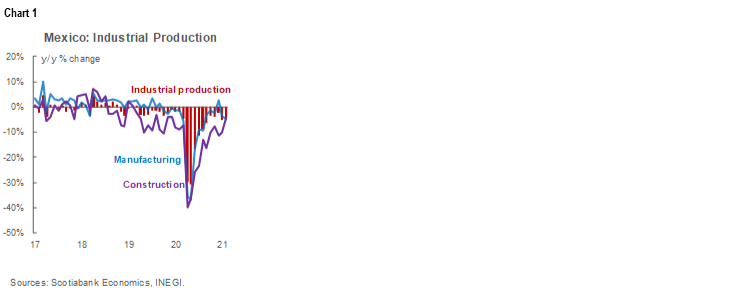
On an annual basis, industrial activity continued to trim its gaps compared with the year before, from -5.0% y/y in January to -4.5% y/y in February (chart 1). This made for a 23rd month in which production has been lower than the year prior. Construction led the improvement as the sector softened its losses from -10.2% y/y to -4.4% y/y; mining also closed its gaps from a year ago, going from -3.4% y/y to -2.5% y/y. Together, these two sectors largely compensated for the deeper declines in manufacturing, from -3.4% y/y to -4.7% y/y, and utilities, from -4.9% y/y to -9.9% y/y, which were both caused by adverse weather conditions and energy shortages in the southern US.
In the coming months, semiconductor bottlenecks in the automotive industry could continue to lead to production holdups, lower installed capacity utilization, and smaller manufacturing output. For 2021, we maintain our view that external demand will lead the recovery, albeit with an outlook marked by persistent uncertainty.
—Paulina Villanueva
PERU: EARLY INDICATIONS POINTED TO POSSIBLE SURPRISE IN PRESIDENTIAL ELECTIONS’ FIRST ROUND
Both exit polls and early returns pointed to a better-than-expected performance by labour leader Pedro Castillo in Sunday’s first round of voting in Peru’s presidential elections. Early exit polls implied that Castillo could win around 16% of votes cast in the Sunday, April 11, process, followed by conservative Keiko Fujimori and economist Hernando de Soto, both at around 12% shares. In actual vote tallies compiled early on Monday, April 12, that accounted for about 16% of ballots cast, Castillo’s support hovered around 15.7%.
Castillo’s performance appears much stronger than the 6–9% share of support anticipated in major polls as recently as early last week (see our April 7 Latam Daily), but numbers are likely to shift further as additional polling stations report results. None of the 18 candidates is expected to secure the 50%+1 share of votes that would allow them to ensure a win in the first round of voting. Instead, the top two candidates are expected to advance to a second vote scheduled for June.
—Brett House
DISCLAIMER
This report has been prepared by Scotiabank Economics as a resource for the clients of Scotiabank. Opinions, estimates and projections contained herein are our own as of the date hereof and are subject to change without notice. The information and opinions contained herein have been compiled or arrived at from sources believed reliable but no representation or warranty, express or implied, is made as to their accuracy or completeness. Neither Scotiabank nor any of its officers, directors, partners, employees or affiliates accepts any liability whatsoever for any direct or consequential loss arising from any use of this report or its contents.
These reports are provided to you for informational purposes only. This report is not, and is not constructed as, an offer to sell or solicitation of any offer to buy any financial instrument, nor shall this report be construed as an opinion as to whether you should enter into any swap or trading strategy involving a swap or any other transaction. The information contained in this report is not intended to be, and does not constitute, a recommendation of a swap or trading strategy involving a swap within the meaning of U.S. Commodity Futures Trading Commission Regulation 23.434 and Appendix A thereto. This material is not intended to be individually tailored to your needs or characteristics and should not be viewed as a “call to action” or suggestion that you enter into a swap or trading strategy involving a swap or any other transaction. Scotiabank may engage in transactions in a manner inconsistent with the views discussed this report and may have positions, or be in the process of acquiring or disposing of positions, referred to in this report.
Scotiabank, its affiliates and any of their respective officers, directors and employees may from time to time take positions in currencies, act as managers, co-managers or underwriters of a public offering or act as principals or agents, deal in, own or act as market makers or advisors, brokers or commercial and/or investment bankers in relation to securities or related derivatives. As a result of these actions, Scotiabank may receive remuneration. All Scotiabank products and services are subject to the terms of applicable agreements and local regulations. Officers, directors and employees of Scotiabank and its affiliates may serve as directors of corporations.
Any securities discussed in this report may not be suitable for all investors. Scotiabank recommends that investors independently evaluate any issuer and security discussed in this report, and consult with any advisors they deem necessary prior to making any investment.
This report and all information, opinions and conclusions contained in it are protected by copyright. This information may not be reproduced without the prior express written consent of Scotiabank.
™ Trademark of The Bank of Nova Scotia. Used under license, where applicable.
Scotiabank, together with “Global Banking and Markets”, is a marketing name for the global corporate and investment banking and capital markets businesses of The Bank of Nova Scotia and certain of its affiliates in the countries where they operate, including; Scotiabank Europe plc; Scotiabank (Ireland) Designated Activity Company; Scotiabank Inverlat S.A., Institución de Banca Múltiple, Grupo Financiero Scotiabank Inverlat, Scotia Inverlat Casa de Bolsa, S.A. de C.V., Grupo Financiero Scotiabank Inverlat, Scotia Inverlat Derivados S.A. de C.V. – all members of the Scotiabank group and authorized users of the Scotiabank mark. The Bank of Nova Scotia is incorporated in Canada with limited liability and is authorised and regulated by the Office of the Superintendent of Financial Institutions Canada. The Bank of Nova Scotia is authorized by the UK Prudential Regulation Authority and is subject to regulation by the UK Financial Conduct Authority and limited regulation by the UK Prudential Regulation Authority. Details about the extent of The Bank of Nova Scotia's regulation by the UK Prudential Regulation Authority are available from us on request. Scotiabank Europe plc is authorized by the UK Prudential Regulation Authority and regulated by the UK Financial Conduct Authority and the UK Prudential Regulation Authority.
Scotiabank Inverlat, S.A., Scotia Inverlat Casa de Bolsa, S.A. de C.V, Grupo Financiero Scotiabank Inverlat, and Scotia Inverlat Derivados, S.A. de C.V., are each authorized and regulated by the Mexican financial authorities.
Not all products and services are offered in all jurisdictions. Services described are available in jurisdictions where permitted by law.