

Chile: Possible second withdrawal from pension funds moves forward in the Chamber of Deputies
Mexico: September exports registered first annual increase since pandemic began
Peru: Bank loans growth still robust in September, but with REACTIVA fading October will be telling
CHILE: POSSIBLE SECOND WITHDRAWAL FROM PENSION FUNDS MOVES FORWARD IN THE CHAMBER OF DEPUTIES
On Tuesday, October 27, the proposal for a second withdrawal of pension funds was approved in the Constitutional Committee of the Chamber of Deputies. Following this endorsement, the bill must be discussed by the entire Chamber of Deputies. If it is approved there, then later it will have to be ratified by the Senate in order to become law.
According to the initiative presented by a group of opposition members of Congress, anyone who has funds in their individual capitalization account at the private pension funds (AFPs) would be able to make a new withdrawal. On this occasion, the withdrawal could be made for amounts equal to those of the first withdrawal: that is, between USD 1,300 and USD 5,600. Those who have savings over the maximum amount would be able to withdraw only 10% of these additional funds. The withdrawals would be effected through the same infrastructure created for the first withdrawal of AFP monies, so the administrators should not change the payment method nor the information channels used previously. According to the bill, this new withdrawal would be made in one installment (n.b., the first was made in two) and, in addition, it would be available to be done at any time since it does not have an expiration date.
Along with another withdrawal of funds from the individual capitalization accounts at the AFPs, the bill would also allow an exceptional draw of resources accumulated at insurance companies in the form of life annuities. These annuities typically provide pensions to people already retired.
Thirdly, the bill under discussion also includes a proposal for a direct bonus amounting to CLP 500,000 (USD 650) for people who no longer have funds in their individual accounts. This proposal must gain the support of the Government since it would imply the disbursement of fiscal resources. If approved, it is estimated that around 3 million people could benefit from this bonus, which would imply a possible fiscal cost of nearly USD 2 bn for this item alone.
Preliminary estimates suggest that this bill would imply a total withdrawal from the pension system of USD 12.8 bn: USD 10 bn of withdrawals from the individual capitalization accounts at the AFPS and USD 2.8 bn from the insurance companies that provide annuities to pensioners. Additionally, this initiative would generate a total fiscal cost of around USD 6 bn: about USD 4 bn would fund a greater contribution to the solidarity pension pillar, while, as noted above, USD 2 bn would be destined for the proposed direct bonus to those who do not have funds in their capitalization accounts.
The Government has expressed its opposition to this bill, arguing that it would reduce future pensions, on average, by 23%. It is estimated that about 2 million people withdrew all of their funds from the pension system under the first withdrawal a few months ago; this second withdrawal would leave a total of about 4 million people without pension funds.
In parallel, the Government is working on a reform to the pension system that would increase individual contributions by 6 percentage points. The distribution of where these 6 percentage points would be directed (i.e., toward individual capitalization accounts or collective funds) is still uncertain. According to the Minister of Finance, the bill is expected to be sent to Congress within the next month.
The BCCh (central bank) has stated that this proposed second withdrawal could have a potentially more disruptive effect on financial markets by forcing a sell-off of a greater proportion of local assets. The central bank and regulators would have limited scope to mitigate these effects. Nevertheless, we do not rule out appreciating pressures on the peso owing to the liquidation of foreign assets and repatriation of funds by the AFPs, which still have a degree of flexibility in their investments.
All in all, the prospects for the approval of this bill are still uncertain. At the time of the first withdrawal, which was discussed in July, the Chilean economy was under strict confinement, with a severe deterioration in economic activity and an urgent need to extend economic aid to a large part of the population. This drove broad support in Congress, from both opposition and governing-coalition members, to approve the withdrawal of pension funds. The current situation is slightly different, with an economy that is in the process of re-opening and with legislators from the ruling coalition less willing to approve a second withdrawal.
—Carlos Muñoz & Waldo Riveras
MEXICO: SEPTEMBER EXPORTS REGISTERED FIRST ANNUAL INCREASE SINCE PANDEMIC BEGAN
On Tuesday, October 27, INEGI released September’s trade data, which continued to show a significant surplus at USD 4.3 bn (chart 1). While this marked a substantial pullback from August’s high of USD 6.1 bn, it was a fourth consecutive month of surplus and a fourth straight month in which the trade balance exceeded consensus expectations, which anticipated USD 4.0 bn in September. The better-than-expected surplus was driven by the first annual increase in exports since March at 3.7% y/y, while imports were off by -8.5% y/y—which was still an improvement from August’s -22.2% y/y. As a result, total foreign trade flows (i.e., exports + imports) attenuated their decrease considerably from -14.9% y/y in August to -2.4% y/y in September.
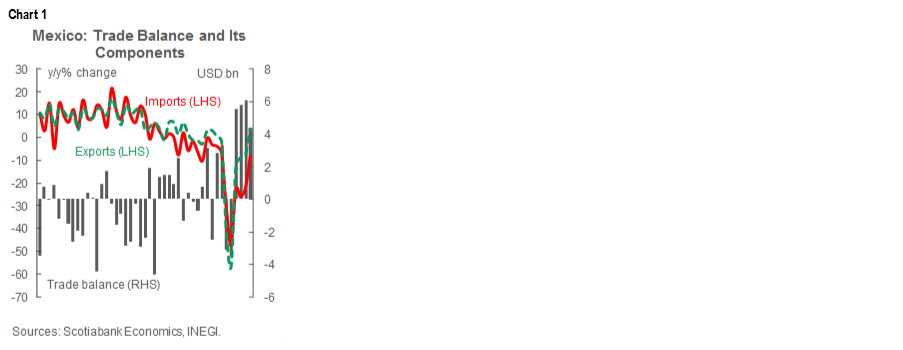
Trade levels reflect a recovery from the large declines in April and May, when many industries were closed due to the COVID-19 pandemic, both in Mexico and its main trade partner the US. Thus, the different rhythms of recovery within external and internal demand point to ongoing weakness in the domestic market, which is giving rise to strong trade surpluses. This behaviour is expected to continue for the rest of the year since domestic demand is likely to remain weak while external demand should continue to grow at a moderate pace.
—Paulina Villanueva
PERU: BANK LOANS GROWTH STILL ROBUST IN SEPTEMBER, BUT WITH REACTIVA FADING OCTOBER WILL BE TELLING
Bank loans were up a robust 13.6% y/y in September according to data recently released by Peru’s banking association, Asbanc (chart 2). This marked a slight slowdown from 14.0% y/y in August. The drop was expected and is projected to continue as the REACTIVA government-sponsored loan program slows. In the details, underlying trends continued. Business loans were up 22.9% y/y, led by small-business lending, which rose a huge 57% y/y. The REACTIVA loans, especially those under its more recent phase 2, were earmarked by the authorities for credit to SMEs. On the other end of the business-loans spectrum, corporate loans rose a negligible 0.2% y/y. This may be more representative of actual economic activity, whereas the REACTIVA-linked loans represent demand for emergency liquidity.
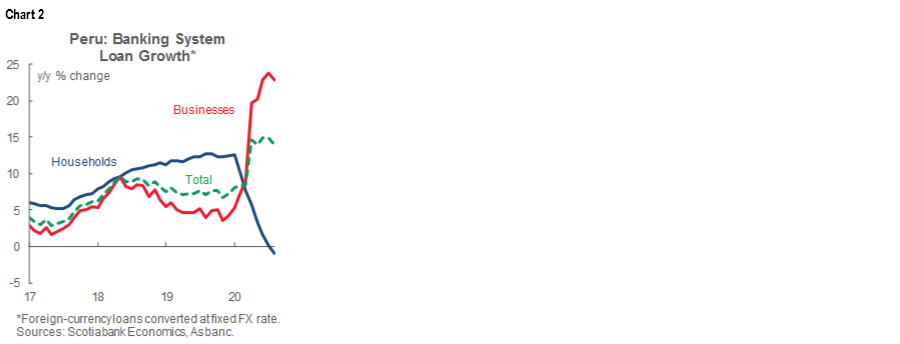
The trend in household loans growth turned down in February, but has now dipped into negative territory, at -0.9% y/y. Consumer loans fell -3.9% y/y. The silver lining was mortgage loans, up 2.9% y/y, in line with relatively buoyant real estate data.
Overall, as the REACTIVA program dissipates—August was the peak, although the program lasted until mid-October—loans growth will become more aligned with economic activity and less with emergency liquidity needs. We expect loans growth to slow significantly beginning in October.
—Guillermo Arbe
DISCLAIMER
This report has been prepared by Scotiabank Economics as a resource for the clients of Scotiabank. Opinions, estimates and projections contained herein are our own as of the date hereof and are subject to change without notice. The information and opinions contained herein have been compiled or arrived at from sources believed reliable but no representation or warranty, express or implied, is made as to their accuracy or completeness. Neither Scotiabank nor any of its officers, directors, partners, employees or affiliates accepts any liability whatsoever for any direct or consequential loss arising from any use of this report or its contents.
These reports are provided to you for informational purposes only. This report is not, and is not constructed as, an offer to sell or solicitation of any offer to buy any financial instrument, nor shall this report be construed as an opinion as to whether you should enter into any swap or trading strategy involving a swap or any other transaction. The information contained in this report is not intended to be, and does not constitute, a recommendation of a swap or trading strategy involving a swap within the meaning of U.S. Commodity Futures Trading Commission Regulation 23.434 and Appendix A thereto. This material is not intended to be individually tailored to your needs or characteristics and should not be viewed as a “call to action” or suggestion that you enter into a swap or trading strategy involving a swap or any other transaction. Scotiabank may engage in transactions in a manner inconsistent with the views discussed this report and may have positions, or be in the process of acquiring or disposing of positions, referred to in this report.
Scotiabank, its affiliates and any of their respective officers, directors and employees may from time to time take positions in currencies, act as managers, co-managers or underwriters of a public offering or act as principals or agents, deal in, own or act as market makers or advisors, brokers or commercial and/or investment bankers in relation to securities or related derivatives. As a result of these actions, Scotiabank may receive remuneration. All Scotiabank products and services are subject to the terms of applicable agreements and local regulations. Officers, directors and employees of Scotiabank and its affiliates may serve as directors of corporations.
Any securities discussed in this report may not be suitable for all investors. Scotiabank recommends that investors independently evaluate any issuer and security discussed in this report, and consult with any advisors they deem necessary prior to making any investment.
This report and all information, opinions and conclusions contained in it are protected by copyright. This information may not be reproduced without the prior express written consent of Scotiabank.
™ Trademark of The Bank of Nova Scotia. Used under license, where applicable.
Scotiabank, together with “Global Banking and Markets”, is a marketing name for the global corporate and investment banking and capital markets businesses of The Bank of Nova Scotia and certain of its affiliates in the countries where they operate, including, Scotiabanc Inc.; Citadel Hill Advisors L.L.C.; The Bank of Nova Scotia Trust Company of New York; Scotiabank Europe plc; Scotiabank (Ireland) Limited; Scotiabank Inverlat S.A., Institución de Banca Múltiple, Scotia Inverlat Casa de Bolsa S.A. de C.V., Scotia Inverlat Derivados S.A. de C.V. – all members of the Scotiabank group and authorized users of the Scotiabank mark. The Bank of Nova Scotia is incorporated in Canada with limited liability and is authorised and regulated by the Office of the Superintendent of Financial Institutions Canada. The Bank of Nova Scotia is authorised by the UK Prudential Regulation Authority and is subject to regulation by the UK Financial Conduct Authority and limited regulation by the UK Prudential Regulation Authority. Details about the extent of The Bank of Nova Scotia's regulation by the UK Prudential Regulation Authority are available from us on request. Scotiabank Europe plc is authorised by the UK Prudential Regulation Authority and regulated by the UK Financial Conduct Authority and the UK Prudential Regulation Authority.
Scotiabank Inverlat, S.A., Scotia Inverlat Casa de Bolsa, S.A. de C.V., and Scotia Derivados, S.A. de C.V., are each authorized and regulated by the Mexican financial authorities.
Not all products and services are offered in all jurisdictions. Services described are available in jurisdictions where permitted by law.