

Colombia: August exports were down by -21.3% y/y, although they keep improving from April’s lows
Mexico: Consensus outlook improves; remittances remain at record levels; referendum looming
Peru: Inflation surprises to the upside; debt relief bill in the works; international flights to resume
COLOMBIA: AUGUST EXPORTS WERE DOWN BY -21.3% Y/Y, ALTHOUGH THEY KEEP IMPROVING FROM APRIL’S LOWS
According to DANE's release on Thursday October 1, August’s monthly exports stood at USD 2.6 bn (-21.3% y/y, chart 1). Although August’s data showed the highest export numbers since the pandemic’s shock began, they continue at their lowest levels in four years. The annual contraction was a bit smaller than in July, especially on the back of better oil-related exports that were down -39% y/y, while in July they were off -51% y/y. Coal exports continue to be weak and remained down by -26% y/y. Agricultural exports were off by -7.1% y/y, while manufacturing exports were still down by -17.2% y/y.
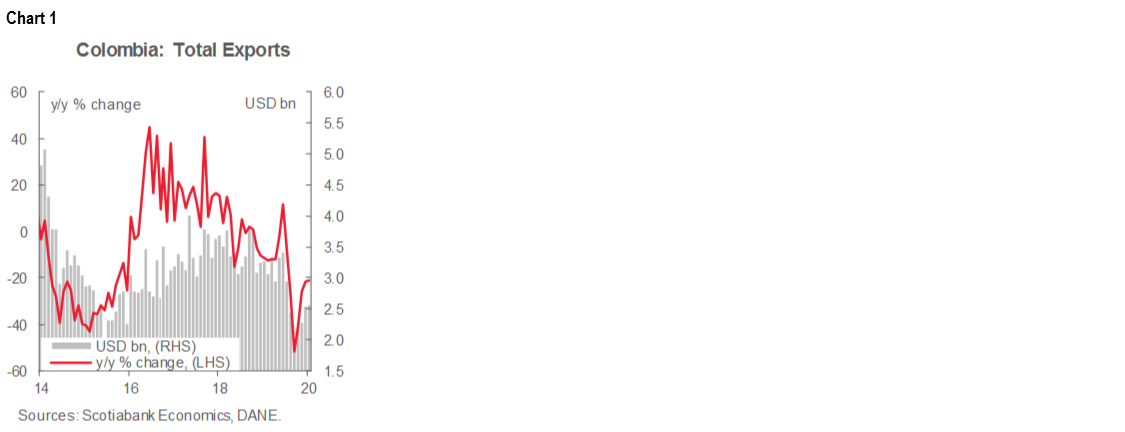
August’s exports still reflect weakness in demand from trade partners and the negative effect of the sharp drop in commodity prices that we’ve seen. Traditional exports were down by -33.4% y/y in August (chart 2), an improvement from the previous month’s figure, but still weak. Coffee exports were still down -9% y/y due to lower volumes. Oil-related exports represented 32% of total exports compared with 40% of total exports in 2019. Yet, oil still provides a drag on total exports since oil shipments continue at their lowest values since 2009. International prices, still lower than last year, and global demand both continued to weigh on oil export values. Similarly, coal exports values were hit on both volumes and prices. Non-traditional exports amounted to USD 1.25 bn in August, a contraction of -2.4% y/y. Agricultural exports were hit by lower flower exports.

August’s exports numbers showed a small improvement compared to the previous months’ data. The world’s economic re-opening process and oil price stability could further firm up export values in the coming months. The impact on the current account should be moderate due to a simultaneous deterioration in exports and imports resulting from automatic stabilizers in the economy.
—Sergio Olarte & Jackeline Piraján
MEXICO: CONSENSUS OUTLOOK IMPROVES; REMITTANCES REMAIN AT RECORD LEVELS; REFERENDUM LOOMING
I. Mexican outlook for 2020 slightly better in September Banxico Survey of Expectations
According to the Banxico Survey of Expectations for September, released on October 1, private-sector economic analysts have edged back their expectations for the 2020 contraction in GDP for a second consecutive time, on this occasion from -9.97% y/y to -9.82% y/y. Likewise, the economic rebound expected in 2021 was notched up from 3.01% y/y to 3.26% y/y, the highest expected rate for 2021 we’ve seen. Looking at the other details:
- Expectations increased for both headline and core inflation at the end of 2020 to 3.89% y/y (previously 3.64% y/y) and 3.90% y/y (previously 3.82% y/y), respectively. For the end of 2021, both headline and core inflation forecasts decreased marginally to 3.57% y/y (previously 3.60% y/y) and 3.47% y/y (previously 3.50% y/y). We emphasize that, on the horizon where monetary policy operates, both headline and core inflation expectations remain within Banxico’s target range.
- Exchange-rate projections for the end of 2020 and 2021 strengthened from the August survey and the Mexican currency is expected to end 2020 at USDMXN 22.50 (previously USDMXN 22.69) and USDMXN 22.50 (USDMXN 22.61) in both cases.
- As for monetary policy, it’s worth noting that for the fourth quarter of 2020, most analysts anticipate an interbank funding rate equal to the current target rate of 4.25%; however, a few expect further cuts this year. From the first quarter of 2021 to the first quarter of 2022, the analysts’ consensus expects the funding rate to fall below the current level.
- Regarding the factors that could hinder Mexico’s economic growth in the next six months, the most-cited issues were related to domestic economic conditions (42%), governance (23%), and external conditions (18%).
—Miguel Saldaña
II. Remittances maintain record levels in August
In data released by Banxico on Thursday, October 1, remittances—an important source of foreign exchange and resources for Mexico, with high impact on consumption—totaled USD 3,574 mn in August and USD 26,396 mn in the first eight months of the year. These were record amounts for both August and the first eight months of the year, which implied annual increases of 5.3% y/y in August and 9.4% y/y YTD. The continuous and favourable evolution of the flow of remittances, as well as the fact that their average amount remained at a high level, reflects the rebound in employment in the United States. Some of the sectors that tend to hire Mexican migrants—construction, manufacturing, professional and administrative services, health and education, and trade—have performed relatively positively, and have offset other sectors, such as hotels and restaurants, that also employ large numbers of Mexican migrants.

—Paulina Villanueva
III. Supreme Court approved a referendum on Presidential trials
In addition, on Thursday, October 1, the Supreme Court approved as constitutional the referendum proposed by the federal government to bring former Presidents to trial on charges of possible corruption. The local financial markets reacted adversely to the decision, in line with their previous reception of referendums that have been conducted, such as those that confirmed the construction of the Mayan Train and the cancellations of the New International Airport of Mexico (NAIM) and the brewery in Mexicalli, close to the US border. This new referendum could hinder the already deteriorated investment environment as investors could perceive the process as a deterioration of the rule of law and the division of constitutional power.
—Miguel Saldaña
PERU: INFLATION SURPRISES TO THE UPSIDE; DEBT RELIEF BILL IN THE WORKS; INTERNATIONAL FLIGHTS TO RESUME
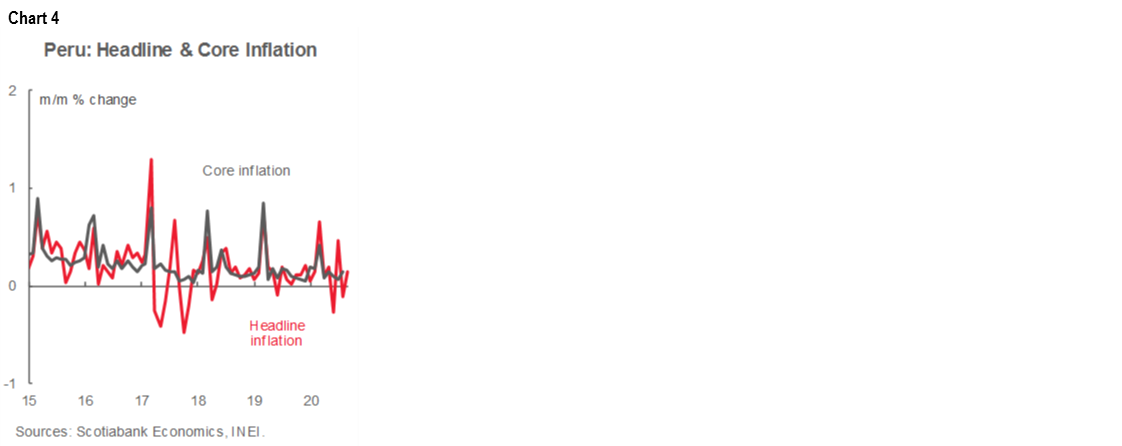
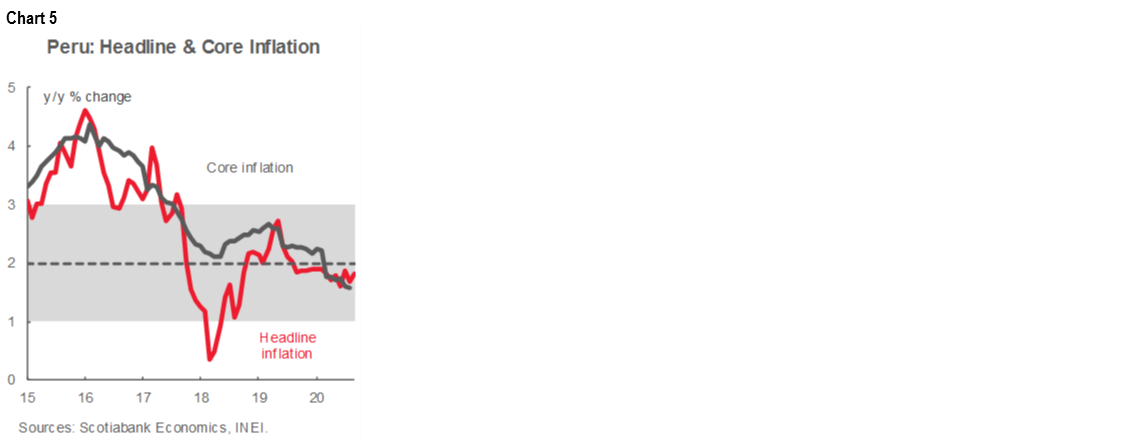
Inflation surprised to the upside in September data out on Thursday, October 1. Lima inflation rose 0.14% m/m (chart 4). This took yearly inflation up to 1.8% y/y, from 1.7% y/y in August (chart 5). We had been expecting annual inflation to slow from August to September. The figure puts our full-year forecast for 2020 of 1.1% y/y into question. September was the third consecutive month in which inflation came in higher than expected. In past months there were one-off effects that one could blame, at least partially. However, there had already been signs, which became much more evident in September, of resistance to deflation in basic food prices. Furthermore, prices of other goods linked to domestic demand were stable, but did not decline, as we thought they might. Now that the worst of the contraction is over, the risk of temporary deflation is fading. The fact that there is no indication that inflation will resume its downward trend should not lead the BCRP to change its monetary policy—we still expect the reference rate to remain at 0.25% for the next twelve months at least—but it does mean that, with only three months left in the year, that both the BCRP 2020 forecast (0.8% y/y) and our own (1.1% y/y) seem now to be out of reach.
The Government has sent Congress a bill that intends to provide bank-debt relief for individuals and some SMEs. The bill targets 25% of individuals, as well as certain small businesses, that have not been able to reprogram their bank debt, presumably due to risk considerations. The relief consists of government backing that would allow financial institutions to reprogram debt payments without incurring related risk. The Government hopes that this proposal will be accepted by Congress and replace much more aggressive—and questionable—Congressional initiatives currently being discussed.
The Government has also authorized international flights and travel to and from Bolivia, Chile, Colombia, Ecuador, Panama, Paraguay, and Uruguay. The Government had already announced that international flights would begin on October 5 to a limited number of destinations, but had not previously indicated which countries would be included. The destinations announced are united by being within a four-hour flight from Peru.
—Guillermo Arbe
DISCLAIMER
This report has been prepared by Scotiabank Economics as a resource for the clients of Scotiabank. Opinions, estimates and projections contained herein are our own as of the date hereof and are subject to change without notice. The information and opinions contained herein have been compiled or arrived at from sources believed reliable but no representation or warranty, express or implied, is made as to their accuracy or completeness. Neither Scotiabank nor any of its officers, directors, partners, employees or affiliates accepts any liability whatsoever for any direct or consequential loss arising from any use of this report or its contents.
These reports are provided to you for informational purposes only. This report is not, and is not constructed as, an offer to sell or solicitation of any offer to buy any financial instrument, nor shall this report be construed as an opinion as to whether you should enter into any swap or trading strategy involving a swap or any other transaction. The information contained in this report is not intended to be, and does not constitute, a recommendation of a swap or trading strategy involving a swap within the meaning of U.S. Commodity Futures Trading Commission Regulation 23.434 and Appendix A thereto. This material is not intended to be individually tailored to your needs or characteristics and should not be viewed as a “call to action” or suggestion that you enter into a swap or trading strategy involving a swap or any other transaction. Scotiabank may engage in transactions in a manner inconsistent with the views discussed this report and may have positions, or be in the process of acquiring or disposing of positions, referred to in this report.
Scotiabank, its affiliates and any of their respective officers, directors and employees may from time to time take positions in currencies, act as managers, co-managers or underwriters of a public offering or act as principals or agents, deal in, own or act as market makers or advisors, brokers or commercial and/or investment bankers in relation to securities or related derivatives. As a result of these actions, Scotiabank may receive remuneration. All Scotiabank products and services are subject to the terms of applicable agreements and local regulations. Officers, directors and employees of Scotiabank and its affiliates may serve as directors of corporations.
Any securities discussed in this report may not be suitable for all investors. Scotiabank recommends that investors independently evaluate any issuer and security discussed in this report, and consult with any advisors they deem necessary prior to making any investment.
This report and all information, opinions and conclusions contained in it are protected by copyright. This information may not be reproduced without the prior express written consent of Scotiabank.
™ Trademark of The Bank of Nova Scotia. Used under license, where applicable.
Scotiabank, together with “Global Banking and Markets”, is a marketing name for the global corporate and investment banking and capital markets businesses of The Bank of Nova Scotia and certain of its affiliates in the countries where they operate, including, Scotiabanc Inc.; Citadel Hill Advisors L.L.C.; The Bank of Nova Scotia Trust Company of New York; Scotiabank Europe plc; Scotiabank (Ireland) Limited; Scotiabank Inverlat S.A., Institución de Banca Múltiple, Scotia Inverlat Casa de Bolsa S.A. de C.V., Scotia Inverlat Derivados S.A. de C.V. – all members of the Scotiabank group and authorized users of the Scotiabank mark. The Bank of Nova Scotia is incorporated in Canada with limited liability and is authorised and regulated by the Office of the Superintendent of Financial Institutions Canada. The Bank of Nova Scotia is authorised by the UK Prudential Regulation Authority and is subject to regulation by the UK Financial Conduct Authority and limited regulation by the UK Prudential Regulation Authority. Details about the extent of The Bank of Nova Scotia's regulation by the UK Prudential Regulation Authority are available from us on request. Scotiabank Europe plc is authorised by the UK Prudential Regulation Authority and regulated by the UK Financial Conduct Authority and the UK Prudential Regulation Authority.
Scotiabank Inverlat, S.A., Scotia Inverlat Casa de Bolsa, S.A. de C.V., and Scotia Derivados, S.A. de C.V., are each authorized and regulated by the Mexican financial authorities.
Not all products and services are offered in all jurisdictions. Services described are available in jurisdictions where permitted by law.