

Two Scotiabank employees and military reservists are leaving their families and day jobs behind for several months to deploy to Latvia as part of Canada’s contribution to NATO’s defence and deterrence mission in the Baltic state.
Canada has been a key player in Operation Reassurance since 2014 and currently leads NATO Multinational Brigade Latvia, with more than 2,000 Canadian Armed Forces members on the ground serving alongside a host of other NATO countries. The mission is Canada’s largest current international military deployment.
Luis Fernando Orellano-Castillo, a Senior Manager of Data Governance at Scotiabank and Captain in the 7th Toronto Regiment of the Royal Canadian Artillery, is already in Riga, the Latvian capital, where the mission is based. A logistics officer, he’s second in command of the technical services support unit, ensuring troops have everything they need, from ammunition to clothing, transportation to portable heaters, and much more.
Orellano-Castillo wasn’t supposed to deploy until December, but he was asked if he could go early to replace an officer who been there for an extended period. When he got the call, which would extend his deployment from six to nine months, he knew he needed to get permission – starting with his wife.
“There were some tears, it wasn’t easy,” he said.
The hard part is missing Christmas, and all three of his teenage children’s birthdays. Despite that, he says his family understands why it’s important for him to answer the call.
“I'm doing this not only for myself or Canada, I do it also for my family,” he said. “It might sound romantic, if I can call it that, but you don't do this because you want to feel good. I had to do it because I had to protect my family, my country, my friends. It's not only a uniform — it's a higher call.”
One-third of Canadian Armed Forces are reservists
He also needed approval from work, which was not a problem.
“The Bank has supported me 100%. Every single time I ask the Bank, they say ‘yes’.”
Reservists make up close to a third of the Canadian Armed Forces and are trained to the same level as their full-time counterparts. Orellano-Castillo joined the reserves in 2015, at the age of 42. The training was hard, and his much-younger colleagues called him “grandpa.” But as an immigrant from Colombia, he saw it as a way to give back to his adoptive country.
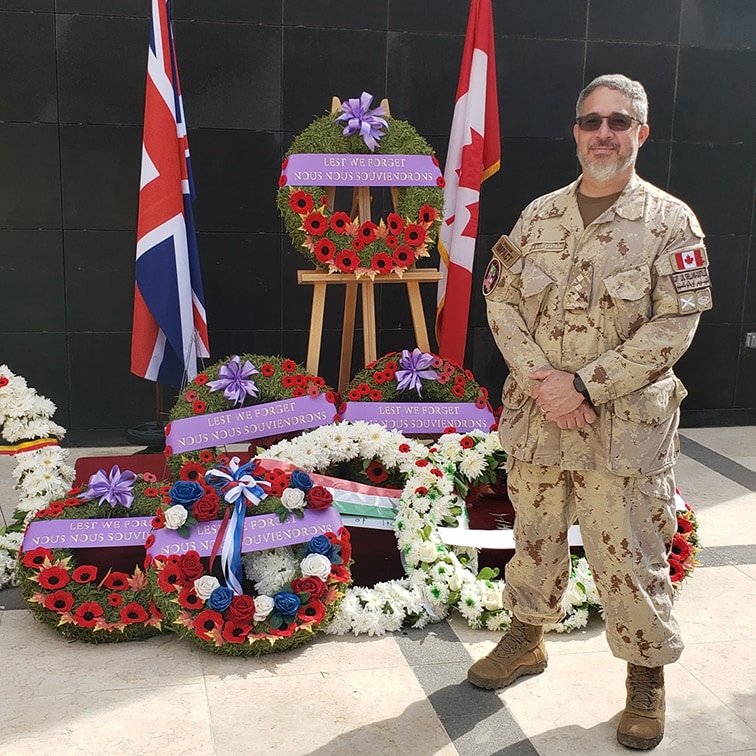
Luis Fernando Orellano-Castillo at a Remembrance Day display.
“I need to pay back my debt of gratitude,” he said in an interview from the base in Latvia. “I’ve been in Canada 23 years, and in those 23 years, I have everything – my house, my kids were born in Canada, everything. There's no better way give back than being honored to wear the country’s uniform and flag.”
Joseph Curry is Director of Physical Security with Scotiabank, and a Major and Deputy Commanding Officer of the Lorne Scots Infantry Regiment in the Army Reserves. He’ll be deploying to Latvia – his third international deployment – shortly after Remembrance Day.
As a senior intelligence officer, he leads teams that assess and manage risks to the armed forces. In Latvia, his work will be focused on force protection, assessing and monitoring for potential risks and threats to personnel.
Though he had no family history of involvement with the military, Curry joined the reserves in 2007. The Canadian Armed Forces (CAF) were then six years into their 14-year deployment in Afghanistan – during which 158 CAF members were ultimately killed. That mission started after the 9/11 terrorist attacks in 2001. Curry said those attacks made him very aware of the dangers of the world, and he decided he wanted to be involved in countering them.
“I had friends that had signed up and gone overseas to serve, and I just felt like it was something that I needed to do, had to do,” Curry said in an interview in Toronto. “And I never thought it would be anything long term. I thought I would go serve overseas in Afghanistan and get out, and that would be it.”

Joseph Curry during his deployment in Kuwait.
Scotiabank Veterans Network supports current, former military personnel
Eighteen years later, and after a further deployment to Kuwait in 2015, Curry is still in the reserves. That involves a couple of evenings a week and one weekend per month for training, and sometimes a couple of weeks in the summer for group training. And like Orellano-Castillo, he has enjoyed the backing of the Bank, both in terms of its policies specifically addressing the needs of reservists, and of his immediate supervisors in particular.
“When I came to them and said, ‘I need five months off to deploy on Operation Reassurance,’ I felt nothing but completely supported. They've been absolutely incredible.”
Kim Poplestone knows something about that support. She’s Director of Corporate Services at Scotiabank and until recently co-chaired the Scotiabank Veterans Network, an employee resource group that supports current and former military personnel within the Bank and provides a forum for networking, training, mentorship and advancement.
Poplestone helped found the Bank’s Veterans Network seven years ago. Though she too had no family history of connection to the military, she was moved by her encounters with veterans seeking employment at Scotiabank. Some were struggling with the transition from military to civilian work and needed help with things like resume-writing and interviewing.
“I was just passionate about helping them tell their stories and get better prepared for a career at a bank,” Poplestone says.
The Veterans Network now has about 400 members, both veterans and active reservists, and in addition to providing a community for them, it has helped advocate for improved benefits for reservists who need time off work to fulfill their military duties.
Scotiabank’s leave policies updated to support reservists
When reservists began to be deployed to assist in Covid response efforts, the Bank wanted to help, providing an allowance during their deployments. Last year, Scotiabank updated its leave policies to further lessen the financial burden on reservists and their families when they are deployed, either internationally or domestically.
The Veterans Network has also organized events – including the Valour and Vision Expo last fall, and the Veteran Employment Symposium at the Invictus Games earlier this year – bringing together the Canadian military, corporate Canada and military support organizations, to find ways to support veterans and reservists through recruitment, retention and support efforts.
The Invictus Games event, created in partnership with the True Patriot Love Foundation and others, resulted in the creation of the Veteran Ready Canada Declaration. The declaration was a commitment to support and expand employment opportunities for the country’s military veterans, and was signed by a number of major Canadian corporations.
“The symposium was an amazing opportunity to bring together corporate Canada and the military to talk about ways that we can enhance policies to support military veterans and their families,” Poplestone said.
Curry says organizations like Scotiabank and others that support the work of reservists and veterans are benefiting from a secure homeland in Canada and in the places where they operate, which in turn supports the business environment. He calls it a win-win-win.
“It's a win for the Canadian Forces; it's a win for the citizen soldier, the reservist who is serving; and it's a win for the business community to have that safe and secure environment,” Curry said.
As we approach Remembrance Day – and at other times of the year – Orellano-Castillo has a simple ask of Canadians, many of whom aren’t aware of the work members of the military do, including Canada’s significant commitment to the NATO mission in Latvia.
“If you see someone in uniform, stop and say thank you. That will make the person’s day.”
