

Above: Rendering of mobile greenhouse being developed as part of GENESIS.
What if you could grow tropical fruit in Canada all year round, in rural or urban areas, simply by using residual heat from your house?
Making that a reality is the focus of one of three ambitious phases of a research project called GENESIS, headed by University of Sherbrooke chemical engineering professor Jean-Michel Lavoie, that aims to reimagine the ways we generate heat, electricity and food sustainably in Canada.
“This is why we chose the name GENESIS,” said Lavoie. “Because we are recreating a full system where we're aiming to address most of the needs of the people: heat, electricity, food and reduce carbon emissions at the same time.”
The project’s phase focused on food production involves creating mobile mini greenhouses that could be attached to homes or industrial buildings to use excess heat to grow vegetables and fruit, thereby reducing the emissions associated with transporting produce long distances.
The GENESIS project – supported by Scotiabank’s Climate Action Research Fund – also has a segment that aims to develop the technology to capture emissions from a factory or generator and convert them, using electricity, into cleaner fuel for vehicles.
Another part of the project aims to develop small generators that can use leftover wood fragments and other dry municipal waste to generate heat and electricity for use in off-grid and remote communities.
Testing in Lac-Mégantic
All three segments of GENESIS are being researched in Lac-Mégantic, Que., a small town of roughly 6,000 people, located about an hour-and-a-half northeast of Sherbrooke, Que. Lac-Mégantic has leaned heavily into renewable and sustainable energy in recent years as it rebuilt the town after a massive train crash and explosion in 2013. In July of that year, a train carrying petroleum crude oil derailed and exploded in the town’s centre, spilling oil and killing dozens.
Since then, Lac-Mégantic has aimed to become an “eco-friendly technological showcase.” That includes being the site of Quebec’s first microgrid, which uses solar panels installed on the roofs of several structures and energy storage units to provide energy for approximately 30 institutional, commercial and residential buildings. GENESIS is working with Lac-Mégantic to use electricity from the microgrid for some of its projects.
Scotiabank’s Climate Action Research Fund recipient in 2023
In 2023, the University of Sherbrooke was one of 10 recipients of Scotiabank’s Climate Action Research Fund, a 10-year, $10-million initiative launched in 2021 that provides grants to organizations conducting research and exploring climate-related initiatives.
“Scotiabank was one of the first to back this project,” said Lavoie. “But it wasn’t just about the funding, it also helped build credibility. It gave us a push in the right direction; it helped a lot.”
The City of Lac-Mégantic is also a funder.
“We believe ambitious research and big ideas like these could help to mitigate climate change,” said Kim Brand, Vice President, Global Sustainable Business at Scotiabank. “Through Scotiabank’s Climate Action Research Fund, we are committed to supporting the important work of Canadian innovators like the University of Sherbrooke to support a transition to a lower-carbon economy.”
GENESIS X
The initial idea for GENESIS came about five years ago, Lavoie says. The first phase of the project was what they dubbed as GENESIS X, which involves using electricity to convert carbon dioxide from flue gas – gas emitted from industrial processes such as a furnace or boiler – into fuel that can be used for vehicles. Their process aims to convert carbon dioxide and water into syngas, a building block in many chemical processes. Syngas can be converted into synthetic diesel or methanol, the latter of which is being increasingly explored as a fuel, he adds.
Typically, methanol is produced using natural gas, but if using their technology and flue gas, that somewhat bypasses the use of fossil fuel and produces a cleaner version, Lavoie said.
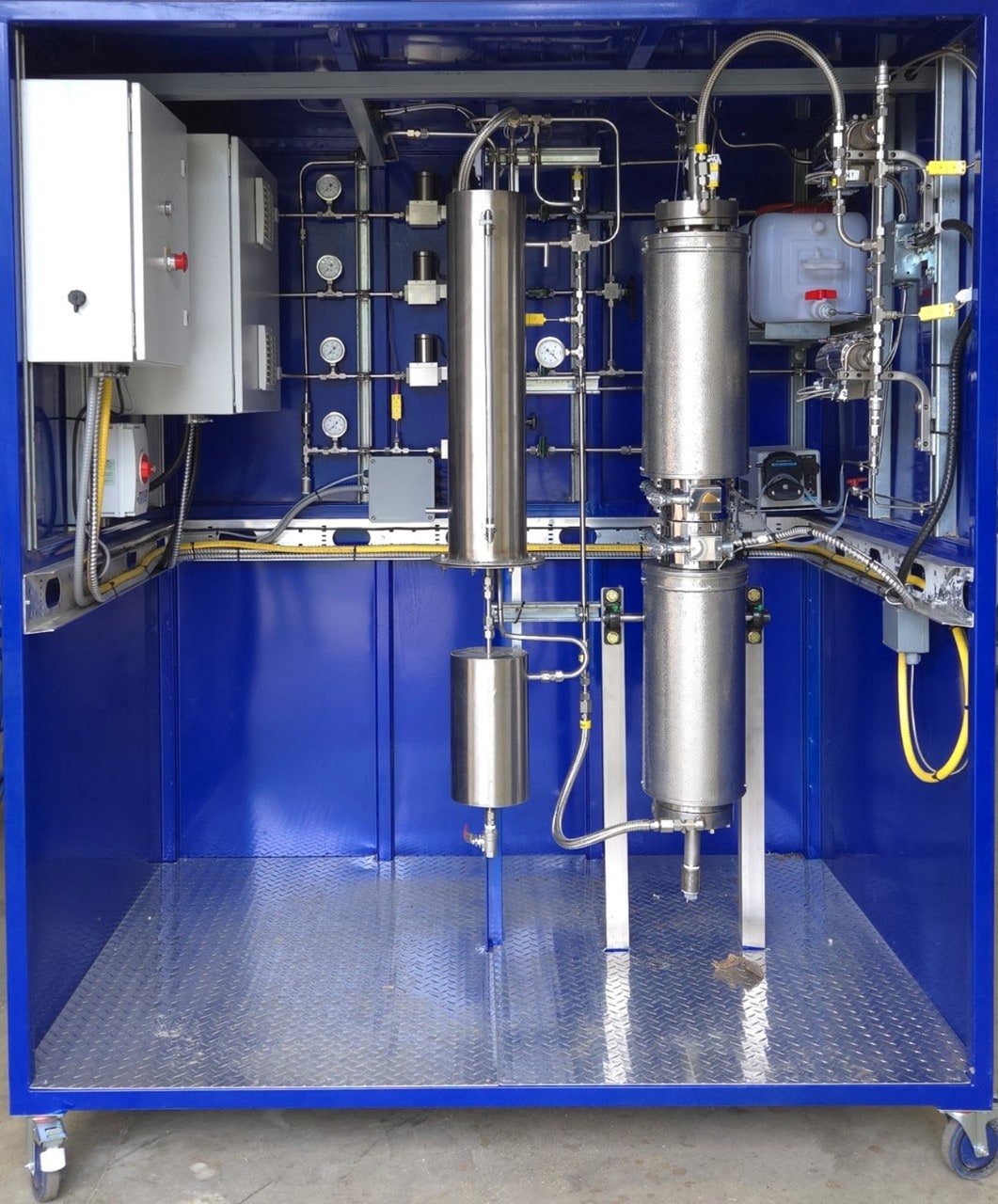
Equipment used as part of the GENESIS X pilot.
“The hope for this is to be able to commercialize units that will allow industries to reduce their greenhouse emissions,” he said.
The GENESIS X pilot will be installed this summer in Lac-Mégantic, using excess electricity from the town’s microgrid, and will run for three years, he said.
This was the initial project, but the scope of GENESIS has expanded over time.
GENESIS Alpha
Another phase dubbed GENESIS Alpha was later added, aimed at exploring how to generate heat and electricity for remote or off-grid communities. Often, generators are used to produce electricity in places where it’s tough for electrical lines to reach, and most use diesel as fuel because of ease of transport, Lavoie explained. Instead, the aim is to create small generators that can use easily available biomass – renewable organic non-fossil material from plants – as fuel. For example, leftover wood from road maintenance could be used, Lavoie said.
This technology could help remote communities, particularly in the north, to be more energy independent, he said.
It will initially be tested in Lac-Mégantic, but GENESIS is partnering with Corporation Nibiischii, a Cree-owned organization that manages the Albanel-Mistassini-and-Wachonichi Wildlife Reserve in Quebec. It will later be tested on a site north of Chibougamau, in Central Quebec.
“They’re going to use this technology for different hunting and fishing lodges, but eventually it could be used for the community to reduce waste and increase independence in energy, electricity and heat,” he said.
GENESIS Beta
Lavoie’s team later came up with the idea of growing food after receiving a lot of queries about the issue of residual industrial heat, which is heat generated in industrial processes but is not put to use, and lost and dumped into the environment. There are technologies that can try to recover this heat, such as heat exchangers, that can help increase energy efficiency and curb emissions.
The aspect of the University of Sherbrooke project dubbed GENESIS Beta will instead aim to capture this waste heat and use it in mobile greenhouses to grow fruit and vegetables. Using small mobile greenhouses on trailers, rather than large permanent ones, helps to adapt to either rural locations or urban settings with limited space. Also, building larger greenhouses often needs zoning approval – smaller mobile greenhouses on wheels do not require these additional requirements, he noted.
“A mobile greenhouse will be easy to place somewhere where they are needed, and eventually removed if needed as well,” Lavoie said. “And it could be additive. We could put one greenhouse, or 10 greenhouses.”
These greenhouses will be assembled and tested initially in Lac-Mégantic, then later tested in Sherbrooke as an urban setting.
Initially, they will start by growing pineapples, after Lavoie purchased roughly 250 pineapple plants last year from a Sherbrooke company that needed to offload them. In the longer term, he said, they will aim to grow native plants such as sea buckthorn, or argousier in French, which produces bright orange berries rich in vitamin C.
GENESIS Alpha and Beta are still in the early stages, but Lavoie expects the technology for both to be on site and begin testing by summer 2026.
Once the technology is validated, he hopes that entrepreneurs and startups will help bring these concepts to the market at scale, resulting in a broader impact. For example, a spinoff company, Secant Fuel, was created last year to commercialize the technology developed in GENESIS X. Since its incorporation, Secant Fuel has scaled its prototype and plans to test a pilot with local partners.
“The goal is to create startups, spin-offs, small to medium enterprises to create these units,” Lavoie said.
