

MARKET TONE
The performance of the US dollar (USD) appears to be faltering following an impressive rally from early September to mid-October. Although the rally delivered a fresh—albeit marginal and short-lived—two-year high in the DXY, price action since the local peak has been moderately defensive as market participants have re-assessed the outlook for relative central bank policy amid a softening in tightening expectations from the Fed. USD weakness observed in the immediate aftermath of the US midterm election results also revealed a key vulnerability for the dollar, as market participants assessed the risks to US growth and expressed concerns related to the AI trade.
The outlook for relative central bank policy remains a dominant driver for currency markets, as policymakers grapple with dynamic inflationary pressures related to the price of energy. Concerns centre around the possibility of broadening inflation and the risk of second-round effects, with a notably broad assessment of policy implications across major central banks.
The hawkish re-pricing of the Fed’s policy rate path has faded considerably over the past month or so, eroding a fundamental pillar of support for the USD as short-term rates markets have softened their expectations for further tightening. Short- and medium-term risks for the USD appear to be firmly shifting to the downside as Fed policymakers push for a more ‘patient’ approach.
The Fed’s continued emphasis on broader themes of productivity and AI, and their roles in increasing the economy’s potential, have been an important differentiator relative to their central bank peers. Fed policymakers have also maintained a focus on the disinflationary trends observed across narrower measures of inflation, providing cover to those seeking to take a more ‘patient’ approach.
The Fed’s October meeting revealed an important update related to the Fed’s five ‘task forces’ currently exploring key policy concepts across a range of vectors. Chair Warsh announced that the ‘Productivity and Employment’ and ‘Balance Sheet’ task forces would be providing important updates in the coming month—both of which could potentially compound the shift to patience.
Beyond the Fed, the major developed economy central banks remain hawkish. The ECB is maintaining expectations for tightening into its December meeting while the BoE is heading into its November decision fully priced for a 25bp hike. The BoJ is also priced for a hike at either of its upcoming meetings—either December or January. For the Bank of Canada, its belated October hike was paired with a moderately hawkish tone, allowing short-term rates markets to prince nearly 50bps of additional tightening by April—still one hike less than Scotiabank Economics’ forecast.
Sentiment and positioning have also shifted away from the USD, amid a renewed easing in geopolitical concerns and a broader equity market that has begun to assess the prospects for the tech/AI/chip trade with increasing caution. The AI buildout has been an important driver of both growth and inflation in the US economy and any softening in its outlook carries meaningful downside risk for the USD. Risk premiums in the options market have faded a good portion of their recent gains, suggesting diminished demand for protection against USD upside.
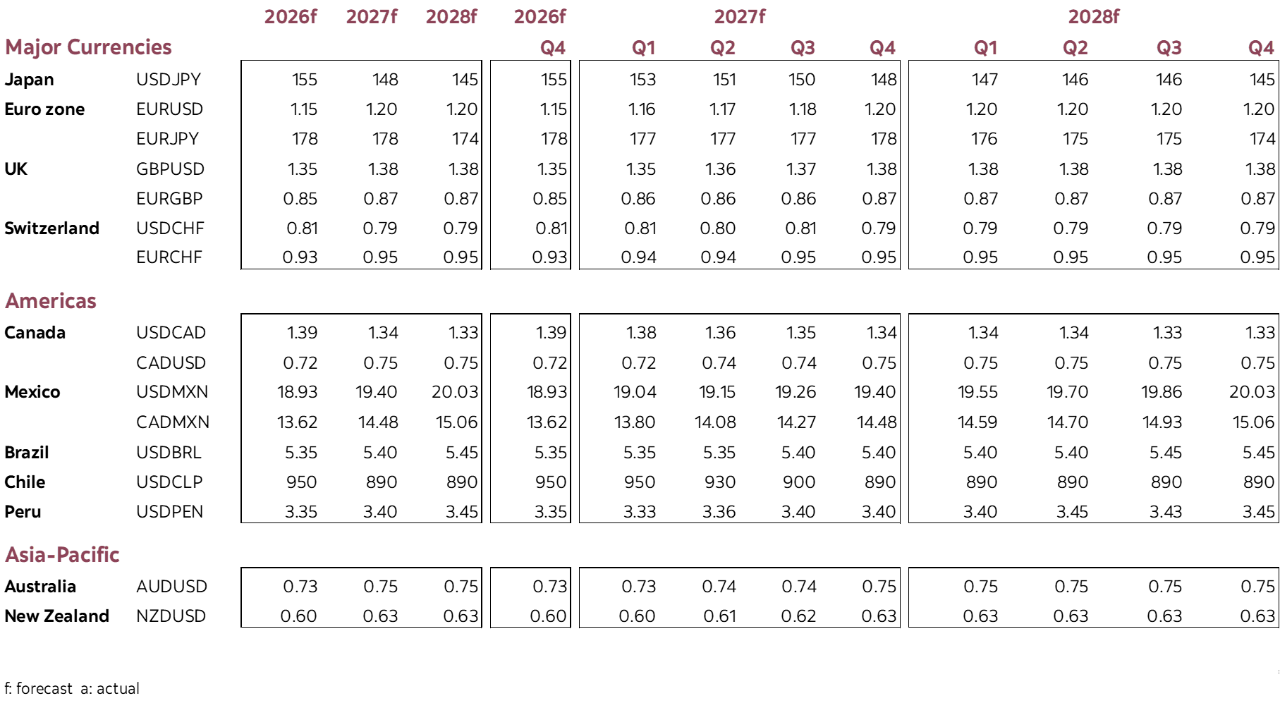
Scotiabank’s FX forecast maintains a broadly bearish outlook on the basis of fundamentals. The central bank forecast pairs near-term Fed tightening with 75bps of easing in the back half of our now-extended forecast horizon, reaching to Q4 2028. We also remain cautious on the prospect of near-term tightening from the Fed, owing to its well-communicated caution.
Structural challenges for the USD remain a major risk, given the US economy’s ‘twin’ fiscal and current account deficits. And we continue to highlight the downside risks facing global investors that have allowed themselves to become overallocated to USD exposures following a multi-decade period of US equity and USD outperformance, relative to the rest of the world. Efforts to protect against these USD risks would likely intensify the USD’s headwinds. Finally, the USD is also historically ‘rich’ and trading well above its 20-year moving average at the upper end of a multi-decade historical range.
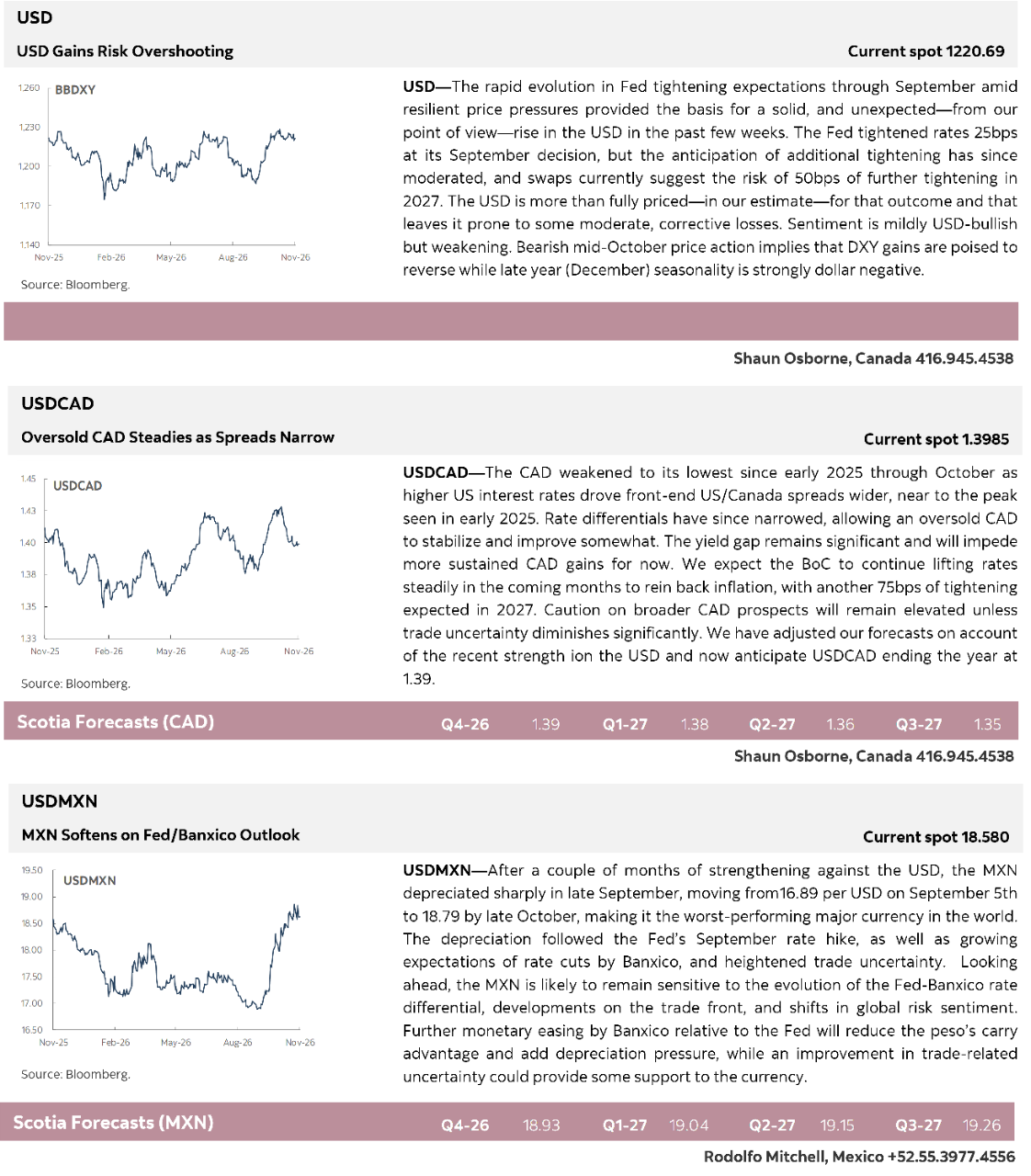
For the Canadian dollar (CAD), we feel that the trade- and policy-related headwinds that had been a major drag on the CAD’s performance have since turned to tailwinds. Trade policy uncertainty remains elevated but the tenor of negotiations looks to have reached a nadir with both Canadian and US officials hinting to an ever-looming resolution. In terms of fundamentals, the BoC’s renewed hawkishness stands in stark contrast to the Fed’s waning commitment to further tightening. Narrowing spreads have been CAD-positive.
We have extended our bearish USDCAD outlook while adjusting the near-term levels for the target path. We hold a Q4 2026 target of 1.39, a Q4 2027 forecast of 1.34, extending to 1.33 by Q4 2028.
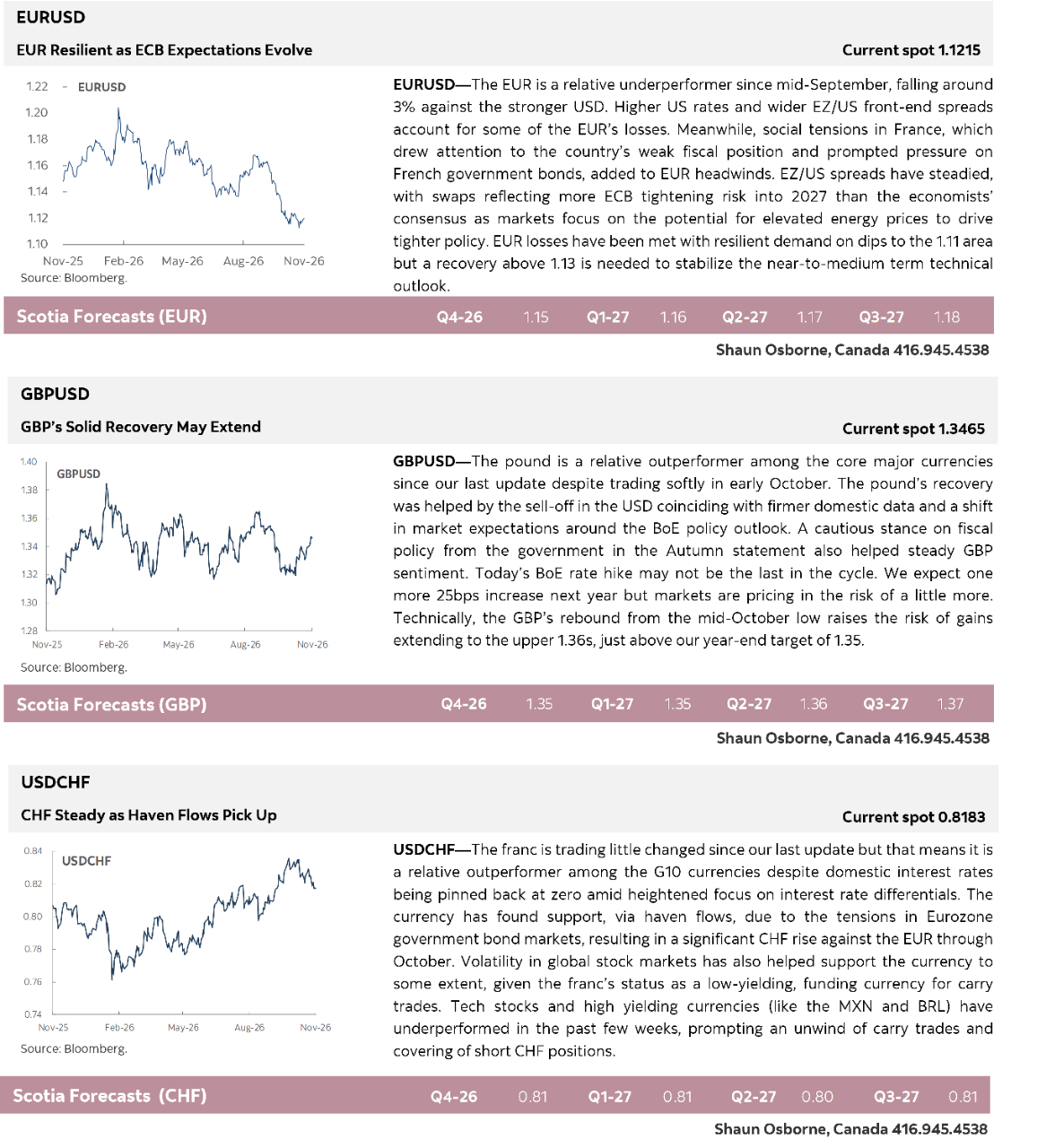
The EUR’s path has been somewhat challenged by domestic and regional developments—namely the worrisome fragmentation of the European government bond market and the blowout in France’s yield spreads to Germany. The ECB’s commitment to tightening has been unwavering however, while showing some flexibility in light of financial market turmoil as wider premia have been acknowledged as delivering their own form of tightening.
The GBP’s outlook remains equally bullish, targeting a return to the upper end of the flat range that has defined the pound’s price action year-to-date. Both the BoE and the government of PM Burnham are working to maintain positive sentiment toward the UK, its bond market, and the pound.
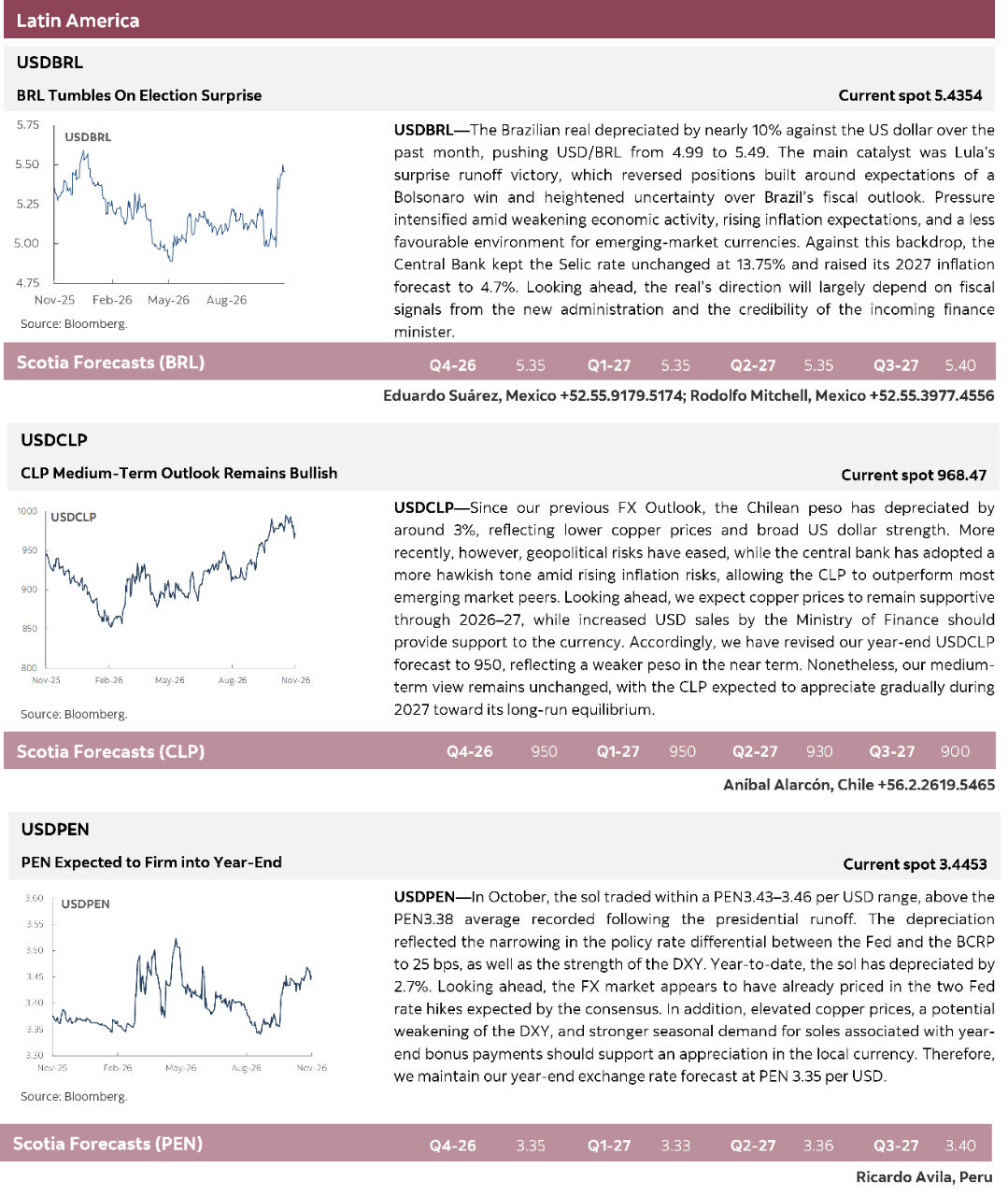
In Latam, the Mexican peso (MXN) has continued to trade defensively—albeit at a decelerated pace. The shocking pace of the September decline looked to have been catalyzed by a combination of both fundamental and flow-related factors, as market participants responded to the Central Bank of Mexico (Banxico)’s guidance shift and its emphasis on a policy path distinctly separate from the Fed. Investors adjusted their expectations and modified their positioning in accordance with their outlook for lower risk-adjusted returns. In Peru, the PEN has also softened in tandem with the deterioration in the broader market’s tone, and in Chile the CLP extended its domestically-driven decline—ignoring supportive terms of trade and near-record copper prices in favour of concerns related to growth.
Eric Theoret, Canada 416.863.5934
FX FORECASTS
CAD FX FORECASTS

FEDERAL RESERVE AND BANK OF CANADA MONETARY POLICY OUTLOOK
FEDERAL RESERVE—TWO AND DONE MAY OVERDO IT
Scotiabank Economics forecasts the Federal Reserve to raise its policy rate a further 25bps at the December 9th meeting and then add one more in the first quarter of next year. Yet we’re concerned about a policy rate overshoot while fragile market conditions are being closely monitored.
The September ‘dot plot’ showed one further hike this year and then a hold. The September plot usually performs well at anticipating where the Committee will land at year’s end, but poorly thereafter.
We estimate the three-month moving average of core PCE inflation to be around 3¼% m/m SAAR—well above target. Several forces suggest that firm inflation could persist for a time.
The US economy grew by 3.4% q/q SAAR in Q3 and consumer spending was up by almost 4%. The US economy is being driven further into excess aggregate demand, motivating ongoing, lagging price pressures. Core producer prices point to higher coming consumer price inflation. El Niño’s effects are estimated by the San Francisco Fed to be adding to currently higher inflation with more to come for a few months. AI-driven inflation may eventually cool but not yet. Tariff pass through is ongoing. Core service prices reflect a rotation of demand and pass through effects.
A very data dependent, backward- or contemporaneously looking Federal Reserve may be stuck in a pattern of responding to inflation persistence for some time.
Yet tight monetary policy could reinforce the effects of what we’ve already been expecting and put excessive downward pressure on growth and underlying inflation. AI investment will remain strong but bend the curve toward lower contributions to growth. Housing markets are in rough waters with no population growth and high mortgage rates. Overall fiscal policy is turning restrictive. The dollar’s lagging effects will restrain net export competitiveness.
And consumers are getting a real wage squeeze with no growth in real house prices. They are still spending by depleting the saving rate. Their ability to absorb extended price pressures is limited. Overdoing on monetary tightening might have contemporaneous support but face rising future risks.
BANK OF CANADA—A SLIPPERY TANGO
After the Bank of Canada met our market-leading expectations for a rate increase, what lies ahead by way of next steps?
Our house forecast is for three more rate hikes that would take the overnight rate up to 3¼% by late winter or early spring. This remains a little more aggressive than market pricing. We continue to guide that the risks are skewed toward a higher terminal rate.
Our terminal rate would only take the policy rate to the upper end of the estimated neutral rate range and would remain very low in real, inflation-adjusted terms. The Bank of Canada may already be behind in its inflation fight which could require a move into outright restrictive territory.
We see clear evidence that varied cost pressures, including rising materials prices, are showing up in trend gains in core inflation measures. Risks going forward point to further price increases.
Soaring core industrial product prices—ex-food and energy—tend to lead increases in core consumer price inflation readings.
We expect the output gap to close by about Springtime. The elimination of slack may motivate less disinflationary pressure alongside upward influences from higher cost pressures. With potential growth estimated to be around 1½% or less, our forecast for quicker actual GDP growth would put the economy into excess aggregate demand thereafter. Monetary policy lags could position the BoC as playing catch up to future inflation risk.
Should oil prices continue to fall then we would take that onboard in our BoC forecast—with caveats and offsets. The oil futures curve continues to point to the $70–80 range in 2027H2—prices that would continue to motivate energy sector investment and reinforce cost pass throughs. A steep sudden collapse in oil prices would be another matter but that’s nowhere close to the information set we feel we face while upside risks still carry a significant weight.
Further, fiscal policy is high-fiving monetary policy on the way through the door. One is entering the room as the other exits. Tighter monetary policy will become more important as massive increases in federal and provincial stimulus unfold through tax breaks, major projects and transfers. Oil price uncertainty and ramped up fiscal supports will jockey for influence.
Derek Holt, Canada 416.863.7707
NORTH AMERICA
MAJOR CURRENCIES
MAJOR CURRENCIES (continued...)
LATIN AMERICA
DISCLAIMERS
FOREIGN EXCHANGE STRATEGY
This publication has been prepared by The Bank of Nova Scotia (Scotiabank) for informational and marketing purposes only. Opinions, estimates and projections contained herein are our own as of the date hereof and are subject to change without notice. The information and opinions contained herein have been compiled or arrived at from sources believed reliable, but no representation or warranty, express or implied, is made as to their accuracy or completeness and neither the information nor the forecast shall be taken as a representation for which Scotiabank, its affiliates or any of their employees incur any responsibility. Neither Scotiabank nor its affiliates accept any liability whatsoever for any loss arising from any use of this information. This publication is not, and is not constructed as, an offer to sell or solicitation of any offer to buy any of the currencies referred to herein, nor shall this publication be construed as an opinion as to whether you should enter into any swap or trading strategy involving a swap or any other transaction. The general transaction, financial, educational and market information contained herein is not intended to be, and does not constitute, a recommendation of a swap or trading strategy involving a swap within the meaning of U.S. Commodity Futures Trading Commission Regulation 23.434 and Appendix A thereto. This material is not intended to be individually tailored to your needs or characteristics and should not be viewed as a “call to action” or suggestion that you enter into a swap or trading strategy involving a swap or any other transaction. You should note that the manner in which you implement any of the strategies set out in this publication may expose you to significant risk and you should carefully consider your ability to bear such risks through consultation with your own independent financial, legal, accounting, tax and other professional advisors. Scotiabank, its affiliates and/or their respective officers, directors or employees may from time to time take positions in the currencies mentioned herein as principal or agent, and may have received remuneration as financial advisor and/or underwriter for certain of the corporations mentioned herein. Directors, officers or employees of Scotiabank and its affiliates may serve as directors of corporations referred to herein. All Scotiabank products and services are subject to the terms of applicable agreements and local regulations. This publication and all information, opinions and conclusions contained in it are protected by copyright. This information may not be reproduced in whole or in part, or referred to in any manner whatsoever nor may the information, opinions and conclusions contained in it be referred to without the prior express written consent of Scotiabank.
™ Trademark of The Bank of Nova Scotia. Used under license, where applicable. Scotiabank, together with “Global Banking and Markets”, is a marketing name for the global corporate and investment banking and capital markets businesses of The Bank of Nova Scotia and certain of its affiliates in the countries where they operate, all members of the Scotiabank group and authorized users of the mark. The Bank of Nova Scotia is incorporated in Canada with limited liability and is authorised and regulated by the Office of the Superintendent of Financial Institutions Canada. The Bank of Nova Scotia and Scotiabank Europe plc are authorised by the UK Prudential Regulation Authority. The Bank of Nova Scotia is subject to regulation by the UK Financial Conduct Authority and limited regulation by the UK Prudential Regulation Authority. Scotiabank Europe plc is authorised by the UK Prudential Regulation Authority and regulated by the UK Financial Conduct Authority and the UK Prudential Regulation Authority. Details about the extent of The Bank of Nova Scotia's regulation by the UK Prudential Regulation Authority are available on request. Scotiabank Inverlat, S.A., Scotia Inverlat Casa de Bolsa, S.A. de C.V., and Scotia Inverlat Derivados, S.A. de C.V., are each authorized and regulated by the Mexican financial authorities. Not all products and services are offered in all jurisdictions. Services described are available in jurisdictions where permitted by law.
SCOTIABANK ECONOMICS
This report has been prepared by Scotiabank Economics as a resource for the clients of Scotiabank. Opinions, estimates and projections contained herein are our own as of the date hereof and are subject to change without notice. The information and opinions contained herein have been compiled or arrived at from sources believed reliable but no representation or warranty, express or implied, is made as to their accuracy or completeness. Neither Scotiabank nor any of its officers, directors, partners, employees or affiliates accepts any liability whatsoever for any direct or consequential loss arising from any use of this report or its contents.
These reports are provided to you for informational purposes only. This report is not, and is not constructed as, an offer to sell or solicitation of any offer to buy any financial instrument, nor shall this report be construed as an opinion as to whether you should enter into any swap or trading strategy involving a swap or any other transaction. The information contained in this report is not intended to be, and does not constitute, a recommendation of a swap or trading strategy involving a swap within the meaning of U.S. Commodity Futures Trading Commission Regulation 23.434 and Appendix A thereto. This material is not intended to be individually tailored to your needs or characteristics and should not be viewed as a “call to action” or suggestion that you enter into a swap or trading strategy involving a swap or any other transaction. Scotiabank may engage in transactions in a manner inconsistent with the views discussed this report and may have positions, or be in the process of acquiring or disposing of positions, referred to in this report.
Scotiabank, its affiliates and any of their respective officers, directors and employees may from time to time take positions in currencies, act as managers, co-managers or underwriters of a public offering or act as principals or agents, deal in, own or act as market makers or advisors, brokers or commercial and/or investment bankers in relation to securities or related derivatives. As a result of these actions, Scotiabank may receive remuneration. All Scotiabank products and services are subject to the terms of applicable agreements and local regulations. Officers, directors and employees of Scotiabank and its affiliates may serve as directors of corporations.
Any securities discussed in this report may not be suitable for all investors. Scotiabank recommends that investors independently evaluate any issuer and security discussed in this report, and consult with any advisors they deem necessary prior to making any investment.
This report and all information, opinions and conclusions contained in it are protected by copyright. This information may not be reproduced without the prior express written consent of Scotiabank.
™ Trademark of The Bank of Nova Scotia. Used under license, where applicable.
Scotiabank, together with “Global Banking and Markets”, is a marketing name for the global corporate and investment banking and capital markets businesses of The Bank of Nova Scotia and certain of its affiliates in the countries where they operate, including; Scotiabank Europe plc; Scotiabank (Ireland) Designated Activity Company; Scotiabank Inverlat S.A., Institución de Banca Múltiple, Grupo Financiero Scotiabank Inverlat, Scotia Inverlat Casa de Bolsa, S.A. de C.V., Grupo Financiero Scotiabank Inverlat, Scotia Inverlat Derivados S.A. de C.V. – all members of the Scotiabank group and authorized users of the Scotiabank mark. The Bank of Nova Scotia is incorporated in Canada with limited liability and is authorised and regulated by the Office of the Superintendent of Financial Institutions Canada. The Bank of Nova Scotia is authorized by the UK Prudential Regulation Authority and is subject to regulation by the UK Financial Conduct Authority and limited regulation by the UK Prudential Regulation Authority. Details about the extent of The Bank of Nova Scotia's regulation by the UK Prudential Regulation Authority are available from us on request. Scotiabank Europe plc is authorized by the UK Prudential Regulation Authority and regulated by the UK Financial Conduct Authority and the UK Prudential Regulation Authority.
Scotiabank Inverlat, S.A., Scotia Inverlat Casa de Bolsa, S.A. de C.V, Grupo Financiero Scotiabank Inverlat, and Scotia Inverlat Derivados, S.A. de C.V., are each authorized and regulated by the Mexican financial authorities.
Not all products and services are offered in all jurisdictions. Services described are available in jurisdictions where permitted by law.