

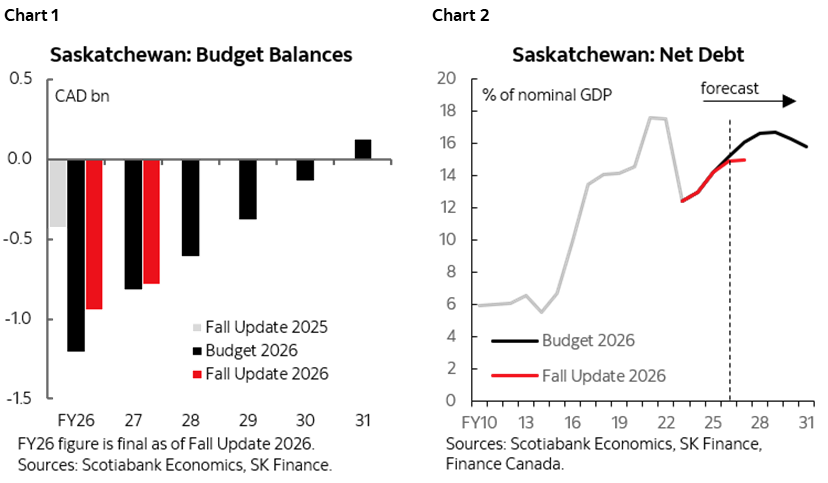
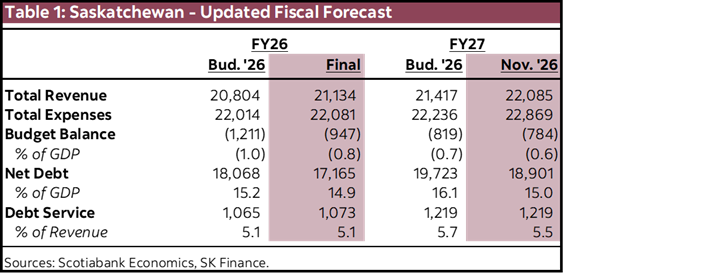
- Saskatchewan’s mid-year fiscal update forecasts a budget deficit of $783.6mn (-0.6% of nominal GDP) in FY27, a slight improvement on Budget 2026’s forecast of $819.4mn (-0.7%). The $35.8mn difference can be attributed to the improved revenue outlook outweighing the concurrent upward revision to total expenses, along with a sizeable positive revision to nominal GDP growth in 2026 vs previous Budget estimates.
- Natural resources, construction investment, firm up economic growth. Real GDP is projected to grow by 1.5% in 2026, slightly lower than Budget’s estimate of 1.6% and our own 2.0% forecast from the mid-October Scotiabank Forecast publication, as lower employment growth and a higher unemployment rate dampen growth. On the other hand, elevated natural resource prices have provided a welcome boost. Significantly higher WTI oil prices through most of the year have led to substantial revisions to total oil revenues expected in FY27, despite oil production expected to decline slightly by 2% compared to Budget 2026’s estimates. The province now expects WTI oil prices to average $86 USD/bbl, roughly in line with the current year-to-date price average, though ongoing volatility and uncertainty in the Middle East could still lead to price pressures in either direction. Strong construction investment growth (+19.9% YTD vs 2025), manufacturing sales (+16.8% YTD) and stable population growth have also played a role in the province’s positive economic outlook. Meanwhile, the nature of how U.S. tariffs have been applied (with Canadian energy products and potash exempt) has meant that Saskatchewan faces one of the lowest effective tariff rates among the provinces, mitigating its impact on the economy and allowing it to grow international goods exports (+15.1% YTD Jan–Sept vs 2025, higher than the national average).
- Total revenue projections have improved by $669mn, or 3.1%. Expected revenue from the province’s non-renewable resources (oil, potash, uranium) account for the vast majority of upward revisions in the mid-year update, as higher WTI oil and uranium prices, along with stronger potash netback pricing have pushed the province to increase revenues from $2.6bn in FY27, to $3.3bn, an adjustment of approximately $725mn vs Budget and a projected increase of 20% over FY26. An increase in Saskatchewan’s other own-source revenue of $153mn ($3.5bn total, -1% y/y) is partially offset by downward revisions via an anticipated tax revenue decline of $87mn vs Budget ($10.6bn total (2.6% y/y), which factors in the implementation and effects of the federal government’s Productivity Mega Deduction (PMD), which came into effect on September 15, 2026, and allows businesses to immediately deduct the full cost of eligible capital assets), net income from GBEs (-$120mn) and federal transfers (-$3.7mn). As a result, revenues for FY27 are projected to total roughly $22.1bn, an increase of 4.5% over the previous year.
- Total expenses have increased by $633mn, or 2.8%. Operating cost pressures from the province’s health authority have meant healthcare expense revisions ($8.8bn, 1.1% y/y) were the largest driver to upward expense pressures (+$350mn vs Budget), while protection of persons and property spending was also significantly reviewed upwards by $202mn ($1.4bn total,-8.6% y/y), largely attributed to costs associated with flooding, wildfire and emergency management activities, and larger correctional facility operating costs. The mid-year update now projects total expenses to land at approximately $22.9bn in FY27, 3.6% higher than FY26.
- A slight improvement to the debt path. While the province’s gross debt figures have deteriorated by $236mn vs Budget (primarily due to increased borrowing requirements by SaskPower), its net debt projection for FY27 is expected to shrink. A lower budget deficit and reduced planned acquisition of GSO capital assets are forecasted to lower its net debt burden by approximately $822mn. Combined with significantly stronger nominal GDP growth in 2026 (8.1% compared to Budget 2026’s previous forecast of 3.3%), the net debt-to-GDP ratio is predicted to settle at 15%, rather than 16.1%.
- Obstacles toward a balanced budget in the years ahead remain. Despite a rosier outlook than previously anticipated, the province will have to stay diligent in the medium-term as it plots its path back to a budget balance by FY31, as outlined in its spring Budget release. Improved revenues largely stemmed from higher oil prices, despite overall oil production expected to decrease slightly in the near term. The welcome boost to finances provided by the oil price shock may decrease heading into FY28, should volatility in the Middle East subside and prices normalize, while the introduction and implementation of the PMD could continue to dampen tax revenues in the years ahead (with the expectation of boosting long-term investment, productivity, and economic growth). Additional expenditure burdens could persist as the province continues to face heightened healthcare cost pressures, while dealing with future natural disasters could also be an additional pull on the province’s finances, as we have seen with the higher expense revision in today’s update. However, large construction growth, particularly among major projects across the province, does provide optimism in the medium-term for its economic outlook.
DISCLAIMER
This report has been prepared by Scotiabank Economics as a resource for the clients of Scotiabank. Opinions, estimates and projections contained herein are our own as of the date hereof and are subject to change without notice. The information and opinions contained herein have been compiled or arrived at from sources believed reliable but no representation or warranty, express or implied, is made as to their accuracy or completeness. Neither Scotiabank nor any of its officers, directors, partners, employees or affiliates accepts any liability whatsoever for any direct or consequential loss arising from any use of this report or its contents.
These reports are provided to you for informational purposes only. This report is not, and is not constructed as, an offer to sell or solicitation of any offer to buy any financial instrument, nor shall this report be construed as an opinion as to whether you should enter into any swap or trading strategy involving a swap or any other transaction. The information contained in this report is not intended to be, and does not constitute, a recommendation of a swap or trading strategy involving a swap within the meaning of U.S. Commodity Futures Trading Commission Regulation 23.434 and Appendix A thereto. This material is not intended to be individually tailored to your needs or characteristics and should not be viewed as a “call to action” or suggestion that you enter into a swap or trading strategy involving a swap or any other transaction. Scotiabank may engage in transactions in a manner inconsistent with the views discussed this report and may have positions, or be in the process of acquiring or disposing of positions, referred to in this report.
Scotiabank, its affiliates and any of their respective officers, directors and employees may from time to time take positions in currencies, act as managers, co-managers or underwriters of a public offering or act as principals or agents, deal in, own or act as market makers or advisors, brokers or commercial and/or investment bankers in relation to securities or related derivatives. As a result of these actions, Scotiabank may receive remuneration. All Scotiabank products and services are subject to the terms of applicable agreements and local regulations. Officers, directors and employees of Scotiabank and its affiliates may serve as directors of corporations.
Any securities discussed in this report may not be suitable for all investors. Scotiabank recommends that investors independently evaluate any issuer and security discussed in this report, and consult with any advisors they deem necessary prior to making any investment.
This report and all information, opinions and conclusions contained in it are protected by copyright. This information may not be reproduced without the prior express written consent of Scotiabank.
™ Trademark of The Bank of Nova Scotia. Used under license, where applicable.
Scotiabank, together with “Global Banking and Markets”, is a marketing name for the global corporate and investment banking and capital markets businesses of The Bank of Nova Scotia and certain of its affiliates in the countries where they operate, including; Scotiabank Europe plc; Scotiabank (Ireland) Designated Activity Company; Scotiabank Inverlat S.A., Institución de Banca Múltiple, Grupo Financiero Scotiabank Inverlat, Scotia Inverlat Casa de Bolsa, S.A. de C.V., Grupo Financiero Scotiabank Inverlat, Scotia Inverlat Derivados S.A. de C.V. – all members of the Scotiabank group and authorized users of the Scotiabank mark. The Bank of Nova Scotia is incorporated in Canada with limited liability and is authorised and regulated by the Office of the Superintendent of Financial Institutions Canada. The Bank of Nova Scotia is authorized by the UK Prudential Regulation Authority and is subject to regulation by the UK Financial Conduct Authority and limited regulation by the UK Prudential Regulation Authority. Details about the extent of The Bank of Nova Scotia's regulation by the UK Prudential Regulation Authority are available from us on request. Scotiabank Europe plc is authorized by the UK Prudential Regulation Authority and regulated by the UK Financial Conduct Authority and the UK Prudential Regulation Authority.
Scotiabank Inverlat, S.A., Scotia Inverlat Casa de Bolsa, S.A. de C.V, Grupo Financiero Scotiabank Inverlat, and Scotia Inverlat Derivados, S.A. de C.V., are each authorized and regulated by the Mexican financial authorities.
Not all products and services are offered in all jurisdictions. Services described are available in jurisdictions where permitted by law.