

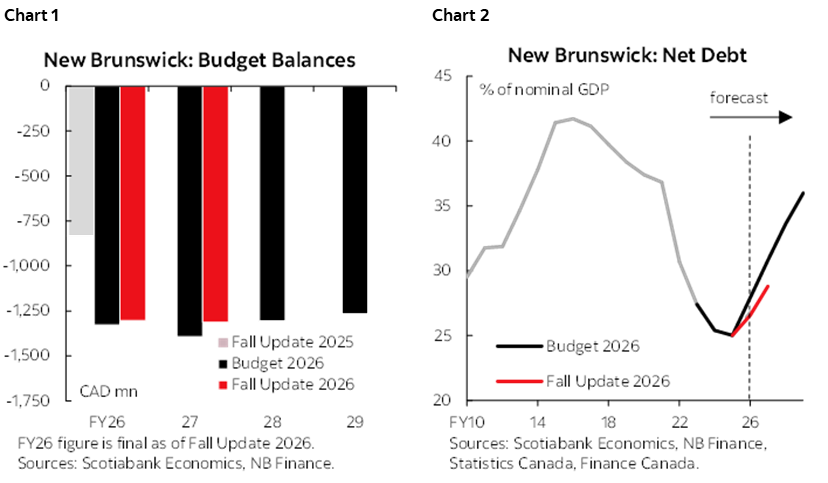
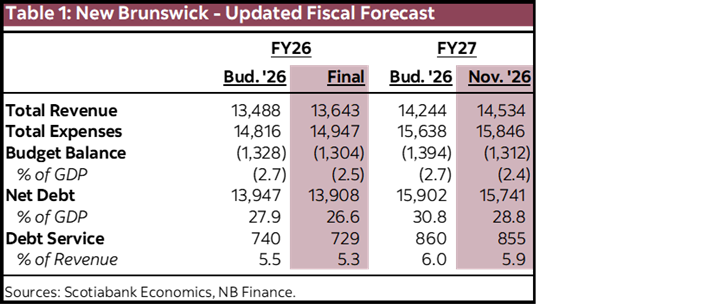
- New Brunswick’s mid-year fiscal update improved its FY27 deficit forecast from $1.39bn (2.7% of nominal GDP) to $1.31bn (2.4%). The approximately $82mn reduction vs Budget 2026 arrives because of greater upward revisions to revenue forecasts outweighing increases to projected expense growth, in part due to stronger expected nominal GDP growth.
- The economic outlook has been upgraded. Annual provincial GDP figures were officially reported on November 5th, with the province recording nominal GDP growth of 6.7% in 2025 (3.1ppts higher than previously projected, additional information here), along with an upward revision to 2024. The budget also boosts its assumed real GDP growth for 2026 to 1.2% (from 1.0% in the Budget and closer to our own growth forecast of 1.5%) and nominal growth to 4.3% from 3.1% (0.7ppts lower than our current 5.0% forecast), supported by strong year-to-date1 reporting in residential investment, manufacturing sales, and international exports—along with a higher inflation forecast.
- Total revenue for FY27 has been revised upward by 2.0%. Total revenue is now anticipated to reach approximately $14.5bn, for year-over-year growth of 6.5%. Increased revenue from growth in corporate and personal income tax revenues, as well as increased revenue from regional health authorities, contributed materially towards the province revising its total revenue projection for FY27 $290mn higher than Budget 2026. These gains were partially offset by reduced forecasts to revenue sources such as Special Operating Agency revenue, royalties, agency revenue, and return on investment income.
- Total expenditure projections for FY27 have also been revised up versus Budget (1.3%). Total expenditures are expected to land at approximately $15.8bn, for year-over-year growth of 6%. Over-budget Social Development costs via increased demand and service delivery, greater Health operating costs, and higher than budgeted winter maintenance expenses for Transportation and Infrastructure have all substantially contributed to total expenditures increasing by $207.9mn vs Budget 2026. On the other hand, projects not advancing as anticipated under the Canada-New Brunswick Integrated Bilateral Agreement shrunk Special Operating Agency budget estimates by $68mn.
- The net debt-to-GDP path has improved. Greater nominal GDP growth in 2025 reduced the province’s net debt-to-GDP ratio in FY26 to 26.6%, down from Budget 2026’s estimate of 27.9%. Meanwhile, reduced budget deficit estimates, combined with lower planned investments in tangible capital assets ($35.7mn, -2.9%) and a stronger nominal GDP growth forecast have pushed FY27 estimates down from 30.8% to 28.8%. The province’s borrowing program remains unchanged.
- Many domestic and global economic headwinds endure, though there is a case to remain cautiously optimistic going forward. At present, the economic growth outlook remains solid, and the nature of how US tariff policies have been applied to Canadian exports has meant New Brunswick endures a lower effective tariff rate than most of its provincial peers, though tariff pressures are still elevated compared to pre-2025, and specific industries continue to feel the effects of these policies disproportionately. Nevertheless, low exposure to the broad scope of tariffs has aided the province in managing global export growth over the last year, while a shifting political landscape in the US could lead to renewed emphasis on reducing current tariff pressures. Meanwhile, efforts towards de-escalation in the Middle East continue, despite the non-linear path towards a resolution. Should regional de-escalation efforts succeed, a path toward easing global supply chains and inflationary pressures is viable.
However, risks to the outlook remain. Spending remains elevated (with near-term total expenses projected higher than previously anticipated) and no contingency funds are in place, if needed, should extra pressures or unforeseen events occur. Though Budget 2026 outlines a slowing spending pace through FY29, a lack of stronger progress (or stricter adherence) on this front could risk a deterioration to future balances.
1 January–August
DISCLAIMER
This report has been prepared by Scotiabank Economics as a resource for the clients of Scotiabank. Opinions, estimates and projections contained herein are our own as of the date hereof and are subject to change without notice. The information and opinions contained herein have been compiled or arrived at from sources believed reliable but no representation or warranty, express or implied, is made as to their accuracy or completeness. Neither Scotiabank nor any of its officers, directors, partners, employees or affiliates accepts any liability whatsoever for any direct or consequential loss arising from any use of this report or its contents.
These reports are provided to you for informational purposes only. This report is not, and is not constructed as, an offer to sell or solicitation of any offer to buy any financial instrument, nor shall this report be construed as an opinion as to whether you should enter into any swap or trading strategy involving a swap or any other transaction. The information contained in this report is not intended to be, and does not constitute, a recommendation of a swap or trading strategy involving a swap within the meaning of U.S. Commodity Futures Trading Commission Regulation 23.434 and Appendix A thereto. This material is not intended to be individually tailored to your needs or characteristics and should not be viewed as a “call to action” or suggestion that you enter into a swap or trading strategy involving a swap or any other transaction. Scotiabank may engage in transactions in a manner inconsistent with the views discussed this report and may have positions, or be in the process of acquiring or disposing of positions, referred to in this report.
Scotiabank, its affiliates and any of their respective officers, directors and employees may from time to time take positions in currencies, act as managers, co-managers or underwriters of a public offering or act as principals or agents, deal in, own or act as market makers or advisors, brokers or commercial and/or investment bankers in relation to securities or related derivatives. As a result of these actions, Scotiabank may receive remuneration. All Scotiabank products and services are subject to the terms of applicable agreements and local regulations. Officers, directors and employees of Scotiabank and its affiliates may serve as directors of corporations.
Any securities discussed in this report may not be suitable for all investors. Scotiabank recommends that investors independently evaluate any issuer and security discussed in this report, and consult with any advisors they deem necessary prior to making any investment.
This report and all information, opinions and conclusions contained in it are protected by copyright. This information may not be reproduced without the prior express written consent of Scotiabank.
™ Trademark of The Bank of Nova Scotia. Used under license, where applicable.
Scotiabank, together with “Global Banking and Markets”, is a marketing name for the global corporate and investment banking and capital markets businesses of The Bank of Nova Scotia and certain of its affiliates in the countries where they operate, including; Scotiabank Europe plc; Scotiabank (Ireland) Designated Activity Company; Scotiabank Inverlat S.A., Institución de Banca Múltiple, Grupo Financiero Scotiabank Inverlat, Scotia Inverlat Casa de Bolsa, S.A. de C.V., Grupo Financiero Scotiabank Inverlat, Scotia Inverlat Derivados S.A. de C.V. – all members of the Scotiabank group and authorized users of the Scotiabank mark. The Bank of Nova Scotia is incorporated in Canada with limited liability and is authorised and regulated by the Office of the Superintendent of Financial Institutions Canada. The Bank of Nova Scotia is authorized by the UK Prudential Regulation Authority and is subject to regulation by the UK Financial Conduct Authority and limited regulation by the UK Prudential Regulation Authority. Details about the extent of The Bank of Nova Scotia's regulation by the UK Prudential Regulation Authority are available from us on request. Scotiabank Europe plc is authorized by the UK Prudential Regulation Authority and regulated by the UK Financial Conduct Authority and the UK Prudential Regulation Authority.
Scotiabank Inverlat, S.A., Scotia Inverlat Casa de Bolsa, S.A. de C.V, Grupo Financiero Scotiabank Inverlat, and Scotia Inverlat Derivados, S.A. de C.V., are each authorized and regulated by the Mexican financial authorities.
Not all products and services are offered in all jurisdictions. Services described are available in jurisdictions where permitted by law.