

BUDGET ON TRACK TO BE BALANCED NEXT YEAR DESPITE NEW AFFORDABILITY MEASURES AND HIGHER CAPITAL SPENDING
- Bottom line: Manitoba is projecting “Canada’s smallest deficit” for the upcoming year and continues to plan for a balanced budget in 2027–28—good news given the province’s higher-than-average level of debt. New spending measures are relatively modest and focused on affordability, and include removing sales tax from remaining grocery items, adding 2,000 new child care spaces, and increasing the homeowners tax credit for homes under $1 million. However, the fiscal track relies on strong revenue growth and includes a fairly modest contingency budget, which suggests that fiscal risks are likely tilted to the downside—especially given the ongoing economic uncertainty and headwinds. In addition, the budget substantially increases planned capital spending, contributing to a somewhat higher debt path.
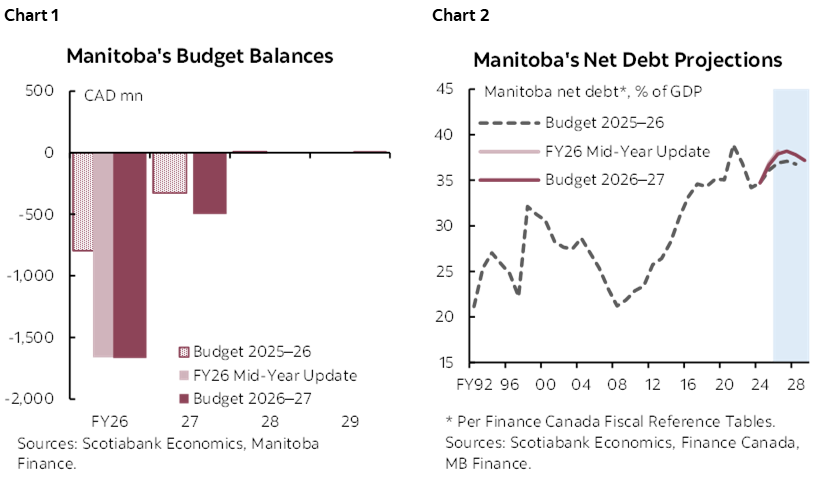
- Budget balance: the deficit for FY26 was largely unchanged from the mid-year update at $1.7 bn (1.7% of nominal GDP) while maintaining the targeted return to balance ($0 bn, 0%) in FY28 (chart 1).
- Economic assumptions: real GDP growth slowing from 1.6% in 2025 to 1.3% in 2026 before increasing 1.7% in 2027.
- Net debt: expected to increase from 37.9% in FY26 to 38.2% in FY27 before declining thereafter to 37.2% by the end of FY29 (chart 2).
- Borrowing requirements: $5.6 bn in FY26, $4.2 bn in FY27, $6.4 bn in FY28, and $6.6 bn in FY29.
OUR TAKE
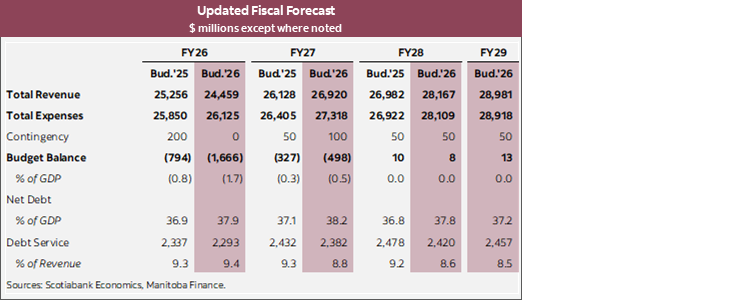
Manitoba’s Budget 2026 presents a path to balancing the budget which is largely unchanged from the previous outlook but will require fiscal restraint to achieve. The budget balance forecast for fiscal year 2025–26 (FY26) is essentially unchanged from the mid-year update published in December, with a deficit of $1.7 bn (1.7% of nominal GDP). While the province expects a deficit of $0.5 bn (0.5% of GDP) in FY28, up from $0.3 bn (0.3%) presented in last year’s budget, the latest outlook maintains a target of returning to balance in FY28 and holding unchanged thereafter. Total revenue is projected to increase faster than expenses over FY27 and FY28 as a driving factor of the return to balance, before growing at the same rate in FY29.
Total revenue is projected to be $26.9 bn in FY27, up 10% from $24.5 bn in FY26, before accounting for the $0.1 bn in revenue contingency. The province’s revenue growth in FY27 is largely driven by higher federal transfers (+$1 bn to $9.7 bn), individual income tax (+$0.3 bn to $5.1 bn), and a return to profit for Manitoba Hydro-Electric Board ($0.14 bn versus a net loss of $0.5 bn). The province is also lowering taxes for some Manitobans by expanding the PST exemption to all food sold in grocery stores, including prepared meals, beginning July 1st, 2026. As well as increasing the Homeowners Affordability Tax Credit to $1,700 in 2027 up from $1,600 in 2026, but reducing the tax credit for homes valued at more than $1 mn and eliminating the credit for homes valued $1.5 mn or more. Total revenue growth is expected to slow in the outer years of the budget, increasing 4.6% year-over-year in FY28 and 2.9% in FY29.
Total expenses are projected to be $27.3 bn in FY27, up 4.6% from $26.1 bn in FY26. Initiatives to improve healthcare and education continue to be major focuses and drivers of costs for the province. Overall spending on Health, Seniors and Long-Term Care is projected to increase 8.4% year-over-year to $10.6 bn in FY27. And overall spending on Education and Early Childhood Learning is projected to increase 5.5% y/y to $4.4 bn in FY27. Growth in total expenses are projected to slow in the outer years, growth 2.9% y/y in both FY28 and FY29, in which spending restraint will be needed to achieve a balanced budget by FY28. Meanwhile, growth in debt servicing costs are projected to slow over the outlook such that debt servicing spending as a share of total revenue is expected to decline from 9.4% in FY26 to 8.5% in FY29.
Net debt is projected to increase to $39.7 bn (38.2% of nominal GDP) by the end of FY27, up from $38.1 bn (37.9%) at the end of FY26. While the province’s debt burden outlook was revised about one percentage point higher relative to last year’s budget, net debt as a share of GDP is projected to peak in the coming fiscal year and decline each year thereafter, falling to 37.2% by the end of FY29. The province’s total strategic infrastructure spending plans include $3.7 bn for FY27, and average over $4.3 bn annually over the next five years which is up from the previous plan of $3.3 bn annually. The Budget assumes that nominal GDP will grow 3.6% in 2026 and 3.8% in 2027. Meanwhile, real GDP growth is assumed to grow 1.3% in 2026, down from 1.6% in 2025, before increasing 1.7% in 2027.
Total borrowing requirements in FY27 are planned to be $4.18 bn, of which $1.76 bn is on behalf of government business enterprises with $2.42 bn in other borrowings, down from the $5.6 bn borrowing in FY26 as of March 4th. Total borrowing is planned to increase to $6.4 bn in FY28, of which $3.7 bn is new cash borrowing and $2.7 bn is refinancing, and borrowing of $6.6 bn in FY29, of which $2.4 bn is new cash and $4.2 bn is refinancing.
DISCLAIMER
This report has been prepared by Scotiabank Economics as a resource for the clients of Scotiabank. Opinions, estimates and projections contained herein are our own as of the date hereof and are subject to change without notice. The information and opinions contained herein have been compiled or arrived at from sources believed reliable but no representation or warranty, express or implied, is made as to their accuracy or completeness. Neither Scotiabank nor any of its officers, directors, partners, employees or affiliates accepts any liability whatsoever for any direct or consequential loss arising from any use of this report or its contents.
These reports are provided to you for informational purposes only. This report is not, and is not constructed as, an offer to sell or solicitation of any offer to buy any financial instrument, nor shall this report be construed as an opinion as to whether you should enter into any swap or trading strategy involving a swap or any other transaction. The information contained in this report is not intended to be, and does not constitute, a recommendation of a swap or trading strategy involving a swap within the meaning of U.S. Commodity Futures Trading Commission Regulation 23.434 and Appendix A thereto. This material is not intended to be individually tailored to your needs or characteristics and should not be viewed as a “call to action” or suggestion that you enter into a swap or trading strategy involving a swap or any other transaction. Scotiabank may engage in transactions in a manner inconsistent with the views discussed this report and may have positions, or be in the process of acquiring or disposing of positions, referred to in this report.
Scotiabank, its affiliates and any of their respective officers, directors and employees may from time to time take positions in currencies, act as managers, co-managers or underwriters of a public offering or act as principals or agents, deal in, own or act as market makers or advisors, brokers or commercial and/or investment bankers in relation to securities or related derivatives. As a result of these actions, Scotiabank may receive remuneration. All Scotiabank products and services are subject to the terms of applicable agreements and local regulations. Officers, directors and employees of Scotiabank and its affiliates may serve as directors of corporations.
Any securities discussed in this report may not be suitable for all investors. Scotiabank recommends that investors independently evaluate any issuer and security discussed in this report, and consult with any advisors they deem necessary prior to making any investment.
This report and all information, opinions and conclusions contained in it are protected by copyright. This information may not be reproduced without the prior express written consent of Scotiabank.
™ Trademark of The Bank of Nova Scotia. Used under license, where applicable.
Scotiabank, together with “Global Banking and Markets”, is a marketing name for the global corporate and investment banking and capital markets businesses of The Bank of Nova Scotia and certain of its affiliates in the countries where they operate, including; Scotiabank Europe plc; Scotiabank (Ireland) Designated Activity Company; Scotiabank Inverlat S.A., Institución de Banca Múltiple, Grupo Financiero Scotiabank Inverlat, Scotia Inverlat Casa de Bolsa, S.A. de C.V., Grupo Financiero Scotiabank Inverlat, Scotia Inverlat Derivados S.A. de C.V. – all members of the Scotiabank group and authorized users of the Scotiabank mark. The Bank of Nova Scotia is incorporated in Canada with limited liability and is authorised and regulated by the Office of the Superintendent of Financial Institutions Canada. The Bank of Nova Scotia is authorized by the UK Prudential Regulation Authority and is subject to regulation by the UK Financial Conduct Authority and limited regulation by the UK Prudential Regulation Authority. Details about the extent of The Bank of Nova Scotia's regulation by the UK Prudential Regulation Authority are available from us on request. Scotiabank Europe plc is authorized by the UK Prudential Regulation Authority and regulated by the UK Financial Conduct Authority and the UK Prudential Regulation Authority.
Scotiabank Inverlat, S.A., Scotia Inverlat Casa de Bolsa, S.A. de C.V, Grupo Financiero Scotiabank Inverlat, and Scotia Inverlat Derivados, S.A. de C.V., are each authorized and regulated by the Mexican financial authorities.
Not all products and services are offered in all jurisdictions. Services described are available in jurisdictions where permitted by law.