

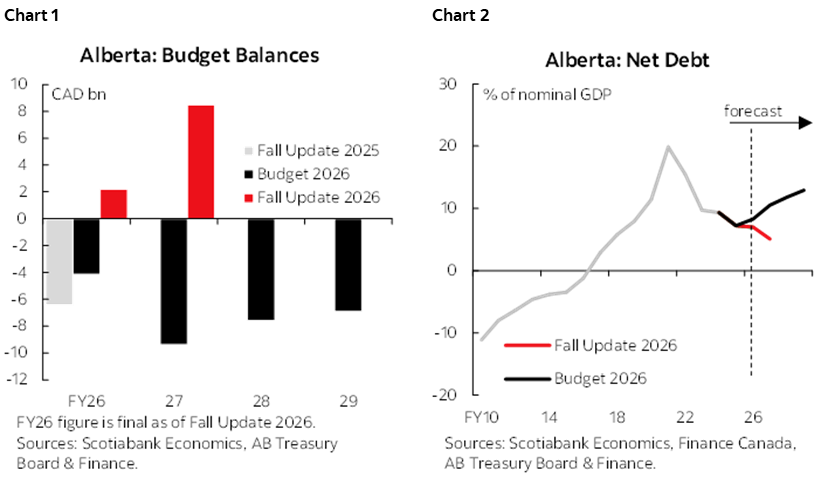
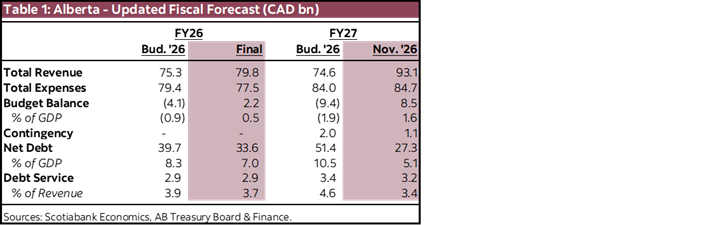
- Alberta’s mid-year fiscal update projects a budget surplus of $8.5bn in FY27 (1.6% of nominal GDP), a significant swing from the $9.4bn (-1.9%) deficit previously projected in its spring Budget 2026 release. The roughly $17.9bn adjustment comes as total revenues were substantially revised upwards vs Budget 2026, while expenses also increased, but only modestly.
- Non-renewable resource revenue completely flips the script for FY27, and economic growth is robust. Significantly higher WTI oil prices through most of 2026 have led to large revisions to total oil revenues expected in FY27. Alberta now expects WTI oil prices to average $83.50 USD/bbl for the year, $23 USD higher than previously estimated in Budget 2026, in turn greatly pushing up forecasted royalties for the fiscal year. While roughly in-line with the current year-to-date price average for WTI, ongoing volatility and uncertainty in the Middle East can continue contributing to price pressures in either direction. Meanwhile, strong forecasted employment growth (3% y/y), a declining unemployment rate, and healthy non-energy business investment (9.8%) all contribute to stronger than expected real GDP growth in 2026 (2.6%, up from 1.8% in Budget 2026 and much more closely aligned with our own forecast of 2.7% in the October Scotiabank Forecast). The nature of how U.S. tariffs have been applied (particularly with Canadian energy products exempt) has meant that Alberta faces one of the lowest effective tariff rates among the provinces, mitigating its impact on the broader economy.
- Total revenue projections have improved by $18.5bn, or 25%. The overwhelming majority of this significant boost has come via non-renewable resource revenues. As previously mentioned, heightened WTI oil prices have pushed the province to more than double its non-resource revenue projection for FY27, from $13.2bn in Budget 2026, to $28.6bn in today’s release (+60% vs FY26). An expected $580mn increase is personal income tax revenue ($16.5bn total, 8% y/y), greater corporate income tax revenue (+$1.1bn, $8.4bn total, 9% y/y), transfers from the federal government (+$434mn), and additional net income from GBEs (+$1.1bn) have all contributed to an overall far rosier revenue outlook for the province in FY27. The application of the Alberta Fuel Tax Relief Program, however, reduced FY27 fuel and electric vehicle tax revenues from roughly $1.5bn in Budget 2026, to $968mn, a decrease of $482mn. As a result, total revenues are anticipated to land at $93.1bn, 17% greater than total revenue earned in FY26.
- Total expenses forecasts have increased very modestly, by $646mn, or 0.8%. Operating expenses were revised upwards by $856mn vs Budget (1.2%), of which, $149mn were derived from AIMCo-related expenses (though offset by revenue), a +$34mn revision from the province’s previous first quarter fiscal update in the cost of selling oil via an increase in royalty volumes increasing trucking, tariff and purchase activity to manage marketed volumes, and a $18mn increase to support summer highway maintenance operations. The increase in operating costs is partially offset by a $224mn reduction in forecasted debt servicing costs, as well as a reduction in the contingency envelope from $2bn in Budget 2026 to $1.1bn in today’s update. Hence, expenses in FY27 are now expected to total $84.7bn, a 9.2% increase over total expenses tabled in FY26.
- Alberta’s debt path has improved significantly. Alberta’s swing from a budget deficit to a surplus in FY27 has subsequently improved the province’s debt position relative to previous Budget estimates. Net debt is now expected to fall by $6.3bn relative to FY26 results, to $27.3bn. Combined with nominal GDP forecasted to grow by 11.3% in 2026 (vs 1.9% in Budget), Alberta’s net debt-to-GDP is expected to fall to 5.1% by year-end, compared to the 10.5% projected in the spring.
- Total borrowing requirements have decreased by $13.1bn, or 63%. Substantially lower borrowing requirements via taxpayer-supported debt (-$16.3bn, $2.4bn total, -82% y/y) and GBEs (-$905mn, $893mn total, -68% y/y) have pushed the province’s borrowing requirements in FY27 down from a previously projected $21bn, to approximately $7.8bn, a 54% reduction over total borrowing requirements in FY26. Meanwhile, capital plan funding has increased by $620mn over Budget, due to increases in capital grants and investment. The $487mn capital grant increase vs Budget stems largely from new funding added over the interim (+$291mn), and $196mn in re-profiling unspent funds from 2025–26. The remaining $133mn originates via new funding for schools, housing and mental health facilities, and sports and recreation infrastructure.
- The medium-term outlook still poses questions and obstacles. Despite Alberta faring far better fiscally than what could have been expected in the early months of the year, the province will have to remain diligent going forward. Today’s budget surplus runs counter to the fiscal outlook lined up in Budget 2026, which had the province running deficits through FY29, where most of the credit can be attributed to significantly higher revenue from non-renewable resources as a consequence of ongoing volatility in the Middle East and elevated oil prices. The welcome boost to this revenue line could moderate in FY28, should tensions subside and prices normalize. However, with several major projects advancing and non-energy business investment forecasted to grow, along with the longer-term expectations of the Productivity Mega Deduction boosting investment, productivity, and economic growth, there is room for optimism in the medium-term for its economic outlook.
DISCLAIMER
This report has been prepared by Scotiabank Economics as a resource for the clients of Scotiabank. Opinions, estimates and projections contained herein are our own as of the date hereof and are subject to change without notice. The information and opinions contained herein have been compiled or arrived at from sources believed reliable but no representation or warranty, express or implied, is made as to their accuracy or completeness. Neither Scotiabank nor any of its officers, directors, partners, employees or affiliates accepts any liability whatsoever for any direct or consequential loss arising from any use of this report or its contents.
These reports are provided to you for informational purposes only. This report is not, and is not constructed as, an offer to sell or solicitation of any offer to buy any financial instrument, nor shall this report be construed as an opinion as to whether you should enter into any swap or trading strategy involving a swap or any other transaction. The information contained in this report is not intended to be, and does not constitute, a recommendation of a swap or trading strategy involving a swap within the meaning of U.S. Commodity Futures Trading Commission Regulation 23.434 and Appendix A thereto. This material is not intended to be individually tailored to your needs or characteristics and should not be viewed as a “call to action” or suggestion that you enter into a swap or trading strategy involving a swap or any other transaction. Scotiabank may engage in transactions in a manner inconsistent with the views discussed this report and may have positions, or be in the process of acquiring or disposing of positions, referred to in this report.
Scotiabank, its affiliates and any of their respective officers, directors and employees may from time to time take positions in currencies, act as managers, co-managers or underwriters of a public offering or act as principals or agents, deal in, own or act as market makers or advisors, brokers or commercial and/or investment bankers in relation to securities or related derivatives. As a result of these actions, Scotiabank may receive remuneration. All Scotiabank products and services are subject to the terms of applicable agreements and local regulations. Officers, directors and employees of Scotiabank and its affiliates may serve as directors of corporations.
Any securities discussed in this report may not be suitable for all investors. Scotiabank recommends that investors independently evaluate any issuer and security discussed in this report, and consult with any advisors they deem necessary prior to making any investment.
This report and all information, opinions and conclusions contained in it are protected by copyright. This information may not be reproduced without the prior express written consent of Scotiabank.
™ Trademark of The Bank of Nova Scotia. Used under license, where applicable.
Scotiabank, together with “Global Banking and Markets”, is a marketing name for the global corporate and investment banking and capital markets businesses of The Bank of Nova Scotia and certain of its affiliates in the countries where they operate, including; Scotiabank Europe plc; Scotiabank (Ireland) Designated Activity Company; Scotiabank Inverlat S.A., Institución de Banca Múltiple, Grupo Financiero Scotiabank Inverlat, Scotia Inverlat Casa de Bolsa, S.A. de C.V., Grupo Financiero Scotiabank Inverlat, Scotia Inverlat Derivados S.A. de C.V. – all members of the Scotiabank group and authorized users of the Scotiabank mark. The Bank of Nova Scotia is incorporated in Canada with limited liability and is authorised and regulated by the Office of the Superintendent of Financial Institutions Canada. The Bank of Nova Scotia is authorized by the UK Prudential Regulation Authority and is subject to regulation by the UK Financial Conduct Authority and limited regulation by the UK Prudential Regulation Authority. Details about the extent of The Bank of Nova Scotia's regulation by the UK Prudential Regulation Authority are available from us on request. Scotiabank Europe plc is authorized by the UK Prudential Regulation Authority and regulated by the UK Financial Conduct Authority and the UK Prudential Regulation Authority.
Scotiabank Inverlat, S.A., Scotia Inverlat Casa de Bolsa, S.A. de C.V, Grupo Financiero Scotiabank Inverlat, and Scotia Inverlat Derivados, S.A. de C.V., are each authorized and regulated by the Mexican financial authorities.
Not all products and services are offered in all jurisdictions. Services described are available in jurisdictions where permitted by law.