

- This note is part of a series that will be published after important data releases, documenting mechanical updates of the nowcast for Canadian GDP coming from the Scotiabank nowcasting model. The evolution of this nowcast will inform Scotiabank Economics’ official macroeconomic outlook.
The model is described in a related note here.
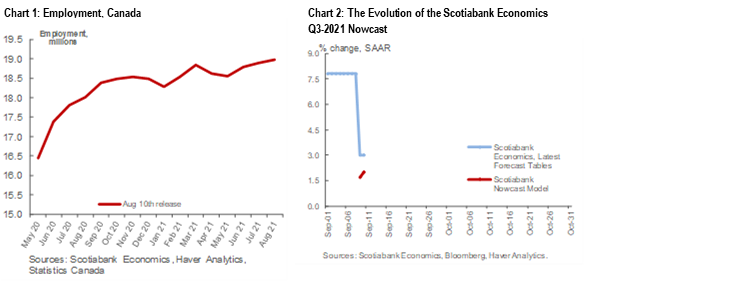
- Following a disappointing Q2-2021 Canadian growth print (more on that below), Q3-2021 seems to have started on a better footing, at least where the labour market is concerned. In August the Canadian economy generated +90K (+0.5% m/m) net new jobs according to the Labour Force Survey (LFS), following a similar gain in July. While the increase in hours worked in August was relatively tepid (+0.1% m/m), any rise was welcome after a jump in hours reported in the July survey (+1.3% m/m). Thus, in the first two months of Q3-2021 the post-lockdown re-opening spurred strong net new hiring and is likely to lead to expansion in the quarter.
- After today’s print, the nowcast moves up to +2.01% Q/Q SAAR, slightly below the most recent Scotiabank forecast. Behind the nowcast estimate, the model is using the strength in employment to discount some of the weakness in early July indicators (retail, manufacturing and wholesale sales, as well as the flash estimate for GDP). The economic justification for this is that the lifting of health restrictions has impacted the services sector to a greater extent, which is not well-captured in these early statistics. The contrast between the goods-producing and services-producing sectors was stark in the August LFS report, with +93K net new jobs generated in the latter, while the former lost -2.6K jobs.
- Other factors also lead us to be wary of being too reliant on the early estimates from Statistics Canada, given that they are usually based on low response rates. This uncertainty also flows into the “flash” estimates of monthly Canadian GDP growth.
- Beyond the uncertainty around early or “flash” indicators, even official monthly GDP growth within a given quarter carries a risk of revisions. Most recently, this occurred in Q2-2021, with a 2.4% quarterly annualized growth estimate as of late July being revised away completely in late August. As a result of the high revision risk, in the model we increased the in-quarter uncertainty around published monthly GDP data and included alternative indicators (e.g. internal card spending data) as a cross-check.
Table 1: Canadian GDP Nowcast, Q3-2021

DISCLAIMER
This report has been prepared by Scotiabank Economics as a resource for the clients of Scotiabank. Opinions, estimates and projections contained herein are our own as of the date hereof and are subject to change without notice. The information and opinions contained herein have been compiled or arrived at from sources believed reliable but no representation or warranty, express or implied, is made as to their accuracy or completeness. Neither Scotiabank nor any of its officers, directors, partners, employees or affiliates accepts any liability whatsoever for any direct or consequential loss arising from any use of this report or its contents.
These reports are provided to you for informational purposes only. This report is not, and is not constructed as, an offer to sell or solicitation of any offer to buy any financial instrument, nor shall this report be construed as an opinion as to whether you should enter into any swap or trading strategy involving a swap or any other transaction. The information contained in this report is not intended to be, and does not constitute, a recommendation of a swap or trading strategy involving a swap within the meaning of U.S. Commodity Futures Trading Commission Regulation 23.434 and Appendix A thereto. This material is not intended to be individually tailored to your needs or characteristics and should not be viewed as a “call to action” or suggestion that you enter into a swap or trading strategy involving a swap or any other transaction. Scotiabank may engage in transactions in a manner inconsistent with the views discussed this report and may have positions, or be in the process of acquiring or disposing of positions, referred to in this report.
Scotiabank, its affiliates and any of their respective officers, directors and employees may from time to time take positions in currencies, act as managers, co-managers or underwriters of a public offering or act as principals or agents, deal in, own or act as market makers or advisors, brokers or commercial and/or investment bankers in relation to securities or related derivatives. As a result of these actions, Scotiabank may receive remuneration. All Scotiabank products and services are subject to the terms of applicable agreements and local regulations. Officers, directors and employees of Scotiabank and its affiliates may serve as directors of corporations.
Any securities discussed in this report may not be suitable for all investors. Scotiabank recommends that investors independently evaluate any issuer and security discussed in this report, and consult with any advisors they deem necessary prior to making any investment.
This report and all information, opinions and conclusions contained in it are protected by copyright. This information may not be reproduced without the prior express written consent of Scotiabank.
™ Trademark of The Bank of Nova Scotia. Used under license, where applicable.
Scotiabank, together with “Global Banking and Markets”, is a marketing name for the global corporate and investment banking and capital markets businesses of The Bank of Nova Scotia and certain of its affiliates in the countries where they operate, including; Scotiabank Europe plc; Scotiabank (Ireland) Designated Activity Company; Scotiabank Inverlat S.A., Institución de Banca Múltiple, Grupo Financiero Scotiabank Inverlat, Scotia Inverlat Casa de Bolsa, S.A. de C.V., Grupo Financiero Scotiabank Inverlat, Scotia Inverlat Derivados S.A. de C.V. – all members of the Scotiabank group and authorized users of the Scotiabank mark. The Bank of Nova Scotia is incorporated in Canada with limited liability and is authorised and regulated by the Office of the Superintendent of Financial Institutions Canada. The Bank of Nova Scotia is authorized by the UK Prudential Regulation Authority and is subject to regulation by the UK Financial Conduct Authority and limited regulation by the UK Prudential Regulation Authority. Details about the extent of The Bank of Nova Scotia's regulation by the UK Prudential Regulation Authority are available from us on request. Scotiabank Europe plc is authorized by the UK Prudential Regulation Authority and regulated by the UK Financial Conduct Authority and the UK Prudential Regulation Authority.
Scotiabank Inverlat, S.A., Scotia Inverlat Casa de Bolsa, S.A. de C.V, Grupo Financiero Scotiabank Inverlat, and Scotia Inverlat Derivados, S.A. de C.V., are each authorized and regulated by the Mexican financial authorities.
Not all products and services are offered in all jurisdictions. Services described are available in jurisdictions where permitted by law.