

- Mexico: August labour market update shows rise in unemployment
- Peru: Mining investment remains strong as existing operations drive spending
MEXICO: AUGUST LABOUR MARKET UPDATE SHOWS RISE IN UNEMPLOYMENT
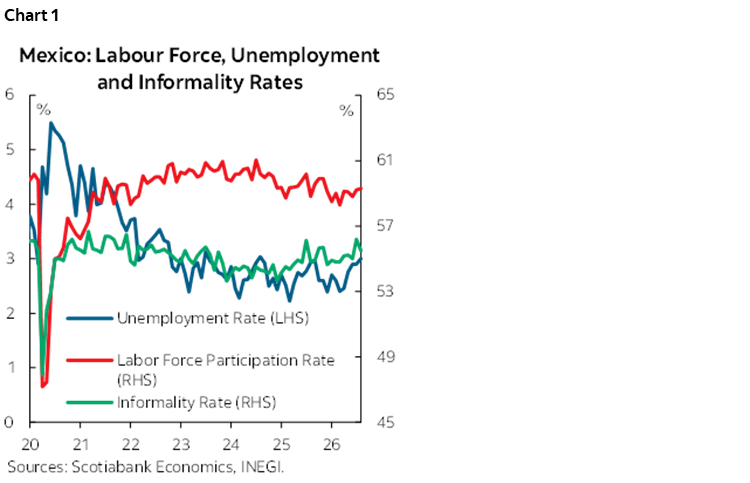
In August, the unemployment rate stood at 3.0% (chart 1), slightly above the previous 2.9%; the labour force participation rate reached 59.3% (up from 59.2%) of the working-age population, with the economically active population totaling 62.6 million people. The informal employment rate remained high at 55.5%, although down from 56.2% previously, while the underemployment rate stood at 7.0%.
—Rodolfo Mitchell, Miguel Saldaña & Martha Cordova
PERU: MINING INVESTMENT REMAINS STRONG AS EXISTING OPERATIONS DRIVE SPENDING
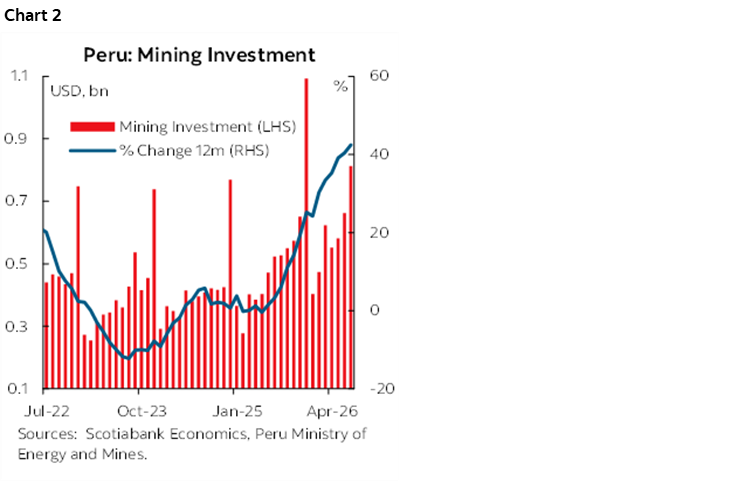
Mining investment reached USD 4.12bn during January–July 2026, up 45.0% y/y from USD 2.84 billion in the same period of 2025, according to Peru’s Ministry of Energy and Mines. July extended the strong momentum observed during the first half of the year, supported by strong spending at Tía María and continued investment in brownfield projects. Mining investment reached USD 812.2mn during the month (chart 2), up 55% y/y.
On the flip side, mining production showed mixed results in July (table 1). Copper output rose 3.8% y/y, driven mainly by higher production at Antamina and Cerro Verde, which more than offset lower output across several other operations. Antamina's gain reflected a higher proportion of copper ore processed at its concentrator, consistent with its mine plan, although this came at the expense of zinc production. Molybdenum production increased 15.0% y/y, while iron ore and tin output rose 2.4% y/y and 6.5% y/y, respectively. Gold production rose 1.8% y/y, as stronger recoveries at Yanacocha and higher output from several medium-sized producers helped offset the impact of expanding illegal mining activity. Zinc was the weakest-performing metal, with output falling 22.2% y/y, while lead production declined 2.5% y/y.

Back to investment, at the company level (table 2), Southern Peru remained the largest mining investor, with accumulated spending of USD 566mn, equivalent to nearly 14% of total mining investment. Spending continued to be led by Tía María, Peru’s only large-scale greenfield mining project currently under construction in the country, which accounts USD 1.8bn. The project has surpassed 47% completion and is expected to start production by the end of 2027. To date, Southern has invested more than USD 700mn, while over USD 1bn has been committed to equipment purchases as construction continues to advance.
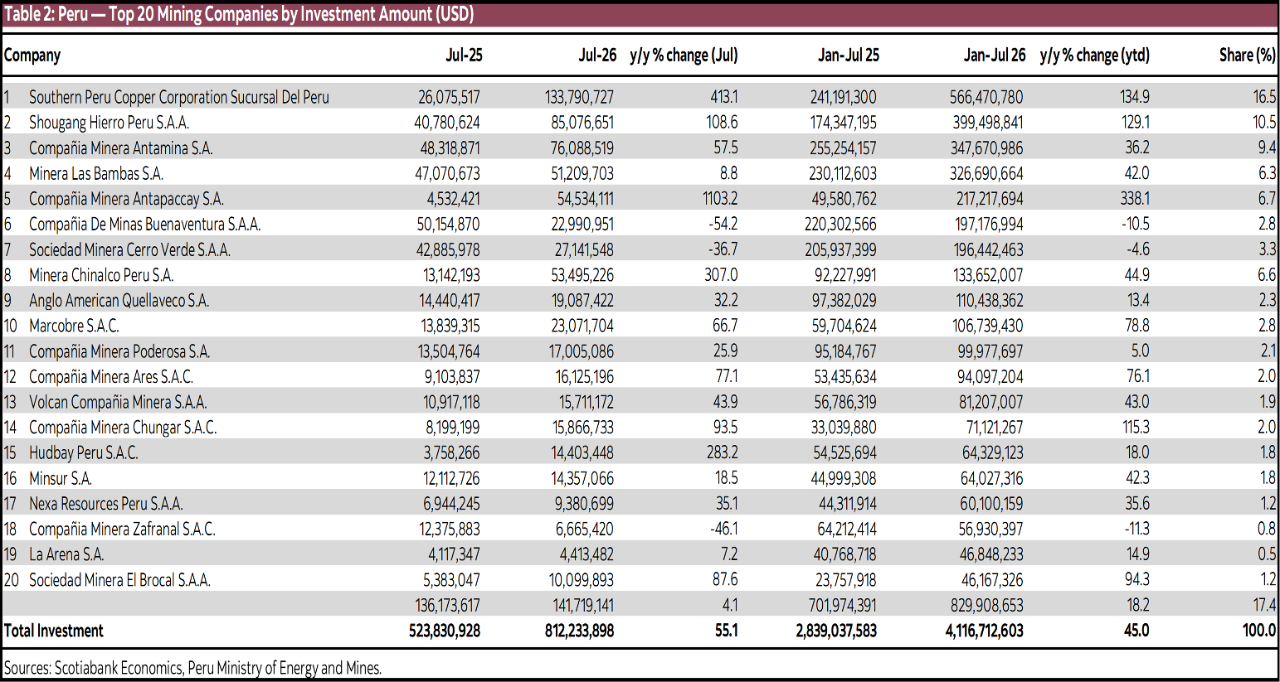
Shougang Hierro Perú ranked second, supported by sustaining capital expenditure at its Marcona iron ore operation. The company accumulated close to USD 400mn in investment through July.
Las Bambas, owned by China's MMG, also remained among the country's largest mining investors, with accumulated spending reaching USD 327mn through July. Investment continued to be supported by the execution of the Ferrobamba Replacement project (USD 1.75bn), which is aimed at extending the mine's life through 2039, as well as by sustaining capital expenditure. MMG's investment plan remains focused on mine development, preparation of new extraction areas, expansion of the tailing’s storage facility and operational infrastructure. During August, the company also commissioned the first phase of its new Truck Shop, a project with a total planned investment of USD 110mn.
Antamina, a large copper mine in southern Peru, also remained among the largest investors, continued advancing initiatives associated with its Antamina replacement project and operational continuity plans.
One of the most notable developments in 2026 has been the sharp increase in investment by Antapaccay, a major copper operation in southern Peru, whose cumulative spending reached USD 217mn, more than four times the level recorded a year earlier. Growth was largely driven by complementary investments, together with higher spending on infrastructure, mining equipment and exploration.
—Katherine Salazar
DISCLAIMER
This report has been prepared by Scotiabank Economics as a resource for the clients of Scotiabank. Opinions, estimates and projections contained herein are our own as of the date hereof and are subject to change without notice. The information and opinions contained herein have been compiled or arrived at from sources believed reliable but no representation or warranty, express or implied, is made as to their accuracy or completeness. Neither Scotiabank nor any of its officers, directors, partners, employees or affiliates accepts any liability whatsoever for any direct or consequential loss arising from any use of this report or its contents.
These reports are provided to you for informational purposes only. This report is not, and is not constructed as, an offer to sell or solicitation of any offer to buy any financial instrument, nor shall this report be construed as an opinion as to whether you should enter into any swap or trading strategy involving a swap or any other transaction. The information contained in this report is not intended to be, and does not constitute, a recommendation of a swap or trading strategy involving a swap within the meaning of U.S. Commodity Futures Trading Commission Regulation 23.434 and Appendix A thereto. This material is not intended to be individually tailored to your needs or characteristics and should not be viewed as a “call to action” or suggestion that you enter into a swap or trading strategy involving a swap or any other transaction. Scotiabank may engage in transactions in a manner inconsistent with the views discussed this report and may have positions, or be in the process of acquiring or disposing of positions, referred to in this report.
Scotiabank, its affiliates and any of their respective officers, directors and employees may from time to time take positions in currencies, act as managers, co-managers or underwriters of a public offering or act as principals or agents, deal in, own or act as market makers or advisors, brokers or commercial and/or investment bankers in relation to securities or related derivatives. As a result of these actions, Scotiabank may receive remuneration. All Scotiabank products and services are subject to the terms of applicable agreements and local regulations. Officers, directors and employees of Scotiabank and its affiliates may serve as directors of corporations.
Any securities discussed in this report may not be suitable for all investors. Scotiabank recommends that investors independently evaluate any issuer and security discussed in this report, and consult with any advisors they deem necessary prior to making any investment.
This report and all information, opinions and conclusions contained in it are protected by copyright. This information may not be reproduced without the prior express written consent of Scotiabank.
™ Trademark of The Bank of Nova Scotia. Used under license, where applicable.
Scotiabank, together with “Global Banking and Markets”, is a marketing name for the global corporate and investment banking and capital markets businesses of The Bank of Nova Scotia and certain of its affiliates in the countries where they operate, including; Scotiabank Europe plc; Scotiabank (Ireland) Designated Activity Company; Scotiabank Inverlat S.A., Institución de Banca Múltiple, Grupo Financiero Scotiabank Inverlat, Scotia Inverlat Casa de Bolsa, S.A. de C.V., Grupo Financiero Scotiabank Inverlat, Scotia Inverlat Derivados S.A. de C.V. – all members of the Scotiabank group and authorized users of the Scotiabank mark. The Bank of Nova Scotia is incorporated in Canada with limited liability and is authorised and regulated by the Office of the Superintendent of Financial Institutions Canada. The Bank of Nova Scotia is authorized by the UK Prudential Regulation Authority and is subject to regulation by the UK Financial Conduct Authority and limited regulation by the UK Prudential Regulation Authority. Details about the extent of The Bank of Nova Scotia's regulation by the UK Prudential Regulation Authority are available from us on request. Scotiabank Europe plc is authorized by the UK Prudential Regulation Authority and regulated by the UK Financial Conduct Authority and the UK Prudential Regulation Authority.
Scotiabank Inverlat, S.A., Scotia Inverlat Casa de Bolsa, S.A. de C.V, Grupo Financiero Scotiabank Inverlat, and Scotia Inverlat Derivados, S.A. de C.V., are each authorized and regulated by the Mexican financial authorities.
Not all products and services are offered in all jurisdictions. Services described are available in jurisdictions where permitted by law.