

- Peru: Inflation surprises, exiting the target range after two years
- Chile: GDP contracts 0.3% y/y in February
PERU: INFLATION SURPRISES, EXITING THE TARGET RANGE AFTER TWO YEARS
Headline inflation in March rose by 2.4% m/m (chart 1), marking the highest monthly rate in the past 32 years. Several factors contributed to this surge: the Camisea gas pipeline incident during the first half of the month, the increase in international oil prices following the closure of the Strait of Hormuz, seasonal education-related costs in March, and adverse weather conditions that have been pushing food prices higher since January.
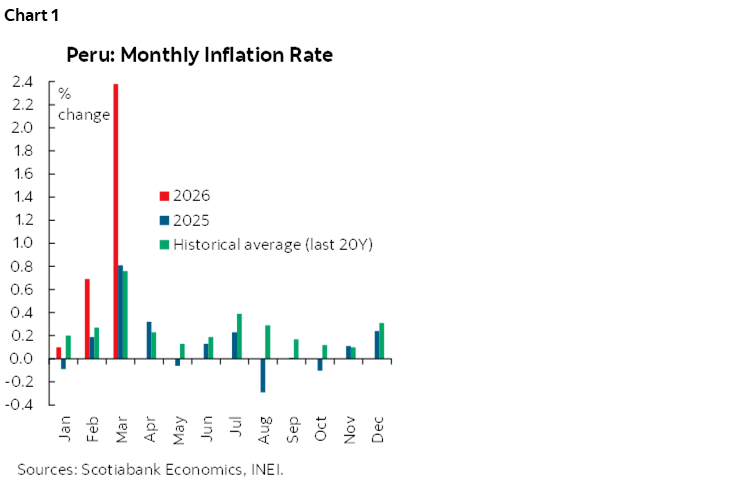
Annual inflation accelerated from 2.2% in February to 3.8% in March, well above Bloomberg’s consensus estimate (2.6%) and our own projection (3.0%). As a result, inflation has once again moved outside the target range of 1%–3% after two years (since March 2024). Core inflation also rose sharply, increasing 2.1% in March and lifting the annual rate from 2.2% in February to 3.7% in March.
The components of the basic household basket that registered the largest increases were:
- Transportation: rose 9.1% month-on-month, a sharp jump compared to the maximum monthly increase of 3.2% observed during the Russia–Ukraine war. The reduced supply of domestic gas appears to have had a stronger-than-expected impact. A correction is expected in April, given the normalization of gas supply, although it would be partial since oil prices remain high.
- Food: increased 3.2% month-on-month, a level not seen since March 2022, with price hikes across nearly all categories.
- Education: rose 2.9% due to seasonal effects from the start of the school year, though below the levels recorded in previous years.
As we have previously noted, we do not expect the central bank (BCRP) to adjust its policy rate at the upcoming meeting on April 9th. Looking ahead, inflation may ease in April given that the supply of natural gas has normalized, some food prices should stabilize, and the high base effect from April 2025 (monthly inflation of 0.3%) comes into play.
—Ricardo Avila
CHILE: GDP CONTRACTS 0.3% Y/Y IN FEBRUARY
- Activity weakness suggests 2% growth as a ceiling for 2026
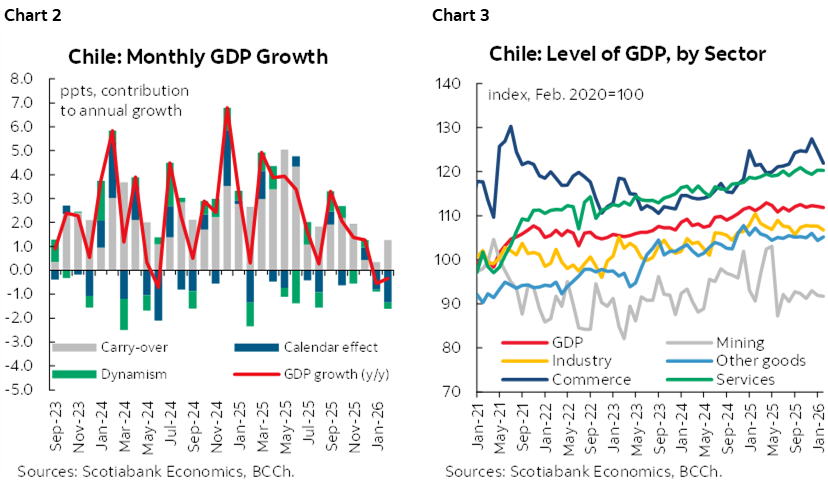
GDP declined 0.3% y/y in February (chart 2), well below market expectations (consensus: +1.5%) and our forecast (+1.2%). In seasonally adjusted terms, activity fell 0.3% m/m, reflecting a broadly weaker performance across economic sectors and temporary supply-side factors. The downside surprise was compounded by a particularly negative calendar effect, which subtracted 1.3 ppts from annual growth, despite the absence of working-day differences in February. This effect could partially reverse in the coming months. Within non-mining GDP, which also fell 0.3% m/m SA, commerce stood out with a sharp 2.3% m/m contraction, marking its second consecutive monthly decline this year (chart 3).
Assuming no further deterioration in the external environment, we maintain our 2026 GDP growth forecast at 2%, while introducing a downside bias. Achieving this growth rate is becoming increasingly challenging and would require seasonally adjusted momentum in non-mining sectors above historical averages. The carry-over for the year is 0%, implying that if activity remains flat over the rest of the year, the economy would post zero growth in 2026.
The probability of a policy rate hike this year has declined materially. Recent activity data reinforce the view that the economy is going through a period of low momentum, with marginal growth running below potential, alongside persistent capacity gaps and continued slack in the labour market. These conditions support the Central Bank’s decision to keep the policy rate on hold, pending further clarity on the external backdrop and its spillovers to the domestic economy.
The sharp contraction in the wholesale and retail trade sector suggests a seasonally adjusted decline in private consumption in Q1-26. The sector’s activity level has returned to mid-2025 levels, fully unwinding the rebound observed in Q4-25. That said, we expect consumption to partially recover as higher liquidity from the Pension Reform—including benefits linked to contribution years and the PGU adjustment—feeds through. Downside risks remain tied to the external scenario, its impact on domestic expectations, and tighter liquidity conditions stemming from higher fuel prices and peso depreciation.
Finally, in a context of cuts to public investment, deregulatory measures will be key to sustaining private investment. Our growth outlook assumes a gradual recovery in investment, supported by the Government’s deregulation agenda, particularly for the private sector. Risks to public investment remain skewed to the downside, given the 3% budget cut (around USD 400 mn) and the slow pace of budget execution, which reached 9.1% of the annual budget in February, below last year’s 10.7%.
—Aníbal Alarcón
DISCLAIMER
This report has been prepared by Scotiabank Economics as a resource for the clients of Scotiabank. Opinions, estimates and projections contained herein are our own as of the date hereof and are subject to change without notice. The information and opinions contained herein have been compiled or arrived at from sources believed reliable but no representation or warranty, express or implied, is made as to their accuracy or completeness. Neither Scotiabank nor any of its officers, directors, partners, employees or affiliates accepts any liability whatsoever for any direct or consequential loss arising from any use of this report or its contents.
These reports are provided to you for informational purposes only. This report is not, and is not constructed as, an offer to sell or solicitation of any offer to buy any financial instrument, nor shall this report be construed as an opinion as to whether you should enter into any swap or trading strategy involving a swap or any other transaction. The information contained in this report is not intended to be, and does not constitute, a recommendation of a swap or trading strategy involving a swap within the meaning of U.S. Commodity Futures Trading Commission Regulation 23.434 and Appendix A thereto. This material is not intended to be individually tailored to your needs or characteristics and should not be viewed as a “call to action” or suggestion that you enter into a swap or trading strategy involving a swap or any other transaction. Scotiabank may engage in transactions in a manner inconsistent with the views discussed this report and may have positions, or be in the process of acquiring or disposing of positions, referred to in this report.
Scotiabank, its affiliates and any of their respective officers, directors and employees may from time to time take positions in currencies, act as managers, co-managers or underwriters of a public offering or act as principals or agents, deal in, own or act as market makers or advisors, brokers or commercial and/or investment bankers in relation to securities or related derivatives. As a result of these actions, Scotiabank may receive remuneration. All Scotiabank products and services are subject to the terms of applicable agreements and local regulations. Officers, directors and employees of Scotiabank and its affiliates may serve as directors of corporations.
Any securities discussed in this report may not be suitable for all investors. Scotiabank recommends that investors independently evaluate any issuer and security discussed in this report, and consult with any advisors they deem necessary prior to making any investment.
This report and all information, opinions and conclusions contained in it are protected by copyright. This information may not be reproduced without the prior express written consent of Scotiabank.
™ Trademark of The Bank of Nova Scotia. Used under license, where applicable.
Scotiabank, together with “Global Banking and Markets”, is a marketing name for the global corporate and investment banking and capital markets businesses of The Bank of Nova Scotia and certain of its affiliates in the countries where they operate, including; Scotiabank Europe plc; Scotiabank (Ireland) Designated Activity Company; Scotiabank Inverlat S.A., Institución de Banca Múltiple, Grupo Financiero Scotiabank Inverlat, Scotia Inverlat Casa de Bolsa, S.A. de C.V., Grupo Financiero Scotiabank Inverlat, Scotia Inverlat Derivados S.A. de C.V. – all members of the Scotiabank group and authorized users of the Scotiabank mark. The Bank of Nova Scotia is incorporated in Canada with limited liability and is authorised and regulated by the Office of the Superintendent of Financial Institutions Canada. The Bank of Nova Scotia is authorized by the UK Prudential Regulation Authority and is subject to regulation by the UK Financial Conduct Authority and limited regulation by the UK Prudential Regulation Authority. Details about the extent of The Bank of Nova Scotia's regulation by the UK Prudential Regulation Authority are available from us on request. Scotiabank Europe plc is authorized by the UK Prudential Regulation Authority and regulated by the UK Financial Conduct Authority and the UK Prudential Regulation Authority.
Scotiabank Inverlat, S.A., Scotia Inverlat Casa de Bolsa, S.A. de C.V, Grupo Financiero Scotiabank Inverlat, and Scotia Inverlat Derivados, S.A. de C.V., are each authorized and regulated by the Mexican financial authorities.
Not all products and services are offered in all jurisdictions. Services described are available in jurisdictions where permitted by law.