

- Colombia: A surprising drop in the unemployment rate for August
On September 29th, the National Statistics Department (DANE) released the labour market figures for the month of August. The national unemployment rate not only remained in single digits, but also fell from the previous month to 9.3%, while the urban unemployment rate fell to 9.6%. These results, along with those recorded in June, are the lowest national totals since August 2016. Meanwhile, the employment rate stood at 58.5% in August 2023, an increase of 1.7 percentage points compared to the same month in 2022 (56.7%).
The seasonally adjusted monthly figures continued their downward trend, as the seasonally adjusted (SA) national unemployment rate reached 9.3%, the lowest since April 2018, while the seasonally adjusted urban unemployment rate was 9.9%, a deterioration of 40 b.p. m/m, but still in single digits (chart 1).
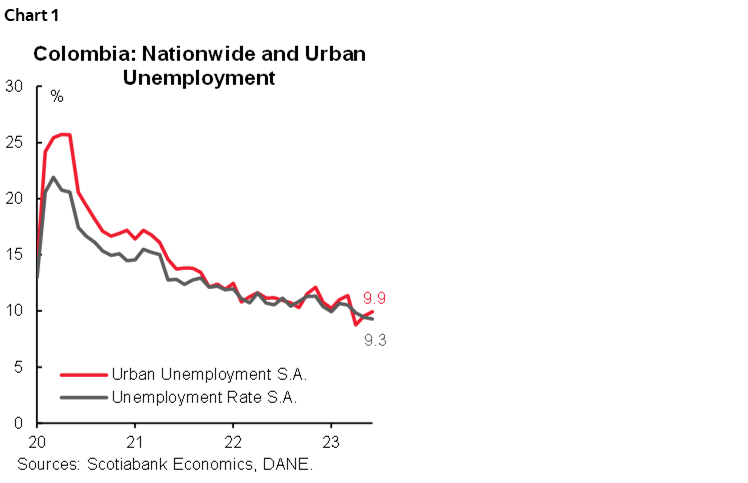
The labour market results for August continue to show good performance, with resilient job creation, while the unemployment rate remains at historically low levels. This will be a factor that BanRep will take into account at the September 29th meeting and will reinforce our call for rate stability in forthcoming months.
Key information on employment data:
- In August, the female unemployment rate was 11.8%, down slightly from 11.9% in July. Meanwhile, the male unemployment rate decreased from 7.9% in July to 7.4% in August. Taking into account the above, the gender gap deteriorated slightly from 4 pp in July to 4.3 pp in August.
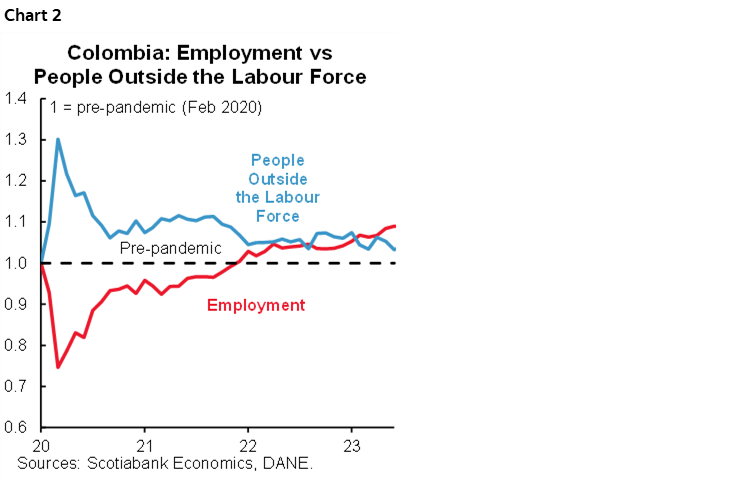
- On an annual basis, the number of people employed showed a positive trend, with another +1 million new jobs created (chart 2). Compared to August 2022, the female population added +509 thousand jobs, representing 50.8% of total job creation, while the male population added +492 thousand jobs, representing around 49.1% of total job creation.
- In terms of sectors, around 50% of total job creation in August was concentrated in three sectors: the manufacturing sector, with a contribution of 0.9 percentage points and the creation of +206 thousand new jobs year-on-year. In second place were public administration and defense, education, and health services, which added +184 thousand new jobs and contributed 0.8pp to the total. Followed by the agriculture sector, which added +178 thousand new jobs, contributing 0.8pp to the total, while the accommodation and food services sector added +167 thousand jobs and a contribution of 0.8pp. On the other hand, the commerce and repair of motor vehicles and motorcycles lost 139 thousand jobs and contributed -0.6 pp, as this sector was among those that deteriorated due to lower domestic demand for durable and semi-durable goods. Similarly, the public services and construction sectors recorded decreases of -75 thousand and -51 thousand respectively, with negative contributions of -0.3 pp and -0.2 pp.
- In terms of the occupational position, the category of private employees (proxy of formality) contributed +495 thousand jobs to the total job creation, which corresponds to 43% of the total job creation (+1 million). It was followed by the occupational position of the self-employed, which contributed +196 thousand jobs (41.7% of those employed). In terms of gender, the greatest job creation for women was in the position of private employee (+333 thousand), while for men it was mainly in the positions of self-employed (+169 thousand), private employee (+162 thousand) and day labourer (+111).
- The share of informality decreased by 1.4 percentage points on an annual basis, standing at 55.9% compared to 57.4% in August 2022. Formal employment added +761 thousand jobs, while informal job creation was +240 thousand. In urban areas, the informality rate improved from 42.1% in August 2022 to 40.9% in August 2023.
Concluding remarks
The labour market results for August showed very good job creation and improvements in formality, not only thanks to public sector hiring. Employment growth in August was concentrated in the manufacturing and services sectors, while a deterioration was observed in the commerce and construction sectors, which is associated with lower household demand for durable and semi-durable goods.
The strength of the labour market will continue to be a carefully evaluated indicator by BanRep and confirms our expectation of stability in interest rates. However, although the economy is on a path of moderation, it is not materially affecting employment and therefore we believe that BanRep will wait for the next inflation data and economic activity before deciding to start the easing cycle.
—Sergio Olarte, Jackeline Piraján & Santiago Moreno
DISCLAIMER
This report has been prepared by Scotiabank Economics as a resource for the clients of Scotiabank. Opinions, estimates and projections contained herein are our own as of the date hereof and are subject to change without notice. The information and opinions contained herein have been compiled or arrived at from sources believed reliable but no representation or warranty, express or implied, is made as to their accuracy or completeness. Neither Scotiabank nor any of its officers, directors, partners, employees or affiliates accepts any liability whatsoever for any direct or consequential loss arising from any use of this report or its contents.
These reports are provided to you for informational purposes only. This report is not, and is not constructed as, an offer to sell or solicitation of any offer to buy any financial instrument, nor shall this report be construed as an opinion as to whether you should enter into any swap or trading strategy involving a swap or any other transaction. The information contained in this report is not intended to be, and does not constitute, a recommendation of a swap or trading strategy involving a swap within the meaning of U.S. Commodity Futures Trading Commission Regulation 23.434 and Appendix A thereto. This material is not intended to be individually tailored to your needs or characteristics and should not be viewed as a “call to action” or suggestion that you enter into a swap or trading strategy involving a swap or any other transaction. Scotiabank may engage in transactions in a manner inconsistent with the views discussed this report and may have positions, or be in the process of acquiring or disposing of positions, referred to in this report.
Scotiabank, its affiliates and any of their respective officers, directors and employees may from time to time take positions in currencies, act as managers, co-managers or underwriters of a public offering or act as principals or agents, deal in, own or act as market makers or advisors, brokers or commercial and/or investment bankers in relation to securities or related derivatives. As a result of these actions, Scotiabank may receive remuneration. All Scotiabank products and services are subject to the terms of applicable agreements and local regulations. Officers, directors and employees of Scotiabank and its affiliates may serve as directors of corporations.
Any securities discussed in this report may not be suitable for all investors. Scotiabank recommends that investors independently evaluate any issuer and security discussed in this report, and consult with any advisors they deem necessary prior to making any investment.
This report and all information, opinions and conclusions contained in it are protected by copyright. This information may not be reproduced without the prior express written consent of Scotiabank.
™ Trademark of The Bank of Nova Scotia. Used under license, where applicable.
Scotiabank, together with “Global Banking and Markets”, is a marketing name for the global corporate and investment banking and capital markets businesses of The Bank of Nova Scotia and certain of its affiliates in the countries where they operate, including; Scotiabank Europe plc; Scotiabank (Ireland) Designated Activity Company; Scotiabank Inverlat S.A., Institución de Banca Múltiple, Grupo Financiero Scotiabank Inverlat, Scotia Inverlat Casa de Bolsa, S.A. de C.V., Grupo Financiero Scotiabank Inverlat, Scotia Inverlat Derivados S.A. de C.V. – all members of the Scotiabank group and authorized users of the Scotiabank mark. The Bank of Nova Scotia is incorporated in Canada with limited liability and is authorised and regulated by the Office of the Superintendent of Financial Institutions Canada. The Bank of Nova Scotia is authorized by the UK Prudential Regulation Authority and is subject to regulation by the UK Financial Conduct Authority and limited regulation by the UK Prudential Regulation Authority. Details about the extent of The Bank of Nova Scotia's regulation by the UK Prudential Regulation Authority are available from us on request. Scotiabank Europe plc is authorized by the UK Prudential Regulation Authority and regulated by the UK Financial Conduct Authority and the UK Prudential Regulation Authority.
Scotiabank Inverlat, S.A., Scotia Inverlat Casa de Bolsa, S.A. de C.V, Grupo Financiero Scotiabank Inverlat, and Scotia Inverlat Derivados, S.A. de C.V., are each authorized and regulated by the Mexican financial authorities.
Not all products and services are offered in all jurisdictions. Services described are available in jurisdictions where permitted by law.