

- Colombia: Consumer confidence and willingness to buy durable goods increases in June
- Peru: BCRP would keep pause for the sixth month, future cut would be on the horizon; mining investment continued to fall in May
USD losses and UST gains continued in Asia hours and deepened in European dealing as the late-Jun/early-Jul selloff in the US front-end is erased following Wednesday’s lower than expected inflation print; 2s are trading at their lowest point since mid-June around 4.65% thanks to an 11bps drop today. Global curves are following Treasurys, bull steepening.
US equity futures are adding to cash gains with a 0.3% move higher overnight, that mirrors the gains in WTI/Brent and copper, lagging a bit the 1% rise in iron ore. The USD is down 0.3% on a broad basis (BBDXY) with the MXN lagging as it sits unchanged—which fair enough considering its gains to the 16.80 area yesterday. The release of US PPI and jobless claims at 8.30ET is the G10 highlight of the day alongside a couple of Fed speakers (Waller and Daly) and the ECB’s June meeting minutes at 7.30ET.
We have a very quiet day ahead in Latam until the after-market BCRP rate decision at 19ET where an unchanged reference rate at 7.75% is practically guaranteed. In today’s report, our Lima economists preview the decision and what to expect, with the economy underperforming forecasts so far in the year possibly prompting a slight change in tone by the central bank. Maybe a cautious stance that would raise the odds of a Q3 rate cut may act to unwind part of the PEN’s massive rally over the past three sessions which yesterday took it to its best levels since late-2020 (~3.575 soles per USD).
—Juan Manuel Herrera
COLOMBIA: CONSUMER CONFIDENCE AND WILLINGNESS TO BUY DURABLE GOODS INCREASES IN JUNE
Colombia’s Consumer Confidence Index (CCI) in June stood at -14.1%, which represents an increase of 8.7 ppts over May (-28.8%). The improvement was driven by an increase in both components of the CCI. The Consumer Expectations Index went from -14.5% in May to -6.5% in June, which corresponds to an increase of 8ppts, similarly, the Economic Conditions Index showed an increase of 9.8 ppts, placing the ECI at -24.4% (chart 1).
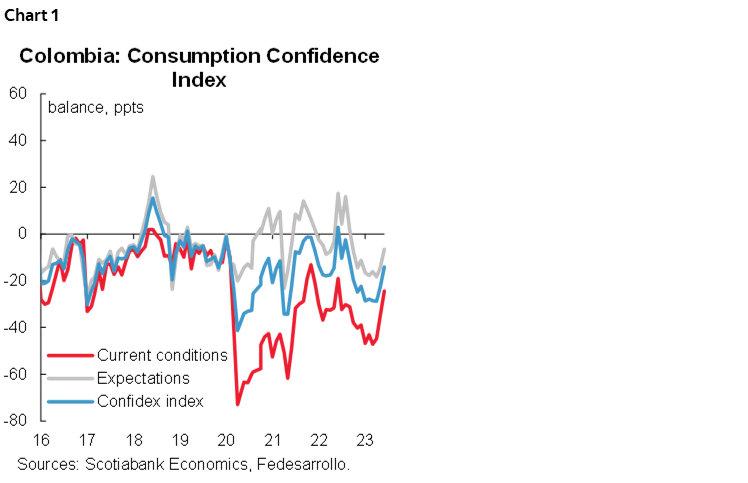
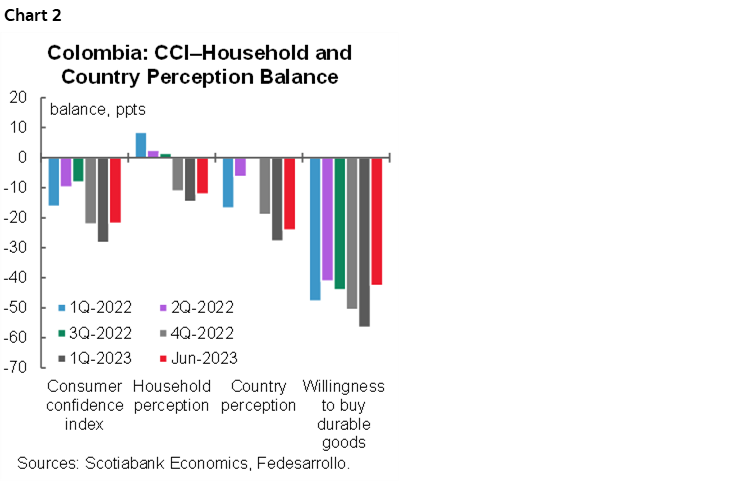
The Consumer Expectations Index had an important increase thanks to the fact that consumers think that the economic conditions of their homes and of the country in general will improve next year. This may be related to the favourable performance of the CPI recorded in the last 3 months. Willingness to buy also improved significantly. The disposition to buy durable goods improved by 13.2 pp from -44.1% in May. The disposition to buy vehicles went from -66.7% to -57.4%, an increase of 9.3 pp. On the other hand, high interest rates and high prices in the construction sector did not significantly favour the disposition to buy housing (-43.5%). Households’ perception of the country’s future remains negative; however, it shows a significant improvement explained by a currency revaluation and slowing inflation.
Looking at the June details:
- The Economic Conditions Index stood at -25.4%, increasing by 9.8 pp from the previous month. Even though the prices of capital and consumer goods continue at high levels, the exchange rate is leveling off upside pressures. That said, price stabilization could be the reason why now households are showing a better willingness to buy durable goods, this index increase by 13.2ppts with respect to the previous month.
- The expectations index stood at -6.5% which represents an improvement of 8 p.p. vs. the previous month. In the next 12 months, households expect their economic situation to improve. A decline in economic activity and inflation slowing down to 12.13% YoY, added to the pause in the hiking cycle by BanRep reflects a better economic scenario, however, the uncertainty about the impacts of the El Niño phenomenon for the second half of 2023 and 2024 could generate new pressures on prices and economic growth.
- The Consumer Confidence Index entered positive territory in Barranquilla, going from -16.3% in May to 4.5%, which represents an increase of 20.8 p.p. Additionally, the other cities analyzed (Bogota, Medellin, Bucaramanga, Cali) also presented an increase in the CCI.
- Consumer confidence increased across all socioeconomic levels. In the high-income group, confidence stood at -35% which represents an increase of 21.3 p.p. compared to the previous month. In the middle-income group, the CCI increased by 10.3ppts to -10.3%. The low-income group increased the least from -21.1% in May to -15.1% in June as high prices impact this group the most.
Despite consumer confidence remaining in negative territory, June data showed an improved perception of the economic outlook for households. Inflation dynamics and FX appreciation could be the reason for the increasing disposition to buy durable goods and vehicles (chart 2). We expect the central bank to keep the interest rate stable until October and that inflation will continue to decelerate. The easing cycle will strongly depend of the inflation dynamic, that said, despite consumer sentiment improving, the effect on consumption could be contained as interest rates remain at high level.
—Sergio Olarte, Jackeline Piraján & Santiago Moreno
PERU: BCRP WOULD KEEP PAUSE FOR THE SIXTH MONTH, FUTURE CUT WOULD BE ON THE HORIZON
We expect the BCRP to leave its reference rate unchanged at 7.75% at its meeting this Thursday, July 13th, a move that is in line with the market consensus according to a Bloomberg survey. Inflation y/y fell visibly in June, although poultry prices accounted for most of the decline, as well as a high base for comparison. However, it was enough for inflationary expectations to also fall. The reading of inflation and its expectations for July will be key to confirming the rate of decline in inflation.
Inflation expectations for 12 months fell from 4.2% to 3.8%, according to the latest BCRP survey, a visible decrease, although still above the target range (between 1% and 3%). The survey also showed that 24-month forward inflation expectations were lowered from 3.1% to 2.9%, reflecting that the consensus still sees that the return of inflation to the target range could take time. Our inflation forecast remains at 5.00% for 2023 and 3.5% for 2024.
Economic activity indicators stagnated in May, and business expectations showed a visible deterioration in June, remaining in a pessimistic territory. The economic indicators have not been recovering as expected. Although the BCRP revised its forecast for 2023 economic growth from 2.6% to 2.2% in June, the consensus has continued to revise its forecast downwards (from 1.9% to 1.8% according to a Focus Economics survey in July).
Recently, BCRP’s chairman, Julio Velarde, pointed out that several engines of the economy are off, that private investment will continue low due to a lack of confidence and that public investment is contracted due to the change of management—in subnational governments. In this context, we hope that in today’s statement the BCRP will make its concern about the weak economic performance more visible. This could be interpreted as a sign that the BCRP would be open to a possible advance in the cycle of interest rate cuts.
This decision does not seem so simple and the BCRP would evaluate it with caution. Although the economic weakness is a factor to consider, the BCRP will prioritize the performance of inflation—which so far in July seems to be a bit high, with some recovery in poultry and perishable food prices, as well as future risks on food prices, mainly derived from an El Niño Phenomenon with increasing probabilities.
—Mario Guerrero
PERU: MINING INVESTMENT CONTINUED TO FALL IN MAY
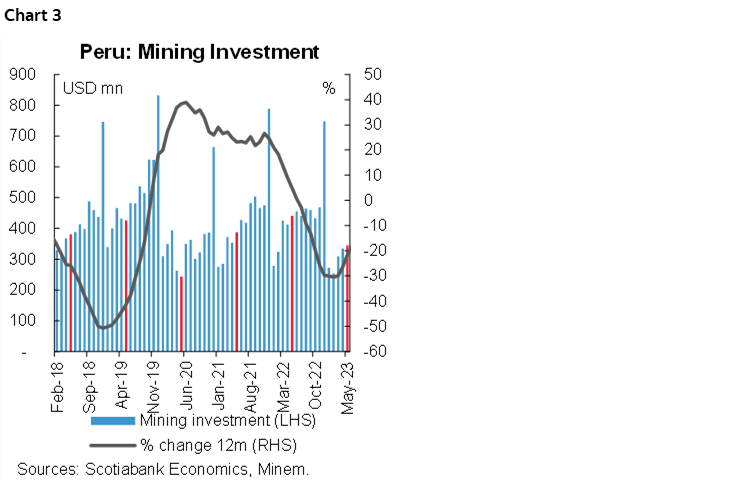
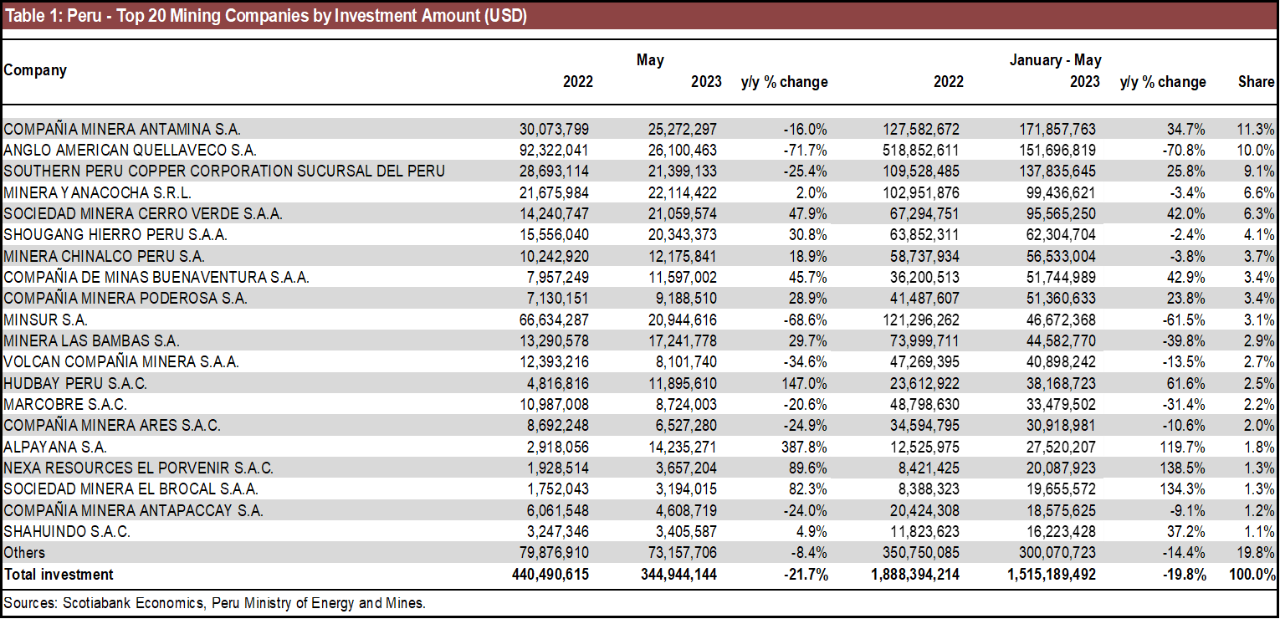
Peru’s local mining investment fell 21.7% y/y in May, according to data from the Ministry of Mining. In the cumulative January–May period, mining investment falls 19.8% y/y, almost in line with our forecasts (chart 3). The lack of projects that give continuity to the sector is being minimally offset by minor projects that were already under construction in previous years. To date in 2023, of the four projects in the pipeline, none has started construction.
Antamina led the mining investment in April (table 1). The company is still waiting for the approval of the changes of the Modified Environmental Impact Study (MEIA-d), which they now expect to obtain by the end of 2023. Antamina raised the investment of the brownfield project from US$1,600 to US$2,000 million and intends to continue the operations of the Antamina mine and extend operations until the year 2036. In addition, the mine is evaluating options to reduce greenhouse gas emissions from its operations in Quebrada Antamina, with the potential to reduce 30 trucks between 2028 and 2036. The other three projects that have not started operations yet are Romina y Magistral (due to lack of EIA approval) and Corani (in limbo due to social unrest at the beginning of the year). Other companies that led the investment were Anglo American and Southern Peru.
Regarding mining output, the sector continued to perform well mainly due to strong copper output (+34.7%). The output also rose for zinc (+8.2%), lead (+5.3%), tin (+6.5%), and molybdenum (+17.1%). While production fell in gold (-7.4%), silver (-4.7%), and iron (-3.7%, table 2).
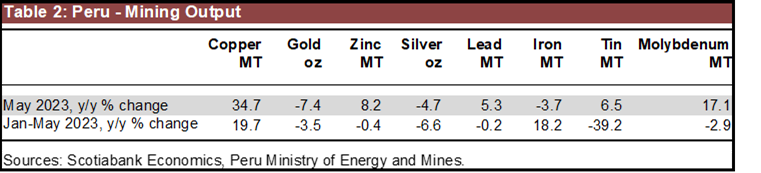
The increase in copper output in May had the same factors seen in April: i) the low base of comparison of Las Bambas (MMG) which continued to be paralyzed due to social unrest in May 2022, and ii) Quellaveco had not yet started operations in May 2022. The base factor will remain in force until August of this year, since Quellaveco started operations in September 2022. On the other hand, molybdenum output also stood out, because Quellaveco and Las Bambas also produce the metal.
—Katherine Salazar
DISCLAIMER
This report has been prepared by Scotiabank Economics as a resource for the clients of Scotiabank. Opinions, estimates and projections contained herein are our own as of the date hereof and are subject to change without notice. The information and opinions contained herein have been compiled or arrived at from sources believed reliable but no representation or warranty, express or implied, is made as to their accuracy or completeness. Neither Scotiabank nor any of its officers, directors, partners, employees or affiliates accepts any liability whatsoever for any direct or consequential loss arising from any use of this report or its contents.
These reports are provided to you for informational purposes only. This report is not, and is not constructed as, an offer to sell or solicitation of any offer to buy any financial instrument, nor shall this report be construed as an opinion as to whether you should enter into any swap or trading strategy involving a swap or any other transaction. The information contained in this report is not intended to be, and does not constitute, a recommendation of a swap or trading strategy involving a swap within the meaning of U.S. Commodity Futures Trading Commission Regulation 23.434 and Appendix A thereto. This material is not intended to be individually tailored to your needs or characteristics and should not be viewed as a “call to action” or suggestion that you enter into a swap or trading strategy involving a swap or any other transaction. Scotiabank may engage in transactions in a manner inconsistent with the views discussed this report and may have positions, or be in the process of acquiring or disposing of positions, referred to in this report.
Scotiabank, its affiliates and any of their respective officers, directors and employees may from time to time take positions in currencies, act as managers, co-managers or underwriters of a public offering or act as principals or agents, deal in, own or act as market makers or advisors, brokers or commercial and/or investment bankers in relation to securities or related derivatives. As a result of these actions, Scotiabank may receive remuneration. All Scotiabank products and services are subject to the terms of applicable agreements and local regulations. Officers, directors and employees of Scotiabank and its affiliates may serve as directors of corporations.
Any securities discussed in this report may not be suitable for all investors. Scotiabank recommends that investors independently evaluate any issuer and security discussed in this report, and consult with any advisors they deem necessary prior to making any investment.
This report and all information, opinions and conclusions contained in it are protected by copyright. This information may not be reproduced without the prior express written consent of Scotiabank.
™ Trademark of The Bank of Nova Scotia. Used under license, where applicable.
Scotiabank, together with “Global Banking and Markets”, is a marketing name for the global corporate and investment banking and capital markets businesses of The Bank of Nova Scotia and certain of its affiliates in the countries where they operate, including; Scotiabank Europe plc; Scotiabank (Ireland) Designated Activity Company; Scotiabank Inverlat S.A., Institución de Banca Múltiple, Grupo Financiero Scotiabank Inverlat, Scotia Inverlat Casa de Bolsa, S.A. de C.V., Grupo Financiero Scotiabank Inverlat, Scotia Inverlat Derivados S.A. de C.V. – all members of the Scotiabank group and authorized users of the Scotiabank mark. The Bank of Nova Scotia is incorporated in Canada with limited liability and is authorised and regulated by the Office of the Superintendent of Financial Institutions Canada. The Bank of Nova Scotia is authorized by the UK Prudential Regulation Authority and is subject to regulation by the UK Financial Conduct Authority and limited regulation by the UK Prudential Regulation Authority. Details about the extent of The Bank of Nova Scotia's regulation by the UK Prudential Regulation Authority are available from us on request. Scotiabank Europe plc is authorized by the UK Prudential Regulation Authority and regulated by the UK Financial Conduct Authority and the UK Prudential Regulation Authority.
Scotiabank Inverlat, S.A., Scotia Inverlat Casa de Bolsa, S.A. de C.V, Grupo Financiero Scotiabank Inverlat, and Scotia Inverlat Derivados, S.A. de C.V., are each authorized and regulated by the Mexican financial authorities.
Not all products and services are offered in all jurisdictions. Services described are available in jurisdictions where permitted by law.