

- Chile: Unemployment rate rises to 8.8%; 6.5k jobs are lost with a sharp increase in the labour force; Good news for the 2024 structural balance: higher long-term copper price estimates and no change in trend GDP growth
CHILE: UNEMPLOYMENT RATE RISES TO 8.8%; 6.5K JOBS ARE LOST WITH A SHARP INCREASE IN THE LABOUR FORCE
- Labour market deterioration is accentuated, but there are green shoots in investment-linked employment.
On Wednesday, August 30th, the statistical agency (INE) released the unemployment rate for the quarter ending in July, which rose to 8.8% (chart 1), above market and our expectation (8.7%) and showing a deterioration with respect to the previous record (8.5%). The main difference with respect to our expectation was not in the destruction of employment but in the renewed dynamism of the labour force. Although this could be explained by transitory reasons (reduction of inactivity for study reasons), female participation increased for the third consecutive quarter, reflecting the fact that women are returning to the labour market in a decisive manner.
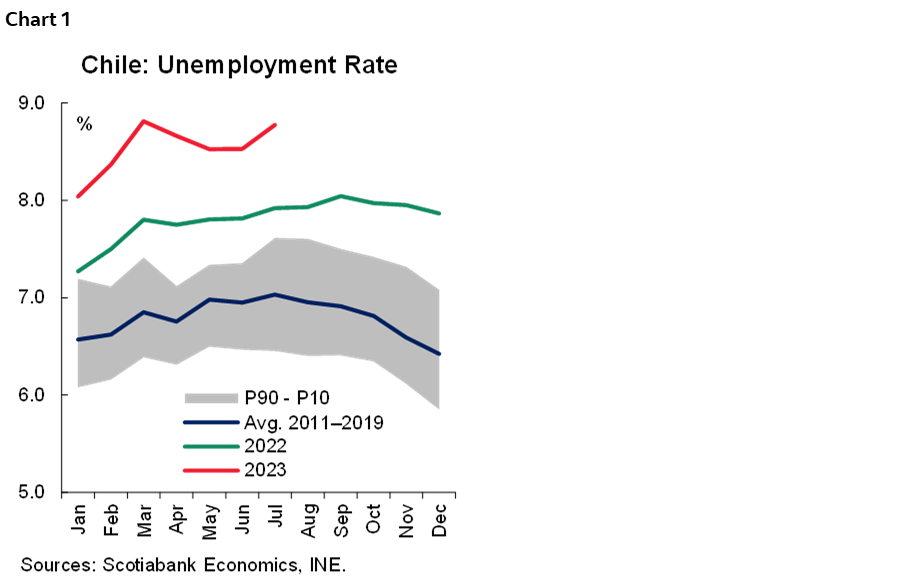
Job destruction continues to reflect weakness in the labour market. Over the last two moving quarters, employment has declined mainly due to the decline in self-employment. In July, this contracted by 10k jobs, most of them employers. In contrast, salaried employment increased (+7k), again thanks to the public sector (+8k), since the private sector destroyed salaried jobs (-1k). All in all, 6.5k jobs were lost in the quarter ending in July.
Relevant and counter-seasonal increase in the labour force (+19k) could be a transitory phenomenon. The increase observed this month put pressure on the unemployment rate, explaining a large part of the deterioration of this indicator with respect to the previous month. Part of the increase in the labour force was explained by a reduction in the inactive population, mainly for study reasons, which was already observed in July of 2022 and showed moderation in the following month. Although this may be a transitory phenomenon, we interpret positively the increase in the female labour participation rate observed in recent quarters, whose level is very close to what was observed before Covid, in contrast to male participation, which continues to decline.
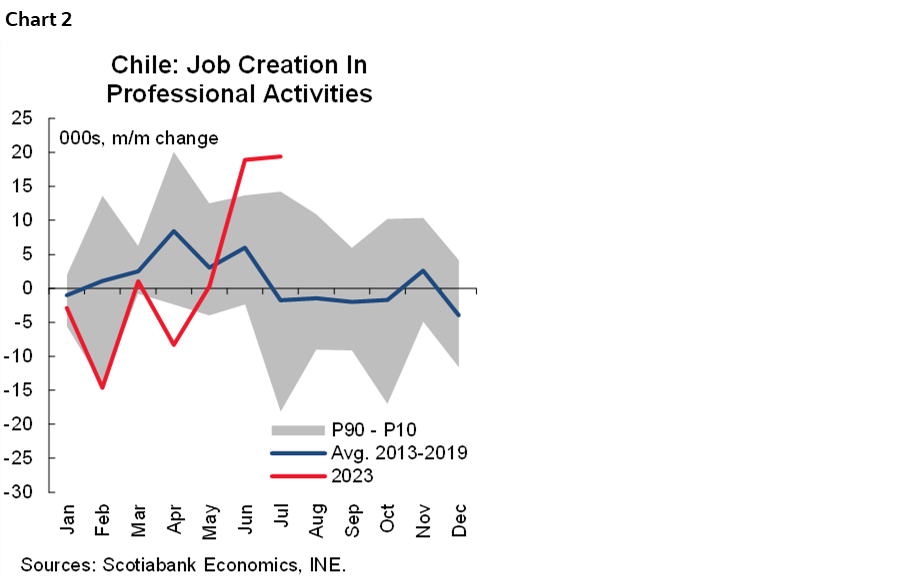
By economic sector, job creation in public administration (+12k) stands out once again, both of public employees and also of people who report being private employees providing services to the public administration, a phenomenon that we have already detected in previous months. Also noteworthy for the second consecutive month was the increase in employment in professional activities (chart 2), which created 19k jobs, mostly salaried employees (13k). This last sector groups professional service providers, generally linked to the development of investment projects in early stages, so its recovery could be in line with the launching of several public and private investment projects in recent months, especially in the mining and energy sector.
On the other hand, the sectors of concern are manufacturing and construction, which continue to destroy employment beyond what is seasonally expected. These sectors, together with commerce, are the main job seekers in Chile, and their weakness is in line with the lack of dynamism or stagnation shown by these sectors in terms of economic activity.
GOOD NEWS FOR THE 2024 STRUCTURAL BALANCE: HIGHER LONG-TERM COPPER PRICE ESTIMATES AND NO CHANGE IN TREND GDP GROWTH
On Wednesday, August 30th, the Ministry of Finance published the estimate of the long-term copper price and trend GDP growth. These parameters represent the main inputs for the estimation of 2024 structural fiscal revenues and are provided by two independent expert groups, one of which (long-term GDP expert committee) is integrated by Scotiabank’s Economics team thanks to the representation of our Chief Economist, Jorge Selaive.
On the one hand, the long-term copper price (10-year average) increased from 374 to 386 USD cents per pound according to the independent experts’ estimates, a value that will be used as input for the 2024 structural revenue estimate and that would imply higher structural revenues than those estimated for next year (ceteris paribus). It should be noted that the Q2-23 Public Finance Report projected the price of copper at 381 USD cents per pound for 2024.
On the other hand, the trend GDP growth estimated by independent experts for 2024 remained stable at 2.3%, increasing from the 1.9% used as a parameter to determine structural revenues in the fiscal 2023 budget. Our GDP growth projection for 2024 stands at 2.3%, reflecting our expectation that the economy will expand at a pace similar to its long-term trend.
The Ministry of Finance should deliver the fiscal budget for 2024 to congress no later than September 30th, which must be passed no later than 60 days later by congress.
—Aníbal Alarcón
DISCLAIMER
This report has been prepared by Scotiabank Economics as a resource for the clients of Scotiabank. Opinions, estimates and projections contained herein are our own as of the date hereof and are subject to change without notice. The information and opinions contained herein have been compiled or arrived at from sources believed reliable but no representation or warranty, express or implied, is made as to their accuracy or completeness. Neither Scotiabank nor any of its officers, directors, partners, employees or affiliates accepts any liability whatsoever for any direct or consequential loss arising from any use of this report or its contents.
These reports are provided to you for informational purposes only. This report is not, and is not constructed as, an offer to sell or solicitation of any offer to buy any financial instrument, nor shall this report be construed as an opinion as to whether you should enter into any swap or trading strategy involving a swap or any other transaction. The information contained in this report is not intended to be, and does not constitute, a recommendation of a swap or trading strategy involving a swap within the meaning of U.S. Commodity Futures Trading Commission Regulation 23.434 and Appendix A thereto. This material is not intended to be individually tailored to your needs or characteristics and should not be viewed as a “call to action” or suggestion that you enter into a swap or trading strategy involving a swap or any other transaction. Scotiabank may engage in transactions in a manner inconsistent with the views discussed this report and may have positions, or be in the process of acquiring or disposing of positions, referred to in this report.
Scotiabank, its affiliates and any of their respective officers, directors and employees may from time to time take positions in currencies, act as managers, co-managers or underwriters of a public offering or act as principals or agents, deal in, own or act as market makers or advisors, brokers or commercial and/or investment bankers in relation to securities or related derivatives. As a result of these actions, Scotiabank may receive remuneration. All Scotiabank products and services are subject to the terms of applicable agreements and local regulations. Officers, directors and employees of Scotiabank and its affiliates may serve as directors of corporations.
Any securities discussed in this report may not be suitable for all investors. Scotiabank recommends that investors independently evaluate any issuer and security discussed in this report, and consult with any advisors they deem necessary prior to making any investment.
This report and all information, opinions and conclusions contained in it are protected by copyright. This information may not be reproduced without the prior express written consent of Scotiabank.
™ Trademark of The Bank of Nova Scotia. Used under license, where applicable.
Scotiabank, together with “Global Banking and Markets”, is a marketing name for the global corporate and investment banking and capital markets businesses of The Bank of Nova Scotia and certain of its affiliates in the countries where they operate, including; Scotiabank Europe plc; Scotiabank (Ireland) Designated Activity Company; Scotiabank Inverlat S.A., Institución de Banca Múltiple, Grupo Financiero Scotiabank Inverlat, Scotia Inverlat Casa de Bolsa, S.A. de C.V., Grupo Financiero Scotiabank Inverlat, Scotia Inverlat Derivados S.A. de C.V. – all members of the Scotiabank group and authorized users of the Scotiabank mark. The Bank of Nova Scotia is incorporated in Canada with limited liability and is authorised and regulated by the Office of the Superintendent of Financial Institutions Canada. The Bank of Nova Scotia is authorized by the UK Prudential Regulation Authority and is subject to regulation by the UK Financial Conduct Authority and limited regulation by the UK Prudential Regulation Authority. Details about the extent of The Bank of Nova Scotia's regulation by the UK Prudential Regulation Authority are available from us on request. Scotiabank Europe plc is authorized by the UK Prudential Regulation Authority and regulated by the UK Financial Conduct Authority and the UK Prudential Regulation Authority.
Scotiabank Inverlat, S.A., Scotia Inverlat Casa de Bolsa, S.A. de C.V, Grupo Financiero Scotiabank Inverlat, and Scotia Inverlat Derivados, S.A. de C.V., are each authorized and regulated by the Mexican financial authorities.
Not all products and services are offered in all jurisdictions. Services described are available in jurisdictions where permitted by law.