

- Colombia: Headline inflation moderates, but core highest since December 2003
COLOMBIA: HEADLINE INFLATION MODERATES, BUT CORE HIGHEST SINCE DECEMBER 2003
According to DANE data published on Saturday June 4, monthly CPI inflation was 0.84% m/m in May 2022, close to the BanRep’s survey (0.82% m/m) and aligned with Scotiabank Economics’ projection (0.84% m/m). The May inflation reading was almost 2.5 times the average monthly inflation observed since 2016 (0.33% m/m) and brings annual headline inflation to 9.07% y/y, down from 9.23% y/y in April (chart 1). Annual food inflation eased from 26.2% y/y to 21.60% y/y, exhausting the upside effect of the nationwide strike one year ago, as the only element of the CPI basket contributing to the deceleration of inflation on a year-over-year basis.
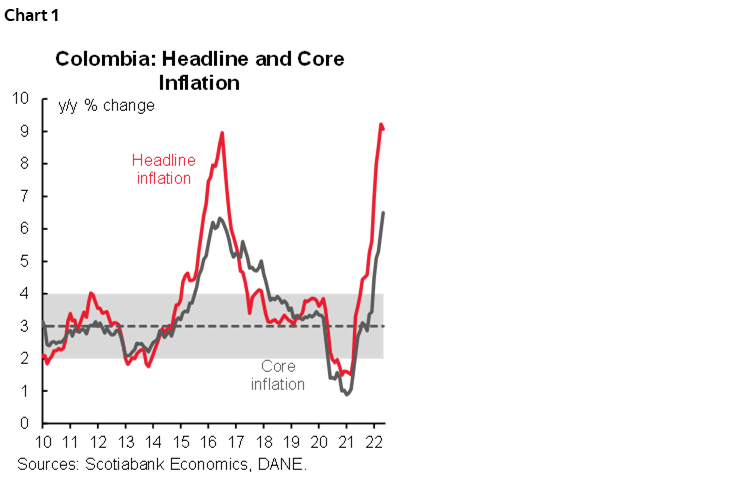
In contrast, core inflation increased again, from 5.94% y/y to 6.50% y/y, the highest rate since December 2003, while ex-food and regulated goods inflation came in at 5.87% y/y (up from 5.26% the previous month), the highest level since August 2016. These results show upside pressures on key prices owing to indexation effects in items such as rent fees and utilities. The consolidation of economic activity, meanwhile, is probably fueling further price rises; in fact, consumption credit demand is increasing above 18% y/y pace, which points to still-strong demand.
Higher core inflation should, in our opinion, motivate a 150 bps rate hike at the June 30th monetary policy meeting. Since the last meeting, economic activity has shown stronger-than-expected results, while inflation is driven by upside pressures in core components. We expect June’s y/y headline inflation to increase again, due to the negative statistical base effect on the back of the normalization in food prices after the nationwide strike one year ago. It will be interesting to see if the VAT holiday (June 17th) moderates the expected spike. That said, we will only have confirmation of a downward path after the July releases. For now, we affirm our expectation of the hiking cycle ending at 8.5% in July, with the rate easing to 6% by the end of 2023, provided inflation moderates in H2-2022 and drops more rapidly in 2023.
Looking at the May numbers in detail, all 12 components of the CPI index contributed to higher inflation (charts 2 and 3). The main highlights are:
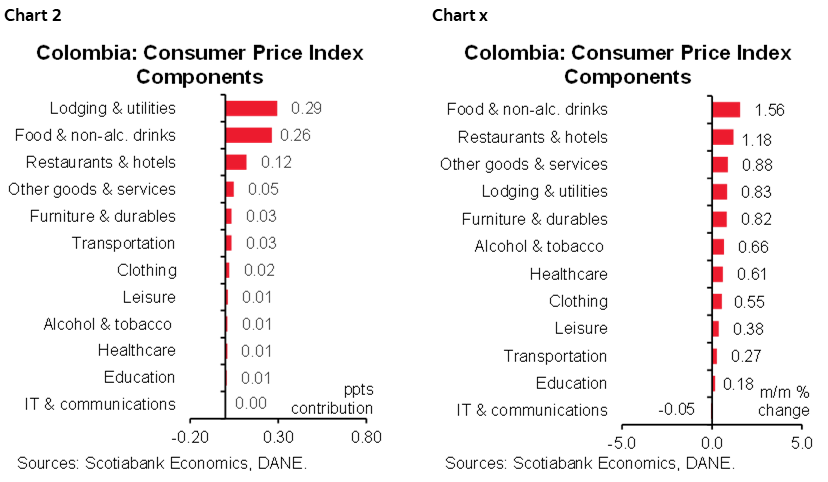
- Foodstuffs had the largest contribution (+29 bps), with inflation of +1.56% m/m, coming from meat (+9 bps), tomatoes (+7 bps), and rice (+5 bps), with other products showing upside pressures from higher input prices. Having said that, food inflation slowed down from its previous record level of 26.2 % y/y in April. Moreover, in May, the PPI showed pressures on fertilizer process that are likely to continue to be reflected in the CPI numbers for foodstuffs in coming months.
- Food inflation will have a high statistical base in June resulting from the normalization after the nationwide strike in 2021, which led to a 1.02% m/m contraction. This base effect should again contribute to an increase in headline inflation. However, if food inflation remains above an average of 0.80% m/m for the rest of the year, inflation would continue accelerating after June. Therefore, the risk of closing 2022 with inflation above 8.50% is high, which would lead to higher indexation effects that would delay the expected y/y reduction of inflation in 2023.
- Lodging and utilities (+26 bps) was the second-largest contributor to headline inflation. In May, rents rose 0.54% m/m, reflecting stronger indexation effects compared with previous months. Utility fees jumped by 1.78% m/m, led by electricity (+2.86% m/m), and water (+1.44% m/m). These increases are a source of concern, since they can continue to push inflation up as indexation rules are consistently triggered.
- Across other groups, inflation reflected upside contributions from tradable goods reflecting FX depreciation, and, more importantly, international bottlenecks that are also propagating price pressures in other core components.
Looking at annual inflation across major categories, goods inflation jumped 68 bps to 8.51 % y/y in April, while services increased from 4.29% y/y to 4.87% y/y. Regulated-price inflation increased 35 bps to 8.85% y/y.
All in all, May inflation showed an expected moderation. However, core components continued to rise in a concerning pattern. In May, meat, electricity, and rent fees were the main contributors to the prices’ increase, while other components also showed a strong dynamic of indexation and the effect of the current strong economic activity. All of the above lead us to expect the central bank to hike the monetary policy rate in June by 150 bps, with an end to the hiking cycle at 8.50% in July.
—Sergio Olarte, Maria (Tatiana) Mejía & Jackeline Piraján
DISCLAIMER
This report has been prepared by Scotiabank Economics as a resource for the clients of Scotiabank. Opinions, estimates and projections contained herein are our own as of the date hereof and are subject to change without notice. The information and opinions contained herein have been compiled or arrived at from sources believed reliable but no representation or warranty, express or implied, is made as to their accuracy or completeness. Neither Scotiabank nor any of its officers, directors, partners, employees or affiliates accepts any liability whatsoever for any direct or consequential loss arising from any use of this report or its contents.
These reports are provided to you for informational purposes only. This report is not, and is not constructed as, an offer to sell or solicitation of any offer to buy any financial instrument, nor shall this report be construed as an opinion as to whether you should enter into any swap or trading strategy involving a swap or any other transaction. The information contained in this report is not intended to be, and does not constitute, a recommendation of a swap or trading strategy involving a swap within the meaning of U.S. Commodity Futures Trading Commission Regulation 23.434 and Appendix A thereto. This material is not intended to be individually tailored to your needs or characteristics and should not be viewed as a “call to action” or suggestion that you enter into a swap or trading strategy involving a swap or any other transaction. Scotiabank may engage in transactions in a manner inconsistent with the views discussed this report and may have positions, or be in the process of acquiring or disposing of positions, referred to in this report.
Scotiabank, its affiliates and any of their respective officers, directors and employees may from time to time take positions in currencies, act as managers, co-managers or underwriters of a public offering or act as principals or agents, deal in, own or act as market makers or advisors, brokers or commercial and/or investment bankers in relation to securities or related derivatives. As a result of these actions, Scotiabank may receive remuneration. All Scotiabank products and services are subject to the terms of applicable agreements and local regulations. Officers, directors and employees of Scotiabank and its affiliates may serve as directors of corporations.
Any securities discussed in this report may not be suitable for all investors. Scotiabank recommends that investors independently evaluate any issuer and security discussed in this report, and consult with any advisors they deem necessary prior to making any investment.
This report and all information, opinions and conclusions contained in it are protected by copyright. This information may not be reproduced without the prior express written consent of Scotiabank.
™ Trademark of The Bank of Nova Scotia. Used under license, where applicable.
Scotiabank, together with “Global Banking and Markets”, is a marketing name for the global corporate and investment banking and capital markets businesses of The Bank of Nova Scotia and certain of its affiliates in the countries where they operate, including; Scotiabank Europe plc; Scotiabank (Ireland) Designated Activity Company; Scotiabank Inverlat S.A., Institución de Banca Múltiple, Grupo Financiero Scotiabank Inverlat, Scotia Inverlat Casa de Bolsa, S.A. de C.V., Grupo Financiero Scotiabank Inverlat, Scotia Inverlat Derivados S.A. de C.V. – all members of the Scotiabank group and authorized users of the Scotiabank mark. The Bank of Nova Scotia is incorporated in Canada with limited liability and is authorised and regulated by the Office of the Superintendent of Financial Institutions Canada. The Bank of Nova Scotia is authorized by the UK Prudential Regulation Authority and is subject to regulation by the UK Financial Conduct Authority and limited regulation by the UK Prudential Regulation Authority. Details about the extent of The Bank of Nova Scotia's regulation by the UK Prudential Regulation Authority are available from us on request. Scotiabank Europe plc is authorized by the UK Prudential Regulation Authority and regulated by the UK Financial Conduct Authority and the UK Prudential Regulation Authority.
Scotiabank Inverlat, S.A., Scotia Inverlat Casa de Bolsa, S.A. de C.V, Grupo Financiero Scotiabank Inverlat, and Scotia Inverlat Derivados, S.A. de C.V., are each authorized and regulated by the Mexican financial authorities.
Not all products and services are offered in all jurisdictions. Services described are available in jurisdictions where permitted by law.