

- Peru: Ministry of Finance seeks to restore the Fiscal Stabilization Fund to its pre-COVID-19 levels
PERU: MINISTRY OF FINANCE SEEKS TO RESTORE THE FISCAL STABILIZATION FUND TO ITS PRE-COVID-19 LEVELS
In a press release on Monday (January 10), the Ministry of Finance officially announced its intention to allocate over PEN 18 bn (USD 4.56 bn) to the Fiscal Stabilization Fund (FEF or Fondo de Estabilización Fiscal). The resources, equivalent to approximately 2% of GDP, are to be deposited on an unspecified date during Q1 2022.
This deposit would restore the FEF to its pre-COVID-19 levels, although it would remain lower than its all-time high of PEN 29.5 bn in 2016 (chart 1). The FEF funds were all but used up during 2020–2021 to provide resources to counter the impact on the economy of the COVID-19 pandemic and the accompanying lockdowns and mobility restrictions.
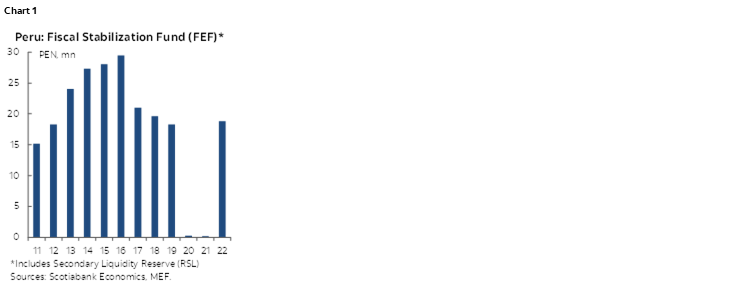
The announcement came as a surprise, especially as the deposit will occur when Peru has a fiscal deficit. In the past, the FEF grew only in years in which there was a fiscal surplus. The press release did not provide too much insight into what the Ministry of Finance has in mind, outside of one key phrase, namely that “The FEF is one of the main elements of countercyclical fiscal policy, as it accumulates resources mainly during scenarios of rising fiscal revenue associated to… favourable commodity prices…” (our translation). In the past, Minister of Finance Pedro Francke had stated the convenience of taxing mining operations while commodity prices are high. Thus, Minister Francke appears to have in mind the importance of the current commodity cycle and the need to take advantage of it for long-term fiscal sustainability, as part of a Keynesian countercyclical policy approach. Rebuilding the FEF during a period of high metal prices would be part of this philosophy.
The press release did not state from whence these resources stem from, however. In the past, the FEF grew based on funds available when Peru registered a fiscal surplus. This is clearly not the case now. The magnitudes of the increments are also much different. In the past, the FEF would increase around PEN 5 bn to PEN 6 bn per year in its better years. This year’s proposed increment is 3x greater. The release did not state how the PEN 18 bn amount was determined. It is broadly in line with PEN 16 bn in fiscal investment funds that had been budgeted for 2021 but went unspent. It is also broadly in line with the fiscal debt issued in 2021. Both may just be a coincidence, except in that they both add to the availability of funds in general. What hasn’t escaped our attention is that the proposed increment will take the FEF back to pre-COVID-19 levels, as this was a message that was stressed in the press release. Thus, part of the aim of the Ministry of Finance may be to show just how resolute it is in its intention to put the country back in the fiscal position it was in before COVID-19. As such, restoring the FEF would be in line with another message that has been given repeatedly by the Ministry of Finance, namely that the fiscal rule (1% of GDP deficit) would be restored by 2025.
There is a bit of discussion on whether it would not have been better to use these funds to finance the 2022–2023 budgets, thus reducing the need to issue debt. After all, the yield of the FEF is likely to be lower than the cost of the same amount in fiscal debt. Note, however, that the decision is in line with the spirit behind the FEF, namely, for the fund to grow when metal prices are high (as they are now), so as to be available for use in times of crisis. The difficulty: normally high metal prices mean a fiscal surplus, and this is not the case now.
Nonetheless, the decision to restore the FEF to past levels underlines a stance of fiscal management that is unexpected in a government otherwise viewed as more in tune with leftist policies. It sends a message that may help reinforce the vision of Peru as a country with healthy fiscal accounts to back up its fiscal debt levels. As such, the decision could also make it more difficult for rating agencies to downgrade Peru debt going forward, and may actually lead them to improve their view on the debt outlook.
—Guillermo Arbe
DISCLAIMER
This report has been prepared by Scotiabank Economics as a resource for the clients of Scotiabank. Opinions, estimates and projections contained herein are our own as of the date hereof and are subject to change without notice. The information and opinions contained herein have been compiled or arrived at from sources believed reliable but no representation or warranty, express or implied, is made as to their accuracy or completeness. Neither Scotiabank nor any of its officers, directors, partners, employees or affiliates accepts any liability whatsoever for any direct or consequential loss arising from any use of this report or its contents.
These reports are provided to you for informational purposes only. This report is not, and is not constructed as, an offer to sell or solicitation of any offer to buy any financial instrument, nor shall this report be construed as an opinion as to whether you should enter into any swap or trading strategy involving a swap or any other transaction. The information contained in this report is not intended to be, and does not constitute, a recommendation of a swap or trading strategy involving a swap within the meaning of U.S. Commodity Futures Trading Commission Regulation 23.434 and Appendix A thereto. This material is not intended to be individually tailored to your needs or characteristics and should not be viewed as a “call to action” or suggestion that you enter into a swap or trading strategy involving a swap or any other transaction. Scotiabank may engage in transactions in a manner inconsistent with the views discussed this report and may have positions, or be in the process of acquiring or disposing of positions, referred to in this report.
Scotiabank, its affiliates and any of their respective officers, directors and employees may from time to time take positions in currencies, act as managers, co-managers or underwriters of a public offering or act as principals or agents, deal in, own or act as market makers or advisors, brokers or commercial and/or investment bankers in relation to securities or related derivatives. As a result of these actions, Scotiabank may receive remuneration. All Scotiabank products and services are subject to the terms of applicable agreements and local regulations. Officers, directors and employees of Scotiabank and its affiliates may serve as directors of corporations.
Any securities discussed in this report may not be suitable for all investors. Scotiabank recommends that investors independently evaluate any issuer and security discussed in this report, and consult with any advisors they deem necessary prior to making any investment.
This report and all information, opinions and conclusions contained in it are protected by copyright. This information may not be reproduced without the prior express written consent of Scotiabank.
™ Trademark of The Bank of Nova Scotia. Used under license, where applicable.
Scotiabank, together with “Global Banking and Markets”, is a marketing name for the global corporate and investment banking and capital markets businesses of The Bank of Nova Scotia and certain of its affiliates in the countries where they operate, including; Scotiabank Europe plc; Scotiabank (Ireland) Designated Activity Company; Scotiabank Inverlat S.A., Institución de Banca Múltiple, Grupo Financiero Scotiabank Inverlat, Scotia Inverlat Casa de Bolsa, S.A. de C.V., Grupo Financiero Scotiabank Inverlat, Scotia Inverlat Derivados S.A. de C.V. – all members of the Scotiabank group and authorized users of the Scotiabank mark. The Bank of Nova Scotia is incorporated in Canada with limited liability and is authorised and regulated by the Office of the Superintendent of Financial Institutions Canada. The Bank of Nova Scotia is authorized by the UK Prudential Regulation Authority and is subject to regulation by the UK Financial Conduct Authority and limited regulation by the UK Prudential Regulation Authority. Details about the extent of The Bank of Nova Scotia's regulation by the UK Prudential Regulation Authority are available from us on request. Scotiabank Europe plc is authorized by the UK Prudential Regulation Authority and regulated by the UK Financial Conduct Authority and the UK Prudential Regulation Authority.
Scotiabank Inverlat, S.A., Scotia Inverlat Casa de Bolsa, S.A. de C.V, Grupo Financiero Scotiabank Inverlat, and Scotia Inverlat Derivados, S.A. de C.V., are each authorized and regulated by the Mexican financial authorities.
Not all products and services are offered in all jurisdictions. Services described are available in jurisdictions where permitted by law.