

- Peru: Record trade surplus recorded; tax exemptions to offset inflation
PERU: RECORD TRADE SURPLUS RECORDED; TAX EXEMPTIONS TO OFFSET INFLATION
I. Record trade surplus
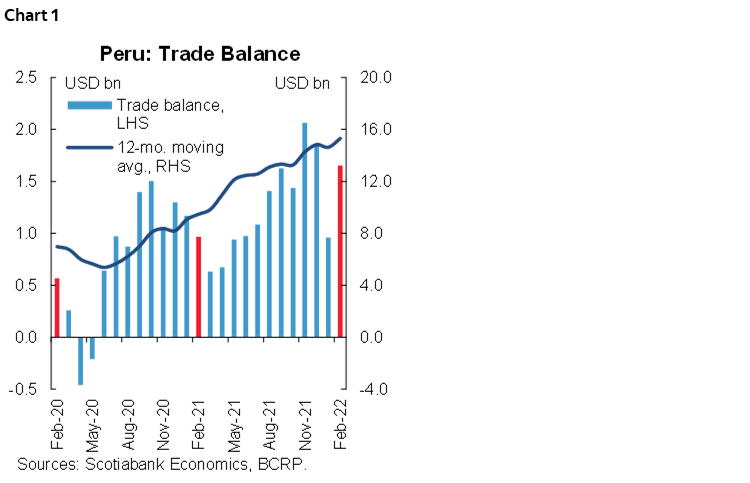
Peru’s trade balance registered a record USD 15.3 bn 12-month surplus to February, surpassing the USD 14.8 bn surplus, also a record, for the full-year 2021. The trend is slightly above our forecast of USD 15.6 bn for full-year 2022. In the month of February alone, the surplus reached USD 1.7 bn, the second highest monthly surplus ever (chart 1).
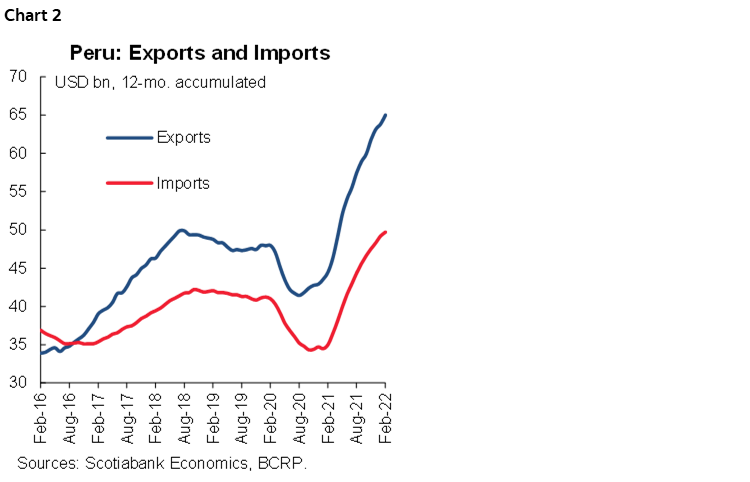
The surplus came with both exports and imports rising, with commodity prices rising faster than volumes (chart 2). Exports reached USD 5.7 bn in February, up 26% y/y, driven mainly by metals, but also natural gas, as the conflict in Ukraine pushed already-elevated prices higher. The increase in the value of natural gas exports stood out, as they nearly quintupled in year-on-year terms. Likewise, copper and gold exports continued to benefit from rising global prices.
Agro-industrial exports, which are currently Peru’s second largest export sector after mining, rose a strong 23% y/y, this time on volume more than prices, which also increased, led by blueberries, grapes, and avocados. In the case of agro-industrial goods, currently in the high-yield phase of their multi-year cycle, higher prices are tied to cost increases such as fertilizers. Textile goods also performed well, up 24% y/y, benefiting mainly from greater demand from the US, which has been reducing its imports from China as consequence of the ban on cotton products imported from the province of Xinjiang due to accusations of labor forced taxes on the Uyghur ethnic minority.
The other side of the equation, imports, amounted to USD 4.0 bn in the month of February. Although this represented a 14% y/y increase, it was the lowest monthly import value since June 2021. Higher fuel purchases, up 73% y/y, was the main driver, evidently the result of an accelerated rise in the price of global fuels in the wake of the Ukraine conflict. Industrial supplies rose 25% y/y, reflecting before the higher prices of steel and fertilizers. In contrast, capital goods imports dropped 8%. This is worrisome, as it ratifies our concerns over declining private investment due to the domestic political turbulence.
—Pablo Nano
II. Authorities seek to counter inflation through tax exemptions
Congress approved legislation on April 7 to exempt a number of key staple goods from paying the 18% sales tax. The legislation mirrors a similar bill sent by the Executive, so should get the government go-ahead in short order. Goods that will be exempt when the law goes into effect on May 1, include chicken, eggs, milk, meat, wheat, pasta, and sugar. Although the measure is temporary in principle, lasting only until year-end, one wonders just how easy it will be to reinstate the tax later, as it will entail an unpopular jump in prices. Based on government figures, we estimate that the fiscal impact from lower revenue will be in the vicinity of 0.3% of GDP for 2022.
—Guillermo Arbe
DISCLAIMER
This report has been prepared by Scotiabank Economics as a resource for the clients of Scotiabank. Opinions, estimates and projections contained herein are our own as of the date hereof and are subject to change without notice. The information and opinions contained herein have been compiled or arrived at from sources believed reliable but no representation or warranty, express or implied, is made as to their accuracy or completeness. Neither Scotiabank nor any of its officers, directors, partners, employees or affiliates accepts any liability whatsoever for any direct or consequential loss arising from any use of this report or its contents.
These reports are provided to you for informational purposes only. This report is not, and is not constructed as, an offer to sell or solicitation of any offer to buy any financial instrument, nor shall this report be construed as an opinion as to whether you should enter into any swap or trading strategy involving a swap or any other transaction. The information contained in this report is not intended to be, and does not constitute, a recommendation of a swap or trading strategy involving a swap within the meaning of U.S. Commodity Futures Trading Commission Regulation 23.434 and Appendix A thereto. This material is not intended to be individually tailored to your needs or characteristics and should not be viewed as a “call to action” or suggestion that you enter into a swap or trading strategy involving a swap or any other transaction. Scotiabank may engage in transactions in a manner inconsistent with the views discussed this report and may have positions, or be in the process of acquiring or disposing of positions, referred to in this report.
Scotiabank, its affiliates and any of their respective officers, directors and employees may from time to time take positions in currencies, act as managers, co-managers or underwriters of a public offering or act as principals or agents, deal in, own or act as market makers or advisors, brokers or commercial and/or investment bankers in relation to securities or related derivatives. As a result of these actions, Scotiabank may receive remuneration. All Scotiabank products and services are subject to the terms of applicable agreements and local regulations. Officers, directors and employees of Scotiabank and its affiliates may serve as directors of corporations.
Any securities discussed in this report may not be suitable for all investors. Scotiabank recommends that investors independently evaluate any issuer and security discussed in this report, and consult with any advisors they deem necessary prior to making any investment.
This report and all information, opinions and conclusions contained in it are protected by copyright. This information may not be reproduced without the prior express written consent of Scotiabank.
™ Trademark of The Bank of Nova Scotia. Used under license, where applicable.
Scotiabank, together with “Global Banking and Markets”, is a marketing name for the global corporate and investment banking and capital markets businesses of The Bank of Nova Scotia and certain of its affiliates in the countries where they operate, including; Scotiabank Europe plc; Scotiabank (Ireland) Designated Activity Company; Scotiabank Inverlat S.A., Institución de Banca Múltiple, Grupo Financiero Scotiabank Inverlat, Scotia Inverlat Casa de Bolsa, S.A. de C.V., Grupo Financiero Scotiabank Inverlat, Scotia Inverlat Derivados S.A. de C.V. – all members of the Scotiabank group and authorized users of the Scotiabank mark. The Bank of Nova Scotia is incorporated in Canada with limited liability and is authorised and regulated by the Office of the Superintendent of Financial Institutions Canada. The Bank of Nova Scotia is authorized by the UK Prudential Regulation Authority and is subject to regulation by the UK Financial Conduct Authority and limited regulation by the UK Prudential Regulation Authority. Details about the extent of The Bank of Nova Scotia's regulation by the UK Prudential Regulation Authority are available from us on request. Scotiabank Europe plc is authorized by the UK Prudential Regulation Authority and regulated by the UK Financial Conduct Authority and the UK Prudential Regulation Authority.
Scotiabank Inverlat, S.A., Scotia Inverlat Casa de Bolsa, S.A. de C.V, Grupo Financiero Scotiabank Inverlat, and Scotia Inverlat Derivados, S.A. de C.V., are each authorized and regulated by the Mexican financial authorities.
Not all products and services are offered in all jurisdictions. Services described are available in jurisdictions where permitted by law.