

ON DECK FOR TUESDAY, SEPTEMBER 1st

KEY POINTS:
- US-Iran tensions continue to drive oil prices & bond yields higher
- USTR Greer threatens Canada again, leaves Canada no choice on how to respond
- The plunge in German retail sales had a partial explanation
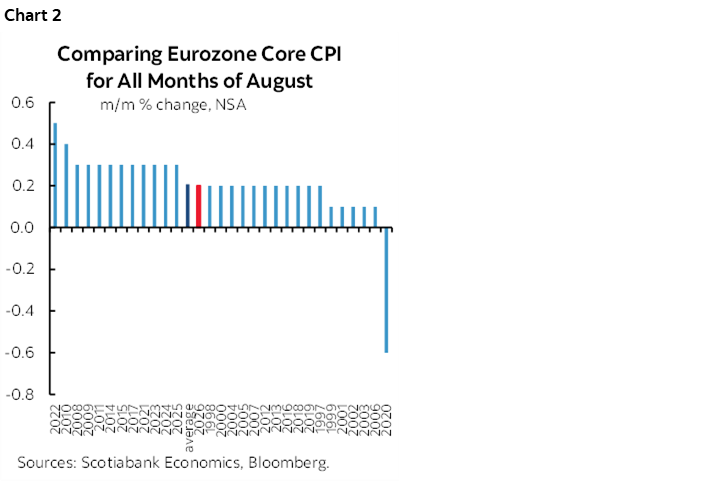
- Eurozone core CPI was average for like months of August
- US data: ISM-mfrg, construction, JOLTS, vehicle sales
- LatAm: Brazil GDP, Chile GDP proxy, Peru CPI
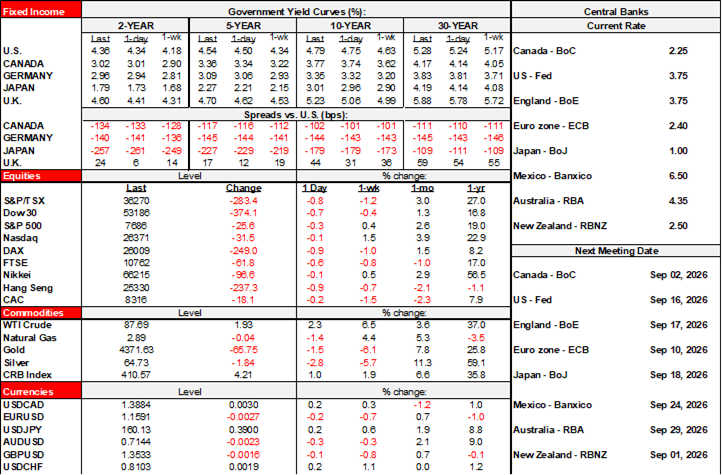
Sabre rattling by the US toward Iran and reports of two oil supertankers being hit by missiles in the Strait of Hormuz continue to push oil prices higher by about 2% across Brent and WTI with both readings floating close to US$90/barrel. There will be no relief for US gasoline prices coming out of today’s meeting between US energy companies and Trump that is mere political theater; as noted many times, they’re running full tilt at record capacity utilization rates to replenish abnormally low gasoline inventories caused by Trump’s war.
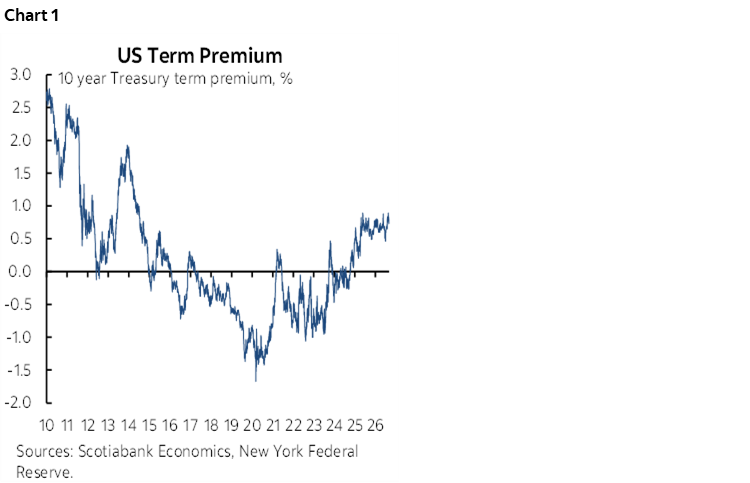
As a result, bonds are under pressure again. The US curve is bear steepening with the long end up by about 3bps. Warsh is trying to talk up bond yields to counter Bessent’s efforts to push them lower with futile measures and we’re left wondering who is in charge in this obvious power struggle that merits a high term premium needed to entice investors to take risk further out along the manipulated curve (chart 1). Gilts are getting hammered with yields up by about 8–9bps across maturities which is mostly a reflection of coming back from yesterday’s holiday and catching up to developments elsewhere.
Equities are under pressure with US futures down by -½% to -1% and TSX futures down by ½% while European cash markets are lower by up to about 1%.
Currency land is putting a bid to the dollar against all major crosses although CAD is ignoring USTR Greer’s latest threats as well as byelections (see below). The federal Liberals swept yesterday’s three byelections and now have 173 seats out of 343 in Parliament for a slightly padded majority. There remain four vacant seats in parliament with further byelections ahead that could further pad the Liberals’ majority if they at least retain two of them that were previously held by Liberals. The last three ridings on this list plus the Saint-Hyacinthe-Bagot-Acton riding are the remaining byelections.
Given oil’s dominance, data just doesn’t matter this morning but here it is anyway!
EGB YIELDS FADE SOFT EUROZONE CPI, TUMBLING GERMAN RETAIL SALES
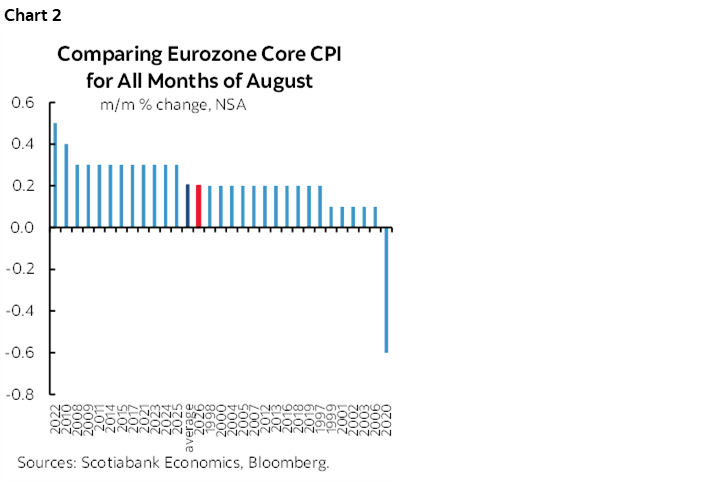
Eurozone core CPI increased by 0.2% m/m in seasonally unadjusted terms. That was spot on the longer-term average for like months of August (chart 2) which is the comparator because it’s seasonally unadjusted data from the source. The result put a little more downward pressure on the year-over-year rate at 2.4% (2.5% consensus and prior).
German retail sales volumes fell 3.4% m/m in July (consensus +0.5%). The drop was the worst for a single month since 2021 and follows a flat reading the prior month but there is an important distortion to consider. Because they are volume-based figures it cannot be pinned on temporarily lower prices for some items like fuel in early July. That said, fuel sales plunged by 9.4% m/m in volume terms because a state fuel discount ended on July 1st in part because it was motivating traffic from neighbouring countries, namely Holland, to fill up in Germany.
US DATA TO TEASE AHEAD OF FRIDAY’S NONFARM
There will be several releases out of the US today as we wait for the only US release that matters on Friday (nonfarm).
ISM-manufacturing is expected to be little change in August’s reading (10amET). Prices paid are expected to continue growing very rapidly alongside probably solid gains in new orders and moderate gains in employment. Manufacturing is a small share of the US economy (9% and falling) and nonfarm payrolls (8%) and yet all of the Trump administration’s trade policy is geared toward protecting this part of the economy at the expense of everything else.
JOLTS job openings during July (10amET) will further inform whether the slight increase this year is a blip on a volatile trend or whether the lowest readings since the depths of the pandemic will be reinforced.
Vehicle sales during August (e.o.d.) are expected to be little changed around the prior month’s 16.3 million SAAR reading. They have trended a little higher from January’s lows but are running around levels seen in 2025.
Construction spending in July (10amET) is expected to be little changed.
LATAM RELEASES ON TAP
There will also be a couple of LatAm releases to consider today. Peru updates August CPI in Lima (11amET) ahead of next week’s BCRP decision and amid expectations for a pick-up in the y/y rate but a tame m/m reading. Brazil refreshed Q2 GDP (0.5% q/q, 0.4% consensus). Chile releases its economic activity index—a GDP proxy—for the month of July (8:30amET) and it is expected to post a reversal of the prior month’s acceleration.
Elsewhere, Canada might release vehicle sales for August either today or soon.
USTR THREATENS CANADA AGAIN
USTR Greer threatened Canada again this morning. He said in a Politico interview released this morning that if Canada goes ahead with the retaliatory tariffs planned for next Tuesday, then the US is preparing to retaliate and Canada “could see additional tariffs and you could see import bans or prohibitions similar to the ones that Canada has imposed on us earlier.”
Recall that Canada’s retaliation was to the latest 50% tariff on C$27 billion of Canadian imports after the US negotiating team—ultimately led by Lutnick—torpedoed trade negotiations with Canada at the last minute by all credible accounts outside of the White House. The Trump administration went into an unprovoked trade war with Canada with no strategy, no support from Congress, no exit plan, and no off-ramp. Sound familiar?!
What should Canada do? It’s really not clear to me that there is any choice other than to dig in and continue to fight back while rolling out more supports and fiscal actions that leverage the best fiscal position of any major economy with the lowest deficit-to-GDP ratio and low net debt to GDP. If you fight, the Trump administration will beat on you with retaliatory measures. If you don’t fight, the Trump administration will beat on you by stealing core industries like autos and steel and lumber all the while raising costs for American consumers and businesses and while seeking tech and cultural dominance.
DISCLAIMER
This report has been prepared by Scotiabank Economics as a resource for the clients of Scotiabank. Opinions, estimates and projections contained herein are our own as of the date hereof and are subject to change without notice. The information and opinions contained herein have been compiled or arrived at from sources believed reliable but no representation or warranty, express or implied, is made as to their accuracy or completeness. Neither Scotiabank nor any of its officers, directors, partners, employees or affiliates accepts any liability whatsoever for any direct or consequential loss arising from any use of this report or its contents.
These reports are provided to you for informational purposes only. This report is not, and is not constructed as, an offer to sell or solicitation of any offer to buy any financial instrument, nor shall this report be construed as an opinion as to whether you should enter into any swap or trading strategy involving a swap or any other transaction. The information contained in this report is not intended to be, and does not constitute, a recommendation of a swap or trading strategy involving a swap within the meaning of U.S. Commodity Futures Trading Commission Regulation 23.434 and Appendix A thereto. This material is not intended to be individually tailored to your needs or characteristics and should not be viewed as a “call to action” or suggestion that you enter into a swap or trading strategy involving a swap or any other transaction. Scotiabank may engage in transactions in a manner inconsistent with the views discussed this report and may have positions, or be in the process of acquiring or disposing of positions, referred to in this report.
Scotiabank, its affiliates and any of their respective officers, directors and employees may from time to time take positions in currencies, act as managers, co-managers or underwriters of a public offering or act as principals or agents, deal in, own or act as market makers or advisors, brokers or commercial and/or investment bankers in relation to securities or related derivatives. As a result of these actions, Scotiabank may receive remuneration. All Scotiabank products and services are subject to the terms of applicable agreements and local regulations. Officers, directors and employees of Scotiabank and its affiliates may serve as directors of corporations.
Any securities discussed in this report may not be suitable for all investors. Scotiabank recommends that investors independently evaluate any issuer and security discussed in this report, and consult with any advisors they deem necessary prior to making any investment.
This report and all information, opinions and conclusions contained in it are protected by copyright. This information may not be reproduced without the prior express written consent of Scotiabank.
™ Trademark of The Bank of Nova Scotia. Used under license, where applicable.
Scotiabank, together with “Global Banking and Markets”, is a marketing name for the global corporate and investment banking and capital markets businesses of The Bank of Nova Scotia and certain of its affiliates in the countries where they operate, including; Scotiabank Europe plc; Scotiabank (Ireland) Designated Activity Company; Scotiabank Inverlat S.A., Institución de Banca Múltiple, Grupo Financiero Scotiabank Inverlat, Scotia Inverlat Casa de Bolsa, S.A. de C.V., Grupo Financiero Scotiabank Inverlat, Scotia Inverlat Derivados S.A. de C.V. – all members of the Scotiabank group and authorized users of the Scotiabank mark. The Bank of Nova Scotia is incorporated in Canada with limited liability and is authorised and regulated by the Office of the Superintendent of Financial Institutions Canada. The Bank of Nova Scotia is authorized by the UK Prudential Regulation Authority and is subject to regulation by the UK Financial Conduct Authority and limited regulation by the UK Prudential Regulation Authority. Details about the extent of The Bank of Nova Scotia's regulation by the UK Prudential Regulation Authority are available from us on request. Scotiabank Europe plc is authorized by the UK Prudential Regulation Authority and regulated by the UK Financial Conduct Authority and the UK Prudential Regulation Authority.
Scotiabank Inverlat, S.A., Scotia Inverlat Casa de Bolsa, S.A. de C.V, Grupo Financiero Scotiabank Inverlat, and Scotia Inverlat Derivados, S.A. de C.V., are each authorized and regulated by the Mexican financial authorities.
Not all products and services are offered in all jurisdictions. Services described are available in jurisdictions where permitted by law.