

ON DECK FOR WEDNESDAY, OCTOBER 7th

KEY POINTS:
- Bonds are not in a happy place…
- …on higher oil, EGB fractures, FOMC minutes, central bank hikes
- FOMC minutes: stale and unstable…
- …as markets struggle with the pivot on the Fed’s reaction function
- Canadian jobs preview
- Japanese real earnings growth softens…
- …JGB impact offset by oil, possible supplementary budget
- RBI hiked and guided more to come
- BCRP may hike this evening
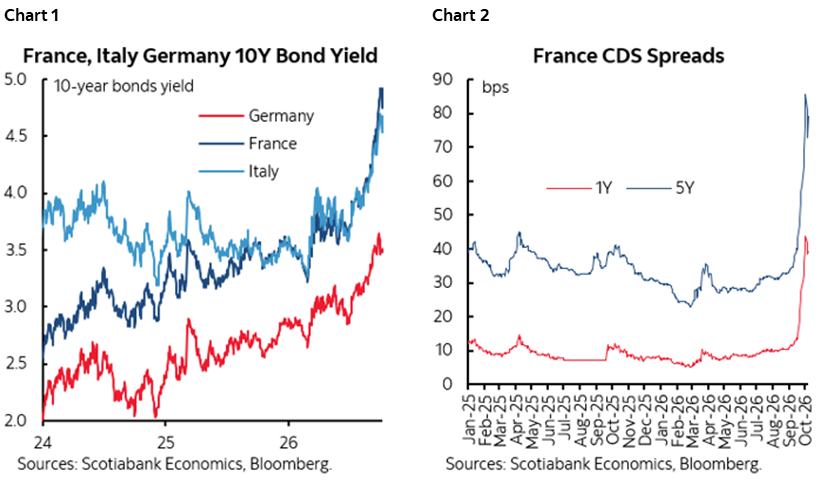
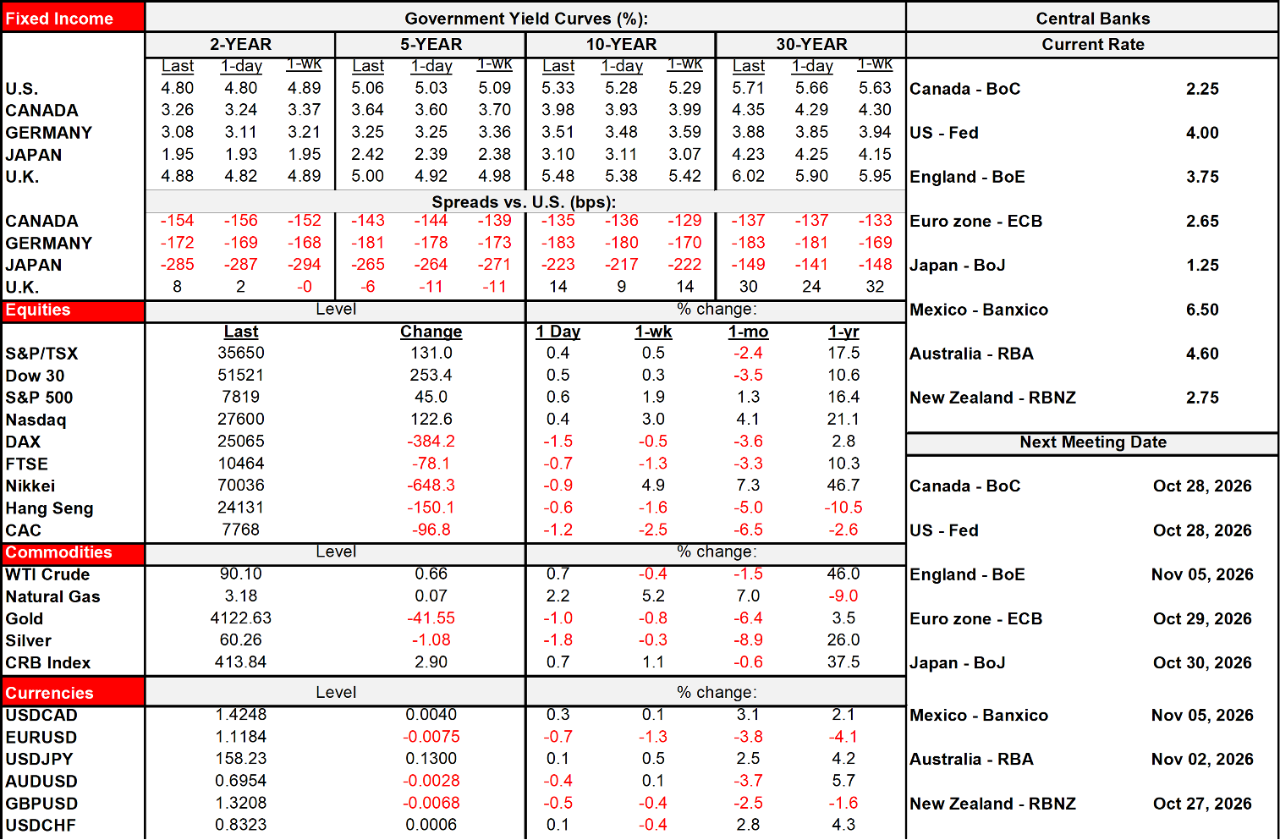
Bond land isn’t in a happy place this morning. Blame oil prices, renewed fractures across EGBs, apprehension ahead of FOMC minutes and ongoing hawkishness across global central banks (RBI hike, BCRP pending). Treasury yields are up by 1–6bps in a bear steepener move concentrated at the long end. Canada’s yields are up by 2–6bps in a similar bear steepener. Longer-dated bond yields are up by 8–15bps across the UK, France, Italy, Spain and Portugal as spreads sharply widen over bunds and CDS spreads remain high (charts 1, 2). Oil prices are up by about 1% or so across WTI and Brent as Iran escalated attacks on ships in the Strait of Hormuz and threatened to broaden pre-emptive attacks. US oil and gas inventories data arrives at 10:30amET. Equities are not taking the news very well with off by between around ½% in N.A. futures to declines of 1-2% across European cash markets. The dollar is broadly stronger on haven seeking and Fed implications.
FOMC MINUTES—STALE AND UNSTABLE
Minutes to the September 15th-16th FOMC meeting arrive at 2pmET today. They will extend the hawkish tone that was conveyed at that meeting but are likely to be stale on arrival and should therefore probably be downplayed.
Data since that meeting has been less supportive of further tightening, though Chair Warsh would likely be indifferent toward this fact given his bias toward the multi-year inflation evidence in the past and future risks. Core PCE inflation climbed by 0.247% m/m SA in August (Scotia 0.2%, consensus 0.3%) and was revised lower including to just 0.1% in July with the year-over-year rate taken down by three-tenths to 3% through revisions. The three-month moving average of core PCE stands at 2% m/m SAAR. Nonfarm payrolls disappointed with just 29k positions created in September alongside downward revisions. Further, financial market conditions tightened further since that meeting including an extra 30+bps on the 10-year Treasury yield.
More fundamentally, our group has struggled with the FOMC under the leadership of Chair Warsh and for two broad sets of reasons. One is that the US economy has recently been performing much better than forecast including Q3 GDP growth that is tracking percentage points above our prior September forecast. A large upward revision is required in the near-term that raises capacity pressures on the US economy and hence near-term inflation risk. There are risks aplenty going forward and the consensus view toward 3-handled Q3 GDP growth isn’t likely to be sustainable but recent growth is outperforming our shop’s expectations.
Second is that I’ve found the Fed’s reaction function to be highly unstable and difficult to read with any consistency. For instance, Chair Warsh’s Senate testimony favoured trimmed mean measures of inflation that are much lower than PCE inflation which sounded neutral-dovish, only to hear him say a few months later that he never said that. Warsh sounded dovish during the interview and confirmation stage and suddenly turned hawkish afterward. He doesn’t believe in submitting forecasts or providing guidance but constantly referencing the past five years of inflation experience sounds like bygones be bygones are out the window in favour of guidance that at times almost sounds like a price level targeting mindset. Warsh told markets to be patient for the work of the five task forces to be revealed and not to pre-judge their views on important matters that could shape the policy outlook, only to then deliver an impatient tightening of monetary policy that declared their work to be at least partly moot. Instead of waiting for their views on the best measures of inflation, whether this is a relative price shock or generalized inflation and if that matters, what impact AI may have over the forward monetary policy horizon and other matters, Warsh set aside a waiting period in favour of acting now.
I believe this instability is part of why bond yields have risen because higher policy uncertainty impacts expected reward for risk across later tenors; in short, we have company in that the bond market is also struggling with the policy pivot at the Fed in addition to the conflicting policy signals from the Treasury.
OTHER DEVELOPMENTS
Japanese inflation-adjusted labour earnings climbed by 1½% y/y in a slowdown from a revised 2.0% prior reading (from 2.4%). The impact on the yen and JGBs was offset by oil and volatility surrounding headlines that Japan is considering a second supplementary budget that could motivate a response by the BoJ.
The Reserve Bank of India raised its repurchase rate by 25bps to 5.5% as widely forecast. Guidance was hawkish and left the door open to further tightening. Key was removal of the reference to a “neutral stance” in favour of “calibrated tightening” while raising the inflation outlook. Markets continue to fully price another hike on December 4th while bond yields climbed by 2–4bps across maturities.
A majority within consensus expect Peru’s central bank to raise its reference rate by 25bps this evening (7pmET). Our Scotiabank colleagues in Peru expect BCRP to hold at 4.25% along with three others while nine within consensus expect a hike.
Other overnight releases included strong German industrial production (+2% m/m, 0.5% consensus) after factory orders disappointed the other day, plus a slightly milder than expected acceleration of Swedish inflation.
CANADIAN JOBS PREVIEW
Canada will release jobs figures for September on Friday and here’s a brief preview.
My estimate is for a flat reading of 0k jobs created in September and a slight rise of the unemployment rate to 6.5%. Consensus is all over the map from a drop of -30k and a gain of similar magnitude after a large 42k decline in July. The usual caution applies by way of the high degree of statistical noise around estimated changes in employment; the 95% confidence interval is +/-57k around monthly employment changes. We still must try, so here we go.
August’s labour force contraction was unusual a) compared to the multi-month prior trend, and b) given upward revisions to population figures by Statistics Canada that may suggest a bigger workforce than previously understood. Ergo, I’m inclined to think it was a one-off and that the labour force could rebound by more than jobs after both contracted in August.
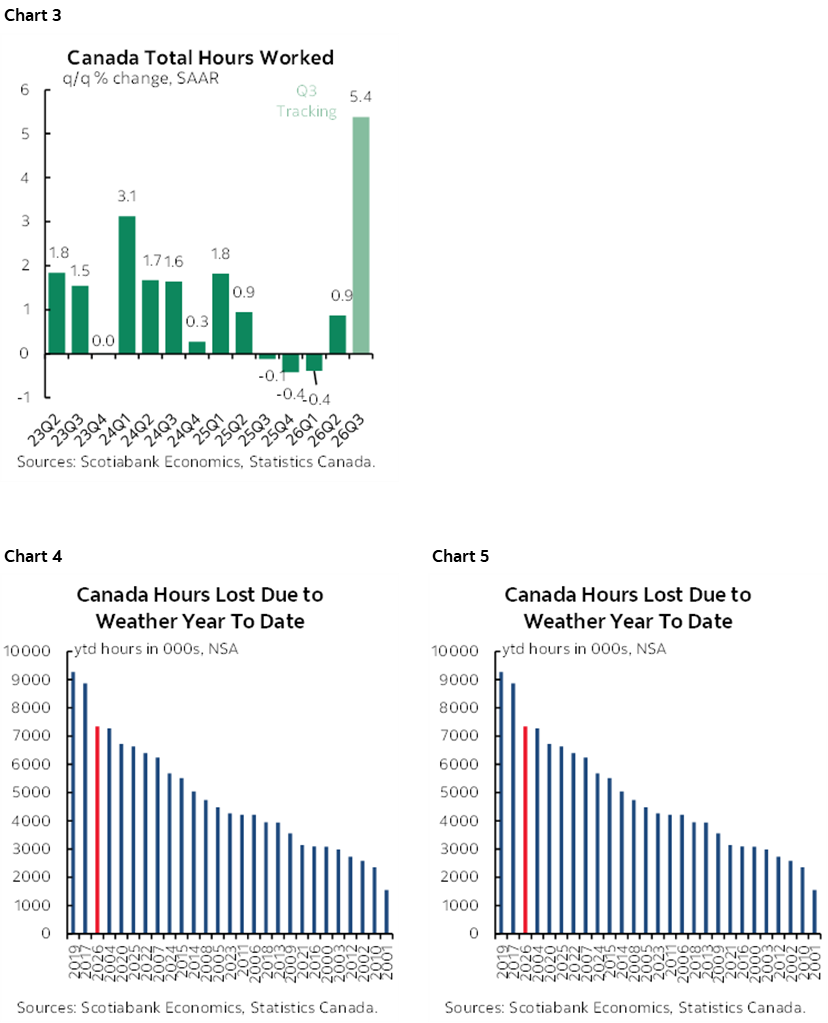
One factor that may restrain job growth is the employer bias toward expanding hours worked over adding bodies. Importantly, I think employers are dealing with the uncertainty by heaping on more hours worked for their existing workers by converting part-time to full-time and increasing working hours and overtime while holding back on hiring new workers. Hours worked are growing very strongly (chart 3) and there is still some upward recovery likely to come from abnormally high lost hours worked due to weather and illness this year (charts 4, 5).
I would be surprised if we saw a sudden material impact of fresh trade tensions on this employment report. Recall that after threatening in July, Trump applied 50% tariffs on about 5% of Canadian exports to the US on August 22nd. Canada retaliated on September 8th with its own counter-tariffs and then the US applied outright import bans on select Canadian exports on September 29th. All of these actions affect very small amounts of trade and often at a stage of the seasonal and annual production and sales cycle that arrived too late to be impactful. A reaction as soon as the September LFS reference week of the 13th to 19th is probably unlikely.
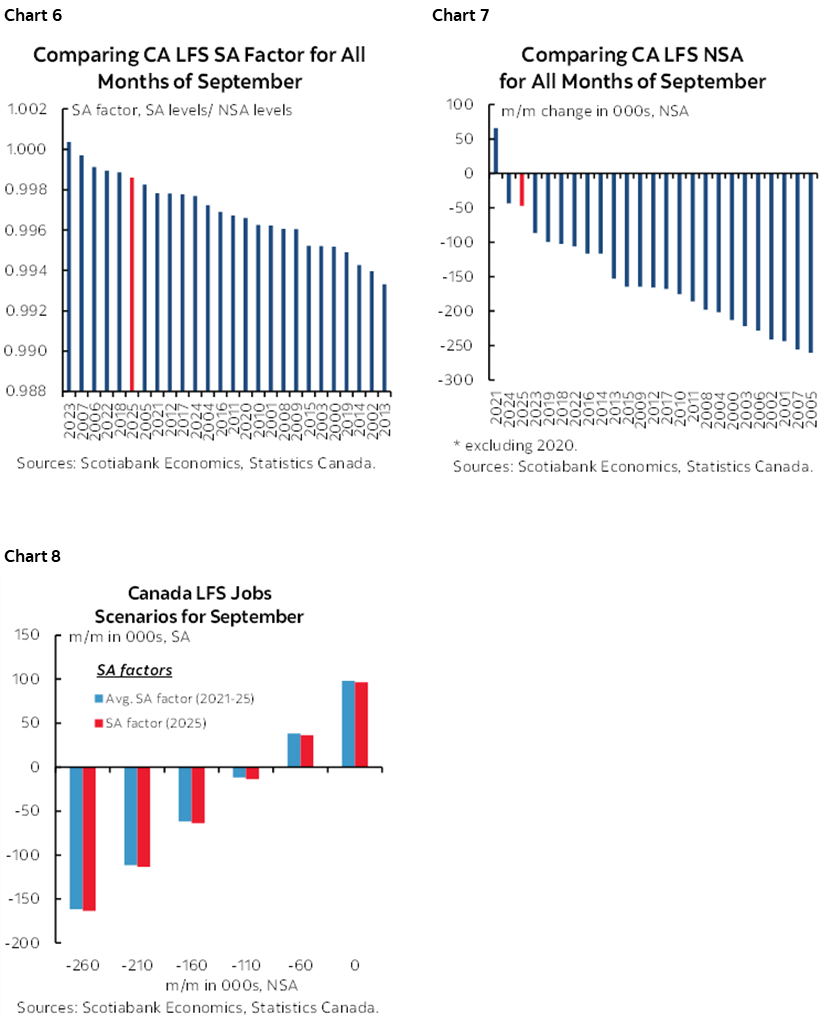
I went with a seasonal adjustment factor similar to last year’s (chart 6) and a seasonally unadjusted change in employment of about -100k which is a little lower than typical (chart 7). That gives about 0k m/m SA but a range of scenarios around different SA factors and NSA changes is shown in chart 8.
DISCLAIMER
This report has been prepared by Scotiabank Economics as a resource for the clients of Scotiabank. Opinions, estimates and projections contained herein are our own as of the date hereof and are subject to change without notice. The information and opinions contained herein have been compiled or arrived at from sources believed reliable but no representation or warranty, express or implied, is made as to their accuracy or completeness. Neither Scotiabank nor any of its officers, directors, partners, employees or affiliates accepts any liability whatsoever for any direct or consequential loss arising from any use of this report or its contents.
These reports are provided to you for informational purposes only. This report is not, and is not constructed as, an offer to sell or solicitation of any offer to buy any financial instrument, nor shall this report be construed as an opinion as to whether you should enter into any swap or trading strategy involving a swap or any other transaction. The information contained in this report is not intended to be, and does not constitute, a recommendation of a swap or trading strategy involving a swap within the meaning of U.S. Commodity Futures Trading Commission Regulation 23.434 and Appendix A thereto. This material is not intended to be individually tailored to your needs or characteristics and should not be viewed as a “call to action” or suggestion that you enter into a swap or trading strategy involving a swap or any other transaction. Scotiabank may engage in transactions in a manner inconsistent with the views discussed this report and may have positions, or be in the process of acquiring or disposing of positions, referred to in this report.
Scotiabank, its affiliates and any of their respective officers, directors and employees may from time to time take positions in currencies, act as managers, co-managers or underwriters of a public offering or act as principals or agents, deal in, own or act as market makers or advisors, brokers or commercial and/or investment bankers in relation to securities or related derivatives. As a result of these actions, Scotiabank may receive remuneration. All Scotiabank products and services are subject to the terms of applicable agreements and local regulations. Officers, directors and employees of Scotiabank and its affiliates may serve as directors of corporations.
Any securities discussed in this report may not be suitable for all investors. Scotiabank recommends that investors independently evaluate any issuer and security discussed in this report, and consult with any advisors they deem necessary prior to making any investment.
This report and all information, opinions and conclusions contained in it are protected by copyright. This information may not be reproduced without the prior express written consent of Scotiabank.
™ Trademark of The Bank of Nova Scotia. Used under license, where applicable.
Scotiabank, together with “Global Banking and Markets”, is a marketing name for the global corporate and investment banking and capital markets businesses of The Bank of Nova Scotia and certain of its affiliates in the countries where they operate, including; Scotiabank Europe plc; Scotiabank (Ireland) Designated Activity Company; Scotiabank Inverlat S.A., Institución de Banca Múltiple, Grupo Financiero Scotiabank Inverlat, Scotia Inverlat Casa de Bolsa, S.A. de C.V., Grupo Financiero Scotiabank Inverlat, Scotia Inverlat Derivados S.A. de C.V. – all members of the Scotiabank group and authorized users of the Scotiabank mark. The Bank of Nova Scotia is incorporated in Canada with limited liability and is authorised and regulated by the Office of the Superintendent of Financial Institutions Canada. The Bank of Nova Scotia is authorized by the UK Prudential Regulation Authority and is subject to regulation by the UK Financial Conduct Authority and limited regulation by the UK Prudential Regulation Authority. Details about the extent of The Bank of Nova Scotia's regulation by the UK Prudential Regulation Authority are available from us on request. Scotiabank Europe plc is authorized by the UK Prudential Regulation Authority and regulated by the UK Financial Conduct Authority and the UK Prudential Regulation Authority.
Scotiabank Inverlat, S.A., Scotia Inverlat Casa de Bolsa, S.A. de C.V, Grupo Financiero Scotiabank Inverlat, and Scotia Inverlat Derivados, S.A. de C.V., are each authorized and regulated by the Mexican financial authorities.
Not all products and services are offered in all jurisdictions. Services described are available in jurisdictions where permitted by law.