

ON DECK FOR TUESDAY, OCTOBER 6th
- French bonds rally, euro rebounds…
- …as France’s Le Pen pledges deficit reduction…
- …calls for highly contestable ECB intervention…
- …and European data was weak
- Quebec election results will keep the PQ on a short leash
- Canadian exports to inform Q3 GDP tracking
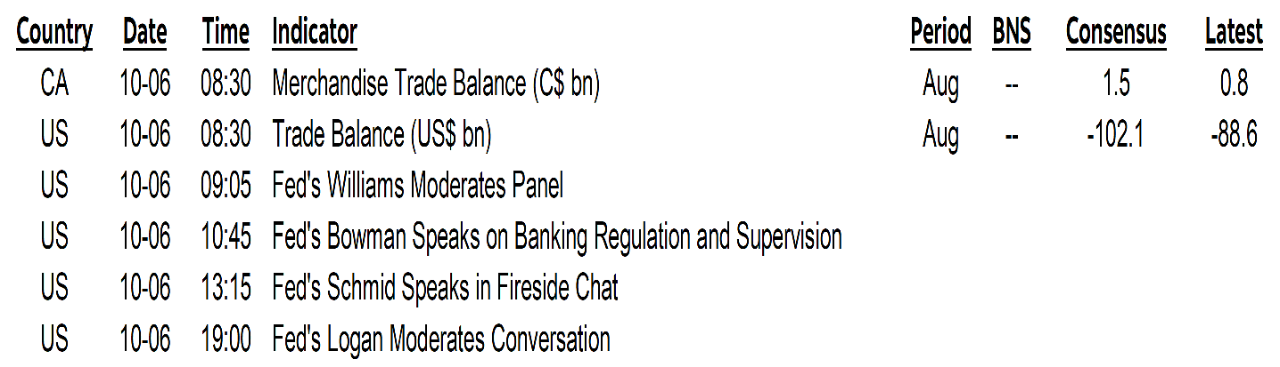
- US trade deficit to widen sharply
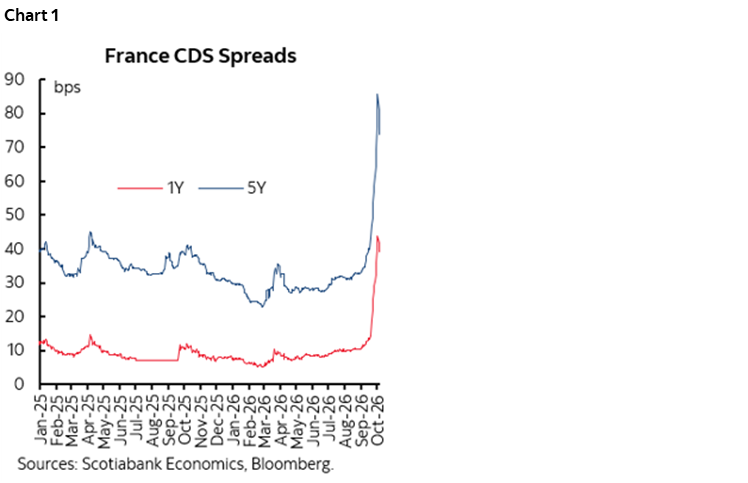
French bonds are the biggest mover among asset classes this morning as yields drop by about 10bps across the curve and tighten spreads over bunds. France’s CDS spreads are slightly narrower but still very elevated (chart 1). Catalysts may include weak European data but more importantly a set of proposals by National Rally leader Marine Le Pen to sharply reduce the size of the fiscal deficit from 5–6% under plans this year and next toward just over 2% by 2032. She also called for the ECB to act which is highly contestable in my view; it’s not the job of the ECB to prop up fiscal mismanagement but jockeying continues to choose President Lagarde’s successor. Le Pen is a leading candidate into the April 18th 2027 Presidential election.
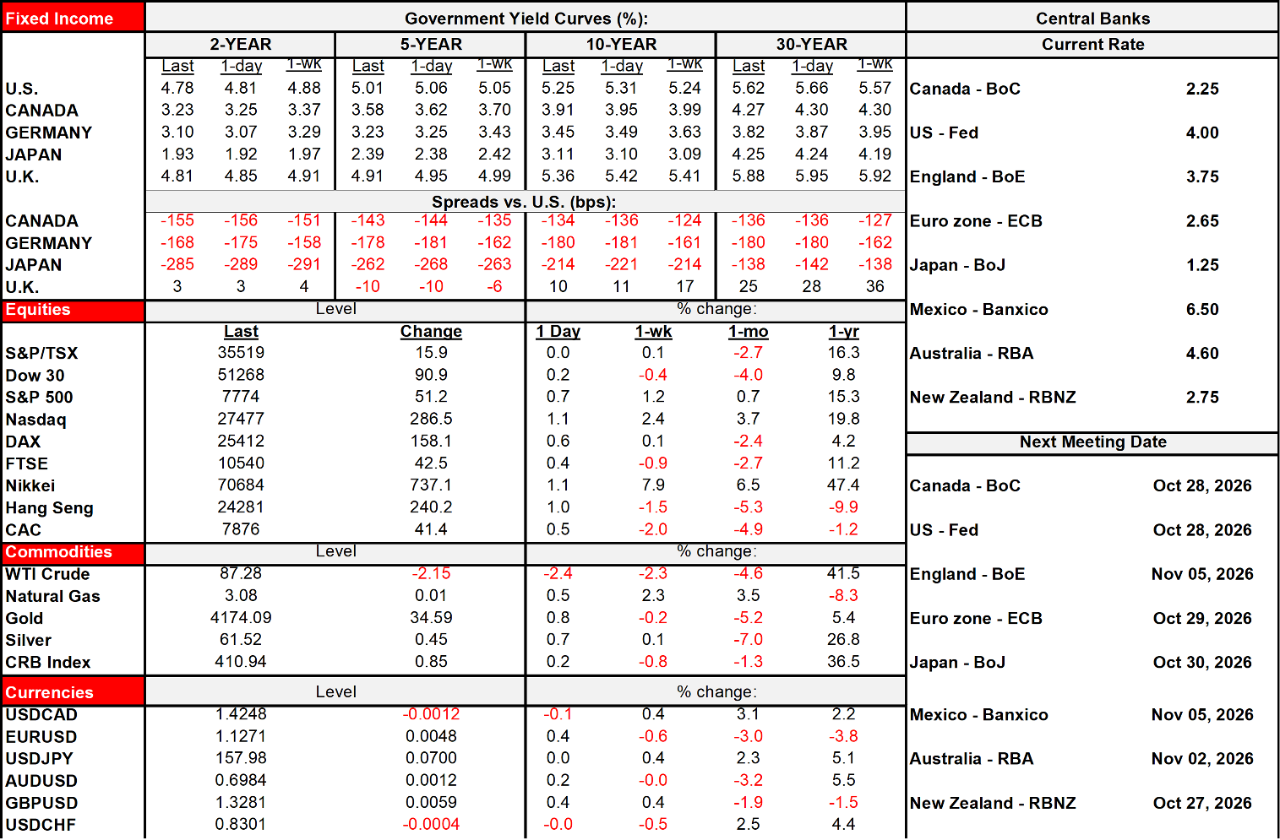
There is mild relief across the rest of the global bond market that is spilling into slightly lower yields in the US, UK, Canada and throughout longer-end EGBs. Equities are broadly higher. The euro is among the currencies bouncing back today versus the USD. Lower oil prices—with WTI and Brent off by about a couple of bucks—are also helping to at least temporarily assuage the market’s inflation fears until conflict with Iran may escalate anew
Other overnight international developments were light with just a plunge in German factory orders during August (-10.6% m/m, consensus -1%) and a drop in French industrial output (-0.3% m/m, consensus +0.2%) with negative revisions to consider.
QUEBEC ELECTION—PQ ON A SHORT LEASH
The Parti Québécois victory in Quebec’s election met expectations for a minority outcome as oft-maligned pollsters generally got this one right. Charts 2–5 summarize the outcome in terms of the change in seats by party, voter turnout compared to history and the share of the vote secured by the winning party compared to history.
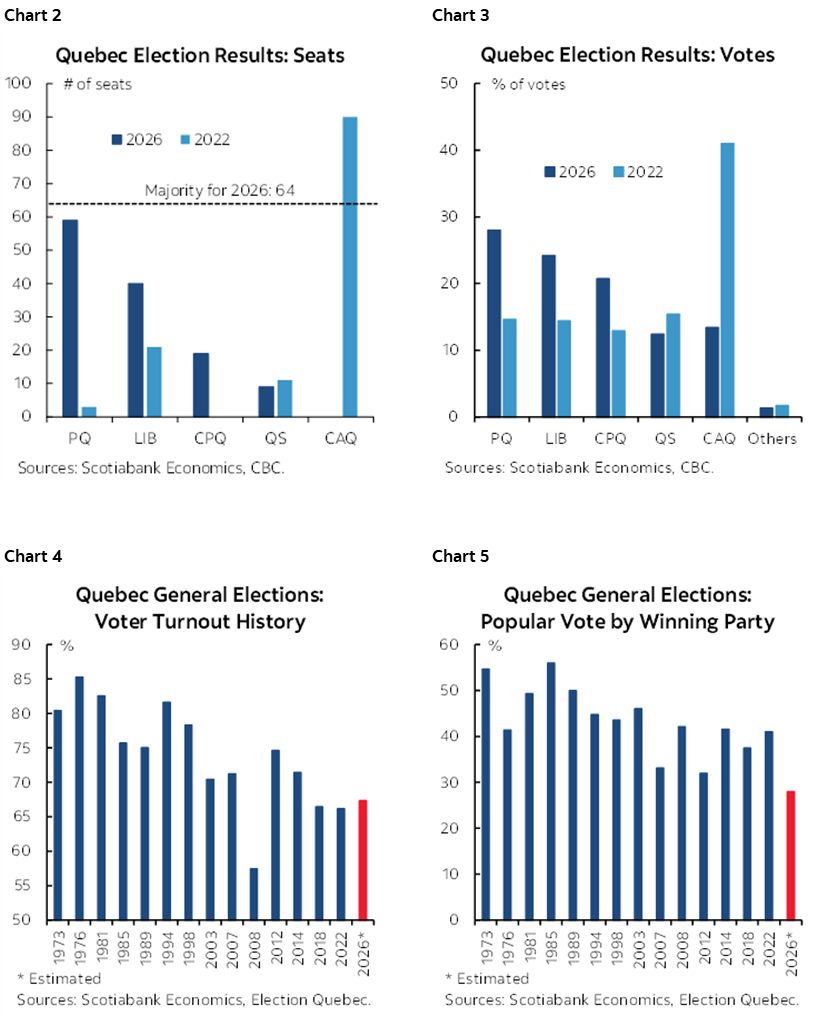
The PQ will struggle to retain power through reliance upon other parties given the tendency of minority governments in Quebec to only last about a couple of years. With 59 seats that are five shy of a majority and just 28% of the popular vote, the PQ lacks support from the vast majority of the voting population but strongly advanced from just 3 seats in the 2022 election.
How? The governing Coalition Avenir Québec (CAQ) under interim Premier Fréchette was literally wiped out, reduced to zero seats in the legislature from 90 after the prior election in 2022. Its seats were eaten up by the Liberals (40 from 21 in 2022) and Conservatives who haven’t had representation in the legislature since 1935 (19 from 0 in 2022) as the Québec Solidaire party won 9 seats from 11 in 2022.
Voter turnout was estimated by Elections Quebec at 67.33% which is the highest since the 2014 election by a slim margin over the 2018 and 2022 elections.
The outcome makes it difficult for the PQ to advance its plans for a referendum on independence as the centre-left PQ will have to rely upon the left-wing Québec Solidaire party to advance any such efforts alongside requisite horse trading on policy initiatives. About 70% of Quebecers have no interest in separating. While the PQ guides that it won’t hold a referendum until after President Trump leaves office2014—largely because it knows there is no current support for one—it would be ironic if Trump outlasts the PQ.
The outcome should be supportive of provincial bond spreads today relative to a stronger showing by the PQ. The PQ’s victory is more of a rejection of the other problem plagued parties than a warm embrace as voters are keeping the PQ on a short leash, rejected by 72% of the voting population. The pivot left with reliance upon the QS could require closely monitoring fiscal plans given expensive election campaign promises (here).
CANADIAN TRADE TO INFORM Q3 GDP TRACKING
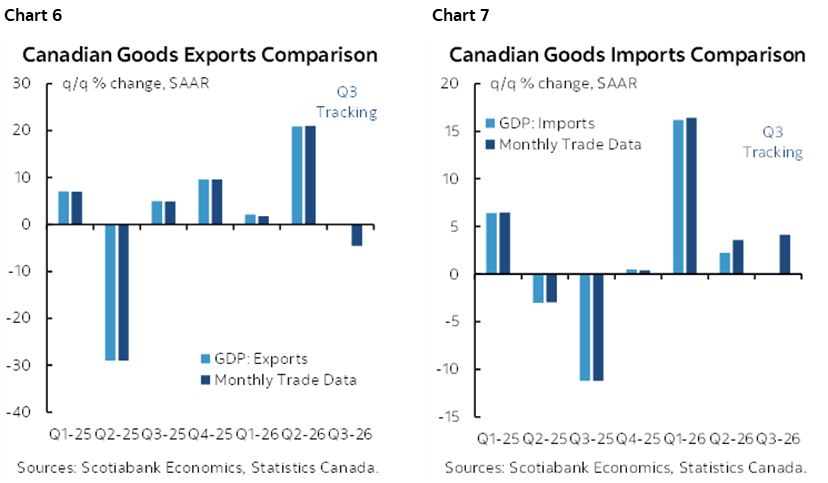
Also on tap today will be trade figures from Canada and the US. If the US advance merchandise trade figures from last week offer any indication, then Canadian exports could surge at least in nominal terms with uncertain volume effects. Charts 6 and 7 show tracking of growth in export and import volumes by comparing the monthly trade figures to how GDP captures trade; the Q2 explosion in export volumes is a touch act to follow but a pickup in import volumes could feed inventory investment.
As for the US trade figures for September (8:30amET), a wider trade deficit is expected after the advance merchandise figures posted a wider deficit last week.
DISCLAIMER
This report has been prepared by Scotiabank Economics as a resource for the clients of Scotiabank. Opinions, estimates and projections contained herein are our own as of the date hereof and are subject to change without notice. The information and opinions contained herein have been compiled or arrived at from sources believed reliable but no representation or warranty, express or implied, is made as to their accuracy or completeness. Neither Scotiabank nor any of its officers, directors, partners, employees or affiliates accepts any liability whatsoever for any direct or consequential loss arising from any use of this report or its contents.
These reports are provided to you for informational purposes only. This report is not, and is not constructed as, an offer to sell or solicitation of any offer to buy any financial instrument, nor shall this report be construed as an opinion as to whether you should enter into any swap or trading strategy involving a swap or any other transaction. The information contained in this report is not intended to be, and does not constitute, a recommendation of a swap or trading strategy involving a swap within the meaning of U.S. Commodity Futures Trading Commission Regulation 23.434 and Appendix A thereto. This material is not intended to be individually tailored to your needs or characteristics and should not be viewed as a “call to action” or suggestion that you enter into a swap or trading strategy involving a swap or any other transaction. Scotiabank may engage in transactions in a manner inconsistent with the views discussed this report and may have positions, or be in the process of acquiring or disposing of positions, referred to in this report.
Scotiabank, its affiliates and any of their respective officers, directors and employees may from time to time take positions in currencies, act as managers, co-managers or underwriters of a public offering or act as principals or agents, deal in, own or act as market makers or advisors, brokers or commercial and/or investment bankers in relation to securities or related derivatives. As a result of these actions, Scotiabank may receive remuneration. All Scotiabank products and services are subject to the terms of applicable agreements and local regulations. Officers, directors and employees of Scotiabank and its affiliates may serve as directors of corporations.
Any securities discussed in this report may not be suitable for all investors. Scotiabank recommends that investors independently evaluate any issuer and security discussed in this report, and consult with any advisors they deem necessary prior to making any investment.
This report and all information, opinions and conclusions contained in it are protected by copyright. This information may not be reproduced without the prior express written consent of Scotiabank.
™ Trademark of The Bank of Nova Scotia. Used under license, where applicable.
Scotiabank, together with “Global Banking and Markets”, is a marketing name for the global corporate and investment banking and capital markets businesses of The Bank of Nova Scotia and certain of its affiliates in the countries where they operate, including; Scotiabank Europe plc; Scotiabank (Ireland) Designated Activity Company; Scotiabank Inverlat S.A., Institución de Banca Múltiple, Grupo Financiero Scotiabank Inverlat, Scotia Inverlat Casa de Bolsa, S.A. de C.V., Grupo Financiero Scotiabank Inverlat, Scotia Inverlat Derivados S.A. de C.V. – all members of the Scotiabank group and authorized users of the Scotiabank mark. The Bank of Nova Scotia is incorporated in Canada with limited liability and is authorised and regulated by the Office of the Superintendent of Financial Institutions Canada. The Bank of Nova Scotia is authorized by the UK Prudential Regulation Authority and is subject to regulation by the UK Financial Conduct Authority and limited regulation by the UK Prudential Regulation Authority. Details about the extent of The Bank of Nova Scotia's regulation by the UK Prudential Regulation Authority are available from us on request. Scotiabank Europe plc is authorized by the UK Prudential Regulation Authority and regulated by the UK Financial Conduct Authority and the UK Prudential Regulation Authority.
Scotiabank Inverlat, S.A., Scotia Inverlat Casa de Bolsa, S.A. de C.V, Grupo Financiero Scotiabank Inverlat, and Scotia Inverlat Derivados, S.A. de C.V., are each authorized and regulated by the Mexican financial authorities.
Not all products and services are offered in all jurisdictions. Services described are available in jurisdictions where permitted by law.