

ON DECK FOR MONDAY, OCTOBER 5th

KEY POINTS:
- Markets on cautious footings with politics front and centre
- Quebec election day expected to bring back the PQ…
- …but support for both the PQ and separation is low…
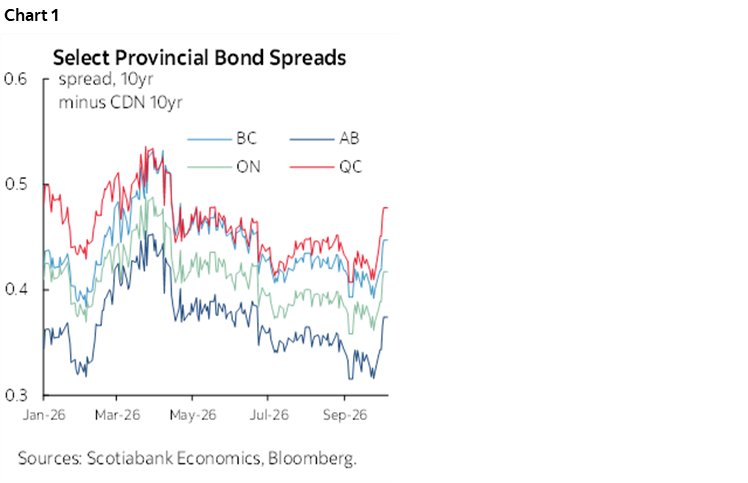
- …as Quebec’s spreads widen alongside other major provinces
- Brazil’s first-round election results to prompt asset rallies...
- …which could be knee-jerk response awaiting an actual Bolsonaro platform
- Spain’s bumbling administration called a snap election
- US ISM-services, Canadian PMIs on tap
- Global Week Ahead highlights
Global markets are starting the week on cautious footings in the aftermath of Friday’s weak nonfarm payrolls reading (29k) and political developments. Global sovereign bond curves are steepening with downward pressure on front ends across the Eurozone in particular—but not the UK—and higher yields across long ends. US Ts and Canadian government bond yields are little changed. Stocks are showing more red than green but not much of either across N.A. futures and European cash. Currencies are mostly little changed to the dollar with the exception of European crosses led by a weaker euro against other majors. Watch Brazilian assets including the real, bonds and Bovespa.
There will be light data this morning, but politics are front and centre across global markets. It's a factor in driving markets in Europe and Brazil ahead of Quebec's provincial election results tonight.
QUEBEC’S ELECTION
Quebec’s polls close at 8pmET tonight and results should start arriving shortly afterward. Advance polling captured about one-quarter of voters. 64 is the magic number in terms of the number of seats out of 127 needed to capture a majority in Quebec’s legislature. The separatist Party Québécois is leading polls which is far from saying that Quebecers support separation. Polls suggest that the PQ may capture around 30% of the vote. Poll aggregator sites that translate into projected seats like this one point to a minority on the edge of possibly a slim majority. Polls also show that a similarly low share support separation from Canada.
Thus, strong majorities oppose both the PQ and separation. The PQ’s polling successes partly speak more to the opposition’s problems with weak leadership, late game pivots by other parties and scandals aplenty. Voters seem to welcome the PQ as a default option on a short leash. Most Quebec voters are old enough to know the costs of political uncertainty through the referenda of 1995 and 1980. That uncertainty drove fiscal disrepair, underperforming housing markets and underinvestment in the province. The PQ has pledged to call a referendum on separation within its term but not while Trump is in office. That could be a false excuse since it’s unlikely that the PQ could launch an effective if albeit cynical campaign to boost support for separation before 2028 anyway. A more likely outcome is that the PQ will seek further concessions.
Quebec’s 10-year bond spreads over Canadian government bonds are shown relative to other provinces in chart 1. The four major provinces have all witnessed spread widening of late with Quebec paying the widest spread among them. Clearly spreads would widen and perhaps rather sharply in a true referendum campaign especially if it surprised pollsters by not rejecting separation.
BRAZIL’S ELECTION SETS UP ASSET RALLIES
Brazilians are a step closer to rewarding with the Presidency a son who pledges to pardon his father who attempted a coup and is accused of plotting assassination attempts against President Lula and Supreme Court judges. That’s how bad the alternative is in President Lula in the eyes of enough Brazilians who voted in the first round of elections yesterday. The run-off that culls the field to just Lula and Bolsonaro will be held on October 25th. Brazilian assets are expected to rally hard today because Bolsonaro secured an unexpected lead in the first round. That could be either correct or fanciful. Personally, I lean more closely to the narratives in The Economist’s take (here). Bolsonaro is thought to be a friendlier right wing offering to markets. Time would tell. He has no plan, it’s unclear that his fiscal leanings would be any better than Lula’s irresponsible fiscal mismanagement and pardoning his father would feed public cynicism toward deep rooted corruption. We frankly don’t really know if his policies will truly unleash Brazil’s prospects that have been promising for decades but mismanaged in serial fashion and not least of which because Mr. Bolsonaro doesn’t appear to have any real platform. Don’t fight the short-term right-is-best market bias, but perhaps know when to sell absent proof.
SPAIN CALLS AN ELECTION
Spain’s centre-left administration under PM Pedro Sánchez called a snap election to be held on November 29th. A long list of challenges faced by his administration, including corruption, finally hit a breaking point when the government’s hastily arranged housing plan was defeated by parliament. It should have been. The plan offered lousy housing economics to affordability challenges that arguably would have worsened conditions. Spanish bond spreads over other EGBs are so far unaffected relative to others.
GLOBAL WEEK AHEAD HIGHLIGHTS
What follows are highlights of expectations for the week ahead in lieu of a weekly because I was out for most of last week.
Canada will focus on today’s aforementioned Quebec election and Friday’s jobs report for September. PMIs for September are little watched in Canada but arrive this morning (9:30amET). Trade figures for August (tomorrow) could reveal solid exports in support of GDP growth if advance US trade figures serve as any indication. I’ve gone with an estimated flat reading for job growth based on SA factors, an estimated seasonally unadjusted change, some special factors and data guides, and a Ouija board that summoned the spirits of deceased economists. Wouldn’t it be something if PM Carney ended the week by winning the Nobel Peace Prize on Friday given his lead on some betting sites; I’m sure he’d be congratulated by Trump….
The US may be in observer mode with an eye on more interesting developments elsewhere this week. Calendar-based US risk will be light with just ISM-services today (10amET), ADP’s weekly payroll measure tomorrow, FOMC minutes on Wednesday afternoon and then UofM’s consumer sentiment reading for October on Friday.
Asia-Pacific markets will consider an expected hike by the RBI on Wednesday that could raise the repo rate by 25bps to 5.5%. Japanese wage figures for August (tomorrow) will be watched by BoJ observers. We might get fresh financing figures for China’s economy either this week or next.
Several countries refresh inflation figures this week. They will include Thailand tonight, Sweden, Colombia and Taiwan on Wednesday followed by Mexico and Chile on Thursday and then Brazil and Norway on Friday.
European markets are focused upon debt and politics alongside modest calendar-based risk. Highlights will focus upon German macro readings in terms of factory orders, industrial output and trade for August from tomorrow through Thursday.
Peru’s central bank is expected to hike its reference rate by 25bps to 4.5% on Wednesday.
DISCLAIMER
This report has been prepared by Scotiabank Economics as a resource for the clients of Scotiabank. Opinions, estimates and projections contained herein are our own as of the date hereof and are subject to change without notice. The information and opinions contained herein have been compiled or arrived at from sources believed reliable but no representation or warranty, express or implied, is made as to their accuracy or completeness. Neither Scotiabank nor any of its officers, directors, partners, employees or affiliates accepts any liability whatsoever for any direct or consequential loss arising from any use of this report or its contents.
These reports are provided to you for informational purposes only. This report is not, and is not constructed as, an offer to sell or solicitation of any offer to buy any financial instrument, nor shall this report be construed as an opinion as to whether you should enter into any swap or trading strategy involving a swap or any other transaction. The information contained in this report is not intended to be, and does not constitute, a recommendation of a swap or trading strategy involving a swap within the meaning of U.S. Commodity Futures Trading Commission Regulation 23.434 and Appendix A thereto. This material is not intended to be individually tailored to your needs or characteristics and should not be viewed as a “call to action” or suggestion that you enter into a swap or trading strategy involving a swap or any other transaction. Scotiabank may engage in transactions in a manner inconsistent with the views discussed this report and may have positions, or be in the process of acquiring or disposing of positions, referred to in this report.
Scotiabank, its affiliates and any of their respective officers, directors and employees may from time to time take positions in currencies, act as managers, co-managers or underwriters of a public offering or act as principals or agents, deal in, own or act as market makers or advisors, brokers or commercial and/or investment bankers in relation to securities or related derivatives. As a result of these actions, Scotiabank may receive remuneration. All Scotiabank products and services are subject to the terms of applicable agreements and local regulations. Officers, directors and employees of Scotiabank and its affiliates may serve as directors of corporations.
Any securities discussed in this report may not be suitable for all investors. Scotiabank recommends that investors independently evaluate any issuer and security discussed in this report, and consult with any advisors they deem necessary prior to making any investment.
This report and all information, opinions and conclusions contained in it are protected by copyright. This information may not be reproduced without the prior express written consent of Scotiabank.
™ Trademark of The Bank of Nova Scotia. Used under license, where applicable.
Scotiabank, together with “Global Banking and Markets”, is a marketing name for the global corporate and investment banking and capital markets businesses of The Bank of Nova Scotia and certain of its affiliates in the countries where they operate, including; Scotiabank Europe plc; Scotiabank (Ireland) Designated Activity Company; Scotiabank Inverlat S.A., Institución de Banca Múltiple, Grupo Financiero Scotiabank Inverlat, Scotia Inverlat Casa de Bolsa, S.A. de C.V., Grupo Financiero Scotiabank Inverlat, Scotia Inverlat Derivados S.A. de C.V. – all members of the Scotiabank group and authorized users of the Scotiabank mark. The Bank of Nova Scotia is incorporated in Canada with limited liability and is authorised and regulated by the Office of the Superintendent of Financial Institutions Canada. The Bank of Nova Scotia is authorized by the UK Prudential Regulation Authority and is subject to regulation by the UK Financial Conduct Authority and limited regulation by the UK Prudential Regulation Authority. Details about the extent of The Bank of Nova Scotia's regulation by the UK Prudential Regulation Authority are available from us on request. Scotiabank Europe plc is authorized by the UK Prudential Regulation Authority and regulated by the UK Financial Conduct Authority and the UK Prudential Regulation Authority.
Scotiabank Inverlat, S.A., Scotia Inverlat Casa de Bolsa, S.A. de C.V, Grupo Financiero Scotiabank Inverlat, and Scotia Inverlat Derivados, S.A. de C.V., are each authorized and regulated by the Mexican financial authorities.
Not all products and services are offered in all jurisdictions. Services described are available in jurisdictions where permitted by law.