

ON DECK FOR THURSDAY, OCTOBER 29th
KEY POINTS:
- Canada’s front-end continues to underperform the US…
- …in the wake of the BoC and Fed decisions
- ECB expected to hold…
- …but Lagarde’s announced resignation will dominate
- Tech earnings disappoint with more due out in the after-market
- Just how strong is the US economy…
- …and at what cost to inflation?
- Ignore Canada’s payrolls report
- Ontario to deliver fiscal update today
- Why housing won’t and cannot stop BoC rate hikes
There is mild continued aftermath from the relative Bank of Canada versus Fed narrative this morning. Canada’s front-end is continuing to underperform the US front-end after an uneventful FOMC decision (recap here) versus the BoC’s hawkish hike (recap here).
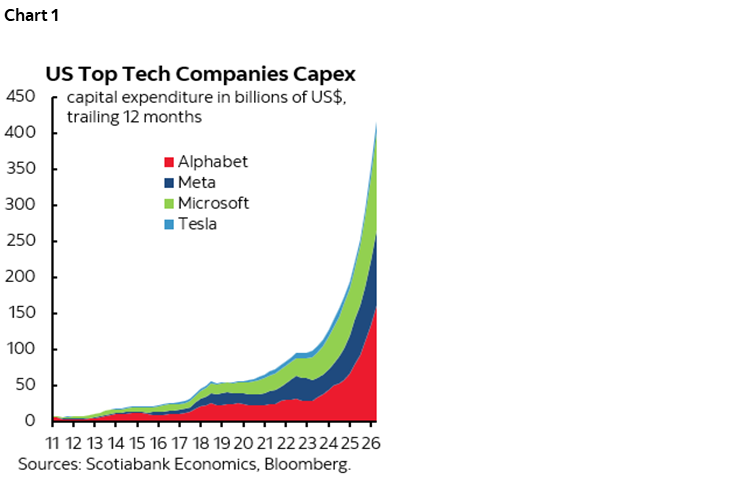
US equity futures are in the red by between about ¼% and ¾% across benchmarks with tech weakness the main culprit following Alphabet’s earnings in yesterday’s after-market. Today’s aftermarket brings out Amazon and Intel, so the uncertainty will continue. By then, we’ll have the complete picture for Mag7 tech spending that continues to reach for the sky (chart 1).
Otherwise, market volatility may be fed by a) Lagarde’s announced resignation, b) US macro reports, and c) the ECB’s communications.
ECB—LAGARDE’S RESIGNATION DOMINATES EXPECTED INACTION
The European Central Bank is priced for no change this morning (9:15amET) followed by President Lagarde’s press conference 30 minutes later. The market is about 80% priced for a 25bps hike at the next meeting on December 17th.
While ECB officials speak of the potential for more work to do on inflation and inflation risk, they have noted little evidence of second-round effects of the spike in energy prices to date. Further, President Lagarde stated that the bond sell-off “will slow growth and reduce pass-through by more than projected” in September.
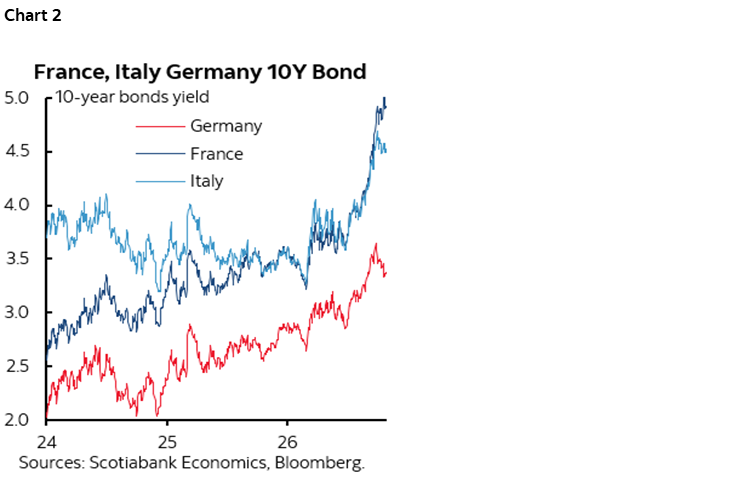
And how. EGBs are in turmoil. France’s 10-year yield has soared from 3.65% at the end of June to just under 5% now. Its spread has increased to just over 150bps over 10-year bunds (chart 2). Italy’s 10-year spread over bunds has also increased, indicating correlated bond market strains and some contagion. And so for now, the ECB’s gradual mantra is likely to be at risk of being evermore gradual. Gradual will be informed by second-round effects of pressures on inflation including next week’s wage tracker.
And yet, the day’s decision is superseded by the advance announcement that President Lagarde will leave her post early on February 7th before her term expires next October. The ECB announced that a search for her successor will commence immediately. Oh, oh, can I, can I? Gosh that sounds like good fun, going into a mess that awaits next year with France’s election by April being among the fresh challenges to a region that is a perennial growth underperformer.
Why now? Perhaps in order to have a successor chosen before France’s far right National Rally—rebranded from previously being the extremist National Front—may win the French election and exert its influence over the choice of Lagarde’s successor. Maybe she just wants a new gig earlier, with some speculation of downgrading to the World Economic Forum’s leadership. Maybe she wants to play a more active role in the French election against Marine Le Pen which is difficult to do for a central bank head. Still, some will say that whatever the motive, the timing is unfortunate given the need for a steady, experienced hand on the wheel.
JUST HOW STRONG IS THE US ECONOMY AND AT WHAT COST TO INFLATION?
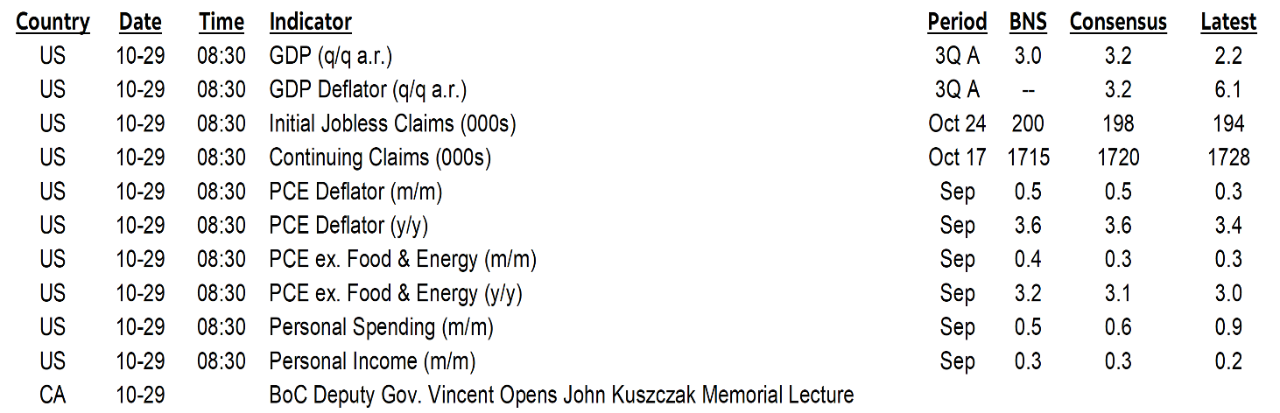
We'll find out just how strong the US economy is and at what cost to inflation when this morning's Q3 GDP and PCE inflation figures arrive (8:30amET).
For GDP, I've gone with 3% q/q SAAR. There is a wide range of consensus views with the median estimate at 3.2% q/q SAAR and the range mostly clustered with about 2½% to about 4%. Some of the reason for this is that
The consumer is a big part of the strength. Pending this morning's updates for spending and incomes in September, Q3 is tracking a gain of 3.3% q/q SAAR and possibly higher if expectations for September come true and without negative revisions. September should be solid based on retail sales, albeit mostly fed by higher prices versus volumes. Further, it’s the saving rate that is likely to continue taking it on the chin as spending growth exceeds income growth.
The inflation figures may nevertheless steal the show. Core PCE inflation is estimated to rise by 0.4% m/m (consensus 0.3%). This is based upon core CPI that was up by 0.3%, conversion to PCE weights, contributions from pertinent producer price categories that are included in PCE, and a small estimate for other methodological differences between CPI and PCE.
IGNORE CANADIAN PAYROLLS
Canada updates payrolls for August this morning (8:30amET). Yes, August. We'll get the Labour Force Survey next week for the month of October. The US releases the household and payrolls reports on the same day for the same freshest month. Not Statcan, so that's one reason to fade the report regardless of what it shows.
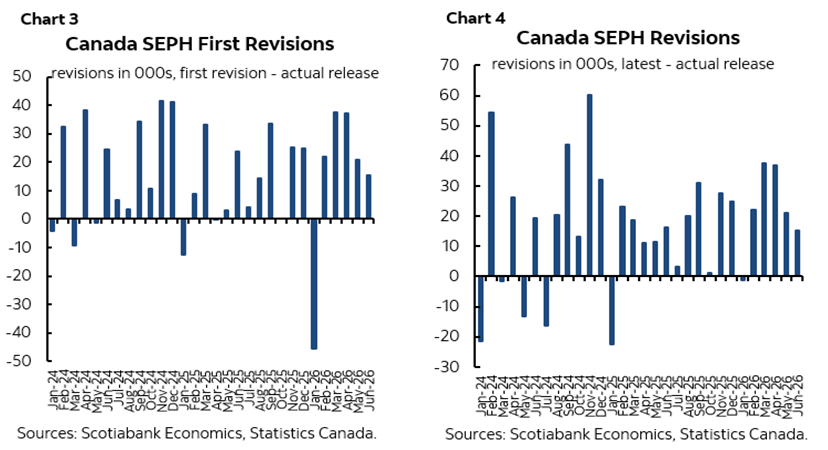
The other reason is that despite what you might think, it's not harder and more reliable data. The estimated change in payrolls is revised often by tens of thousands of jobs each month on both initial revisions (chart 3) and final revisions (chart 4).
I'll give estimates for next week's Labour Force Survey in tomorrow's weekly along with further explanation of why the BoC is right to have not even mentioned the recent figures.
REASONS WHY HOUSING WON'T STOP BOC HIKES
One of the pushbacks on Bank of Canada rate increases is that they shouldn’t be happening for the sake of the housing market. I believe this narrative is incorrect.
- Their job is managing inflation to a 2% target.
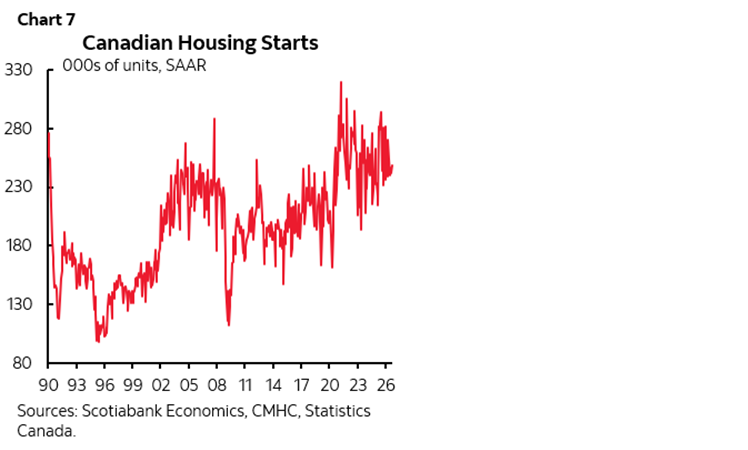
- Shelter inflation is being overtaken by other inflation drivers like services ex-shelter, but clients who tell me that shelter inflation is a drag on overall inflation are not respecting the data (charts 5, 6).
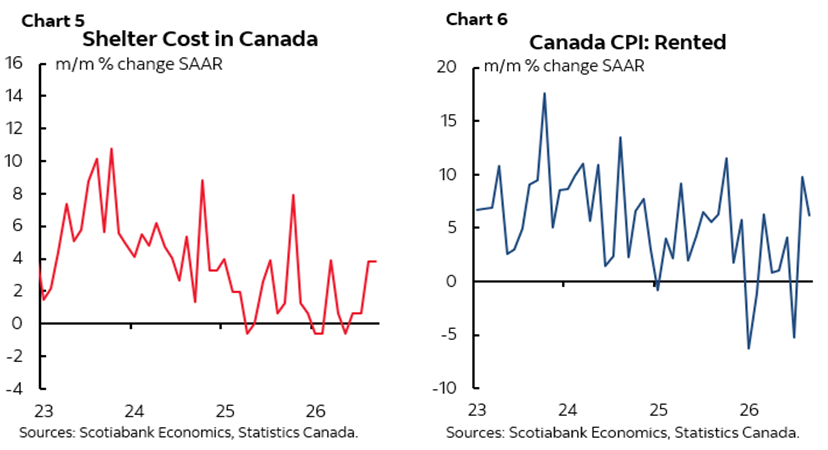
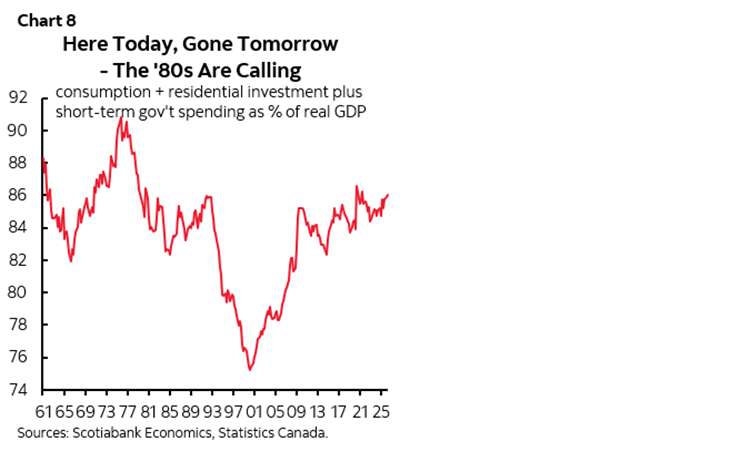
- Housing is holding up better than some narratives. Look at starts, for example (chart 7).
- The worst damage that you can do to housing is to allow inflation to rip and then slam the brakes on later with steeper and higher rate increases. Hiking earlier than later could mitigate the risk of even higher rates later on and with it more damage to housing. Homebuilders need to understand that the worst risk to their market is a repeat of runaway inflation.
- Condo markets in Toronto and Vancouver remain troubled but that's not a rates issue. Supply overshot and investors often behaved irresponsibly.
- It's also an immigration issue as Canada tightened policy after a wild overshoot on temps. I've long argued Canada will get back training immigration targets likely by next year and in a smarter way this time. We don't have enough of the skilled labour to meet the investment needs.
- Other growth drivers are taking over. Consumer spending. Investment. Exports.
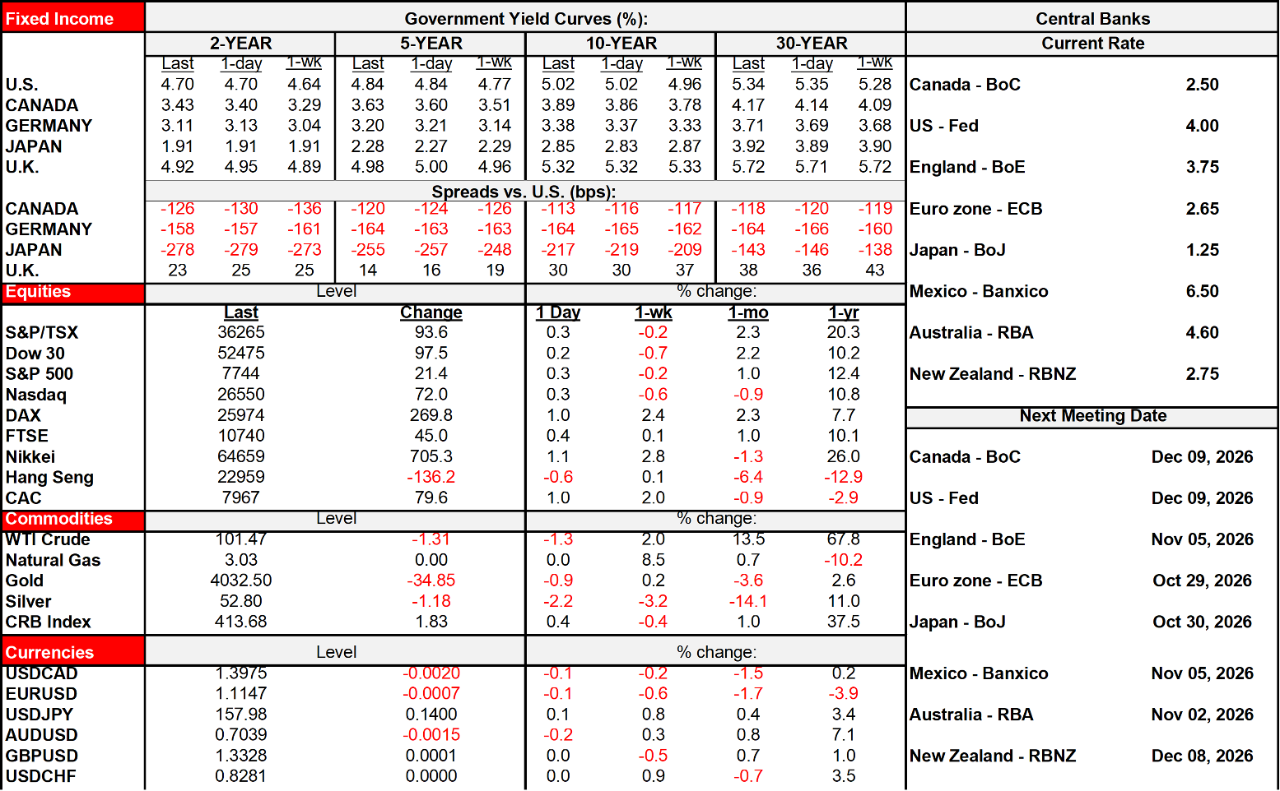
- Canada has allocated most activity toward short-term spending for too long. The country is rotating toward an investment-led agenda. Chart 8 shows the share of GDP into consumption, housing and current spending by governments. About 86% of GDP is in here-today-gone-tomorrow spending. That’s at the highest since the 1980s but not quite as high as the 1970s. The country has had a very short-term mindset for too long. Absent longer-term investment, productivity and prosperity suffer. The country is in the early stages of having a very different macro framework.
- Mortgage rates remain cheap. Yes, cheap. In a longer run sense, the 5-year mortgage rate's key driver—the five-year GoC bond yield—remains low in real terms by taking the current 3.6% level and deducting your favourite measure of inflation or expected inflation. Housing models use real rates. With the information at hand, I find the 5-year bond yield to be around fair value, having incorporated reasonable estimates of where the policy rate is going alongside a tacked on term premium.
Fundamentally, housing's challenges are an income problem. Rates can't fix that. Affordability is strained by years of sub-par income growth. A productivity and investment agenda would generate greater housing rewards than anything rates could do.
ONTARIO’S FISCAL UPDATE
Mitch Villeneuve is a provincial economist on our team and here’s what he has to say about Ontario’s fiscal update today.
Ontario releases its mid-year fiscal update around 1pm EDT today. Its Spring budget pushed back its planned return to budget balance by a year to FY29, and developments since then point to further deterioration in the deficit path. The final deficit number for 2025–26 (FY26) came in at $13 bn, up a bit from the $12.3 bn forecast in March, due in part to weaker personal income tax assessments—which will carry forward into future years. The real GDP forecast has also slipped since the Spring, though higher GDP inflation is mitigating the impact on projected nominal GDP.
The biggest impacts will come from the cost of new measures. Minister Bethlenfalvy confirmed yesterday what he hinted at last week, which is that Ontario will match the federal Productivity Mega Deduction, at a fiscal cost of $8 bn over five years. He had announced in the Spring that Ontario would adopt the feds’ Super Deduction, though didn’t include the associated cost in the fiscal numbers at that time, as the federal legislation was still pending. Combined, these two measures will drop tax revenues by around $12 billion in total over the forecast horizon. Ontario has also made a number of new spending announcements, most notably a $2.7 bn contribution to the joint Canada-Ontario support package for the steel and auto sectors announced last week—though the impact of this announcement on the deficit is likely to be minimal given that it appears to be loans rather than grants.
The independent Financial Accountability Office of Ontario forecast in the Summer a deficit of $17 bn in FY27, dropping to $8-10 bn in future years. I agree that the deficit path is likely to be revised higher compared to the Budget 2026 numbers, but expect the government to set out a clearer path toward an eventual return to balance.
DISCLAIMER
This report has been prepared by Scotiabank Economics as a resource for the clients of Scotiabank. Opinions, estimates and projections contained herein are our own as of the date hereof and are subject to change without notice. The information and opinions contained herein have been compiled or arrived at from sources believed reliable but no representation or warranty, express or implied, is made as to their accuracy or completeness. Neither Scotiabank nor any of its officers, directors, partners, employees or affiliates accepts any liability whatsoever for any direct or consequential loss arising from any use of this report or its contents.
These reports are provided to you for informational purposes only. This report is not, and is not constructed as, an offer to sell or solicitation of any offer to buy any financial instrument, nor shall this report be construed as an opinion as to whether you should enter into any swap or trading strategy involving a swap or any other transaction. The information contained in this report is not intended to be, and does not constitute, a recommendation of a swap or trading strategy involving a swap within the meaning of U.S. Commodity Futures Trading Commission Regulation 23.434 and Appendix A thereto. This material is not intended to be individually tailored to your needs or characteristics and should not be viewed as a “call to action” or suggestion that you enter into a swap or trading strategy involving a swap or any other transaction. Scotiabank may engage in transactions in a manner inconsistent with the views discussed this report and may have positions, or be in the process of acquiring or disposing of positions, referred to in this report.
Scotiabank, its affiliates and any of their respective officers, directors and employees may from time to time take positions in currencies, act as managers, co-managers or underwriters of a public offering or act as principals or agents, deal in, own or act as market makers or advisors, brokers or commercial and/or investment bankers in relation to securities or related derivatives. As a result of these actions, Scotiabank may receive remuneration. All Scotiabank products and services are subject to the terms of applicable agreements and local regulations. Officers, directors and employees of Scotiabank and its affiliates may serve as directors of corporations.
Any securities discussed in this report may not be suitable for all investors. Scotiabank recommends that investors independently evaluate any issuer and security discussed in this report, and consult with any advisors they deem necessary prior to making any investment.
This report and all information, opinions and conclusions contained in it are protected by copyright. This information may not be reproduced without the prior express written consent of Scotiabank.
™ Trademark of The Bank of Nova Scotia. Used under license, where applicable.
Scotiabank, together with “Global Banking and Markets”, is a marketing name for the global corporate and investment banking and capital markets businesses of The Bank of Nova Scotia and certain of its affiliates in the countries where they operate, including; Scotiabank Europe plc; Scotiabank (Ireland) Designated Activity Company; Scotiabank Inverlat S.A., Institución de Banca Múltiple, Grupo Financiero Scotiabank Inverlat, Scotia Inverlat Casa de Bolsa, S.A. de C.V., Grupo Financiero Scotiabank Inverlat, Scotia Inverlat Derivados S.A. de C.V. – all members of the Scotiabank group and authorized users of the Scotiabank mark. The Bank of Nova Scotia is incorporated in Canada with limited liability and is authorised and regulated by the Office of the Superintendent of Financial Institutions Canada. The Bank of Nova Scotia is authorized by the UK Prudential Regulation Authority and is subject to regulation by the UK Financial Conduct Authority and limited regulation by the UK Prudential Regulation Authority. Details about the extent of The Bank of Nova Scotia's regulation by the UK Prudential Regulation Authority are available from us on request. Scotiabank Europe plc is authorized by the UK Prudential Regulation Authority and regulated by the UK Financial Conduct Authority and the UK Prudential Regulation Authority.
Scotiabank Inverlat, S.A., Scotia Inverlat Casa de Bolsa, S.A. de C.V, Grupo Financiero Scotiabank Inverlat, and Scotia Inverlat Derivados, S.A. de C.V., are each authorized and regulated by the Mexican financial authorities.
Not all products and services are offered in all jurisdictions. Services described are available in jurisdictions where permitted by law.