

ON DECK FOR TUESDAY, OCTOBER 20th

KEY POINTS:
- Higher oil prices strengthen BoC hike pricing, CAD gains
- The polls correctly called Alberta’s foolish separation vote
- BoC expectations––hikes at 3 of four next meetings…
- …as Scotiabank Economics led everyone in consensus and market pricing
- Rise in long-term inflation expectations will spook the BoC
- UK job market readings bolster BoE hike pricing
- Light US data on tap
Oil is up sharply this morning, led by Brent’s 5% rise and a smaller US$1-2/barrel increase in WTI. Some headlines about Iran’s VP saying they have “no choice” but to assert control over the Strait of Hormuz and a commitment from the UK to be drawn further into defending the Saudis against attacks by the Houthis may be contributing factors.
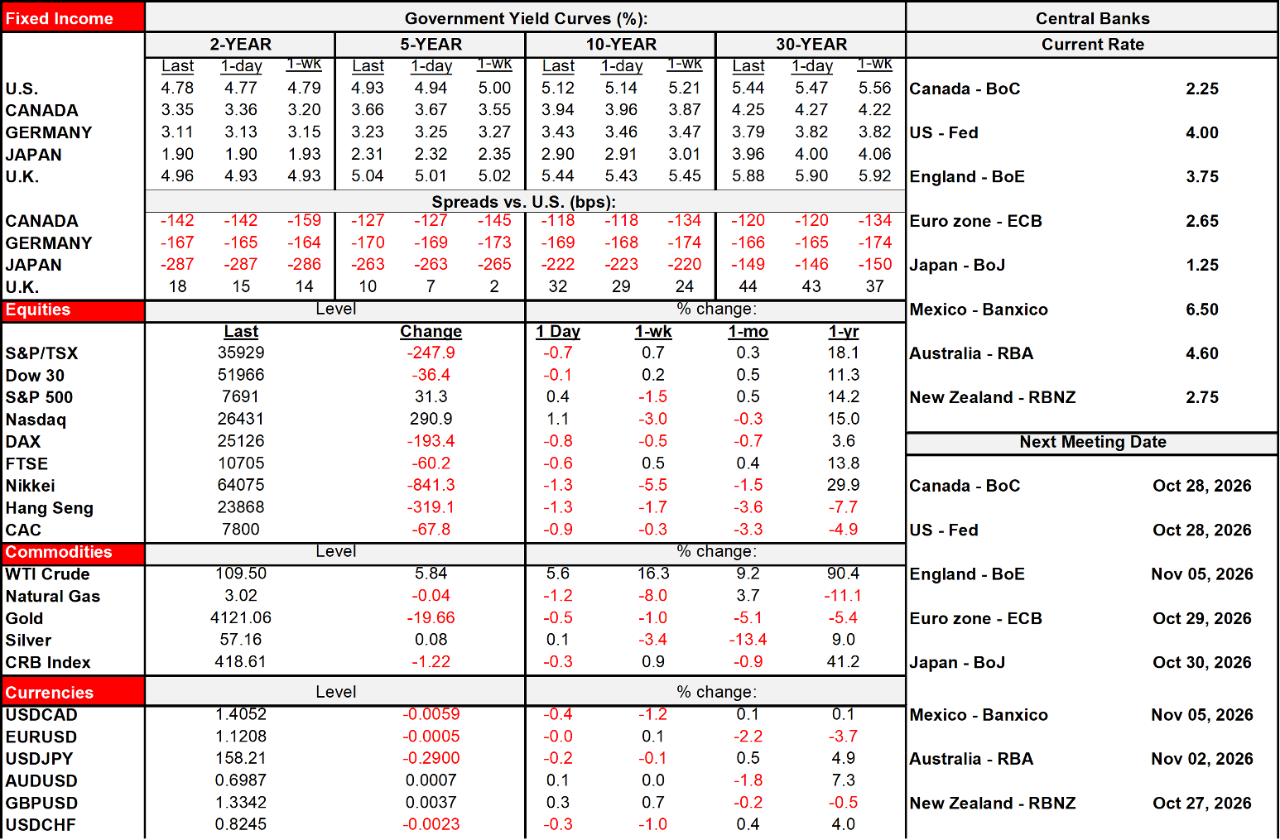
The result is harming risk appetite. Stocks are broadly lower across NA futures and European cash markets after Asian benchmarks sold off overnight. French bonds remain under pressure and short-dated UK gilt yields are up post jobs (see below), but otherwise there is little movement across N.A. rates. Perceived petro currencies like CAD and NOK are outperforming this morning but with sterling not far behind again on jobs and BoE expectations.
The BoC is priced for 22 out of 25bps of a rate hike one week from today. Let’s be clear on one thing—Scotiabank Economics was way ahead of everyone else in consensus and way ahead of market pricing in calling for hikes this year. November’s forecast last year showed hikes in 2026H2 that we punted to Q4 in our January update and held steady on that timing since while adding another hike since then.
POLLS CORRECTLY CALLED ALBERTA’S SEPARATIST VOTE
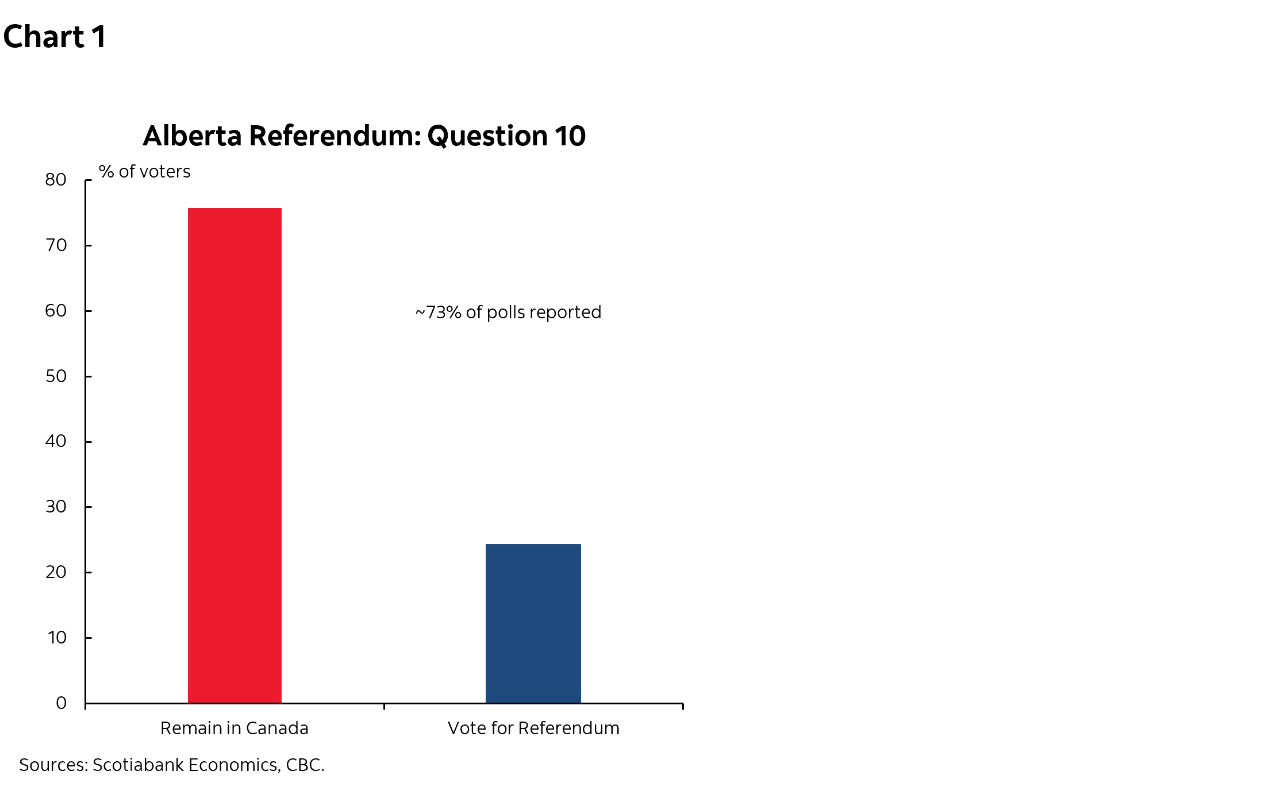
76% of Albertans voted to remain in Canada and against starting the process toward a referendum on exiting (chart 1). Results are here and are still being tallied but the sampling and statistical margin of error strongly lead to the conclusion that ‘remain’ won hands down. The polls correctly called it.
Markets totally ignored the outcome when CBC called it at about 1:15amET. TSX futures were unchanged. So was CAD on an otherwise solid gain for a second straight day having everything to do with the Bank of Canada and higher oil prices.
Canada emerges from the vote in stronger fashion. The last thing it needed was division given that the US administration seems closer to Russia than Canada and the need for national unity around core domestic priorities. There should be some accountability for having called this waste of taxpayer money in the first place and the risk that a surprise Brexit-like vote could have been a risk. How separatists exact their vengeance on the provincial administration remains uncertain, as will ill sentiment toward various US actors whose interference in the referendum was well documented by news media organizations.
BC’s election this weekend will be the next major development on Canada’s calendar while polls show the incumbent NDP administration is at strong risk of losing to the Conservatives.
BOC FOLLOW UP
As shared with clients and chat rooms, what will concern the Bank of Canada the most about its consumer and business surveys that were refreshed after CPI will be longer-term inflation expectations.
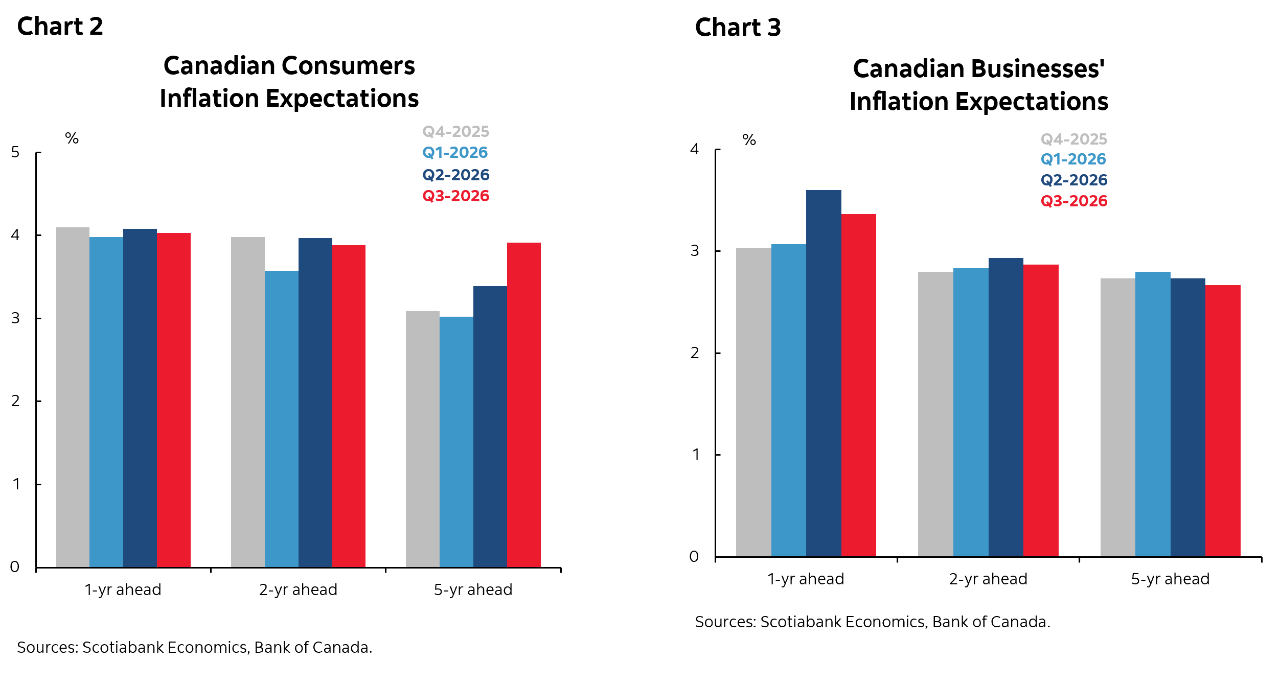
Consumers expectations for inflation five years out jumped toward 4% (chart 2) while businesses signalled steady longer-term inflation expectations above the BoC’s 2% target (chart 3). I don’t hold this data in high regard. The sample is stale on arrival because the BoC is so slow at getting the results out from sampling that was concentrated in August before oil prices really began taking off again. Besides, consumers and businesses generally have a poor understanding of inflation.
Yet the BoC follows these measures. Governor Macklem has previously dismissed the rise in short-term inflation expectations in favour of emphasizing stable longer-term measures. The fact he can no longer say this
is likely to drive some hawkish discomfort at the BoC. Knowing the initial sample readings when he spoke at the IMF meetings this past weekend may have been a modest contributor to his hawkish leanings.
A separate issue is the prospect of serial hikes by the Bank of Canada after next week in keeping with client questions. We already have hikes in three of the next four BoC meetings starting next week through March so I’m not personally comfortable with turning more aggressive on the shorter-run rate picture for now although open to tweaks as we learn more.
One reason for this is not counting your chickens before they’ve hatched. There is a modest but non-zero chance that the Bank of Canada could surprise markets with a hold next week although I don’t believe they will. There have been some past instances when the BoC has whiffed on market pricing for either a cut or a hike, but not under Governor Macklem’s tenure since taking over from Governor Poloz in 2020.
Another reason for this is to recall the BoC’s playbook around past energy price shocks. After WTI collapsed over 2014H2, the BoC cut in January 2015, skipped, and then cut again. The reasons for the skip included guidance that there is merit to keeping powder dry amid the uncertainty, policy adjustments don’t have to proceed in a straight line, and markets had done some of their work for them. This last point is a bit of a chicken-and-egg issue in that markets did their work for them assuming they would cut, so had they not, then markets would have reversed.
That period may be instructive to today’s context albeit given great differences like trade, changed domestic priorities, fiscal stimulus etc. Uncertainty nevertheless remains elevated. The six-week period between next week’s decision and December’s decision may reveal another expansionary Federal budget, but the BoC’s annoying practice is to declare nothing changes until they incorporate the effects into their rigid quarterly forecasts in January. The environment after US midterms and any spillover effects in the ‘lame duck’ session of the dying Congress may wish to be considered.
The more interesting debate may be whether 3¼% is high enough as our terminal rate as it would merely pivot the policy rate from the low end of the neutral rate range to the high end that would not necessarily be restrictive.
UK JOB MARKET BOLSTERS BOE HIKE PRICING
Evidence of strength in UK labour markets added to expectations for the Bank of England to hike Bank Rate on November 5th. Pricing bumped up by 1–2 bps to almost a fully priced 25bps hike. Sterling appreciated post-jobs and is among the class leaders the USD this morning. The UK 2-year gilt yield increased a couple of points to 4.95% and the curve registered a mild bear steepener.
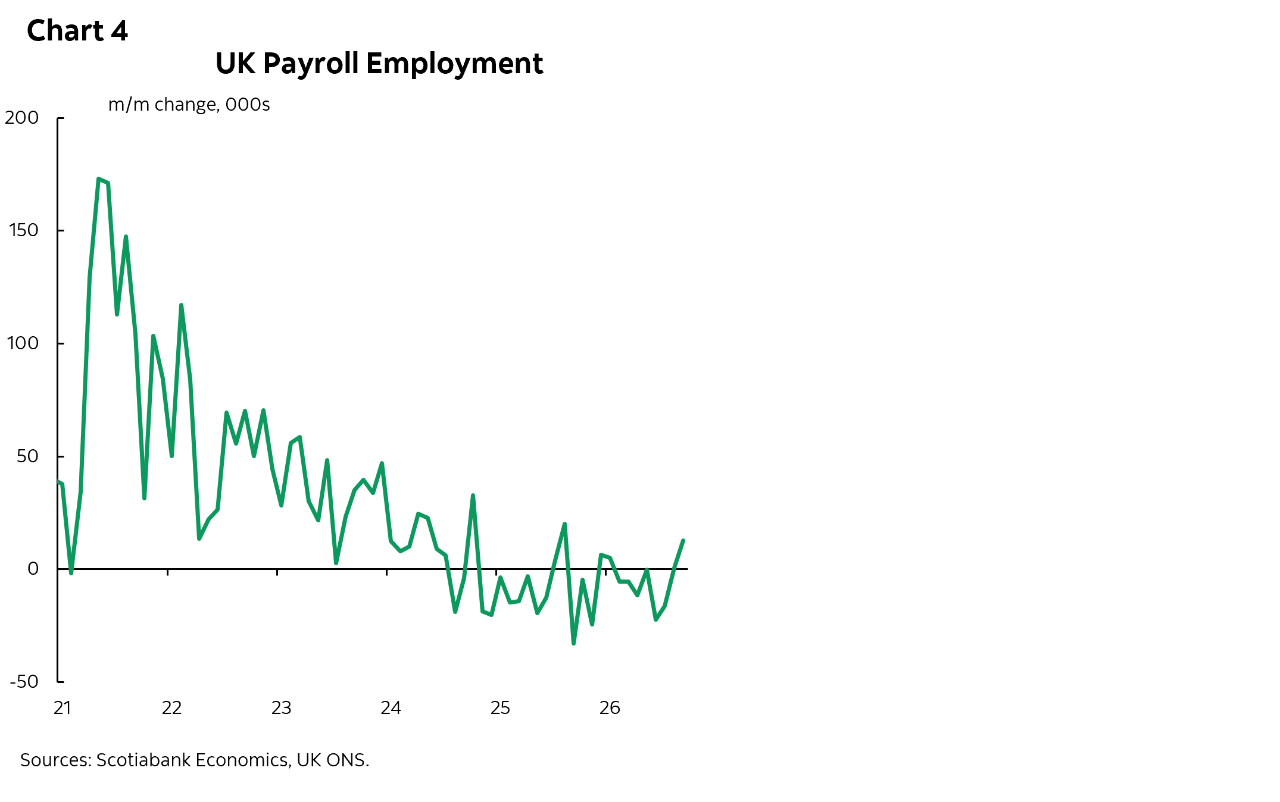
- Payroll employment was up by 13k in September for the strongest gain since August 2025 (chart 4).
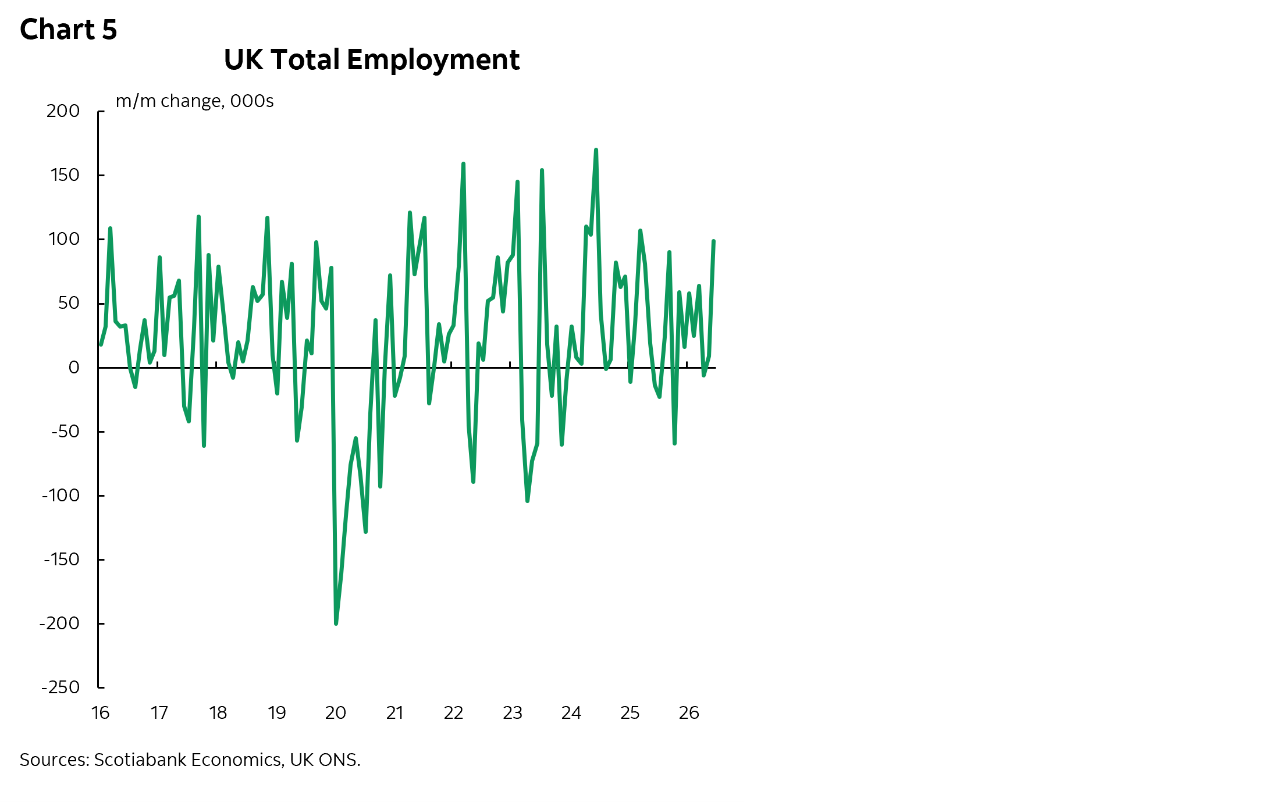
- Total employment increased by about 100k in August for the strongest gain since May 2025 (chart 5).
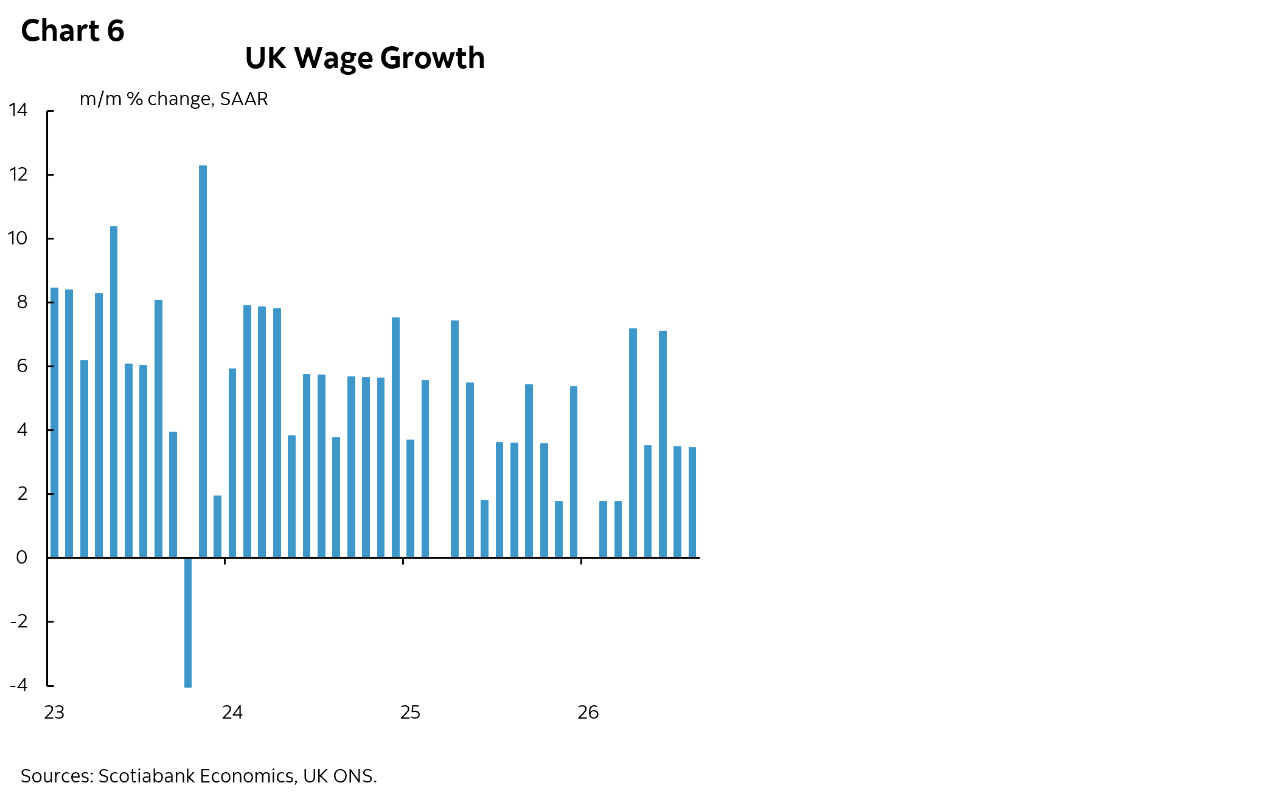
- Wage growth held steady at 3½% m/m SAAR in August (chart 6).
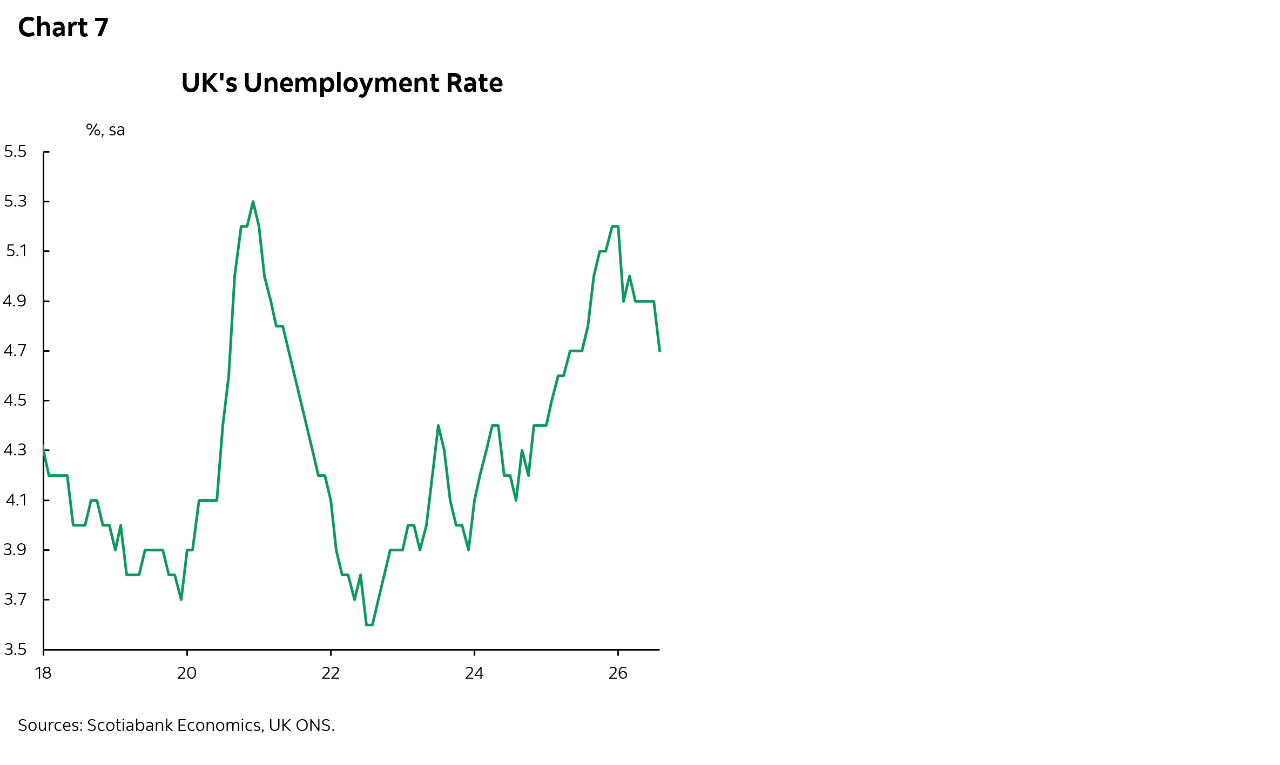
- The unemployment rate fell to 4.7% and has fallen from a peak of 5.2% at the turn of the new year (chart 7).
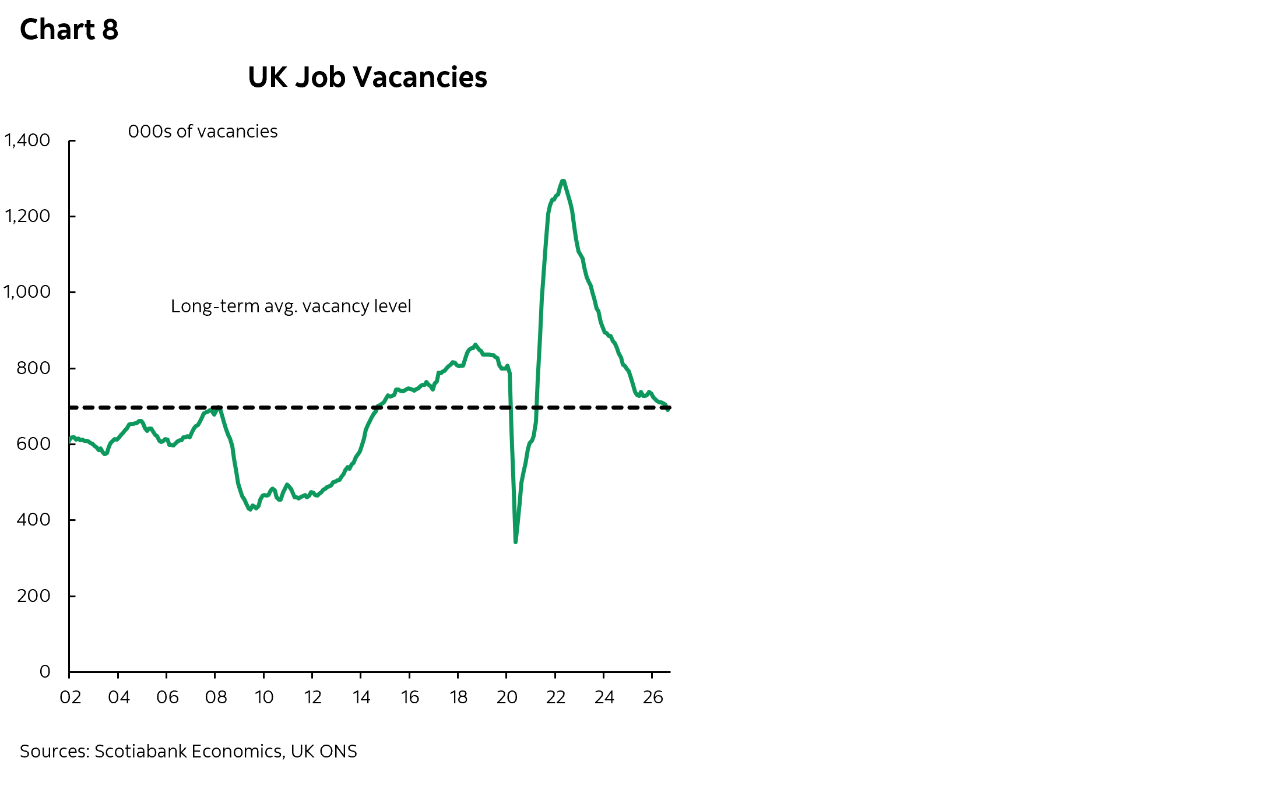
- UK job vacancies were little changed as they dipped below 700k for the first time since April 2021 (chart 8).
TRIVIAL US DATA
Updates on housing starts during September (8:30amET), US pending home sales during the same month (10amET) and ADP’s weekly private payrolls measure (8:15amET) are all due out. None of them are likely to be terribly impactful to markets.
DISCLAIMER
This report has been prepared by Scotiabank Economics as a resource for the clients of Scotiabank. Opinions, estimates and projections contained herein are our own as of the date hereof and are subject to change without notice. The information and opinions contained herein have been compiled or arrived at from sources believed reliable but no representation or warranty, express or implied, is made as to their accuracy or completeness. Neither Scotiabank nor any of its officers, directors, partners, employees or affiliates accepts any liability whatsoever for any direct or consequential loss arising from any use of this report or its contents.
These reports are provided to you for informational purposes only. This report is not, and is not constructed as, an offer to sell or solicitation of any offer to buy any financial instrument, nor shall this report be construed as an opinion as to whether you should enter into any swap or trading strategy involving a swap or any other transaction. The information contained in this report is not intended to be, and does not constitute, a recommendation of a swap or trading strategy involving a swap within the meaning of U.S. Commodity Futures Trading Commission Regulation 23.434 and Appendix A thereto. This material is not intended to be individually tailored to your needs or characteristics and should not be viewed as a “call to action” or suggestion that you enter into a swap or trading strategy involving a swap or any other transaction. Scotiabank may engage in transactions in a manner inconsistent with the views discussed this report and may have positions, or be in the process of acquiring or disposing of positions, referred to in this report.
Scotiabank, its affiliates and any of their respective officers, directors and employees may from time to time take positions in currencies, act as managers, co-managers or underwriters of a public offering or act as principals or agents, deal in, own or act as market makers or advisors, brokers or commercial and/or investment bankers in relation to securities or related derivatives. As a result of these actions, Scotiabank may receive remuneration. All Scotiabank products and services are subject to the terms of applicable agreements and local regulations. Officers, directors and employees of Scotiabank and its affiliates may serve as directors of corporations.
Any securities discussed in this report may not be suitable for all investors. Scotiabank recommends that investors independently evaluate any issuer and security discussed in this report, and consult with any advisors they deem necessary prior to making any investment.
This report and all information, opinions and conclusions contained in it are protected by copyright. This information may not be reproduced without the prior express written consent of Scotiabank.
™ Trademark of The Bank of Nova Scotia. Used under license, where applicable.
Scotiabank, together with “Global Banking and Markets”, is a marketing name for the global corporate and investment banking and capital markets businesses of The Bank of Nova Scotia and certain of its affiliates in the countries where they operate, including; Scotiabank Europe plc; Scotiabank (Ireland) Designated Activity Company; Scotiabank Inverlat S.A., Institución de Banca Múltiple, Grupo Financiero Scotiabank Inverlat, Scotia Inverlat Casa de Bolsa, S.A. de C.V., Grupo Financiero Scotiabank Inverlat, Scotia Inverlat Derivados S.A. de C.V. – all members of the Scotiabank group and authorized users of the Scotiabank mark. The Bank of Nova Scotia is incorporated in Canada with limited liability and is authorised and regulated by the Office of the Superintendent of Financial Institutions Canada. The Bank of Nova Scotia is authorized by the UK Prudential Regulation Authority and is subject to regulation by the UK Financial Conduct Authority and limited regulation by the UK Prudential Regulation Authority. Details about the extent of The Bank of Nova Scotia's regulation by the UK Prudential Regulation Authority are available from us on request. Scotiabank Europe plc is authorized by the UK Prudential Regulation Authority and regulated by the UK Financial Conduct Authority and the UK Prudential Regulation Authority.
Scotiabank Inverlat, S.A., Scotia Inverlat Casa de Bolsa, S.A. de C.V, Grupo Financiero Scotiabank Inverlat, and Scotia Inverlat Derivados, S.A. de C.V., are each authorized and regulated by the Mexican financial authorities.
Not all products and services are offered in all jurisdictions. Services described are available in jurisdictions where permitted by law.