

ON DECK FOR MONDAY, OCTOBER 19th
KEY POINTS:
- Canada leads global rates sell-off post-Macklem, pre-CPI
- Today is Canada’s Day as everything else takes a back seat
- BoC’s Macklem issues hawkish warning…
- …that sharply lifted October hike pricing
- It’s Alberta vote day as turnout seems very high so far…
- …and here’s the where, how and when to see results
- Will Canadian core inflation measures maintain the upward pressure?
- BoC surveys will probably show higher inflation expectations
- China’s economy beat expectations
- Global Week Ahead—It Will Only Make Canada Stronger (reminder here)
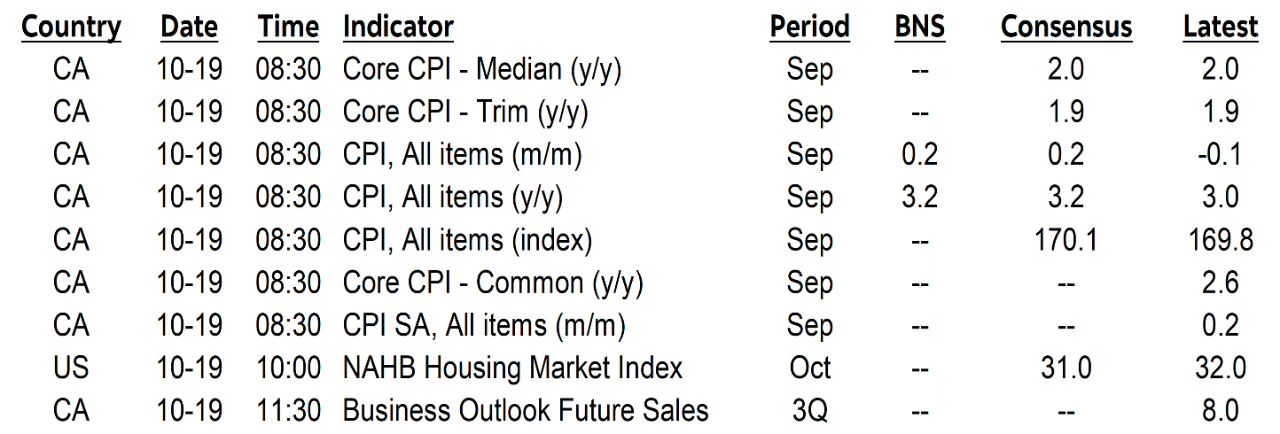
This is Canada’s day. Whatever else is happening across global markets can take a back seat to hawkish comments by BoC Governor Macklem over the weekend, Alberta’s separation vote, Canadian CPI and Bank of Canada measures of inflation expectations.
Macklem’s comments spiked the punchbowl in terms of market expectations for the October 28th decision. On Friday, about 9bps of a hike was priced for next week and now it’s about 18bps. CAD is vaulting forward this morning.
I suspect Alberta’s vote will handily reject separation and the country will emerge stronger as a result, even though it was truly unwise judgement to hold such a referendum in the first place.
Now let’s see pending data this morning.
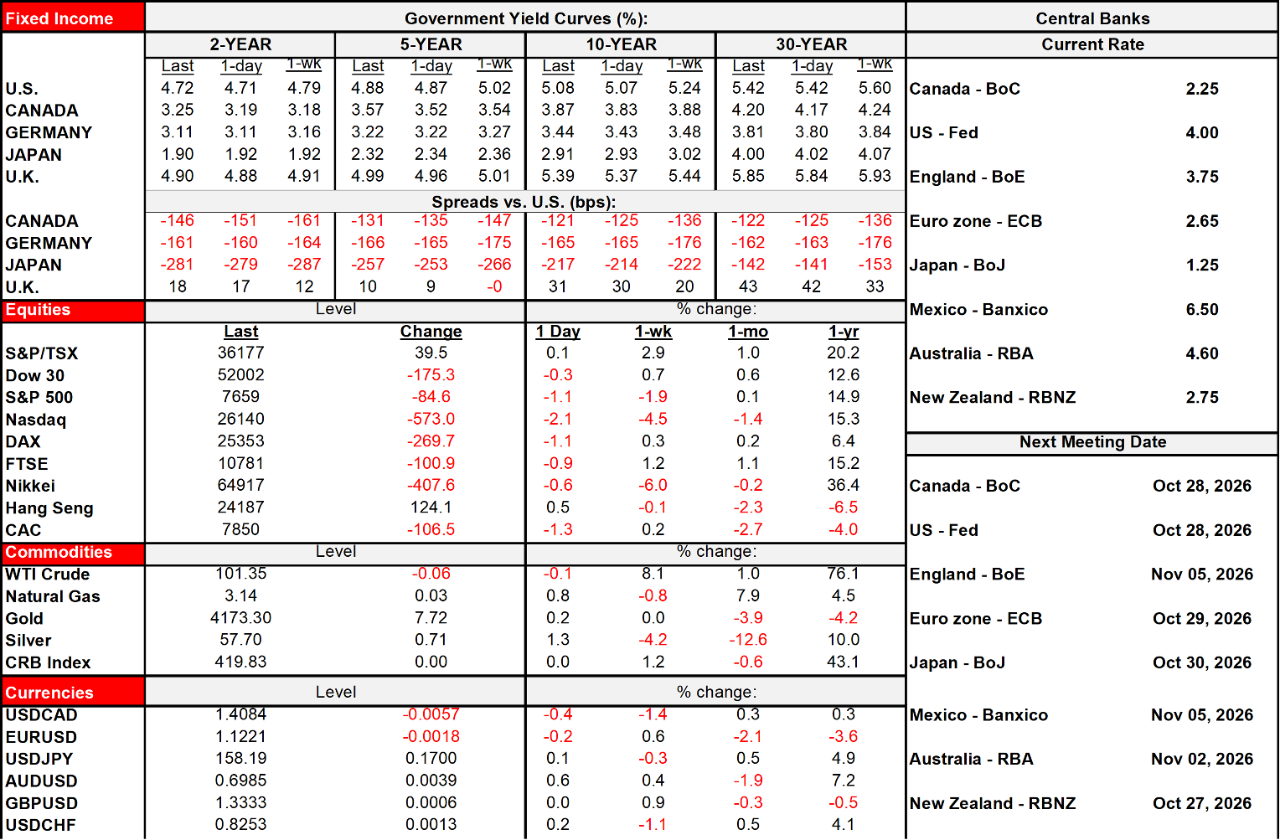
Other stuff going on across global markets includes higher yields across US Ts and European curves. Canada’s bond yields are strongly selling off and underperforming US Treasuries after Macklem’s comments. Stocks are mixed with US futures up, TSX futures a bit lower and European cash markets selling off. Oil is a few dimes lower.
CANADIAN INFLATION—THE FINAL PIECE OF THE OCTOBER PUZZLE
Canadian CPI for September is on tap for release at 8:30amET and is estimated to rise by 0.2% m/m NSA and 3.2% y/y (3.0% prior). The suite of readings could be highly impactful to expectations for the October 28th and subsequent decisions by the Bank of Canada, although Macklem’s comments over the weekend sounded like data dependency takes a back seat to forward-looking concerns for a change.
Key will be the core measures including traditional core, weighted median and trimmed mean CPI. There has been clear evidence of pass-through of cost pressures into all three measures over recent months, including four months in a row in which traditional core has risen by 3%+ m/m SAAR, and two in which the other measures have risen by 2¾% m/m SAAR. See my weekly here for more insight.
BOC’S SURVEYS TO REFRESH INFLATION EXPECTATIONS
The Bank of Canada’s twin consumer and business surveys for Q3 will be refreshed at 11:30amET. Expect them to show a pick-up in inflation expectations in keeping with fresher and timelier small business surveys.
ALBERTA’S SEPARATION REFERENDUM—WHEN AND WHERE TO EXPECT RESULTS
It’s vote day in Alberta. Or rather, it’s in-person vote day, as Elections Alberta estimates that about 43% of eligible voters have already cast their votes in advance voting and mail-ins (here). That’s incredibly high; by comparison, the same link notes that 27.5% voted ahead of time in the 2023 provincial election. While there were more advance voters, what particularly made the difference was a jump of almost half a million in mail-in ballots. Polls shut at 8pmMT (10pmET) but will clear long line-ups if needed. The vote results cannot be shared until all locations have closed. Live results will then start to appear at this link. Question #10—the one on whether to start the process toward holding a separation referendum—will be counted first. Elections Alberta has up to 48 hours to complete the counts by law. See my weekly for more.
BOC GOVERNOR MACKLEM SOUNDED HAWKISH
Bank of Canada Governor Macklem delivered what I thought were relatively hawkish remarks in a media roundtable at the conclusion of the IMF meetings in Bangkok. His comments were issued on Saturday morning at 9amET.
A full transcript is unavailable, so we’re unfortunately captive to what journalists heard and chose to report and how. Still, he flagged that higher oil prices are “having a positive effect on growth” and repeated a bias toward raising their inflation forecast in the upcoming October MPR which he has previously indicated.
Macklem summed it up by saying “The question we’re going to be asking ourselves is inflation likely to come back down towards our target on its own, or are we going to have to raise interest rates to influence the path.” Ergo, October is definitely a ‘live’ meeting.
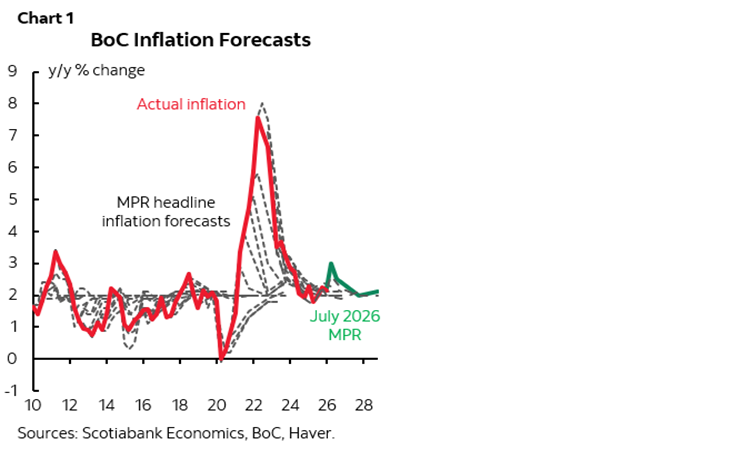
Given that the Bank of Canada has a poor track record of forecasting inflation by missing inflection points and understating inflation waves, I think they should take out insurance against the risk of inflation being higher and more persistent than they are forecasting. Chart 1 provides the evidence; each line shows the BoC’s inflation forecast drawn from past MPRs and compares it to the actual line.
Having said that, Macklem’s year-long handling of the energy shock has been odd to say the least. At first, he emphasized a real wage squeeze and how it was negative for consumers while giving none of the usual arguments for how a commodity driven terms of trade shock benefits Canada on net. He made himself sound like he was totally downbeat on the implications of a commodity shock on a major commodity producing economy!
Now he has pivoted toward the more upbeat narrative by flagging growth benefits to exports, investment and government finances that outweigh a real wage squeeze, though it still feels like he isn’t going far enough. High commodities usually trickle down to benefit corporations and households as well. I don't know why he didn't give these more balance arguments on the effects of a commodity shock from the beginning. His predecessors, like former Governor Poloz, would always emphasize how a positive commodity shock extracts income from the rest of the world economy and trickles down through broad sectors through improved balances (fiscal, profits, household income) and drives activity, while the reverse is true for a negative commodity-driven terms of trade shock. It feels like the BoC muffed up its interpretation and communications around the effects of a positive commodity shock and could have been better situated beforehand.
And consider a few additional points:
it's not just energy. Canada produces all the stuff that has seen price spikes
there are broader drivers of inflation, like a closing output gap that we forecast to shut early next year. Like shipping costs.
there are other growth drivers in our forecasts. Fiscal policy being a key one as we're in a serial pattern of applying more each time budget updates arrive and in between. Investment activity being another, in part leveraging fiscal actions, but in part independent of them (AI data centres, approaching capacity constraints, resource sector responses to high prices etc).
So on balance I view his comments as hawkish in nature. Let's see CPI and BoC surveys today while assuming that Albertans behave sensibly in today's vote.
CHINA’S ECONOMY BEAT EXPECTATIONS
China’s economy beat expectations (charts 2–4). A batch of overnight readings covered a wide range of activity measures as follows:
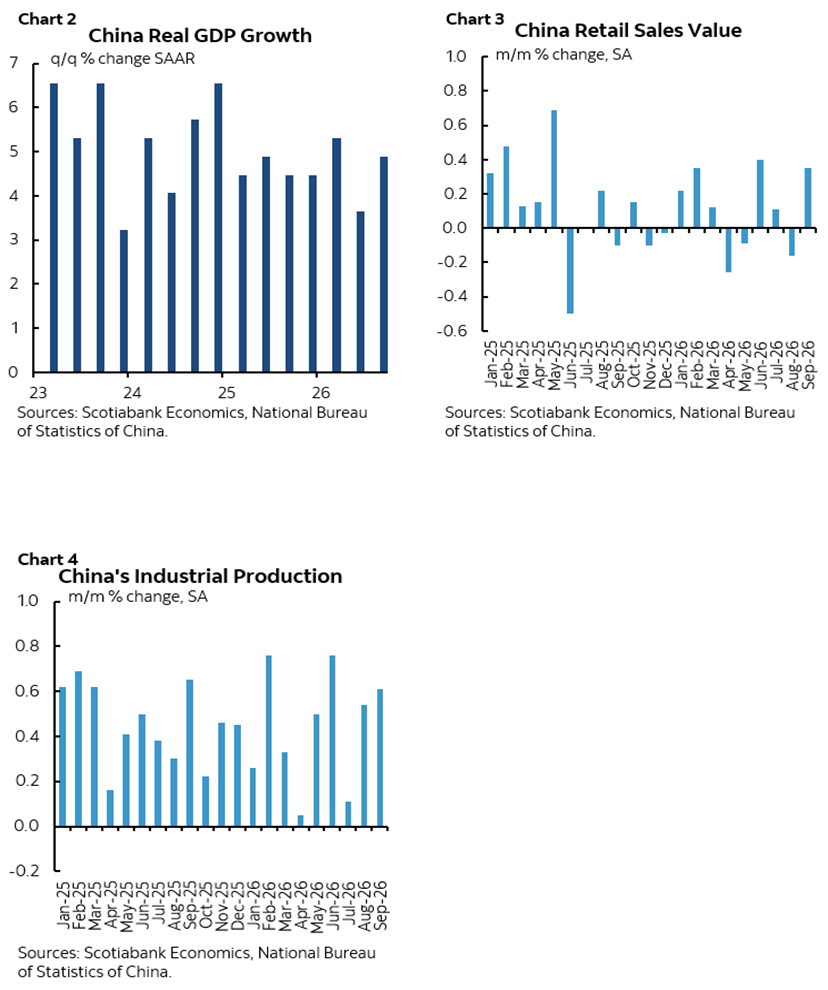
- Q3 GDP grew by 1.2% q/q SA (1.0% consensus), or 4.9% q/q SAAR. Consumption contributed 45.2% of GDP growth, investment accounted for 34% and net exports 17.9%.
- Retail sales expanded by 0.35% m/m SA, or 1.1% y/y (0.5% consensus).
- Industrial output was up 0.6% m/m SA and 5.5% y/y with the latter matching consensus.
- The jobless rate fell a tick to 5.2% (5.3% prior and consensus).
- Investment continues to fall (-7.2% ytd/ytd) and led by property investment (-20.6%).
DISCLAIMER
This report has been prepared by Scotiabank Economics as a resource for the clients of Scotiabank. Opinions, estimates and projections contained herein are our own as of the date hereof and are subject to change without notice. The information and opinions contained herein have been compiled or arrived at from sources believed reliable but no representation or warranty, express or implied, is made as to their accuracy or completeness. Neither Scotiabank nor any of its officers, directors, partners, employees or affiliates accepts any liability whatsoever for any direct or consequential loss arising from any use of this report or its contents.
These reports are provided to you for informational purposes only. This report is not, and is not constructed as, an offer to sell or solicitation of any offer to buy any financial instrument, nor shall this report be construed as an opinion as to whether you should enter into any swap or trading strategy involving a swap or any other transaction. The information contained in this report is not intended to be, and does not constitute, a recommendation of a swap or trading strategy involving a swap within the meaning of U.S. Commodity Futures Trading Commission Regulation 23.434 and Appendix A thereto. This material is not intended to be individually tailored to your needs or characteristics and should not be viewed as a “call to action” or suggestion that you enter into a swap or trading strategy involving a swap or any other transaction. Scotiabank may engage in transactions in a manner inconsistent with the views discussed this report and may have positions, or be in the process of acquiring or disposing of positions, referred to in this report.
Scotiabank, its affiliates and any of their respective officers, directors and employees may from time to time take positions in currencies, act as managers, co-managers or underwriters of a public offering or act as principals or agents, deal in, own or act as market makers or advisors, brokers or commercial and/or investment bankers in relation to securities or related derivatives. As a result of these actions, Scotiabank may receive remuneration. All Scotiabank products and services are subject to the terms of applicable agreements and local regulations. Officers, directors and employees of Scotiabank and its affiliates may serve as directors of corporations.
Any securities discussed in this report may not be suitable for all investors. Scotiabank recommends that investors independently evaluate any issuer and security discussed in this report, and consult with any advisors they deem necessary prior to making any investment.
This report and all information, opinions and conclusions contained in it are protected by copyright. This information may not be reproduced without the prior express written consent of Scotiabank.
™ Trademark of The Bank of Nova Scotia. Used under license, where applicable.
Scotiabank, together with “Global Banking and Markets”, is a marketing name for the global corporate and investment banking and capital markets businesses of The Bank of Nova Scotia and certain of its affiliates in the countries where they operate, including; Scotiabank Europe plc; Scotiabank (Ireland) Designated Activity Company; Scotiabank Inverlat S.A., Institución de Banca Múltiple, Grupo Financiero Scotiabank Inverlat, Scotia Inverlat Casa de Bolsa, S.A. de C.V., Grupo Financiero Scotiabank Inverlat, Scotia Inverlat Derivados S.A. de C.V. – all members of the Scotiabank group and authorized users of the Scotiabank mark. The Bank of Nova Scotia is incorporated in Canada with limited liability and is authorised and regulated by the Office of the Superintendent of Financial Institutions Canada. The Bank of Nova Scotia is authorized by the UK Prudential Regulation Authority and is subject to regulation by the UK Financial Conduct Authority and limited regulation by the UK Prudential Regulation Authority. Details about the extent of The Bank of Nova Scotia's regulation by the UK Prudential Regulation Authority are available from us on request. Scotiabank Europe plc is authorized by the UK Prudential Regulation Authority and regulated by the UK Financial Conduct Authority and the UK Prudential Regulation Authority.
Scotiabank Inverlat, S.A., Scotia Inverlat Casa de Bolsa, S.A. de C.V, Grupo Financiero Scotiabank Inverlat, and Scotia Inverlat Derivados, S.A. de C.V., are each authorized and regulated by the Mexican financial authorities.
Not all products and services are offered in all jurisdictions. Services described are available in jurisdictions where permitted by law.