

ON DECK FOR FRIDAY, OCTOBER 16th
KEY POINTS:
- Markets ending the week anticlimactically
- What Fed Chair Warsh said
- What BoC Governor Macklem said
- Lutnick torpedoes trade talks again…
- …this time with Mexico
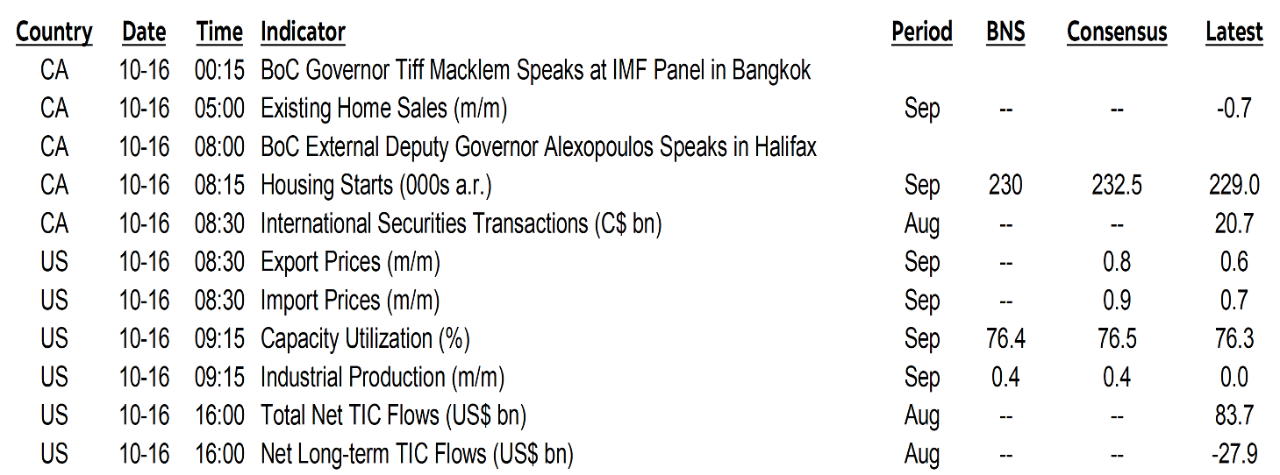
- Minor data: Canadian housing, US industrial output
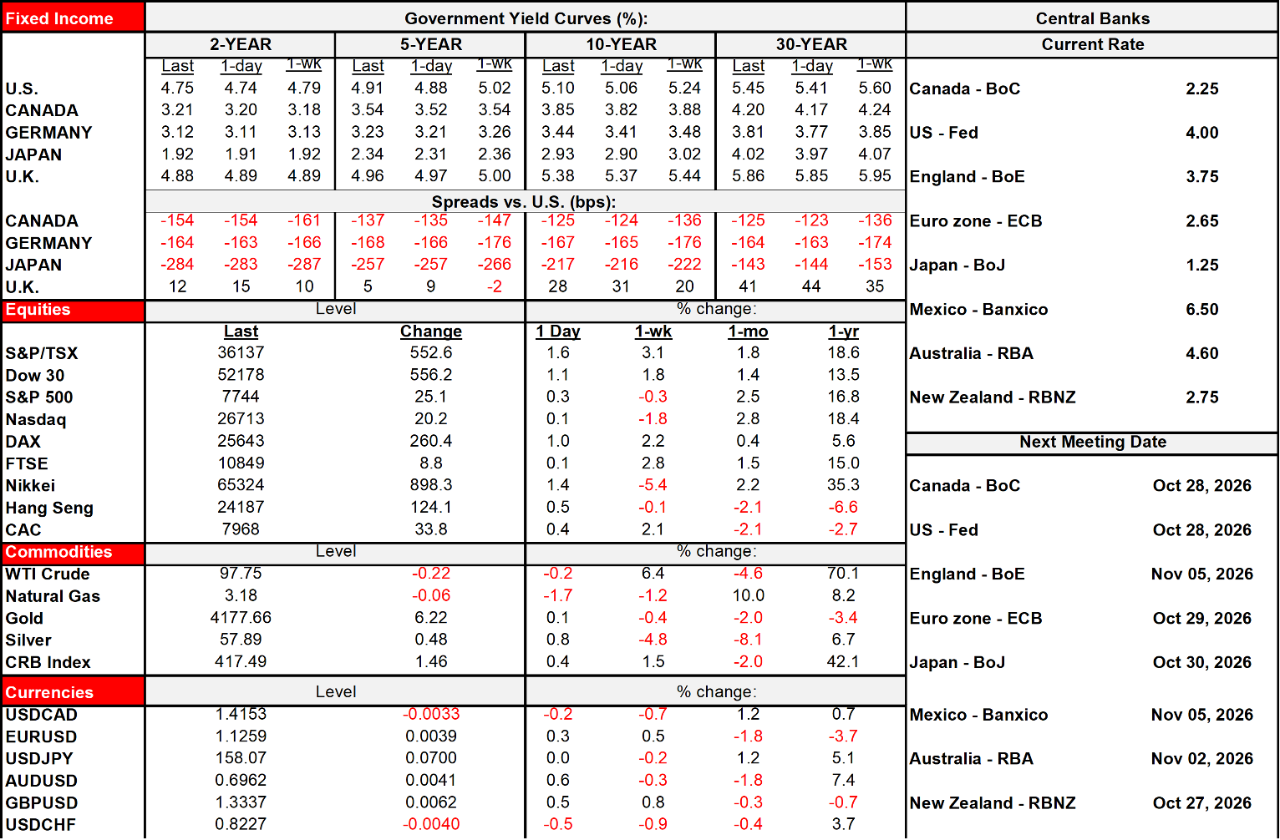
The week is ending somewhat anticlimactically in the wake of largely inconsequential remarks from the heads of the Federal Reserve and Bank of Canada. More interesting are indications that US Commerce Secretary Lutnick is doing to US-Mexico trade talks what he did to US-Canada talks. Sovereign bonds are little changed across global markets with a small degree of bear steepening as longer-term bond yields rise a few basis points everywhere. Stocks are generally higher, but not by much. The dollar is generally ending the week on softer footings against major crosses. Oil prices are up a few dimes.
Neither Warsh nor Macklem said anything consequential overnight. Literary licence was employed by anyone who heard otherwise.
WHAT FED CHAIR WARSH SAID
Warsh said nothing that would even remotely inform nearer term monetary policy considerations other than to repeat that he doesn’t believe in forward guidance into meetings. Specifically, he said: “I don’t prejudge meetings. I don’t believe in saying now what I might do at the meetings we have in the balance of this year. It’s a new chapter at the Fed, and we’re not in that business anymore.” Of course, other FOMC officials appear to think otherwise given the ongoing massive amount of Fed-speak.
Warsh stated what everyone else thinks about AI—it’s demand stimulative in the short-term, stimulates the supply side in the medium-term and he doesn’t know the net impact on jobs.
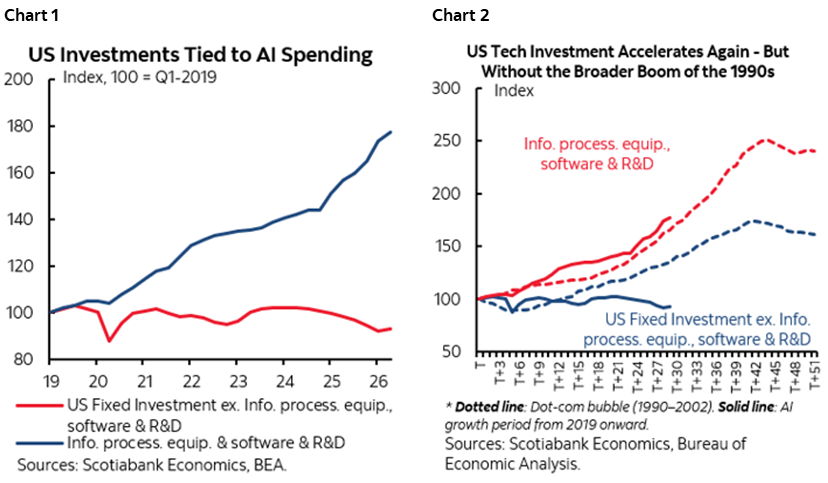
Warsh pulled out the pom poms as cheerleader in chief for the US economy with generally upbeat remarks on the outlook. One bone of contention is when he said the investment upswing isn’t just in AI; charts 1 and 2 suggest otherwise including by comparison to the dot com period.
He also noted that the first “field hearing” by one of five task forces assigned the task of opining on AI and its effects on productivity and jobs will be held in San Francisco on November 16th. You can watch his 35-minute video here.
WHAT BOC GOVERNOR MACKLEM SAID
BoC Governor Macklem said on his panel in response to a question on whether he will raise rates:
“I’m very good at not answering that question. But I will say we haven’t raised our rates yet. We’ve been looking through the increase in energy prices, but the longer this goes, the harder that gets. So, we are asking ourselves that question. Are we going to have to raise rates?”
Other than that, he opined on general AI influences and debates.
Onto next week’s CPI and BoC surveys including inflation expectations. You can watch his hour-long panel and the views of other participants from Anthropic, the IMF, and others here.
On AI, the panel and Macklem specifically spoke very generally about the potential effects. His narrative was that it is everywhere in the data. You see it in the economy, in the bond and stock markets and in trade flows. He (and Warsh) noted that we don’t talk secular stagnation anymore and Warsh noted it was an incorrect view even in the past. Macklem said that we used to talk about excess savings in the global economy but now we’re in an investment boom. On jobs, he said there will be winners and losers but that if we look at “every major wave of technology in the past, they have created more jobs than they’ve destroyed” and so far, there is no meaningful evidence of job losses.
The FOMC blackout commences tomorrow before the October 28th decision for which little chance at a hike is priced. We forecast one more hike this year, likely in December.
It’s unclear if there will be remarks from the sidelines as the IIF/IMF meetings wrap up in Bangkok.
LUTNICK TORPEDOES TRADE TALKS—AGAIN
US Commerce Secretary is doing to Mexico what he did in the final hours of talks with Canada before they broke down. This WSJ exclusive piece reports from behind the scenes on trade talks between the US and Mexico and portrays Lutnick as essentially inserting himself in a manner that once again downplays prospects for a deal to be reached.
Lutnick reportedly opposes significant cuts to the 25% tariff on imports of automobiles and 50% tariffs on imports of steel and aluminum and derivative products from Mexico. His department controls those tariffs and so he is overriding any progress there may have been among the negotiators.
President Sheinbaum has guided that the original list of 54 tariff and nontariff issues that the US brought up has been reduced to a still significant list of 12 items and clearly large tariffs remain on that list.
If there is a trade deal to be had, then Mr. Lutnick’s role in the talks will have to be diminished and presumably by Trump and before the new Congress convenes in January. At that point, the Trump administration may well be negotiating with the Democrats if they take at least one of the two chambers, given that Congress would have to approve a new CUSMA/USMCA deal.
LIGHT DATA
Other developments are very light.
Canadian existing home sales fell -2.3% m/m SA in September; we’re in the in-between period in terms of the most influential Spring housing market. Canada will also release housing starts for the month of September (8:15amET).
US industrial output is expected to register a small gain in September’s reading (9:15amET).
DISCLAIMER
This report has been prepared by Scotiabank Economics as a resource for the clients of Scotiabank. Opinions, estimates and projections contained herein are our own as of the date hereof and are subject to change without notice. The information and opinions contained herein have been compiled or arrived at from sources believed reliable but no representation or warranty, express or implied, is made as to their accuracy or completeness. Neither Scotiabank nor any of its officers, directors, partners, employees or affiliates accepts any liability whatsoever for any direct or consequential loss arising from any use of this report or its contents.
These reports are provided to you for informational purposes only. This report is not, and is not constructed as, an offer to sell or solicitation of any offer to buy any financial instrument, nor shall this report be construed as an opinion as to whether you should enter into any swap or trading strategy involving a swap or any other transaction. The information contained in this report is not intended to be, and does not constitute, a recommendation of a swap or trading strategy involving a swap within the meaning of U.S. Commodity Futures Trading Commission Regulation 23.434 and Appendix A thereto. This material is not intended to be individually tailored to your needs or characteristics and should not be viewed as a “call to action” or suggestion that you enter into a swap or trading strategy involving a swap or any other transaction. Scotiabank may engage in transactions in a manner inconsistent with the views discussed this report and may have positions, or be in the process of acquiring or disposing of positions, referred to in this report.
Scotiabank, its affiliates and any of their respective officers, directors and employees may from time to time take positions in currencies, act as managers, co-managers or underwriters of a public offering or act as principals or agents, deal in, own or act as market makers or advisors, brokers or commercial and/or investment bankers in relation to securities or related derivatives. As a result of these actions, Scotiabank may receive remuneration. All Scotiabank products and services are subject to the terms of applicable agreements and local regulations. Officers, directors and employees of Scotiabank and its affiliates may serve as directors of corporations.
Any securities discussed in this report may not be suitable for all investors. Scotiabank recommends that investors independently evaluate any issuer and security discussed in this report, and consult with any advisors they deem necessary prior to making any investment.
This report and all information, opinions and conclusions contained in it are protected by copyright. This information may not be reproduced without the prior express written consent of Scotiabank.
™ Trademark of The Bank of Nova Scotia. Used under license, where applicable.
Scotiabank, together with “Global Banking and Markets”, is a marketing name for the global corporate and investment banking and capital markets businesses of The Bank of Nova Scotia and certain of its affiliates in the countries where they operate, including; Scotiabank Europe plc; Scotiabank (Ireland) Designated Activity Company; Scotiabank Inverlat S.A., Institución de Banca Múltiple, Grupo Financiero Scotiabank Inverlat, Scotia Inverlat Casa de Bolsa, S.A. de C.V., Grupo Financiero Scotiabank Inverlat, Scotia Inverlat Derivados S.A. de C.V. – all members of the Scotiabank group and authorized users of the Scotiabank mark. The Bank of Nova Scotia is incorporated in Canada with limited liability and is authorised and regulated by the Office of the Superintendent of Financial Institutions Canada. The Bank of Nova Scotia is authorized by the UK Prudential Regulation Authority and is subject to regulation by the UK Financial Conduct Authority and limited regulation by the UK Prudential Regulation Authority. Details about the extent of The Bank of Nova Scotia's regulation by the UK Prudential Regulation Authority are available from us on request. Scotiabank Europe plc is authorized by the UK Prudential Regulation Authority and regulated by the UK Financial Conduct Authority and the UK Prudential Regulation Authority.
Scotiabank Inverlat, S.A., Scotia Inverlat Casa de Bolsa, S.A. de C.V, Grupo Financiero Scotiabank Inverlat, and Scotia Inverlat Derivados, S.A. de C.V., are each authorized and regulated by the Mexican financial authorities.
Not all products and services are offered in all jurisdictions. Services described are available in jurisdictions where permitted by law.
DISCLAIMER
This report has been prepared by Scotiabank Economics as a resource for the clients of Scotiabank. Opinions, estimates and projections contained herein are our own as of the date hereof and are subject to change without notice. The information and opinions contained herein have been compiled or arrived at from sources believed reliable but no representation or warranty, express or implied, is made as to their accuracy or completeness. Neither Scotiabank nor any of its officers, directors, partners, employees or affiliates accepts any liability whatsoever for any direct or consequential loss arising from any use of this report or its contents.
These reports are provided to you for informational purposes only. This report is not, and is not constructed as, an offer to sell or solicitation of any offer to buy any financial instrument, nor shall this report be construed as an opinion as to whether you should enter into any swap or trading strategy involving a swap or any other transaction. The information contained in this report is not intended to be, and does not constitute, a recommendation of a swap or trading strategy involving a swap within the meaning of U.S. Commodity Futures Trading Commission Regulation 23.434 and Appendix A thereto. This material is not intended to be individually tailored to your needs or characteristics and should not be viewed as a “call to action” or suggestion that you enter into a swap or trading strategy involving a swap or any other transaction. Scotiabank may engage in transactions in a manner inconsistent with the views discussed this report and may have positions, or be in the process of acquiring or disposing of positions, referred to in this report.
Scotiabank, its affiliates and any of their respective officers, directors and employees may from time to time take positions in currencies, act as managers, co-managers or underwriters of a public offering or act as principals or agents, deal in, own or act as market makers or advisors, brokers or commercial and/or investment bankers in relation to securities or related derivatives. As a result of these actions, Scotiabank may receive remuneration. All Scotiabank products and services are subject to the terms of applicable agreements and local regulations. Officers, directors and employees of Scotiabank and its affiliates may serve as directors of corporations.
Any securities discussed in this report may not be suitable for all investors. Scotiabank recommends that investors independently evaluate any issuer and security discussed in this report, and consult with any advisors they deem necessary prior to making any investment.
This report and all information, opinions and conclusions contained in it are protected by copyright. This information may not be reproduced without the prior express written consent of Scotiabank.
™ Trademark of The Bank of Nova Scotia. Used under license, where applicable.
Scotiabank, together with “Global Banking and Markets”, is a marketing name for the global corporate and investment banking and capital markets businesses of The Bank of Nova Scotia and certain of its affiliates in the countries where they operate, including; Scotiabank Europe plc; Scotiabank (Ireland) Designated Activity Company; Scotiabank Inverlat S.A., Institución de Banca Múltiple, Grupo Financiero Scotiabank Inverlat, Scotia Inverlat Casa de Bolsa, S.A. de C.V., Grupo Financiero Scotiabank Inverlat, Scotia Inverlat Derivados S.A. de C.V. – all members of the Scotiabank group and authorized users of the Scotiabank mark. The Bank of Nova Scotia is incorporated in Canada with limited liability and is authorised and regulated by the Office of the Superintendent of Financial Institutions Canada. The Bank of Nova Scotia is authorized by the UK Prudential Regulation Authority and is subject to regulation by the UK Financial Conduct Authority and limited regulation by the UK Prudential Regulation Authority. Details about the extent of The Bank of Nova Scotia's regulation by the UK Prudential Regulation Authority are available from us on request. Scotiabank Europe plc is authorized by the UK Prudential Regulation Authority and regulated by the UK Financial Conduct Authority and the UK Prudential Regulation Authority.
Scotiabank Inverlat, S.A., Scotia Inverlat Casa de Bolsa, S.A. de C.V, Grupo Financiero Scotiabank Inverlat, and Scotia Inverlat Derivados, S.A. de C.V., are each authorized and regulated by the Mexican financial authorities.
Not all products and services are offered in all jurisdictions. Services described are available in jurisdictions where permitted by law.