

ON DECK FOR THURSDAY, OCTOBER 15th
KEY POINTS:
- Is this the great rotation back into bonds, or a mere hiccup?
- US producer prices to inform PCE tracking
- US retail sales face a tough act to follow
- US lumber tariffs raise US housing costs
- Will Fed’s Warsh say anything helpful tonight?
- Light Canadian manufacturing, wholesale data
- Aussie yields drop on lost part-time jobs
- Gilts, sterling yawned at UK data
Is this the asset allocation pivot we’ve been warning about or merely a flash in the pan?
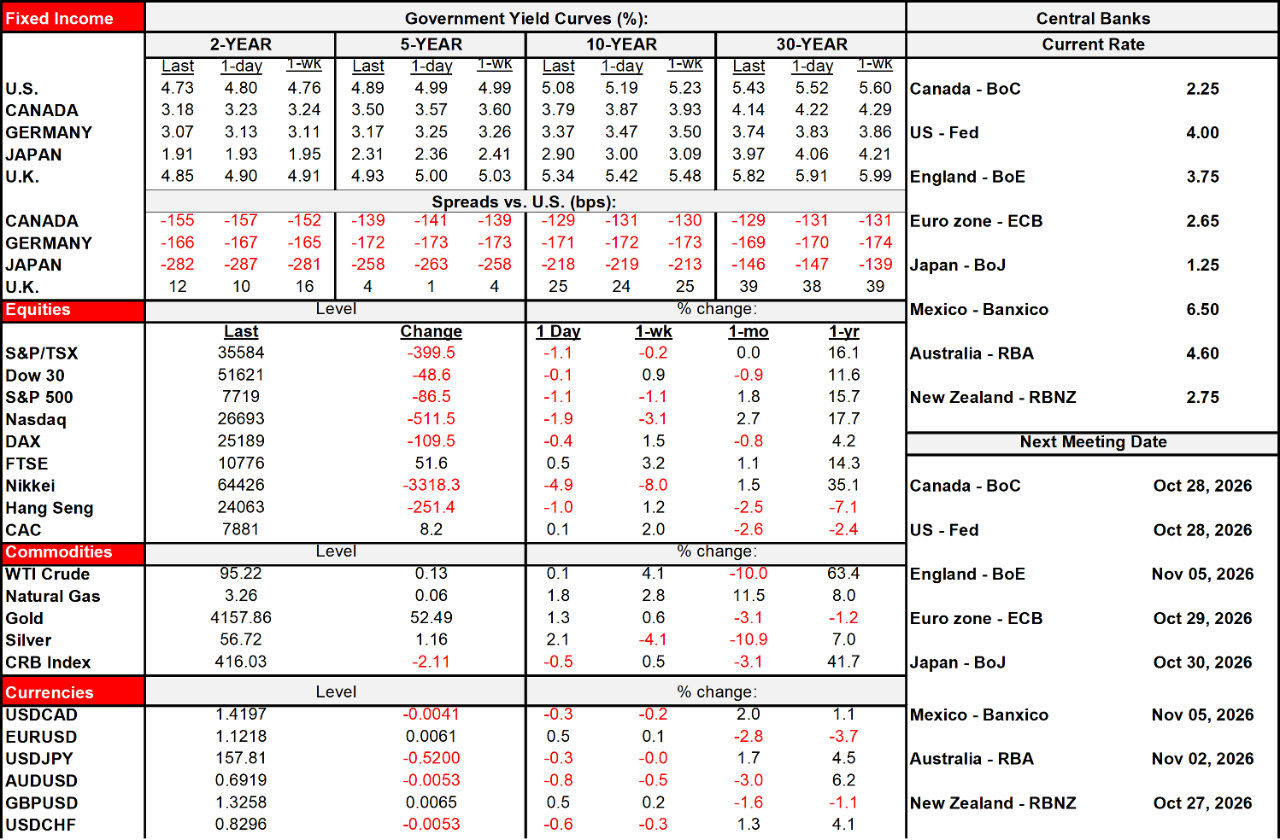
The answer isn’t clear, but we’re set up for another day on which sovereign bonds are rallying while equities waver. US Treasury yields are down by 6–10bps across the curve in a bull flattener move. The US 10-year yield is 22bps below the peak ten days ago. Canada’s curve is also rallying by 5–8bps. European yields are performing in generally similar fashion. Aussie yields plunged post-jobs (see below). JGBs and kiwi bonds also rallied overnight. All of this is despite yesterday’s US CPI reading (recap here) but somewhat compatible with slightly lower oil prices led by a buck decline in Brent.
Meanwhile stocks are teetering toward general softness today. US equity futures are down by between ¼% (S&P) and over 1% (Nasdaq). TSX futures are holding steady. European cash markets are mixed with declines in Germany and Italy, little change in Paris and a mild gain in London. Currencies are mixed.
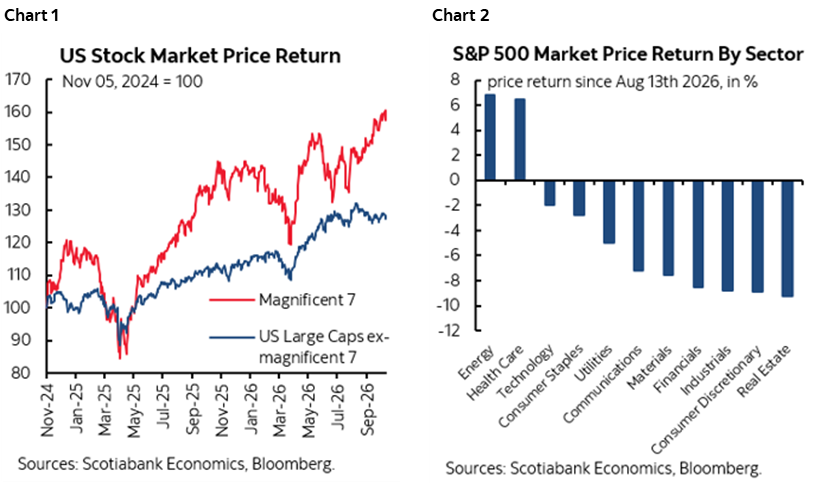
Interestingly it’s not the richly valued Mag7 that are weighing on the S&P (chart 1)––it’s everything else. Since stocks ex-Mag7 began softening after August 13th, only energy and health care have been up while all other sectors have been lower (chart 2).
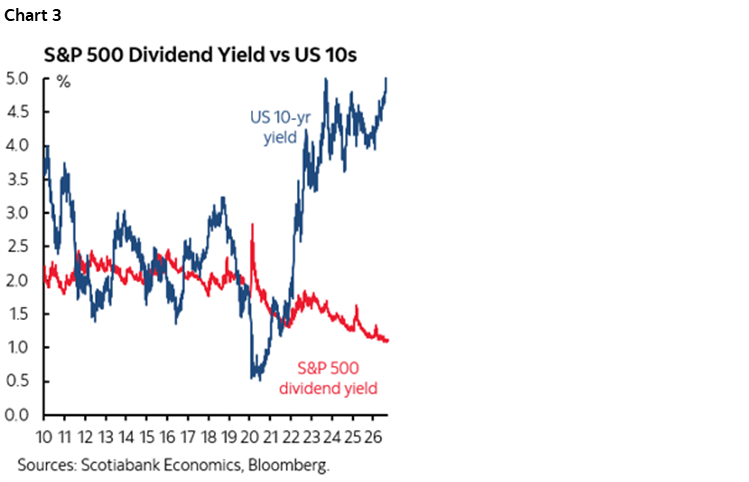
My weekly offered numerous equity valuation charts to argue that stocks were dear relative to cheap bonds including chart 3 showing the widest spread between the US 10s yield and the S&P dividend yield in decades. It’s the Benjamin Graham or sometimes called Fed model approach.
US PPI TO FIRM UP PCE TRACKING
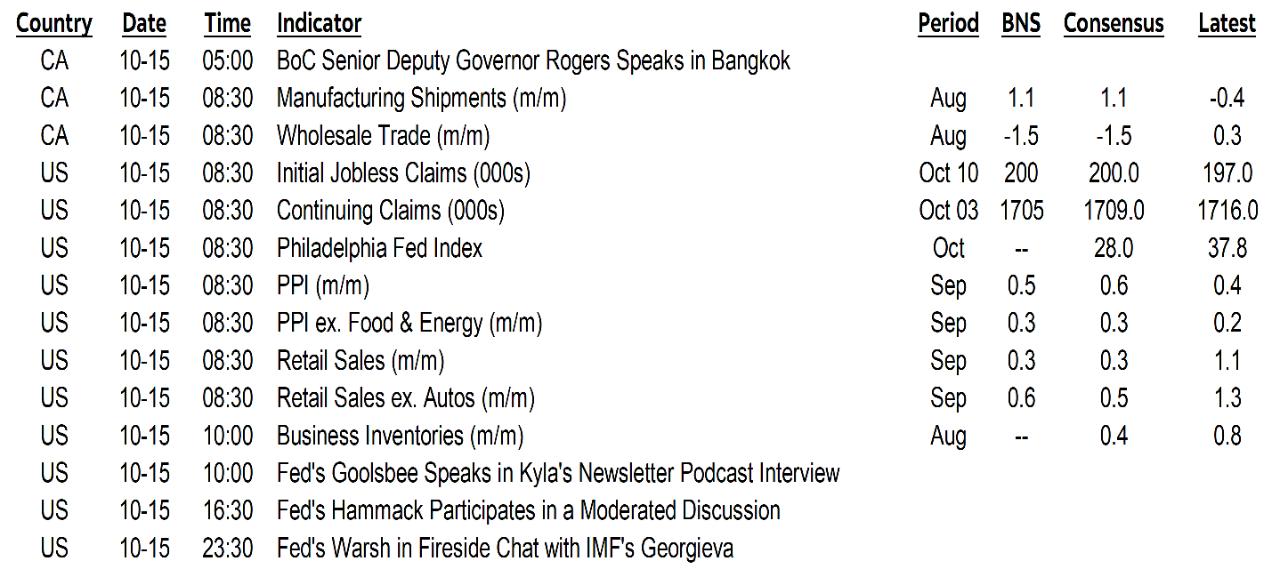
US producer prices will further inform estimated PCE inflation. Violent position covering subsequently reined in much of yesterday’s initial response to CPI. Total producer prices are expected to rise by 0.6% m/m SA with prices ex-food and energy up 0.3%.
Key will be the categories within PPI that are included in the Fed’s historically preferred PCE measure of inflation. They were collectively light in August’s readings and had no net influence on core PCE for that month as a sharp rise in airline passenger service prices was offset by declines in other prices like portfolio management services.
US CONSUMERS MIGHT TAKE A BREATHER
US retail sales may struggle in the wake of August’s large 1%+ gains across headline, core and control group readings. One reason is that auto sales fell by 4.7% m/m SA in September, but this could be offset by the weighted impact of higher gasoline prices since the figures are reported in nominal terms.
The US also refreshes jobless claims (8:30amET) and the Empire gauge of manufacturing activity that kicks off the regional measures on the path to the next ISM-manufacturing print (8:30amET).
FED’S WARSH––WILL HE SAY ANYTHING USEFUL?
Key could be how the day ends late at night when Chair Warsh speaks from Bangkok (11:30pmET). He says he doesn’t care about recent data, yet he’s also very backward oriented in terms of his views and refuses to offer his own forecasts. I’m doubtful he’ll provide any clarity but feel his communications have been highly erratic on core matters and therefore anything could happen.
US LUMBER TARIFFS RAISE US HOUSING COSTS
Trump’s assault on Canada was resurrected yesterday. 51st state nonsense and general political interference in Canada’s sovereign affairs were resurrected along with disparaging comments on Canada. When you steadily challenge another nation’s sovereign status, turnabout is fair play. Trump also hit Americans in the pocketbook with lumber tariffs in tone deaf fashion toward affordability challenges.
The US tariff against Canadian softwood lumber was set at 35%, down from 45% over a year ago but still absurdly protectionist. The US government is working against housing affordability in the US by a) driving up raw materials costs like tariffs on lumber, b) pursuing fiscal policies that raise bond yields and mortgage rates, and c) by pursuing overly restrictive immigration policy. Policy that is genuinely concerned about affordability challenges facing everyday Americans would a) sweep away tariffs, b) settle the botched Iran war one way or the other, and c) create a credible fiscal plan.
LIGHT CANADIAN DATA
Canada watchers face light data that may moderately enhance GDP tracking. Mixed August readings for manufacturing and wholesale are expected for the month of August (8:30amET). Manufacturing sales were previously guided to be up by over 1% m/m in nominal terms, but wholesale sales were guided to be down by over 1%, both based on partial samples.
AUSTRALIAN YIELDS PLUMMET AFTER JOB LOSS
Australia lost 39,300 jobs in September entirely in part-time positions (-73.7k) as full-time employment was up 34.4k. The participation rate fell three-tenths to 66.8% and the unemployment rate edged up a tick to 4.7%. The trade deficit sharply narrowed mainly as imports fell (-1.5% m/m) and exports were flat (0.1%) after a strong prior gain of 2%.
GILTS, STERLING YAWN AT UK DATA BEATS
The UK economy beat expectations again through a batch of August readings, but sterling and gilts had other things on their minds this morning as they largely ignored the lagging readings. GDP was up 0.1% (consensus -0.1%). Industrial output led the way (0.8%, -0.1% consensus) including manufacturing (1.2%, 0% consensus). Services were flat (consensus -0.1%). Construction output fell -0.2% (consensus 0%).
DISCLAIMER
This report has been prepared by Scotiabank Economics as a resource for the clients of Scotiabank. Opinions, estimates and projections contained herein are our own as of the date hereof and are subject to change without notice. The information and opinions contained herein have been compiled or arrived at from sources believed reliable but no representation or warranty, express or implied, is made as to their accuracy or completeness. Neither Scotiabank nor any of its officers, directors, partners, employees or affiliates accepts any liability whatsoever for any direct or consequential loss arising from any use of this report or its contents.
These reports are provided to you for informational purposes only. This report is not, and is not constructed as, an offer to sell or solicitation of any offer to buy any financial instrument, nor shall this report be construed as an opinion as to whether you should enter into any swap or trading strategy involving a swap or any other transaction. The information contained in this report is not intended to be, and does not constitute, a recommendation of a swap or trading strategy involving a swap within the meaning of U.S. Commodity Futures Trading Commission Regulation 23.434 and Appendix A thereto. This material is not intended to be individually tailored to your needs or characteristics and should not be viewed as a “call to action” or suggestion that you enter into a swap or trading strategy involving a swap or any other transaction. Scotiabank may engage in transactions in a manner inconsistent with the views discussed this report and may have positions, or be in the process of acquiring or disposing of positions, referred to in this report.
Scotiabank, its affiliates and any of their respective officers, directors and employees may from time to time take positions in currencies, act as managers, co-managers or underwriters of a public offering or act as principals or agents, deal in, own or act as market makers or advisors, brokers or commercial and/or investment bankers in relation to securities or related derivatives. As a result of these actions, Scotiabank may receive remuneration. All Scotiabank products and services are subject to the terms of applicable agreements and local regulations. Officers, directors and employees of Scotiabank and its affiliates may serve as directors of corporations.
Any securities discussed in this report may not be suitable for all investors. Scotiabank recommends that investors independently evaluate any issuer and security discussed in this report, and consult with any advisors they deem necessary prior to making any investment.
This report and all information, opinions and conclusions contained in it are protected by copyright. This information may not be reproduced without the prior express written consent of Scotiabank.
™ Trademark of The Bank of Nova Scotia. Used under license, where applicable.
Scotiabank, together with “Global Banking and Markets”, is a marketing name for the global corporate and investment banking and capital markets businesses of The Bank of Nova Scotia and certain of its affiliates in the countries where they operate, including; Scotiabank Europe plc; Scotiabank (Ireland) Designated Activity Company; Scotiabank Inverlat S.A., Institución de Banca Múltiple, Grupo Financiero Scotiabank Inverlat, Scotia Inverlat Casa de Bolsa, S.A. de C.V., Grupo Financiero Scotiabank Inverlat, Scotia Inverlat Derivados S.A. de C.V. – all members of the Scotiabank group and authorized users of the Scotiabank mark. The Bank of Nova Scotia is incorporated in Canada with limited liability and is authorised and regulated by the Office of the Superintendent of Financial Institutions Canada. The Bank of Nova Scotia is authorized by the UK Prudential Regulation Authority and is subject to regulation by the UK Financial Conduct Authority and limited regulation by the UK Prudential Regulation Authority. Details about the extent of The Bank of Nova Scotia's regulation by the UK Prudential Regulation Authority are available from us on request. Scotiabank Europe plc is authorized by the UK Prudential Regulation Authority and regulated by the UK Financial Conduct Authority and the UK Prudential Regulation Authority.
Scotiabank Inverlat, S.A., Scotia Inverlat Casa de Bolsa, S.A. de C.V, Grupo Financiero Scotiabank Inverlat, and Scotia Inverlat Derivados, S.A. de C.V., are each authorized and regulated by the Mexican financial authorities.
Not all products and services are offered in all jurisdictions. Services described are available in jurisdictions where permitted by law.