

ON DECK FOR WEDNESDAY, OCTOBER 14th
KEY POINTS:
- Markets are in a good place before US CPI
- US CPI––A mere placeholder
- Macklem’s overnight comments offered very little
- New rates forecasts include an additional BoC hike totalling 100bps…
- …and reinsurance on the Fed’s minimalist insurance hikes
- US financials post mixed results
- China’s trade figures mushroomed, PBOC continues to fail to hit its inflation target
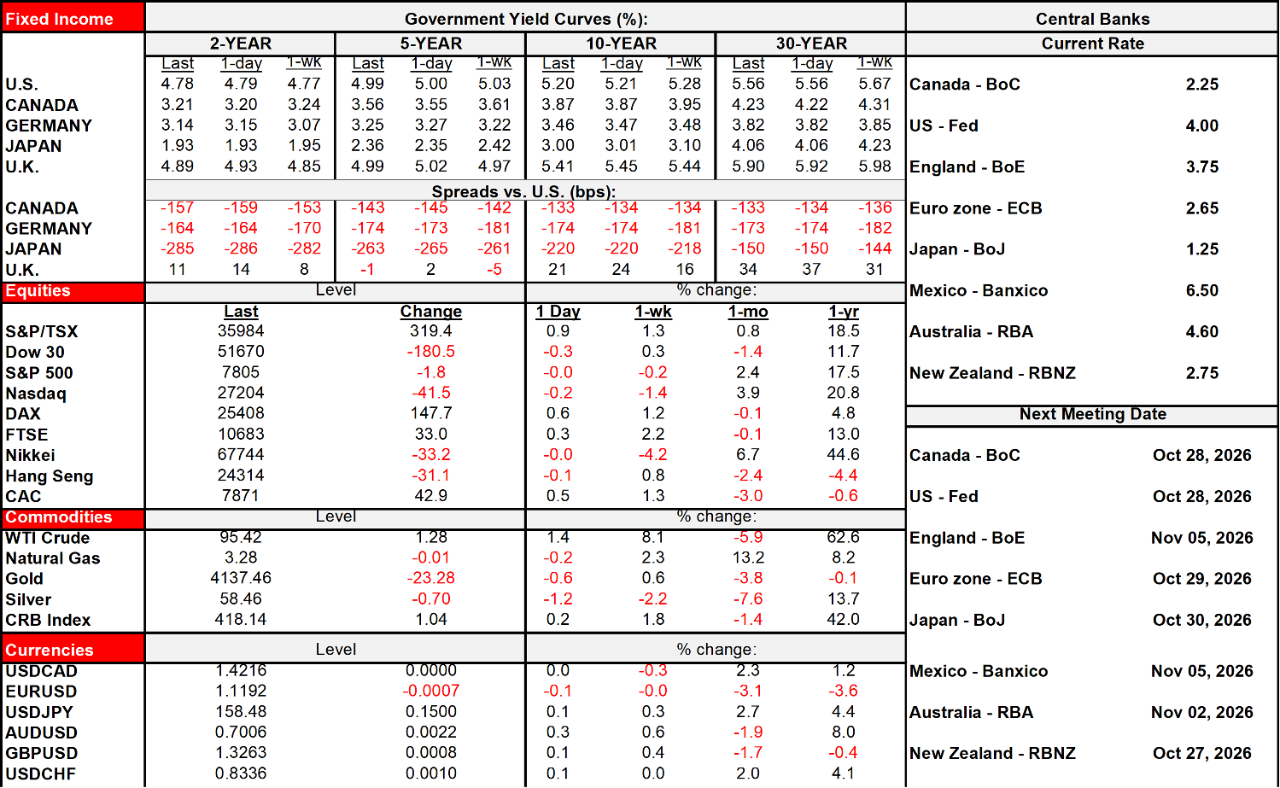
It could spin on a dime after US CPI, but for now, global markets are in a generally good place to start the trading day. Stocks are up from about ¼% in N.A. futures to as much as ¾% across Europe. Sovereign bond yields are under mild downward pressure. FX land is little changed relative to the USD. Oil prices are up by around 1%.
Today’s three main focal points include a) Macklem comments overnight, b) US CPI, and c) US bank earnings. We might also start to get very preliminary advance polling turnout (not results) from Alberta’s week-long referenda.
NEW RATES FORECASTS
We have issued fresh rates forecasts for Canada and the US. They are shown in the accompanying table and charts 1–2 and represent the Scotiabank Economics house view.

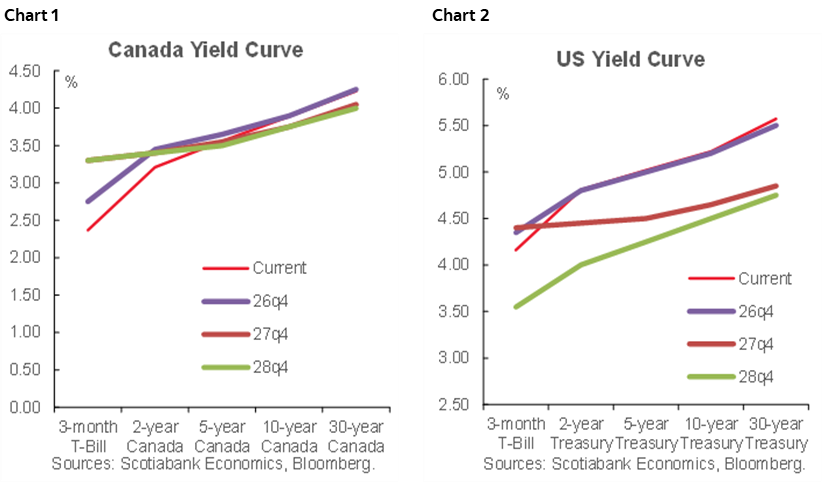
BoC: We’re forecasting a hike this quarter as soon as the October 28th decision or in December followed by 75bps of additional increases totalling 100bps. The terminal rate is projected to be 3.25% which is 25bps higher than previously forecast but as previously guided in presentations and client meetings. That would still leave policy barely within or slightly outside of the nominal neutral rate range with a real policy rate that turns meaningfully positive. Greater upside growth potential has been moderated by further forecast policy tightening.
FOMC: We’re forecasting two more rate hikes to a fed funds target rate of 4.5% including one more increase likely in December followed by one more hike in 2027Q1 and then flat at the terminal rate over the rest of 2027. Call it reinsurance on the Fed’s insurance hikes because raising the policy rate by just 25-50bps would accomplish very little in terms of the lagging effects on growth and inflation. We view 4.5% as meaningfully restrictive and a policy overshoot that we take back as soon as late next year or starting in 2028.
Yield curves: The US yield curve is likely undervalued in absolute terms and relative to the Canadian yield curve that is too dear in our view. We forecast the BoC’s current -175bps
policy rate spread to narrow to about 100bps below the Fed. That should drive some yield curve convergence. Yield curves begin to show relief over 2027 as we forecast a bending of the AI curve and hyperscaler issuance, ongoing pressures from government debt issuance, ebbing inflation risk, cooler US growth and upside risk to our Canadian forecasts for growth and inflation.
BOC’S MACKLEM DIDN’T SAY MUCH
BoC Governor Macklem’s comments during his short fireside chat at the IIF meeting in Bangkok a few hours ago were kind of a dud.
He said nothing about monetary policy. Nothing about the job market. He just commented on stretched equity valuations (see my weekly for various measures) and that every central bank is worried about the Middle East conflict and price pass through. A full transcript is unavailable but a video link is to be made available.
Macklem speaks again on Friday. Today was a more open Q&A. Friday’s appearance is supposed to be more about AI. On that issue, Canada is seeing explosive investments in data centers now with about 300 of them which is about 6% of the total number in the US and slightly below what would be proportionate in terms of relative market sizes (here). It’s going on nationwide, but Alberta is likely to lead going forward.
Macklem’s appearance will disappoint anyone expecting any updated remarks since the hawkish September 2nd press conference and his September 21st presser when he sounded hawkish on inflation, dovish on Q4 GDP growth and skipped right over Q3 resilience.
What is that new information? Canadian core inflation measures were quite warm on September 14th. Or consider GDP that’s tracking 2% in Q3 after the August 0.2% m/m ‘flash’ estimate last month. Hours worked were up sharply in Q3 as more hours substituted for fewer bodies. Note that the BoC released a short note on demographics and curtailed labour supply the day before the job numbers. Or note the resumption of energy market tensions since the last decision, including higher WTI and especially higher Brent that affects the east coast projects. Macklem won’t reveal the results this week, but he will probably also have in his head the outcome of the latest Q3 business and consumer surveys that will probably follow the CFIB measure of inflation expectations higher. He’s a tad cagey so the balance he strikes between all of these readings isn’t certain but if I were him, I wouldn’t spend two seconds on the jobs reading as argued in three separate publications and would instead focus instead on GDP, closing slack, inflation tracking and inflation risk.
US CPI––A MERE PLACEHOLDER
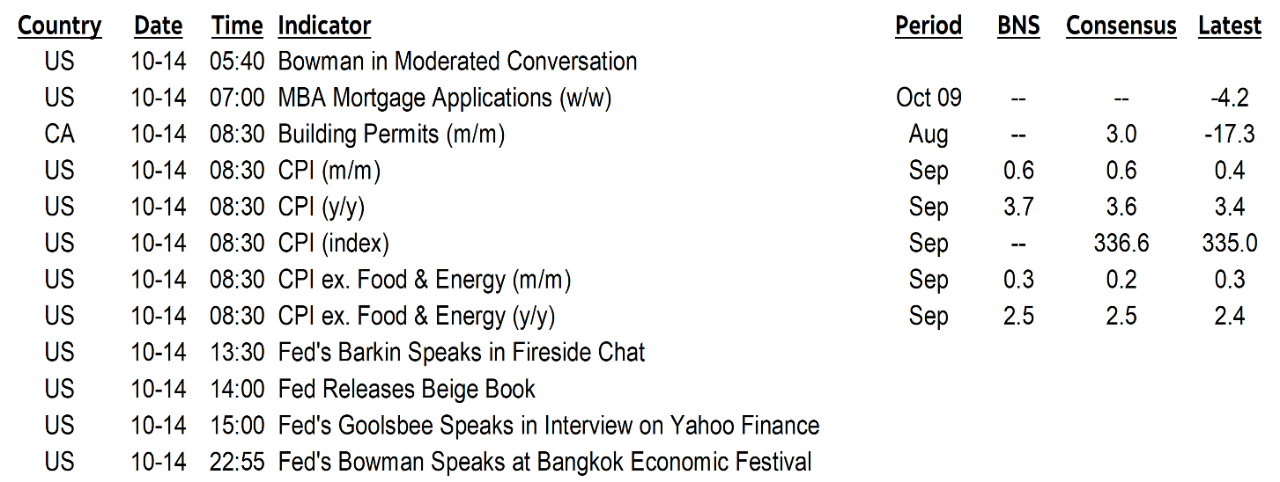
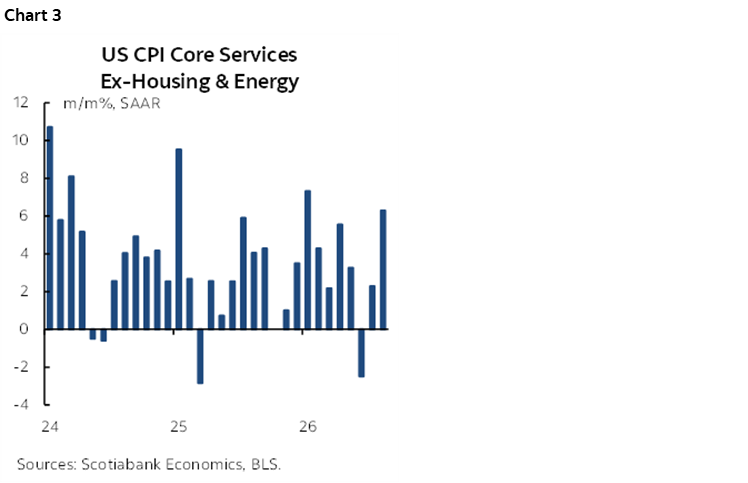
Scotia’s house estimates for US CPI in September (8:30amET) are 0.6% m/m for total CPI (0.6% consensus) and 0.3% m/m for core CPI (0.2% consensus). Those could lift the y/y rates to 3.7% from 3.4% (3.6% consensus) and 2.5% from 2.4% (2.5% consensus) for headline and core respectively. See my weekly for more of an explanation of the drivers. Key may be whether core services inflation repeats (chart 3).
Key will be translating the core CPI implications for core PCE alongside the producer price flow through into PCE when we get those numbers tomorrow.
Still, as argued in my weekly, these numbers probably won’t matter to the FOMC that has generally signalled they’ll skip in October and await further information at the December decision.
US FINANCIALS POST MIXED RESULTS
BofA, Morgan Stanley, BlackRock and State Street all release in the pre-market. Chart 4.
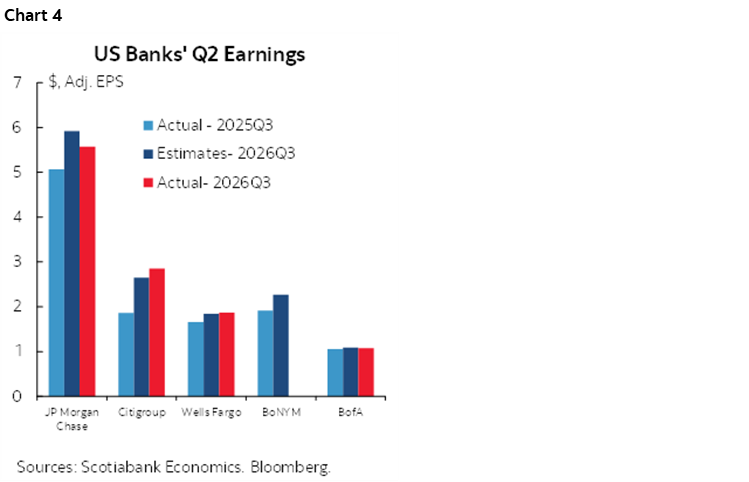
Bank of America registered adjusted EPS of US$1.08 (consensus $1.09). FICC and equity trading revenues both disappointed but investment banking and wealth revenues slightly beat while they paid employees less than expected.
BlackRock posted adjusted EPS of US$15.93 (consensus $14.15) along with a revenue beat.
Morgan Stanley and State Street are pending as this note is being distributed.
CHINA TRADE MUSHROOMED
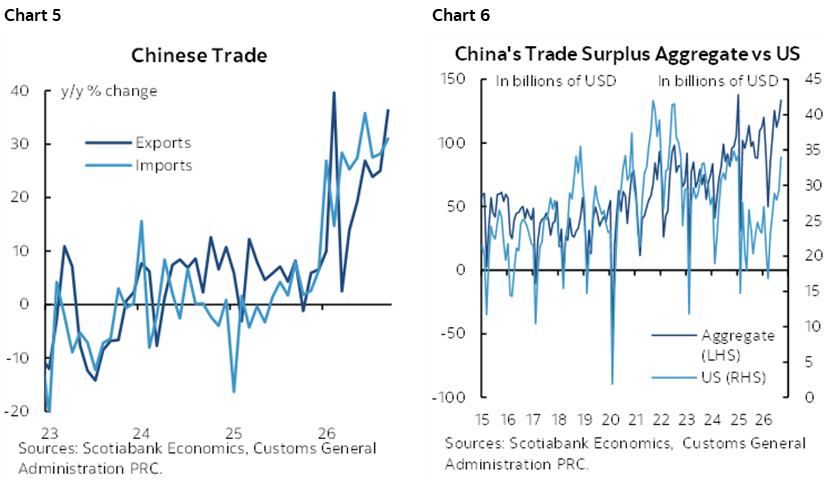
China’s trade figures blossomed in September (chart 5). Exports were up 36% y/y in dollar terms (consensus 26%) and 30% in yuan terms. Imports were up 31% y/y (consensus 25%) and 25% in yuan terms. The surplus with the US increased and has been reversing the narrowing pattern that unfolded during the early part of Trump 2.0 (chart 6).
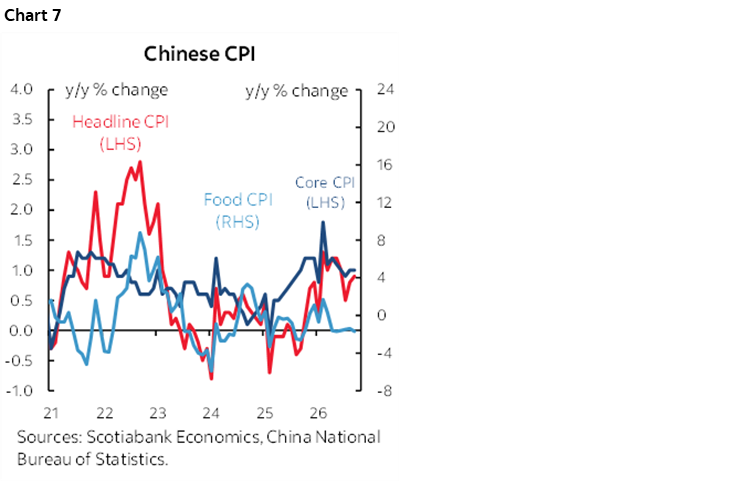
The PBOC continues to fail to achieve its inflation goal with CPI landing at 0.9% y/y in September and core CPI at just 1%. This is one central bank that couldn’t care less about its inflation target as it is serially too high relative to reality (chart 7).
DISCLAIMER
This report has been prepared by Scotiabank Economics as a resource for the clients of Scotiabank. Opinions, estimates and projections contained herein are our own as of the date hereof and are subject to change without notice. The information and opinions contained herein have been compiled or arrived at from sources believed reliable but no representation or warranty, express or implied, is made as to their accuracy or completeness. Neither Scotiabank nor any of its officers, directors, partners, employees or affiliates accepts any liability whatsoever for any direct or consequential loss arising from any use of this report or its contents.
These reports are provided to you for informational purposes only. This report is not, and is not constructed as, an offer to sell or solicitation of any offer to buy any financial instrument, nor shall this report be construed as an opinion as to whether you should enter into any swap or trading strategy involving a swap or any other transaction. The information contained in this report is not intended to be, and does not constitute, a recommendation of a swap or trading strategy involving a swap within the meaning of U.S. Commodity Futures Trading Commission Regulation 23.434 and Appendix A thereto. This material is not intended to be individually tailored to your needs or characteristics and should not be viewed as a “call to action” or suggestion that you enter into a swap or trading strategy involving a swap or any other transaction. Scotiabank may engage in transactions in a manner inconsistent with the views discussed this report and may have positions, or be in the process of acquiring or disposing of positions, referred to in this report.
Scotiabank, its affiliates and any of their respective officers, directors and employees may from time to time take positions in currencies, act as managers, co-managers or underwriters of a public offering or act as principals or agents, deal in, own or act as market makers or advisors, brokers or commercial and/or investment bankers in relation to securities or related derivatives. As a result of these actions, Scotiabank may receive remuneration. All Scotiabank products and services are subject to the terms of applicable agreements and local regulations. Officers, directors and employees of Scotiabank and its affiliates may serve as directors of corporations.
Any securities discussed in this report may not be suitable for all investors. Scotiabank recommends that investors independently evaluate any issuer and security discussed in this report, and consult with any advisors they deem necessary prior to making any investment.
This report and all information, opinions and conclusions contained in it are protected by copyright. This information may not be reproduced without the prior express written consent of Scotiabank.
™ Trademark of The Bank of Nova Scotia. Used under license, where applicable.
Scotiabank, together with “Global Banking and Markets”, is a marketing name for the global corporate and investment banking and capital markets businesses of The Bank of Nova Scotia and certain of its affiliates in the countries where they operate, including; Scotiabank Europe plc; Scotiabank (Ireland) Designated Activity Company; Scotiabank Inverlat S.A., Institución de Banca Múltiple, Grupo Financiero Scotiabank Inverlat, Scotia Inverlat Casa de Bolsa, S.A. de C.V., Grupo Financiero Scotiabank Inverlat, Scotia Inverlat Derivados S.A. de C.V. – all members of the Scotiabank group and authorized users of the Scotiabank mark. The Bank of Nova Scotia is incorporated in Canada with limited liability and is authorised and regulated by the Office of the Superintendent of Financial Institutions Canada. The Bank of Nova Scotia is authorized by the UK Prudential Regulation Authority and is subject to regulation by the UK Financial Conduct Authority and limited regulation by the UK Prudential Regulation Authority. Details about the extent of The Bank of Nova Scotia's regulation by the UK Prudential Regulation Authority are available from us on request. Scotiabank Europe plc is authorized by the UK Prudential Regulation Authority and regulated by the UK Financial Conduct Authority and the UK Prudential Regulation Authority.
Scotiabank Inverlat, S.A., Scotia Inverlat Casa de Bolsa, S.A. de C.V, Grupo Financiero Scotiabank Inverlat, and Scotia Inverlat Derivados, S.A. de C.V., are each authorized and regulated by the Mexican financial authorities.
Not all products and services are offered in all jurisdictions. Services described are available in jurisdictions where permitted by law.