

ON DECK FOR MONDAY, NOVEMBER 9th

KEY POINTS:
- Risk-on as AI trade rebounds despite Nvidia’s troubling romance
- Oil down again in lose-lose situation for US-Israeli coalition
- NZ election tentatively buoys the NZ$
- The PBOC’s inflation target is pointless
- China formalizes temporary deescalation of trade war with US
- German trade rebounds
- Mexican CPI surprises a touch higher
- Fed-speak to react to nonfarm on eve of CPI
- Philippines peso sinks on GDP miss, ignores Canada deal
- Otherwise quiet N.A. calendars
- Global Week Ahead—It Won’t be Lame (reminder here)
Stocks are broadly higher partly as the AI trade rebounds and oil prices continue to slide in the wake of a solid nonfarm payrolls reading (recap here). With any luck, US CPI won’t ruin it all tomorrow with core expected to be up 0.3% m/m SA (consensus 0.2%).
US futures are up by around ½% including Nasdaq futures as the AI trade rebounds despite Nvidia’s troubling romance that has its stock down in the pre-market. TSX futures are also up by about ¾%. European cash markets are rallying by between ¾% and 2%.
Sovereign bond yields are mixed with Treasury yields flat, gilts and EGBs slightly richer, and Key Asian curves ending the overnight session a touch cheaper.
The USD is broadly softer against all majors. The biggest outliers are the won (recovering AI-trade), the Philippine peso (big miss on GDP) and the NZ$ (election results).
OIL DOWN ON AS IRANIAN REGIME IS APPEARING VICTORIOUS
It’s lose-lose for the Trump administration in Iran which presents an awkward combination of lower energy prices accompanied by political defeat. Trump punctuated this assessment by stating that attacking Iran is “highly unlikely.”
Do nothing further against Iran, and you’ve achieved nothing since February. Iran’s regime is still in place, it still retains enriched uranium, it continues to develop nuclear technology, it retains large stockpiles of missiles and drones that it is growing, and it retains plenty of friends in low places.
Yet the US administration can’t do much for two reasons. It may be losing its Israeli partner given that President Herzog asked Gadi Eisenkot to attempt to piece together a fragile coalition government that could include Arab party partners, though success against incumbent PM Netanyahu is not assured. Several weeks of uncertainty may lie ahead.
Further, the US will to escalate the war against Iran is weak, given political realities after a drubbing in the midterms and the party’s future by 2028 heavily in doubt.
Lower gas prices may await, but America may have lost another conflict against an inferior foe in what has amounted to a totally botched conflict from the beginning. The outlook for energy prices is uncertain amid a Middle East situation that has been worsened by a thoroughly mismanaged war and with Iran holding all the cards in any negotiations including over such matters as the future of the Strait of Hormuz.
MOSTLY QUIET N.A. CALENDARS
A wave of weekly Fed-speak starts with Vice Chair Bowman (8:40amET), then Chicago’s Goolsbee and Richmond’s Barkin (12:15pmET). Reaction to nonfarm payrolls will be a focus but may be tempered on the eve of fresh inflation figures due out tomorrow.
Mexican CPI slightly surprised higher in October (0.65% m/m, 0.56% consensus). The fact that Mexico releases CPI on a bi-weekly basis makes a monthly surprise somewhat rare. Core CPI was in line at 0.32% m/m.
Otherwise, the US and Canadian calendars will be quiet today.
THE PBOC’S INFLATION TARGET IS A JOKE
China’s rate of inflation moved a touch lower in October. Total CPI was up by only 0.7% y/y (0.9% prior, 0.8% consensus). Core CPI was up 0.8% y/y (1.0% prior, 0.9% consensus). In month-over-month seasonally unadjusted terms (as per convention), core CPI was little changed and hence a little lower than typical when comparing like months of October over history (chart 1).
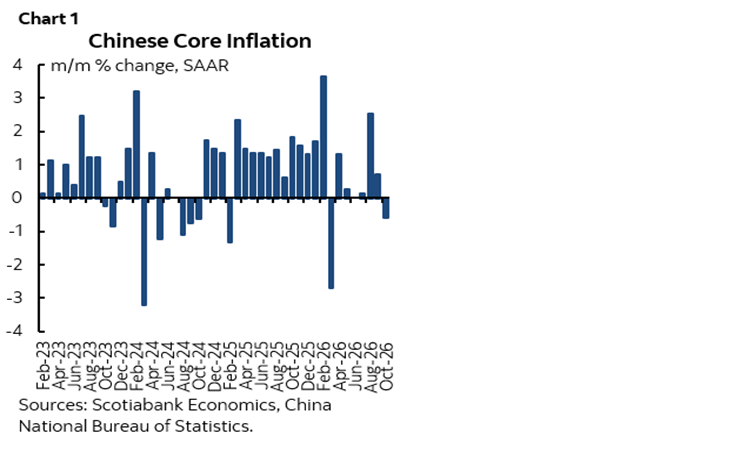
The PBOC clearly doesn’t treat its 3% inflation target seriously as it serially falls well shy of it. It may not wish to inflame property markets all over again as they continue to decline, but the yuan has been on a sharply appreciating trend since April of last year; it has gained about 9% to the dollar over this period.
NEW ZEALAND’S ELECTION NAILBITER BUOYS THE NZ$—FOR NOW
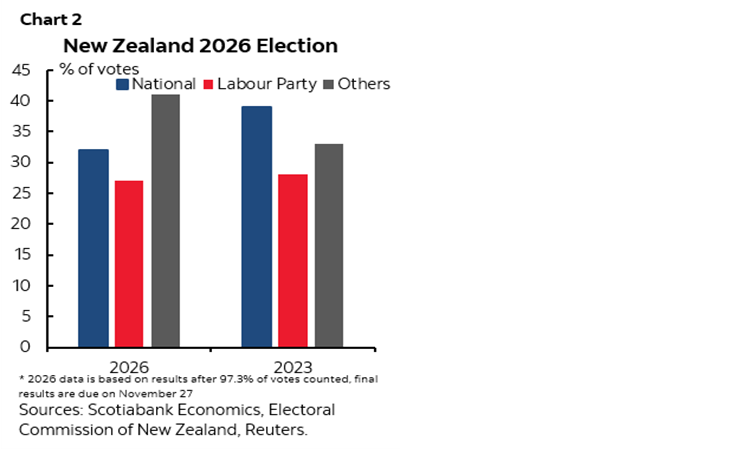
The NZ$ outperformed other major crosses in the wake of the NZ election results even though final results will be pending for a while. Chart 2 shows the outcome so far. The incumbent National Party and its coalition partners—Act Party and NZ First—appear to have won a fragile majority by a single seat despite having their numbers culled. Other coalitions are being explored and counting of special votes including overseas voters will continue.
CHINA FORMALIZES TEMPORARY DEESCALATION OF TRADE WAR
China formally suspended additional retaliatory 24% tariffs on US goods for two months and held the rate at 10% on some goods while also suspending plans to impose special fees on US ships at Chinese ports. The move formalizes a step that was agreed upon between China and the US earlier and following the US-China Summit. China noted that it is watching US plans to replace IEEPA tariffs with 301 tariffs as a sign of the conditionality surrounding next steps.
GERMANY’S EXPORTS REBOUNDED SHARPLY
German export growth came back from the dead in September. Exports were up 2% m/m after two months of decline. Growth was the strongest since February. Imports grew by even more than exports (4.2% m/m), therefore squeezing the net trade balance, although that remains largely trendless through recent years.
PHILIPPINE PESO HIT BY GDP MISS
News that the Philippines and Canada have struck a trade agreement didn’t budge the peso, but disappointing GDP did. The trade relationship with Canada is too small to matter for now. Q3 GDP landed at 0.1 % q/q (0.8% consensus) with a slight downward revision to Q2 (0.5% instead of 0.6%). The year-over-year rate fell back to 2.1% (3.1% consensus) in a pretty stunning downside disappointment to local forecasters.
Across the components, consumption was up 2.4% y/y as growth continues to slide. Investment was flat (-0.2% y/y). Exports were up 8.6% y/y while imports accelerated to 7.7% y/y. Inventories were flat again.
DISCLAIMER
This report has been prepared by Scotiabank Economics as a resource for the clients of Scotiabank. Opinions, estimates and projections contained herein are our own as of the date hereof and are subject to change without notice. The information and opinions contained herein have been compiled or arrived at from sources believed reliable but no representation or warranty, express or implied, is made as to their accuracy or completeness. Neither Scotiabank nor any of its officers, directors, partners, employees or affiliates accepts any liability whatsoever for any direct or consequential loss arising from any use of this report or its contents.
These reports are provided to you for informational purposes only. This report is not, and is not constructed as, an offer to sell or solicitation of any offer to buy any financial instrument, nor shall this report be construed as an opinion as to whether you should enter into any swap or trading strategy involving a swap or any other transaction. The information contained in this report is not intended to be, and does not constitute, a recommendation of a swap or trading strategy involving a swap within the meaning of U.S. Commodity Futures Trading Commission Regulation 23.434 and Appendix A thereto. This material is not intended to be individually tailored to your needs or characteristics and should not be viewed as a “call to action” or suggestion that you enter into a swap or trading strategy involving a swap or any other transaction. Scotiabank may engage in transactions in a manner inconsistent with the views discussed this report and may have positions, or be in the process of acquiring or disposing of positions, referred to in this report.
Scotiabank, its affiliates and any of their respective officers, directors and employees may from time to time take positions in currencies, act as managers, co-managers or underwriters of a public offering or act as principals or agents, deal in, own or act as market makers or advisors, brokers or commercial and/or investment bankers in relation to securities or related derivatives. As a result of these actions, Scotiabank may receive remuneration. All Scotiabank products and services are subject to the terms of applicable agreements and local regulations. Officers, directors and employees of Scotiabank and its affiliates may serve as directors of corporations.
Any securities discussed in this report may not be suitable for all investors. Scotiabank recommends that investors independently evaluate any issuer and security discussed in this report, and consult with any advisors they deem necessary prior to making any investment.
This report and all information, opinions and conclusions contained in it are protected by copyright. This information may not be reproduced without the prior express written consent of Scotiabank.
™ Trademark of The Bank of Nova Scotia. Used under license, where applicable.
Scotiabank, together with “Global Banking and Markets”, is a marketing name for the global corporate and investment banking and capital markets businesses of The Bank of Nova Scotia and certain of its affiliates in the countries where they operate, including; Scotiabank Europe plc; Scotiabank (Ireland) Designated Activity Company; Scotiabank Inverlat S.A., Institución de Banca Múltiple, Grupo Financiero Scotiabank Inverlat, Scotia Inverlat Casa de Bolsa, S.A. de C.V., Grupo Financiero Scotiabank Inverlat, Scotia Inverlat Derivados S.A. de C.V. – all members of the Scotiabank group and authorized users of the Scotiabank mark. The Bank of Nova Scotia is incorporated in Canada with limited liability and is authorised and regulated by the Office of the Superintendent of Financial Institutions Canada. The Bank of Nova Scotia is authorized by the UK Prudential Regulation Authority and is subject to regulation by the UK Financial Conduct Authority and limited regulation by the UK Prudential Regulation Authority. Details about the extent of The Bank of Nova Scotia's regulation by the UK Prudential Regulation Authority are available from us on request. Scotiabank Europe plc is authorized by the UK Prudential Regulation Authority and regulated by the UK Financial Conduct Authority and the UK Prudential Regulation Authority.
Scotiabank Inverlat, S.A., Scotia Inverlat Casa de Bolsa, S.A. de C.V, Grupo Financiero Scotiabank Inverlat, and Scotia Inverlat Derivados, S.A. de C.V., are each authorized and regulated by the Mexican financial authorities.
Not all products and services are offered in all jurisdictions. Services described are available in jurisdictions where permitted by law.