

ON DECK FOR FRIDAY, NOVEMBER 6th
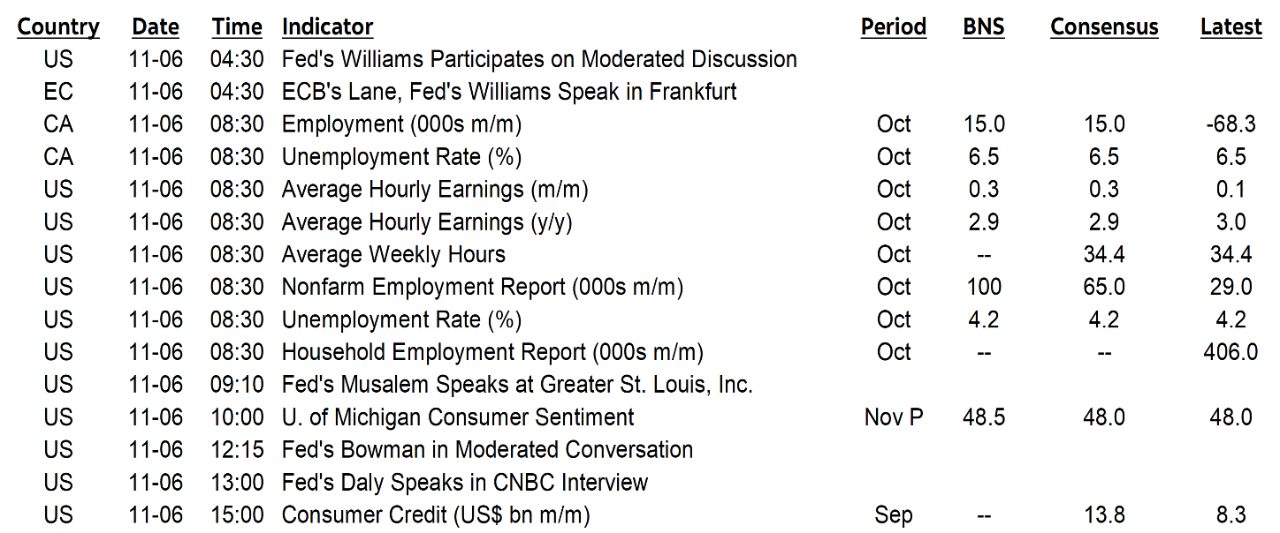
KEY POINTS:
- US equities stabilizing after global blood bath…
- …that triggered circuit breakers and short sale restrictions in Asia
- Nonfarm payrolls on tap
- Canadian jobs to pivot attention back to fundamentals
- Canadian federal budget tidbits and changes affecting the financial sector
- BoC’s inflation agreement wipes messy fingerprints clean
- Why the drop in AI and tech stocks?
- Chilean CPI reinforces hawkish BCCh minutes
- Light data: UMich, Cdn Ivey, European IP
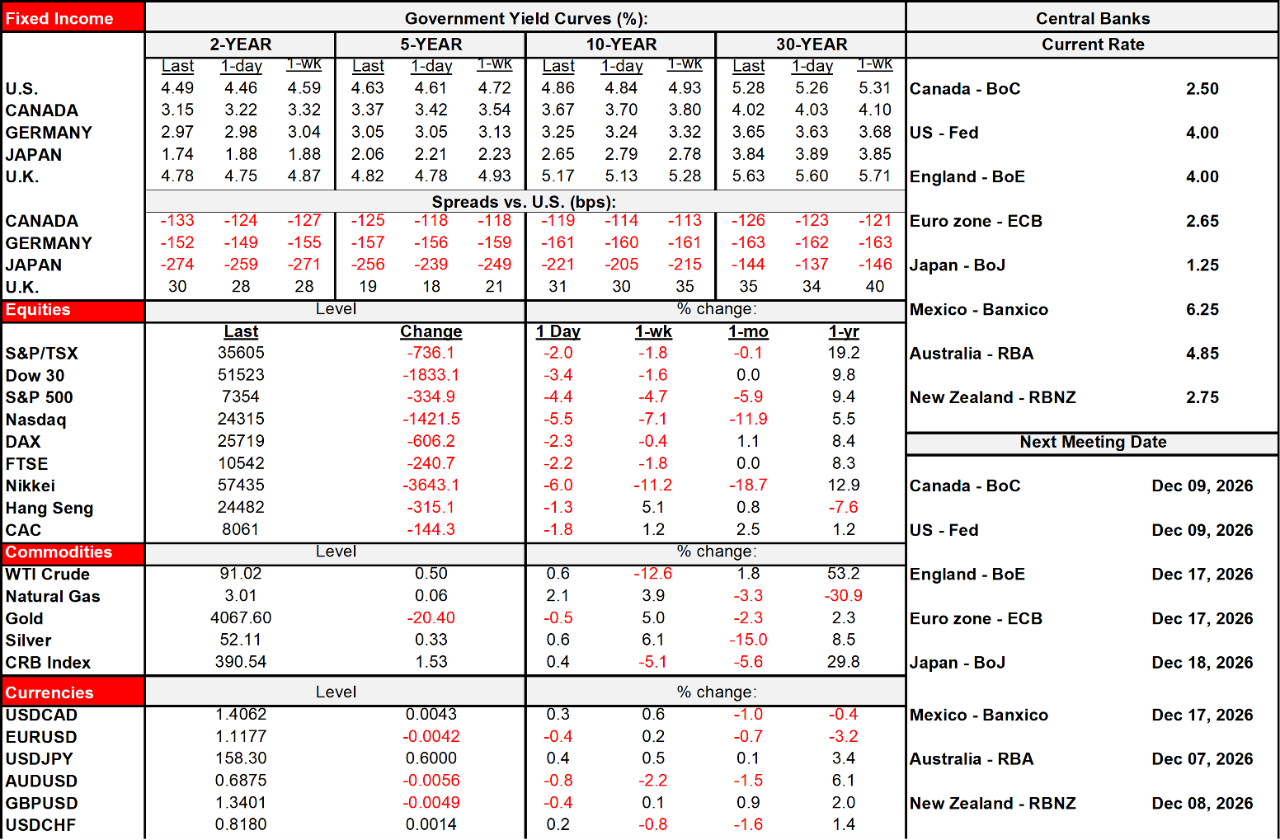
Yesterday’s hatchet job on risk appetite is showing signs of stabilizing ahead of N.A. jobs reports. US equity futures are higher by ¼% (s&p) to 1½% (Nasdaq) after the indices shed 4–5% of value yesterday. TSX futures are slightly lower. European cash markets are catching up to yesterday afternoon’s US softness and dropping by 1–2% this morning. Asia-Pacific markets followed the US session lower with Tokyo down about 6%, Seoul’s Kospi losing 6% after circuit breakers were tripped, Chinese indices were down by 1–2%, and Taiwan lost almost 5% with the government imposing a short selling limit.
Sovereign bonds are not picking up much if any of the flow this morning. Gilts keep mildly selling off post-BoE. US Ts are slightly cheaper. EGBs have a slight richening bias.
FX-land is snapping up the USD with most majors slightly weaker this morning.
All of which could change in short order as nonfarm payrolls arrive with a side order of Canadian jobs that matter locally. Other developments include stronger than expected gains in German and Spanish industrial production. Chilean inflation was a touch less hotter than expected as CPI was up 4.5% y/y in October (4.1% prior, 4.6% consensus) but nevertheless reinforces the hawkish effects of yesterday’s BCCh minutes. US UMich consumer sentiment is due out after payrolls (10amET).
US NONFARM PAYROLLS
Nonfarm payrolls and related job market readings for the month of October arrive at 8:30amET. A gain of 100k is lightly pencilled in. Supporting arguments are given in my weekly which I won’t repeat at this late stage. Let’s just see the numbers.
CANADIAN JOBS
Canadian job growth and related readings for the month of October will be released at 8:30amET. A rebound with 15k jobs created is very lightly pencilled in. Supporting arguments are given in my weekly.
CANADIAN FEDERAL BUDGET TIDBITS
I’ll offer a few follow-up thoughts on yesterday’s Canadian budget (here), the “brief” 50-page version (here) of the over 500-page tome and refer you to Rebekah’s good recap from the all-day lock-up here.
Charts 1-11 offer various depictions of the budget.
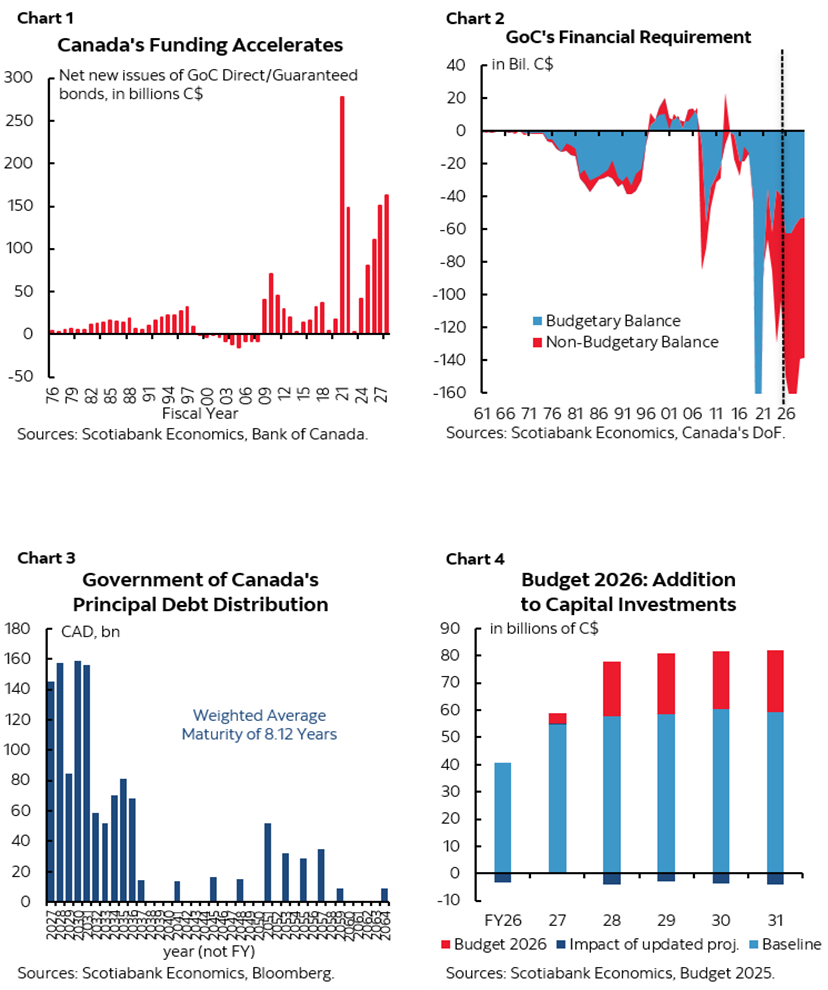
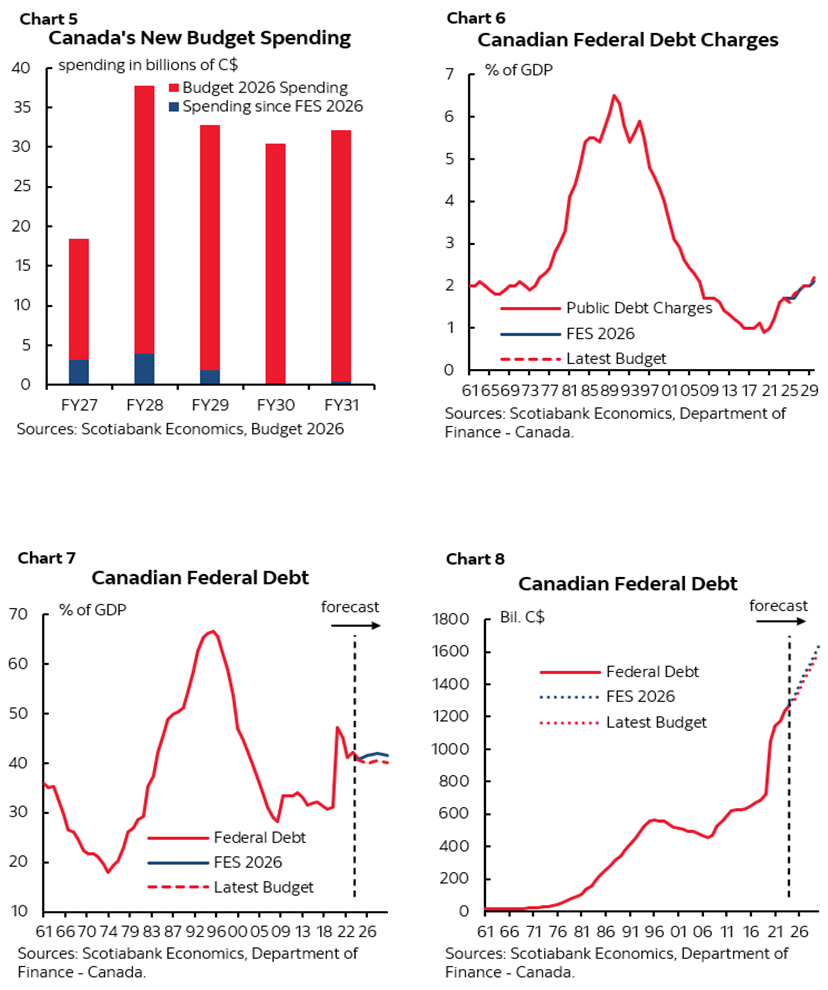
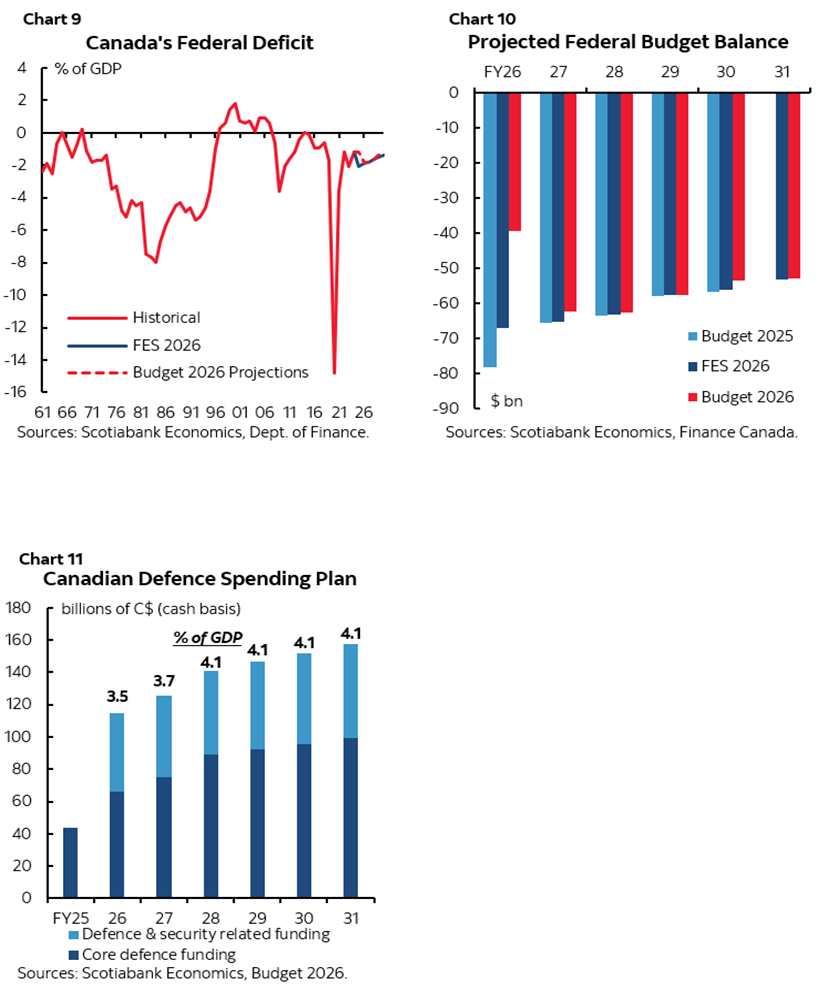
Overall, this budget is an illustration of how the commodity dividend and positive terms of trade shock trickle through the economy. Canada is extracting more income from the world economy through the export-to-import price wedge. In turn, this improves fiscal balances, so Ottawa and other layers of government can spend it, and then it all trickles throughout the economy. It’s the national equivalent to winning the lottery and then spending it all but I like the investment focus and efficiency gains versus paying it out.
Our very first pass estimate is that the budget would add under ¼% to GDP growth in 2027 and probably considerably under it. This is above and beyond what we previously incorporated through the effects of federal and provincial fiscal actions prior to yesterday. The limited extra announcements for 2027 include the added funding for the "grocery" benefit—which actually has nothing to do with groceries whatsoever and is just a subsidy to households with modest means—and extra investments. Total new measures in FY27 equal about $15B, then $34B in 2028 relative to the Spring update.
This would have the effect of lending a little more confidence to our forecast for three more BoC rate hikes with ongoing risk of even more hikes as we’ve constantly emphasized. It enhances expectations for a December hike. The BoC won't fully incorporate incremental announcements from the budget until the January MPR, but it had incorporated announcements since the Spring fiscal update.
The Feds are banking on about C$24B of extra annual revenues than they had in the Spring budget and cutting about $12B/yr in direct program expenses as they pursue efficiency improvements and civil service downsizing such as the EDC/BDC job cuts that likely lie ahead. A grand total of $152B of new spending was brought onboard compared to the Spring update which includes all of the off-budget announcements since then. This is paid for by $158B of higher revenues and lower expenses than the Spring budget.
Hello commodity dividend. Buh-Bye commodity dividend.
Ottawa claims it will hold its deficits to a peak of $65B this year and falling to about $53B five years out. That’s a LOT lower than they could have been. Take that with a lot of salt. Chart 12 is updated to include the latest projection and serves as a reminder that Ottawa always shows narrowing deficits, just as the BoC always shows inflation magically returning to target. I strongly suspect they will raise and push out deficit projections a) given serially ambitious forecasts, b) high execution risk, c) likely cost overruns and resource shortfalls to drive their plans, and d) serial further additions to measures as each new budget update adds to the prior update.
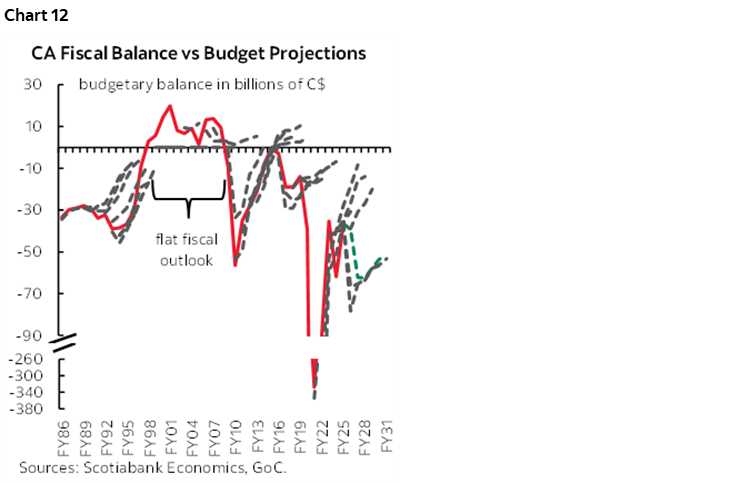
As a consequence, the street should take debt issuance numbers with a big salt-shaker handy unless their bacon gets saved again by much higher oil which raises a host of other issues. If it hadn’t been for the serendipitous effects of surging oil prices, Ottawa would be awash in much more red ink, or cutting program spending by more, and/or raising taxes on Ottawa’s preferred ‘fairness’ targets.
Much lower oil? Shush. Don’t say that too loudly around FinMin Champagne. They’d better hope that doesn’t happen or the commodity dividend swings in leveraged reverse because they’ve assumed that this gift just keeps on giving for years to come and pre-spent it.
I’m very happy to see the foreign home buyer ban relaxed. There was never any credible backing for its existence. Foreign buyers were scapegoated by the previous administration for causing housing affordability challenges instead of pointing the finger back at failings to address supply shortfalls while serially overstimulating demand through housing incentives. The move improves Canada’s reputation after damaging it with this form of capital control. It may bring back some demand for condos in struggling markets like Toronto and Vancouver.
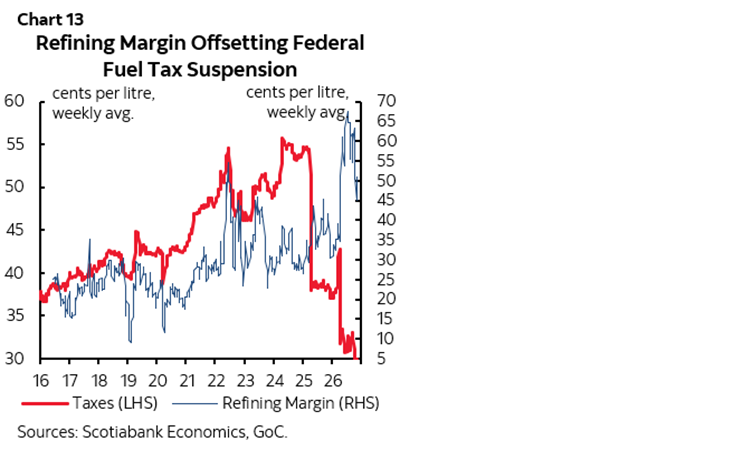
I’m not thrilled about the fuel excise tax cut extension to March. It’s bad policy with populist cross-party support in parliament. This remains a multi-billion-dollar gift to refiners who crowded in the space vacated by the cut (chart 13). There are better uses for the money.
BANK OF CANADA INFLATION RENEWAL AGREEMENT
The Budget also jointly released the updated five-year Monetary Policy Framework with the Bank of Canada (here). Gone are references to fully inclusive maximum employment and climate change. Hooray! Price stability is noted as the best way of achieving maximum sustainable employment and economic growth which is as it should be. This confirms my suspicions at the time that former FinMin Freeland and Liberal party strategists sought to have those references included. They’re gone under Carney—a clearly experienced central banker.
WHAT THE BUDGET CONTAINED ABOUT THE FINANCIAL SECTOR
The Budget contained quite a few measures that apply to financial services. Some are more meaningful than others. For instance, being able to file taxes two weeks later is merely a boon to procrastinators. More meaningful could be the proposal to have an RRSP-for-life that wipes out the requirement to convert to a RRIF/annuity at 71 and consolidates the two products while maintaining minimum withdrawal requirements and simplifies spousal transfers. Some industry participants will be rattled, but fm2c I like the move toward administrative simplicity and efficiency.
Also welcomed is the move to consolidate the Business Development Bank and Export Development Canada into one crown corp that serves small businesses. It should mean efficiency gains to the over 5,000 employees at the two outfits.
I’m still not particularly thrilled about the Canada Strong Fund which is a previously announced sovereign wealth fund. First, SWFs normally exist in net saving countries like Norway, Singapore, the UAE etc. Canada is not one of them. Second, it’s small, since C$25B phased in gradually over coming years is a drop in the bucket in the overall financial system. Third, we’ll see what take up is like for the retail funding product. Fourth, absent net saving status for the country as a whole, a SWF would largely be a shell game that diverts saving from other existing financial institutions and products.
David Cimon shares the following list of what was contained in the Budget that relates to the financial sector. Further research is needed and David will discuss with clients.
In their 2026 budget, the government signaled an intent to increase financial sector competition. Some of their proposed changes include:
1. Changing ownership structure rules for mid-sized banks.
a. Banks would now have to transition to being “widely held” (i.e. no major shareholder holding more than 20% of voting shares) at $25B in equity, up from $12B.
b. Foreign subsidiaries with less than $8B in equity would not be subject to public holding requirements if their parent is widely held and publicly listed on a recognized foreign stock exchange.
2. Introduction of a secondary competition objective for OSFI.
3. Speeding up the process for becoming a federally regulated financial institution, by providing applicants a decision within a one-year timeline.
4. Increasing deposit insurance limits to $250,000, allowing for high-balance coverage during certain “life events” (home sale is listed as an example), and removing limits for deposits in some registered and tax-free accounts.
5. Obliging banks to provide customers with a single annual statement of fees paid on chequing and savings accounts.
6. Other smaller items: increasing options for solvent but troubled banks to pursue private market exits, increased clarity on entry support for regulated FIs, an intention to work with small and mid-sized banks to strengthen funding access and a pilot project for voluntary digital credentials in financial services.
MIDTERM INFLUENCES ON AI STOCKS
Why has the midterm election had such a profound effect on risks surrounding US-domiciled data centres, AI and tech more generally? Why did the Nasdaq tank yesterday with negative effects carrying over into the overnight session?
Some of it is fear-driven and related to policy risks facing AI that I’ll highlight. Some of it is concern about policy gridlock with Trump saying he’ll veto anything the Democrats offer up. Some of it could just be a long overdue correction as we’ve warned about for some time by comparing various measures of equity and bond valuations. Some could be out of concern toward pending data like today’s nonfarm payrolls and next week’s US CPI that will inform how the FOMC may act in December and beyond. Some of it could be ongoing concern over the risk of escalation in the war with Iran after Trump said yesterday afternoon that a decision on what to do next was “coming soon.”
Below is a partial list of US legislative actions aimed at data centres. The GOP has generally been focused upon allowing as many to build as quickly as possible while trying to create the optics of wagging a finger at them through weak actions. The Dems are all about making the data centre companies absorb more of the costs they view as being offloaded onto communities. Data centres should onboard more of their related costs in my view since otherwise this adds to already frequent and generous subsidies that measure in the billions.
- Ratepayer Protection Act, H.R. 9340
- The POWER Up Act
- Senator Tom Cotton's DATA Act
- H.R. 6529, Protecting Families from AI Data Center Energy Costs Act
- H.R. 9332, Load Forecasting Enhancement Act
- H.R. 9339, Affordable Innovation for the Grid Act
- H.R. 8241, Power for the People Act
- H.R. 8488, AI Data Center Site Selection Transparency Act
DISCLAIMER
This report has been prepared by Scotiabank Economics as a resource for the clients of Scotiabank. Opinions, estimates and projections contained herein are our own as of the date hereof and are subject to change without notice. The information and opinions contained herein have been compiled or arrived at from sources believed reliable but no representation or warranty, express or implied, is made as to their accuracy or completeness. Neither Scotiabank nor any of its officers, directors, partners, employees or affiliates accepts any liability whatsoever for any direct or consequential loss arising from any use of this report or its contents.
These reports are provided to you for informational purposes only. This report is not, and is not constructed as, an offer to sell or solicitation of any offer to buy any financial instrument, nor shall this report be construed as an opinion as to whether you should enter into any swap or trading strategy involving a swap or any other transaction. The information contained in this report is not intended to be, and does not constitute, a recommendation of a swap or trading strategy involving a swap within the meaning of U.S. Commodity Futures Trading Commission Regulation 23.434 and Appendix A thereto. This material is not intended to be individually tailored to your needs or characteristics and should not be viewed as a “call to action” or suggestion that you enter into a swap or trading strategy involving a swap or any other transaction. Scotiabank may engage in transactions in a manner inconsistent with the views discussed this report and may have positions, or be in the process of acquiring or disposing of positions, referred to in this report.
Scotiabank, its affiliates and any of their respective officers, directors and employees may from time to time take positions in currencies, act as managers, co-managers or underwriters of a public offering or act as principals or agents, deal in, own or act as market makers or advisors, brokers or commercial and/or investment bankers in relation to securities or related derivatives. As a result of these actions, Scotiabank may receive remuneration. All Scotiabank products and services are subject to the terms of applicable agreements and local regulations. Officers, directors and employees of Scotiabank and its affiliates may serve as directors of corporations.
Any securities discussed in this report may not be suitable for all investors. Scotiabank recommends that investors independently evaluate any issuer and security discussed in this report, and consult with any advisors they deem necessary prior to making any investment.
This report and all information, opinions and conclusions contained in it are protected by copyright. This information may not be reproduced without the prior express written consent of Scotiabank.
™ Trademark of The Bank of Nova Scotia. Used under license, where applicable.
Scotiabank, together with “Global Banking and Markets”, is a marketing name for the global corporate and investment banking and capital markets businesses of The Bank of Nova Scotia and certain of its affiliates in the countries where they operate, including; Scotiabank Europe plc; Scotiabank (Ireland) Designated Activity Company; Scotiabank Inverlat S.A., Institución de Banca Múltiple, Grupo Financiero Scotiabank Inverlat, Scotia Inverlat Casa de Bolsa, S.A. de C.V., Grupo Financiero Scotiabank Inverlat, Scotia Inverlat Derivados S.A. de C.V. – all members of the Scotiabank group and authorized users of the Scotiabank mark. The Bank of Nova Scotia is incorporated in Canada with limited liability and is authorised and regulated by the Office of the Superintendent of Financial Institutions Canada. The Bank of Nova Scotia is authorized by the UK Prudential Regulation Authority and is subject to regulation by the UK Financial Conduct Authority and limited regulation by the UK Prudential Regulation Authority. Details about the extent of The Bank of Nova Scotia's regulation by the UK Prudential Regulation Authority are available from us on request. Scotiabank Europe plc is authorized by the UK Prudential Regulation Authority and regulated by the UK Financial Conduct Authority and the UK Prudential Regulation Authority.
Scotiabank Inverlat, S.A., Scotia Inverlat Casa de Bolsa, S.A. de C.V, Grupo Financiero Scotiabank Inverlat, and Scotia Inverlat Derivados, S.A. de C.V., are each authorized and regulated by the Mexican financial authorities.
Not all products and services are offered in all jurisdictions. Services described are available in jurisdictions where permitted by law.