

ON DECK FOR THURSDAY, NOVEMBER 5th
KEY POINTS:
- Stocks (mostly) continue to rally post-midterms
- Canadian Budget Day—pad away!
- BoE hiked with a mildly hawkish bias
- US labour market teasers ahead of nonfarm
- Banxico expected to hold
- Norges, Negara and BCB all held as expected
- BoC’s second day of testimony will be about avoiding headlines
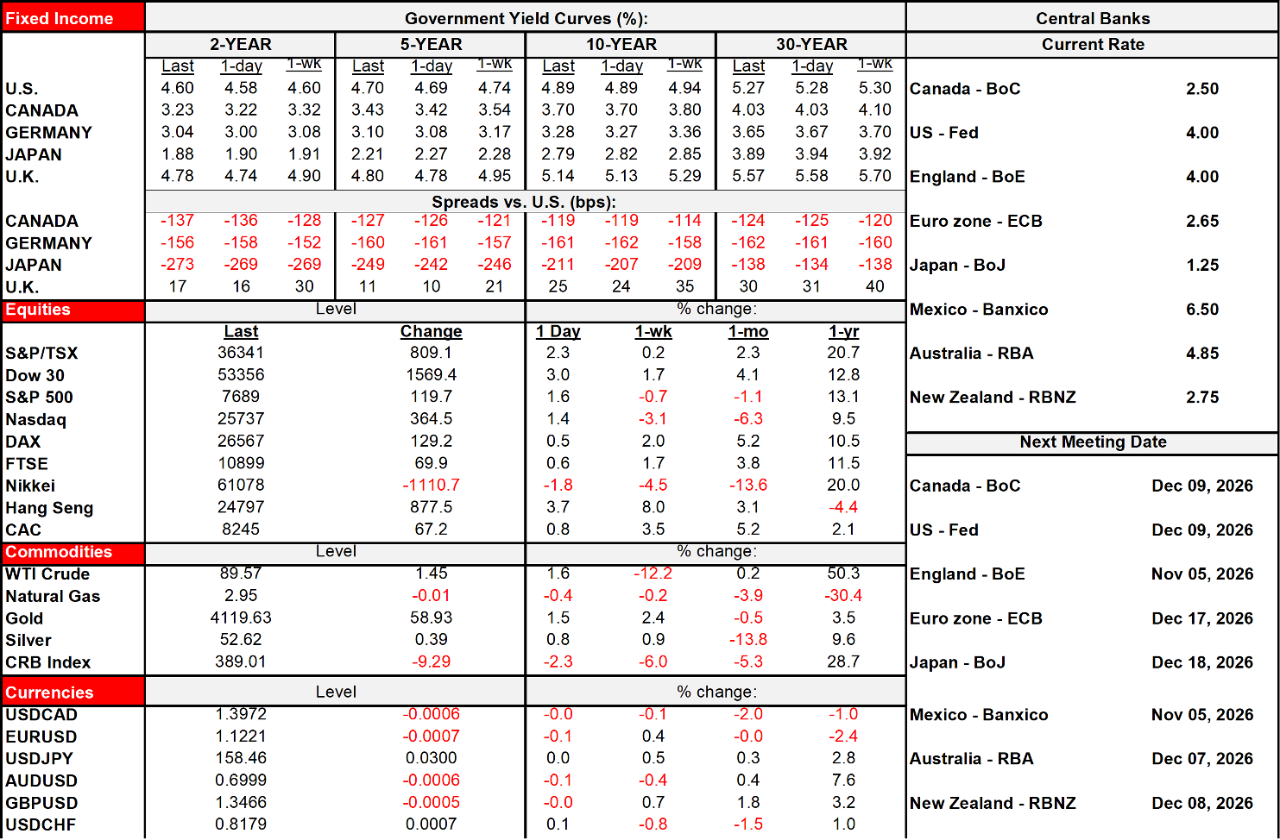
Stocks generally continue to rally this morning, with the exception of Nasdaq futures. Otherwise, N.A. equity futures are mildly higher and European cash markets are rallying by either side of ¾%. Sovereign bond yields are little changed with a mild cheapening front-end bias particularly in the UK post-BoE (see below). Currencies are mixed with petro-currencies (real or stereotyped) like CAD, MXN and NOK rallying on the back of gently higher oil prices. Sterling is little changed overall post-BoE.
IT’S BUDGET DAY IN OTTAWA
Canada’s federal budget arrives after the market close today. Rebekah did a preview last week and contributed to my weekly on the topic. Basically the issue is two-fold: bringing on-budget the tens and tens of billions in off-budget spending announced since the Spring update on April 28th, and secondly, what further spending they have in mind.
If the Budget focuses on affordability and cultural sovereignty, as FinMin Champagne has guided, then it might be a bit of a snoozer. Budgets are not what they used to be as so much off-budget, between-cycle spending has lessened the anticipation around the event itself. In one sense this is fine, since policy has to have the flexibility to adapt outside of a regimented, fixed schedule. In another sense, however, it’s not so fine, since piecemeal, large announcements without a funding plan spark uncertainty around issuance pressures on the bond market. They’ve spent a tonne of money already since the last update including the ‘mega-deduction’ and the recent extension of the gas tax holiday until March among other items. More spending for cultural groups may be particularly targeted to Quebec. There is some talk about emphasis upon competition and yet more support for small businesses that already enjoy heavy policy supports.
The Canadian policy narrative has fiscal policy high-fiving monetary policy on the way through the door. One is easing, the other has to sterilize some of it as fiscal stimulus contributes to closing spare capacity with actual GDP growth exceeding potential growth. As this happens, fiscal policy is likely to increasingly contribute to inflation risk. You’ll never hear the BoC say that explicitly, given tight relations between the BoC and government.
Absent a recession, Canada is capitalizing upon being less ugly than the fiscal positions of other countries like the US, France, Japan etc. There is considerable accounting gimmickry behind the figures.
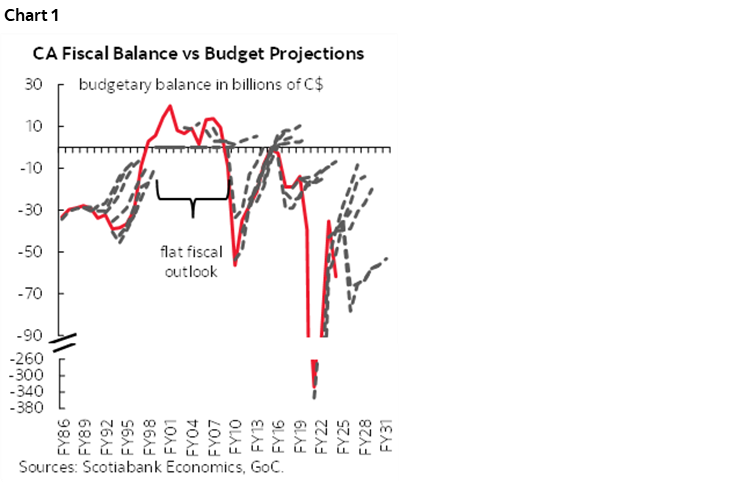
I’ve warned throughout the shift in Ottawa’s fiscal stance that deficits and debt issuance will be tracking higher and chasing evolving plans. That’s still my narrative. Take today’s numbers with another mountain of salt. Chart 1 shows Ottawa’s horrible track record of deficit projections; like the BoC’s inflation forecasts, Finance is hardwired to always show a magical path back toward balance within the fiscal horizon. A year ago, we obviously did not anticipate a massive surge in commodity prices that saved Ottawa’s bacon—only to see the commodity dividend being spent and then some which in fairness is how the terms of trade shifts tend to work through the economy. Yet the types of initiatives that Ottawa is targeting are notorious for cost overruns and delays plagued by procurement challenges—namely defence and major projects—and especially given relatively tight markets for labour and materials and skilled labour shortages. It’s an open question whether clamping down on procurement practices will be any more successful as containing costs than has been the case in the past.
US LABOUR MARKET TEASERS
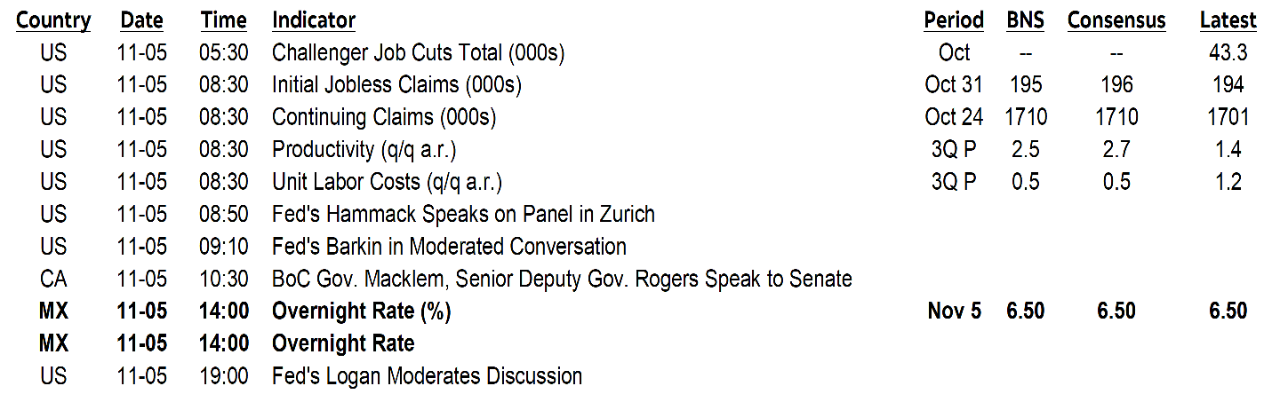
A few US labour market teasers are out ahead of tomorrow’s nonfarm payrolls. Challenger job cuts held little changed at about 44k last month. Q3 labour productivity is estimated to have risen by about 2½% q/q SAAR and that probably means that unit labour costs (ie: productivity-adjusted labour costs) were up only modestly by around ½% q/q SAAR. If so, then that would be the slowest increase since 2025Q2. Slower ULC growth eases labour contributions to inflation risk all else equal.
THE BANK OF ENGLAND HIKED WITH A MILDLY HAWKISH STANCE
The Bank of England just raised Bank Rate by 25bps to 4% as widely expected and priced. The broad tone of the communications was mildly hawkish and that’s the way markets took it. The 2-year gilt yield is up by about 3–4bps, sterling is a touch firmer, and December BoE OIS pricing is up by about 4bps.
This paragraph from the statement about sums it up:
"While the direct effects of higher energy prices are clear, and will continue to feed into firm and household energy bills, there remains limited evidence of knock-on effects on other prices and wages. However, the degree of inflationary pressure in the pipeline is now sufficient to warrant an increase in Bank Rate. Activity data in recent months have generally been stronger than expected, adding to the case for modestly tighter monetary policy."
The vote was 8–1 with Catherine Mann dissenting in favour of a 50bps hike. Guidance shifted to make every meeting a ‘live’ meeting by stating that the MPC will “assess the evidence at each meeting.” The BoE’s forecasts expect inflation to peak at just shy of 5% in 2027Q2.
Guidance from individual MPC members other than Mann was mixed but more hawkish than not. Governor Bailey indicated it’s unlikely to be one-and-done unless the war with Iran ends while saying he sees an argument for future increases but not necessarily a string of them. Chief Economist Pill is often hawkish and said one is unlikely to be enough. Lombardelli leaned toward more near-term hikes, while Breeden advised being careful about assuming that pre-war disinflation has stopped.
This central bank fought the good fight against hike talk but was under insurmountable pressure to buckle. Confidence that it could look through a transitory shock to inflation has waned as the BoE raises concern toward second-round pass-through effects of soaring energy costs into broader prices. I recall client marketing in London on two separate occasions earlier this year and there was high—and ultimately misplaced—conviction that the BoE would never hike in response to an energy shock.
OTHER CENTRAL BANKS
Banxico is widely expected to remain on hold at an overnight rate of 6.5% this afternoon (2pmET), thereby extending the holding pattern since the last cut in May. Uncertainty surrounding the Federal Reserve’s next move may inform a pause. So may upside risks to inflation. September’s CPI reading jumped 0.2% to about 3½% y/y with core CPI at 3.8%. Rising energy prices and the peso’s depreciation of over 10% to the USD since September will keep the inflation hawks on high alert.
There were no surprises across other central bank decisions overnight. Each of Norges Bank, Bank Negara and Brazil’s central bank held policy rates unchanged as widely expected.
Round two of the BoC’s parliamentary testimony starts at 10:30amET this morning, this time before the Standing Senate Committee on Banking, Commerce and the Economy. Nothing meaningful was said during Tuesday’s testimony and the name of the game today is to avoid headlines on Budget day in Ottawa.
DISCLAIMER
This report has been prepared by Scotiabank Economics as a resource for the clients of Scotiabank. Opinions, estimates and projections contained herein are our own as of the date hereof and are subject to change without notice. The information and opinions contained herein have been compiled or arrived at from sources believed reliable but no representation or warranty, express or implied, is made as to their accuracy or completeness. Neither Scotiabank nor any of its officers, directors, partners, employees or affiliates accepts any liability whatsoever for any direct or consequential loss arising from any use of this report or its contents.
These reports are provided to you for informational purposes only. This report is not, and is not constructed as, an offer to sell or solicitation of any offer to buy any financial instrument, nor shall this report be construed as an opinion as to whether you should enter into any swap or trading strategy involving a swap or any other transaction. The information contained in this report is not intended to be, and does not constitute, a recommendation of a swap or trading strategy involving a swap within the meaning of U.S. Commodity Futures Trading Commission Regulation 23.434 and Appendix A thereto. This material is not intended to be individually tailored to your needs or characteristics and should not be viewed as a “call to action” or suggestion that you enter into a swap or trading strategy involving a swap or any other transaction. Scotiabank may engage in transactions in a manner inconsistent with the views discussed this report and may have positions, or be in the process of acquiring or disposing of positions, referred to in this report.
Scotiabank, its affiliates and any of their respective officers, directors and employees may from time to time take positions in currencies, act as managers, co-managers or underwriters of a public offering or act as principals or agents, deal in, own or act as market makers or advisors, brokers or commercial and/or investment bankers in relation to securities or related derivatives. As a result of these actions, Scotiabank may receive remuneration. All Scotiabank products and services are subject to the terms of applicable agreements and local regulations. Officers, directors and employees of Scotiabank and its affiliates may serve as directors of corporations.
Any securities discussed in this report may not be suitable for all investors. Scotiabank recommends that investors independently evaluate any issuer and security discussed in this report, and consult with any advisors they deem necessary prior to making any investment.
This report and all information, opinions and conclusions contained in it are protected by copyright. This information may not be reproduced without the prior express written consent of Scotiabank.
™ Trademark of The Bank of Nova Scotia. Used under license, where applicable.
Scotiabank, together with “Global Banking and Markets”, is a marketing name for the global corporate and investment banking and capital markets businesses of The Bank of Nova Scotia and certain of its affiliates in the countries where they operate, including; Scotiabank Europe plc; Scotiabank (Ireland) Designated Activity Company; Scotiabank Inverlat S.A., Institución de Banca Múltiple, Grupo Financiero Scotiabank Inverlat, Scotia Inverlat Casa de Bolsa, S.A. de C.V., Grupo Financiero Scotiabank Inverlat, Scotia Inverlat Derivados S.A. de C.V. – all members of the Scotiabank group and authorized users of the Scotiabank mark. The Bank of Nova Scotia is incorporated in Canada with limited liability and is authorised and regulated by the Office of the Superintendent of Financial Institutions Canada. The Bank of Nova Scotia is authorized by the UK Prudential Regulation Authority and is subject to regulation by the UK Financial Conduct Authority and limited regulation by the UK Prudential Regulation Authority. Details about the extent of The Bank of Nova Scotia's regulation by the UK Prudential Regulation Authority are available from us on request. Scotiabank Europe plc is authorized by the UK Prudential Regulation Authority and regulated by the UK Financial Conduct Authority and the UK Prudential Regulation Authority.
Scotiabank Inverlat, S.A., Scotia Inverlat Casa de Bolsa, S.A. de C.V, Grupo Financiero Scotiabank Inverlat, and Scotia Inverlat Derivados, S.A. de C.V., are each authorized and regulated by the Mexican financial authorities.
Not all products and services are offered in all jurisdictions. Services described are available in jurisdictions where permitted by law.