

ON DECK FOR WEDNESDAY, NOVEMBER 4th

KEY POINTS:
- Americans delivered a total shellacking of the Trump administration…
- …and why markets are doing just fine
- What’s next for the ‘lame duck’ session’s priorities?
- Canadian vehicle sales up, US sales down
- Riksbank hikes as expected and guides there could be more
- Eurozone CPI lands on the screws
- Canadian trade to further inform Q3 tracking
- US ISM-services, ADP, refunding announcement on tap
- Kiwi rates outperform after jobs disappointment
- BCB expected to hold
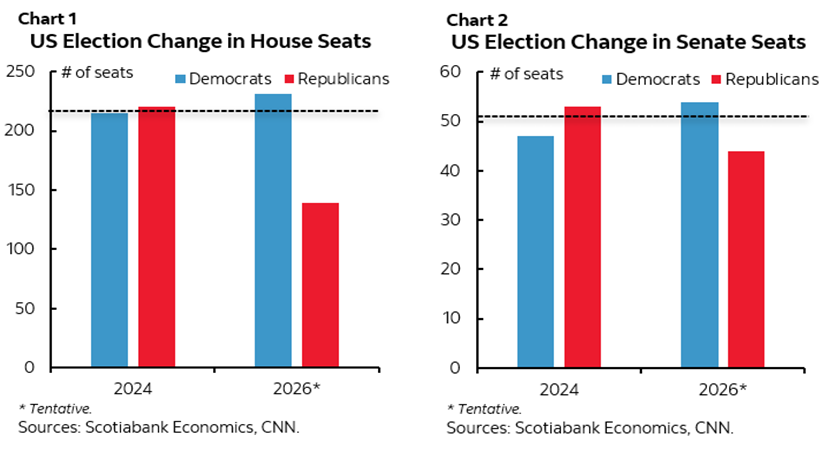
American voters delivered a total shellacking of the Trump administration and its GOP enablers, and markets are doing just fine. Results are still rolling in but a current summary is available here. At present, the Democrats will take at least 241 House seats which is 23 more than need for a majority, plus 54 Senate seats which is three more than needed for a majority in that chamber (charts 1, 2). These figures will continue to be refined as close votes are settled and some may be subject to challenges. Still, the breadth of the changes—including booting the GOP in strongholds like Texas and Kansas—is breathtaking.
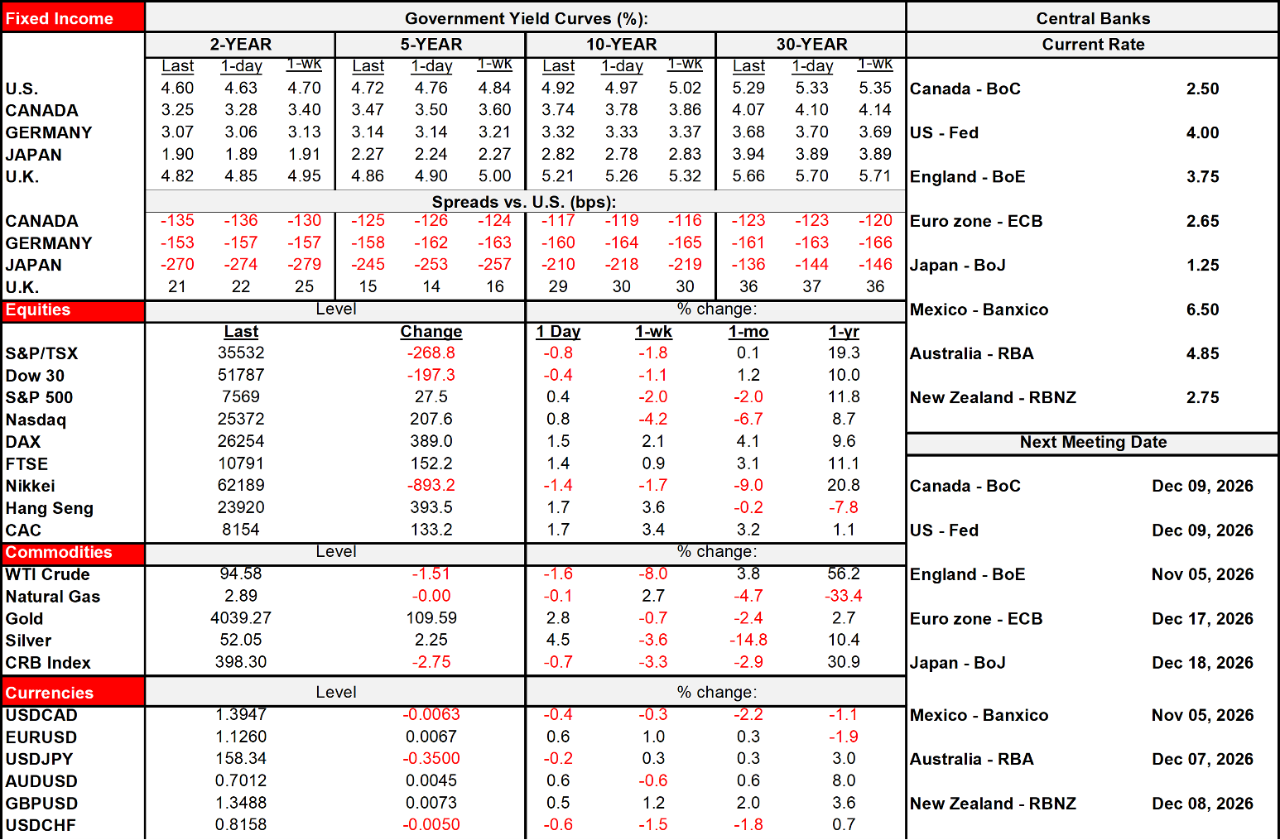
Stocks are broadly higher with US futures up by between ½% and over 1%, TSX futures up by over 1%, and European cash markets rallying by about 1–2%+. Sovereign bonds are also richer with yields lower by about 3–4bps across US Ts, Canadian yields down by 3–4bps, a curve-wide rally in gilts and EGB spread narrowing over bunds. Currencies are up almost everywhere across the majors relative to the USD. Oil is off by about 1%.
Initial market reactions were negative as the midterm results began to roll, so what gave? Perhaps the magnitude of victory by the Democrats put to rest concern that the results would be challenged by Trump who came out saying he would respect the outcome. Trump also downplayed the risk of escalating the Iran war which we’ll see about. I’ll also come back to arguing that policy developments over the next two months could possibly turn out to be constructive to market risk appetite independent of other drivers.
Regardless, those who had the courage to stand against the Trump administration’s policies were vindicated by the checks and balances of the US political system that ultimately pushed American voters to issue their bold verdict on less than two years of Trump 2.0. Voters saw this period as marked by inflamed deficits, unwise trade policies, overstimulation of growth and capacity pressures that sparked affordability challenges, broken promises about ending forever wars, attacks on public institutions, a revenge agenda and overly harsh immigration policy.
WHAT’S NEXT IN THE ‘LAME DUCK’ SESSION OF CONGRESS?
Now the issue at hand will be what may be achieved in the lame duck session before the new Congress convenes after January 3rd next year. With so many GOP members of Congress now out of jobs, will they be disengaged in a general state of apathy, or engaged to achieve whatever they can before losing power?
WHAT MAY THEY SEEK TO ACHIEVE?
- USMCA 2.0. I still maintain that this is the window that counts for a potential CUSMA/USMCA 2.0 deal. If the aim is to get DJT’s signature on a new comprehensive agreement, then do so before having to put it through a Congress controlled by the Democrats. At that point, the Dems control the issues and may seek greater input over matters like labour controls and the environment. A smaller deal and reversal or watering down of prior executive orders is also a possibility outside of Congress. Overall, I’m cautiously optimistic and don’t buy the common narrative that Trump will double down against the agreement. If either he or GOP members read the room last evening, then tariffs, assaults on key trading partners and allies and divisive trade policy were among the factors that cost them the vote.
- Address the December 11th funding deadline. A shutdown would seem unlikely given that failure to achieve a funding deal would then pass control over what shape it takes to the Democrats in the new Congress.
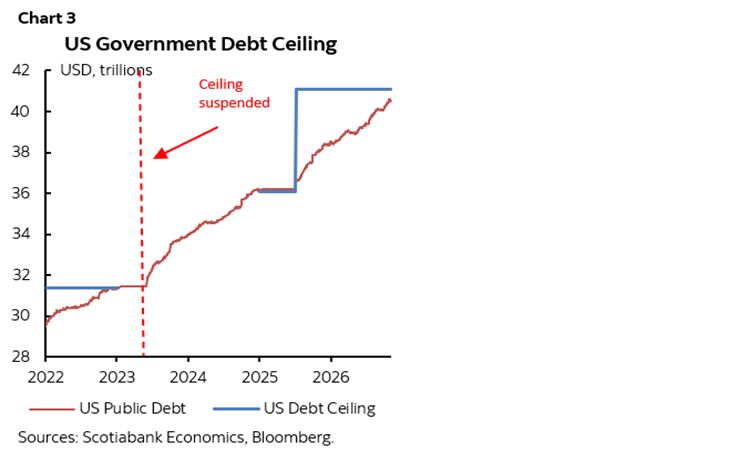
- Address the debt ceiling which is close to becoming binding (chart 3). The GOP may get a jump on the Democrats by raising or suspending the debt ceiling now before the Democrats could apply leverage against the administration.
- Pass a reconciliation bill? This presents the opportunity to pass final priorities for the administration. This could include tax measures. It could also address disaster funding, defence appropriations, and various other policy priorities.
- Farm Bill extension. The massive collection of subsidies to US farmers expired at the end of September and needs to be addressed probably in this window before the new Congress given the importance of the farming base to Trump.
- Trump is likely to issue pardons left, right and centre before the Dems take control. Key figures in his current administration could be included. There may also be changes to his cabinet including rumours that Hegseth may be out.
OTHER US DEVELOPMENTS
- US developments other than midterm results could be impactful and include the following:
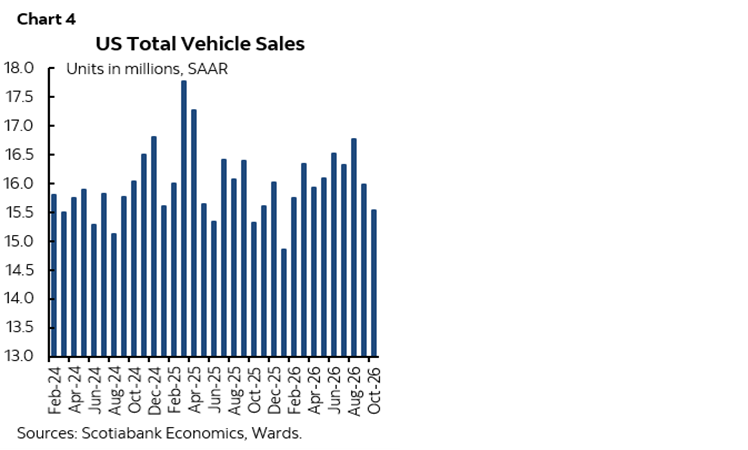
- US vehicle sales fell by -2.8% m/m SA in October in yesterday’s release after the close. Sales landed at 15.54 million SAAR, matching my estimate and below consensus that was expecting 15.8 after 16.0 the prior month. In weighted terms, the dip will shave under -½% from October retail sales. Sales have fallen for two months (chart 4).
- US ISM-services for October is expected to continue to post moderate growth (10amET).
- US ADP private payrolls could post a gain of about 65k for October but ADP has a habit of revising its weekly profile at the last second which could impact the monthly reading (8:15amET). Still, it offers poor tracking of private nonfarm payrolls.
- The Treasury’s quarterly refunding announcement arrives at 8:30amET.
GLOBAL DEVELOPMENTS
Canada updates trade figures for September that will further inform how trade is holding up and net trade contributions to growth (8:30amET).
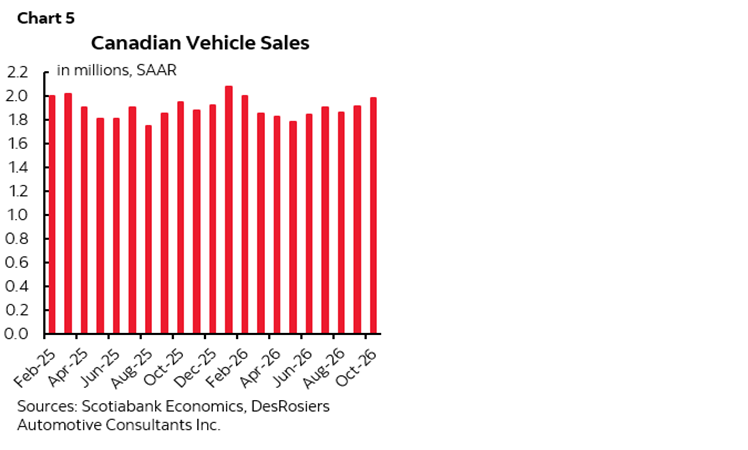
Canadian new vehicle sales registered another gain in October with a roughly 4% m/m SA increase. That’s the highest level of sales since the strong start to the year in January–February. It’s a great start to tracking Q4 given the way Q3 ended and Q4 sales started (chart 5).
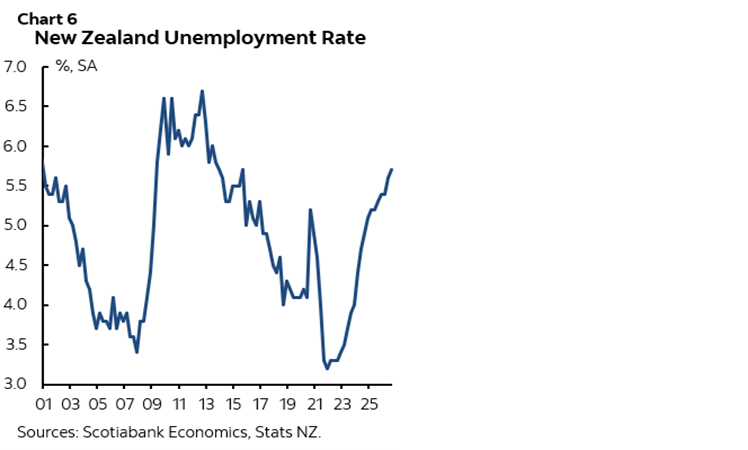
The kiwi rates curve was the biggest outperformer overnight after jobs data disappointed. Q3 employment slipped by -0.1% q/q SA (consensus +0.4%) with a downward revision. It’s the first drop since 2025Q2. Pricing for the RBNZ’s December decision fell by about 4bps to 16bps of a hike. The unemployment rate continues to creep higher (chart 6).
Sweden’s Riksbank raised its policy rate by 25bps as widely expected. A mildly hawkish tone included statement guidance that “If the outlook for inflation and economic activity holds, it is likely that the policy rate will be raised further in the coming year, in line with the policy rate forecast in September.” The next formal forecast update with explicit forward rate guidance will be delivered at the December 16th decision.
Eurozone CPI landed on the screws at 0.4% m/m SA and 4% y/y with core at 2.5% y/y. The release hardly surprised markets given that we already had the major countries that released at the end of last week.
Brazil's central bank is expected to hold its Selic rate unchanged at 13.75% (4:30pmET).
DISCLAIMER
This report has been prepared by Scotiabank Economics as a resource for the clients of Scotiabank. Opinions, estimates and projections contained herein are our own as of the date hereof and are subject to change without notice. The information and opinions contained herein have been compiled or arrived at from sources believed reliable but no representation or warranty, express or implied, is made as to their accuracy or completeness. Neither Scotiabank nor any of its officers, directors, partners, employees or affiliates accepts any liability whatsoever for any direct or consequential loss arising from any use of this report or its contents.
These reports are provided to you for informational purposes only. This report is not, and is not constructed as, an offer to sell or solicitation of any offer to buy any financial instrument, nor shall this report be construed as an opinion as to whether you should enter into any swap or trading strategy involving a swap or any other transaction. The information contained in this report is not intended to be, and does not constitute, a recommendation of a swap or trading strategy involving a swap within the meaning of U.S. Commodity Futures Trading Commission Regulation 23.434 and Appendix A thereto. This material is not intended to be individually tailored to your needs or characteristics and should not be viewed as a “call to action” or suggestion that you enter into a swap or trading strategy involving a swap or any other transaction. Scotiabank may engage in transactions in a manner inconsistent with the views discussed this report and may have positions, or be in the process of acquiring or disposing of positions, referred to in this report.
Scotiabank, its affiliates and any of their respective officers, directors and employees may from time to time take positions in currencies, act as managers, co-managers or underwriters of a public offering or act as principals or agents, deal in, own or act as market makers or advisors, brokers or commercial and/or investment bankers in relation to securities or related derivatives. As a result of these actions, Scotiabank may receive remuneration. All Scotiabank products and services are subject to the terms of applicable agreements and local regulations. Officers, directors and employees of Scotiabank and its affiliates may serve as directors of corporations.
Any securities discussed in this report may not be suitable for all investors. Scotiabank recommends that investors independently evaluate any issuer and security discussed in this report, and consult with any advisors they deem necessary prior to making any investment.
This report and all information, opinions and conclusions contained in it are protected by copyright. This information may not be reproduced without the prior express written consent of Scotiabank.
™ Trademark of The Bank of Nova Scotia. Used under license, where applicable.
Scotiabank, together with “Global Banking and Markets”, is a marketing name for the global corporate and investment banking and capital markets businesses of The Bank of Nova Scotia and certain of its affiliates in the countries where they operate, including; Scotiabank Europe plc; Scotiabank (Ireland) Designated Activity Company; Scotiabank Inverlat S.A., Institución de Banca Múltiple, Grupo Financiero Scotiabank Inverlat, Scotia Inverlat Casa de Bolsa, S.A. de C.V., Grupo Financiero Scotiabank Inverlat, Scotia Inverlat Derivados S.A. de C.V. – all members of the Scotiabank group and authorized users of the Scotiabank mark. The Bank of Nova Scotia is incorporated in Canada with limited liability and is authorised and regulated by the Office of the Superintendent of Financial Institutions Canada. The Bank of Nova Scotia is authorized by the UK Prudential Regulation Authority and is subject to regulation by the UK Financial Conduct Authority and limited regulation by the UK Prudential Regulation Authority. Details about the extent of The Bank of Nova Scotia's regulation by the UK Prudential Regulation Authority are available from us on request. Scotiabank Europe plc is authorized by the UK Prudential Regulation Authority and regulated by the UK Financial Conduct Authority and the UK Prudential Regulation Authority.
Scotiabank Inverlat, S.A., Scotia Inverlat Casa de Bolsa, S.A. de C.V, Grupo Financiero Scotiabank Inverlat, and Scotia Inverlat Derivados, S.A. de C.V., are each authorized and regulated by the Mexican financial authorities.
Not all products and services are offered in all jurisdictions. Services described are available in jurisdictions where permitted by law.