

ON DECK FOR THURSDAY, NOVEMBER 26th

KEY POINTS:
- Global equities rallying with the US out
- It’s a BoC pile on now!
- How Trump’s Section 301 tariffs would impact tariff rates by region…
- …while adding to price pressures
- NOK shook off weak GDP
- Bank of Korea hiked, guided more to come
- Ignore Canada’s SEPH
- Happy Thanksgiving to Americans
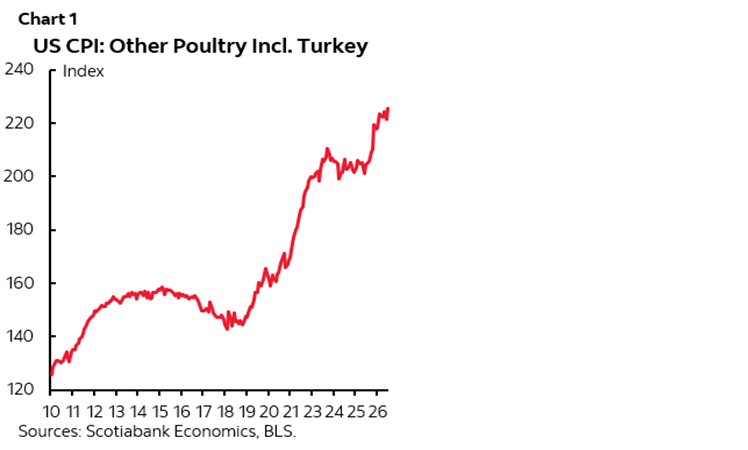
Happy Thanksgiving to our American clients and colleagues as inflation hits the dinner plate (chart 1). US markets are shut today and will only be open for a few hours before tomorrow’s early closes. That removes a substantial amount of flow and liquidity from global markets which may have been playing a role in recent risk aversion alongside position covering into the holidays.
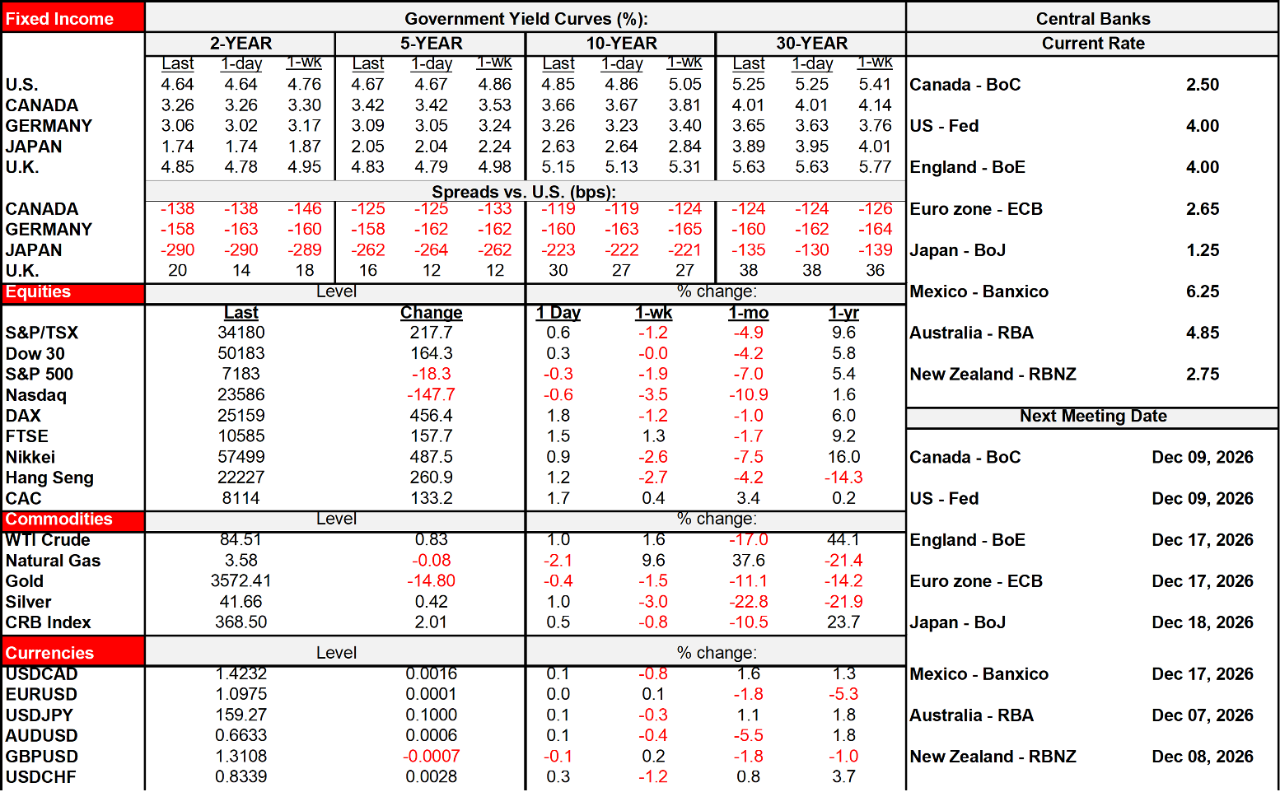
But many markets are still open and trading amid ongoing developments. Sovereign bond yields are up across the UK and Eurozone in bear flattener fashion. Stocks are broadly higher including US futures that are up by about ½% on the S&P and Nasdaq with TSX futures up by about ¼%. European cash markets are up by over 1%. Asia also rallied overnight.
Oil prices are higher by a few dimes and partly due to ongoing Middle East tensions. Currencies are mixed but with most of the majors little changed to the dollar.
December 9th decisions are fully priced for a Fed hike of 25bps and over 80% priced for a BoC hike.
THE IMPACT OF TRUMP’S SECTION 301 TARIFFS
One thing that bonds may be reacting to in addition to oil prices is yesterday’s announcements on Section 301 tariffs proposed by the USTR yesterday and as replacements for the IEEPA tariffs that SCOTUS had shot down. They will add to inflation risk and to the case for adding more Fed hikes if implemented.
Note that Canada and Mexico are not included, at least yet, as they continue to negotiate bilateral deals with the US amid signs of progress. This could be offsetting if tariffs on those countries are meaningfully lowered. We’ll see amid sensible caution given the erratic behaviour of the US administration.
This is a good site that was quick with their calcs. They figure that the Section 301 tariffs —if implemented—would raise the Effective Tariff Rate on US imports back to 13.9% from 11.35%. Chart 2 breaks it down by region. China’s ETR would rise to 34.6% from just over 24%, Canada’s would remain at 8.3%, Mexico’s would remain at 6.45%, the EU tariff would be 9.75% instead of 8.17%, Japan’s would rise to 13.6% from 12.95% and the UK would be unchanged at about 7%. The rest of the world—such as Brazil’s tariff hike—would see an ETR increase to 14.2% from 10.6%.
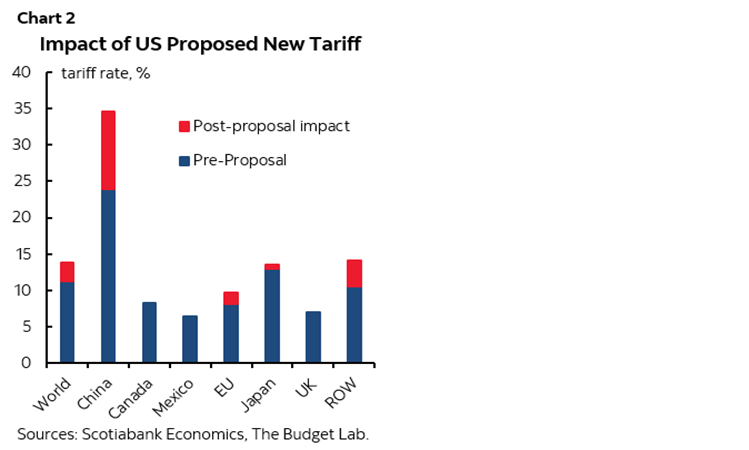
They figure that the tariffs will add about 0.3% to inflation and raise +/-$300 billion in government revenues over ten years which is what tariffs are all about. Tariffs are a tax on Americans without calling them a tax and US fiscal policy is a mess.
BOK HIKED AND SIGNALLED IT’S NOT DONE
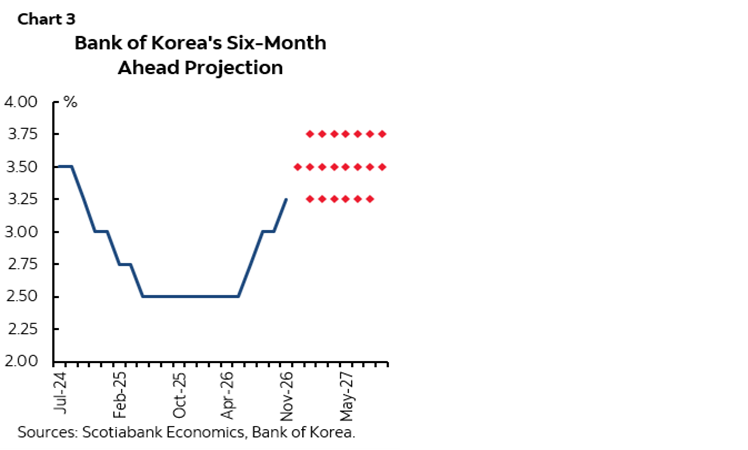
The Bank of Korea raised its base rate by 25bps to 3.25% as widely expected. Five out of seven Board members voted for a hike with two preferring a pause. Verbal guidance was cautious, but the BoK’s updated dot plot indicated a bias toward further tightening. Six expect no further hikes, eight expect one more, and seven expect two more (chart 3).
NOK SHAKES OFF WEAK GDP IN FAVOUR OF HIGHER OIL
Norway’s economy disappointed on Q3 GDP and negative revisions. The economy barely grew (+0.1% q/q) in Q3 (consensus 0.3%) and the prior quarter was revised down from 0.3% to 0.1% q/q SA. Norway’s rates curve largely ignored it as backward looking in favour of responding to this morning’s somewhat higher oil prices. Ditto for the NOK.
IGNORE CANADA’S PAYROLLS REPORT
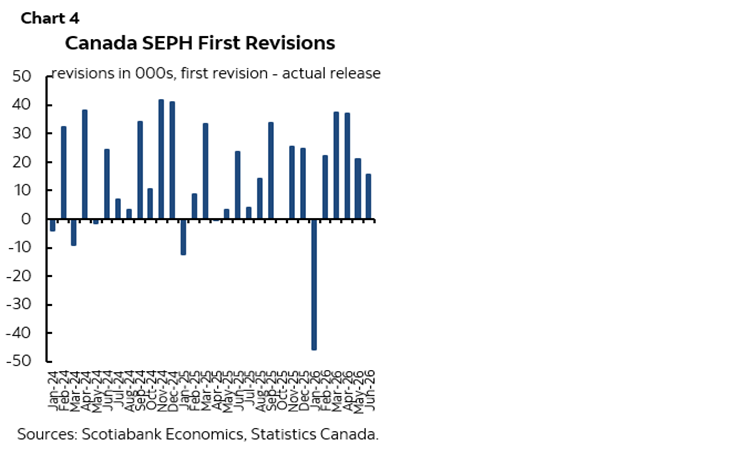
Canada updates the SEPH payrolls report for September this morning (8:30amET). With Macklem fading backward data, he’s sure to fade this laggard of a reading. Besides, whereas you might think that a payrolls survey would be harder data, it’s actually subject to ginormous revisions each and every month on average (chart 4) and the revisions don’t stop at the first revision either.
BOC IS LIKELY TO FADE DATA BETWEEN NOW AND ITS NEXT DECISION
Welcome to the party! Scotia was first in expecting the BoC to hike again on December 9th. We formally did so back on November 19th (here) after providing guidance in that direction over prior weeks and after being first to forecast rate hikes by 2026Q4 ever since last November. Now every one of the banks is onboard with a December call.
The view that we should wait for data between now and then would require a much worse set of readings than the BoC already expects. They know that CPI inflation won’t come in at the 3.4% y/y rate they had projected for 2026Q4 in the October MPR and that it’s likely to be just a few tenths lower but still hot. They know that GDP probably won’t land at 2% q/q SAAR on Monday as they had in the October MPR and is likely to be one-handled. They know that jobs have been weakening and when asked about that, Macklem batted the question away as he should have and as argued in my weekly.
None of that affected Macklem’s messaging. There is a very high bar for any of that data to matter. And in any event, the BoC is very clear about being forward-looking, concerned about an inflation overshoot throughout 2027 and beyond. Backward data isn’t carrying the day in their thinking. Nor is strict adherence to its forecasts that will take time to assess. The BoC is in risk management mode, concerned about inflation risk and seeking to avoid falling behind like they did the last time. In my view, they are already behind.
DISCLAIMER
This report has been prepared by Scotiabank Economics as a resource for the clients of Scotiabank. Opinions, estimates and projections contained herein are our own as of the date hereof and are subject to change without notice. The information and opinions contained herein have been compiled or arrived at from sources believed reliable but no representation or warranty, express or implied, is made as to their accuracy or completeness. Neither Scotiabank nor any of its officers, directors, partners, employees or affiliates accepts any liability whatsoever for any direct or consequential loss arising from any use of this report or its contents.
These reports are provided to you for informational purposes only. This report is not, and is not constructed as, an offer to sell or solicitation of any offer to buy any financial instrument, nor shall this report be construed as an opinion as to whether you should enter into any swap or trading strategy involving a swap or any other transaction. The information contained in this report is not intended to be, and does not constitute, a recommendation of a swap or trading strategy involving a swap within the meaning of U.S. Commodity Futures Trading Commission Regulation 23.434 and Appendix A thereto. This material is not intended to be individually tailored to your needs or characteristics and should not be viewed as a “call to action” or suggestion that you enter into a swap or trading strategy involving a swap or any other transaction. Scotiabank may engage in transactions in a manner inconsistent with the views discussed this report and may have positions, or be in the process of acquiring or disposing of positions, referred to in this report.
Scotiabank, its affiliates and any of their respective officers, directors and employees may from time to time take positions in currencies, act as managers, co-managers or underwriters of a public offering or act as principals or agents, deal in, own or act as market makers or advisors, brokers or commercial and/or investment bankers in relation to securities or related derivatives. As a result of these actions, Scotiabank may receive remuneration. All Scotiabank products and services are subject to the terms of applicable agreements and local regulations. Officers, directors and employees of Scotiabank and its affiliates may serve as directors of corporations.
Any securities discussed in this report may not be suitable for all investors. Scotiabank recommends that investors independently evaluate any issuer and security discussed in this report, and consult with any advisors they deem necessary prior to making any investment.
This report and all information, opinions and conclusions contained in it are protected by copyright. This information may not be reproduced without the prior express written consent of Scotiabank.
™ Trademark of The Bank of Nova Scotia. Used under license, where applicable.
Scotiabank, together with “Global Banking and Markets”, is a marketing name for the global corporate and investment banking and capital markets businesses of The Bank of Nova Scotia and certain of its affiliates in the countries where they operate, including; Scotiabank Europe plc; Scotiabank (Ireland) Designated Activity Company; Scotiabank Inverlat S.A., Institución de Banca Múltiple, Grupo Financiero Scotiabank Inverlat, Scotia Inverlat Casa de Bolsa, S.A. de C.V., Grupo Financiero Scotiabank Inverlat, Scotia Inverlat Derivados S.A. de C.V. – all members of the Scotiabank group and authorized users of the Scotiabank mark. The Bank of Nova Scotia is incorporated in Canada with limited liability and is authorised and regulated by the Office of the Superintendent of Financial Institutions Canada. The Bank of Nova Scotia is authorized by the UK Prudential Regulation Authority and is subject to regulation by the UK Financial Conduct Authority and limited regulation by the UK Prudential Regulation Authority. Details about the extent of The Bank of Nova Scotia's regulation by the UK Prudential Regulation Authority are available from us on request. Scotiabank Europe plc is authorized by the UK Prudential Regulation Authority and regulated by the UK Financial Conduct Authority and the UK Prudential Regulation Authority.
Scotiabank Inverlat, S.A., Scotia Inverlat Casa de Bolsa, S.A. de C.V, Grupo Financiero Scotiabank Inverlat, and Scotia Inverlat Derivados, S.A. de C.V., are each authorized and regulated by the Mexican financial authorities.
Not all products and services are offered in all jurisdictions. Services described are available in jurisdictions where permitted by law.